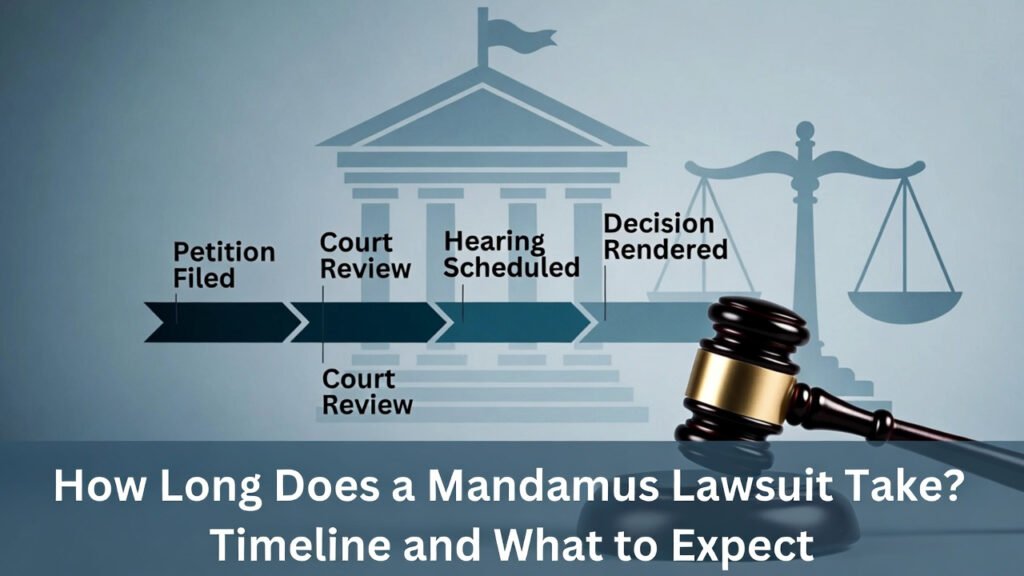
When you are already frustrated by years of waiting for USCIS, the last thing you want is another process that drags on indefinitely. Many applicants hesitate to sue the government because they fear a “court battle” will take years. The good news is that the Mandamus lawsuit timeline is often much faster than most people expect.
If you are tired of checking your case status every morning only to see “Case is Being Actively Reviewed,” it is time to look at the facts. While the USCIS processing times continue to climb, federal litigation remains the most predictable way to force a decision.
A Typical Mandamus Lawsuit Timeline: Month by Month
Based on our experience handling hundreds of mandamus cases, here is what a typical timeline looks like. Preparation and filing takes approximately 1–2 weeks. The government then has 60 days to respond to the complaint. However, in many cases, USCIS begins acting on the underlying application well before that 60-day deadline. Most of our clients see meaningful movement — an interview scheduled, a decision issued, or a request for additional evidence — within 30–60 days of filing.
Based on our experience handling hundreds of immigration cases, a Mandamus lawsuit timeline generally follows a very specific trajectory. Here is what you can realistically expect:
Week 1–2: Preparation and Filing
The process begins with gathering your case history. We review your initial application date, any Service Requests you’ve made, and Congressional inquiries. Once the complaint is drafted and filed in the U.S. District Court, the clock officially starts.
Day 1–60: The Government’s Response Window
Once we serve the lawsuit, the government (represented by a Department of Justice attorney) has exactly 60 days to respond. This is the most active part of the Mandamus lawsuit timeline. In the vast majority of cases, USCIS does not want to go to court. Instead, the DOJ attorney contacts the local field office or service center to ask, “Why is this case stuck?”
Most of our clients see meaningful movement—such as an interview notice, a decision issued, or a Request for Evidence (RFE)—within 30 to 60 days of filing.
Month 3–6: The “Contested” Phase
What if the government does not act voluntarily? While rare, if USCIS attempts to dismiss the case, the litigation proceeds through motions and discovery. Even in these contested scenarios, the Mandamus lawsuit timeline typically concludes within 6 months, as judges are often skeptical of multi-year delays for standard applications like the I-485 or N-400.
Why Does Filing Speed Things Up?
You might wonder why a lawsuit works when phone calls to USCIS fail. The answer lies in accountability. When a Mandamus lawsuit timeline begins, your case is no longer just a number in a pile of millions. It is assigned to a specific attorney at the Department of Justice.
This attorney’s job is to defend the government. However, defending a delay is costly and time-consuming. It is almost always easier and more efficient for USCIS to simply finish adjudicating your application than it is to pay a government lawyer to argue that a 3-year delay is “reasonable.”
Factors That Influence Your Mandamus Lawsuit Timeline
While most cases resolve quickly, a few factors can extend the duration:
-
Background Checks: If there is a legitimate security issue, the government may ask for more time to complete investigations.
-
Missing Records: Occasionally, physical files are lost between offices, which requires extra time for USCIS to locate and digitize them.
-
Court Backlogs: Some federal districts move faster than others. For example, the “Rocket Docket” in Virginia is known for a very fast Mandamus lawsuit timeline.
Making the Decision to Move Forward
Comparing the Mandamus lawsuit timeline to the “wait and see” approach reveals a clear winner. If you have been waiting for two years, and the average lawsuit takes 60 days, the investment in your future is obvious.
If you are interested in ending the uncertainty, you should also read our related guide: 7 Key Things to Know: What Is a Mandamus Lawsuit for Immigration?
The Bottom Line
Do not let your life remain on hold indefinitely. While every case is different, most mandamus cases resolve within 30–60 days of filing. If you are tired of waiting and want a professional evaluation of your Mandamus lawsuit timeline, contact us today for a free consultation.