
If your USCIS case has been pending for months or years, the silence can feel impossible to explain. An APA 706 USCIS delay lawsuit may be one legal option when USCIS has a duty to act but your case remains stuck with no meaningful progress.
This article focuses only on USCIS delays, not consular processing, NVC delays, or the broader question of whether to file mandamus or APA. For that broader comparison, see our guide on Immigration Mandamus vs. APA Lawsuit. Here, the question is narrower: when can a federal court be asked to compel USCIS action under APA §706(1)?
In This Article
- What an APA §706(1) Lawsuit Means in a USCIS Delay Case
- When Is USCIS Required to Act?
- Common USCIS Delays That May Support an APA Claim
- What Facts Make a USCIS Delay Stronger or Weaker?
- What Can a Federal Court Order USCIS to Do?
- How This Differs from a General Mandamus vs. APA Analysis
- Frequently Asked Questions
What an APA §706(1) Lawsuit Means in a USCIS Delay Case
The Administrative Procedure Act, often called the APA, is a federal law that allows courts to review certain agency actions and failures to act. Under 5 U.S.C. §706(1), a court may compel agency action that has been unlawfully withheld or unreasonably delayed.
In the USCIS delay context, this usually means the applicant is not asking the court to approve the case. The applicant is asking the court to recognize that USCIS cannot leave a properly filed case pending indefinitely when the agency has a legal duty to complete a required step or issue a decision.
| Concept | What It Means | USCIS Delay Example |
|---|---|---|
| Agency action | A legally recognized action by an agency | Adjudicating a petition, scheduling an interview, issuing a decision |
| Unlawfully withheld | Required action has not been taken | USCIS fails to complete a required decision-making step |
| Unreasonably delayed | Action is pending too long without adequate justification | An I-485, I-130, or N-400 remains stalled far beyond normal expectations |
The key point is simple: an APA lawsuit is not a shortcut around eligibility rules. It is a way to challenge agency inaction when the delay itself has become the legal problem.
An APA §706(1) lawsuit usually asks for movement, not favoritism. The goal is not to skip the line unfairly. The goal is to require USCIS to do what the law already requires: take action on a pending case.
When Is USCIS Required to Act?
USCIS has discretion over many immigration decisions. It can approve, deny, request more evidence, schedule an interview, or continue review when legally justified. But discretion over the outcome is different from unlimited discretion to leave a case pending with no endpoint.
The Supreme Court’s decision in Norton v. Southern Utah Wilderness Alliance is important because it explains that APA §706(1) claims generally require a discrete agency action that the agency is legally required to take.
- Weak framing: “USCIS should handle immigration cases faster.”
- Stronger framing: “USCIS has a pending application and must complete adjudication within a reasonable time.”
- Weak framing: “The agency should change its priorities.”
- Stronger framing: “This specific filing has remained pending despite repeated inquiries and no meaningful explanation.”
This distinction matters because federal courts do not manage USCIS like a supervisor. A court usually looks for a specific legal duty, a specific pending case, and facts showing that the delay has crossed from ordinary processing into unreasonable agency inaction.
Processing Duty Versus Approval Duty
Applicants often ask whether an APA lawsuit can make USCIS approve a case. The more accurate answer is that an APA claim usually seeks a decision or required action, not a guaranteed approval. USCIS may still approve, deny, issue an RFE, schedule an interview, or take another legally available step.
That may sound limited, but it can still be powerful. For many applicants, the real harm is not only the final result; it is the years of uncertainty, the inability to work or travel freely, and the fact that their case is stuck without accountability.
Common USCIS Delays That May Support an APA Claim
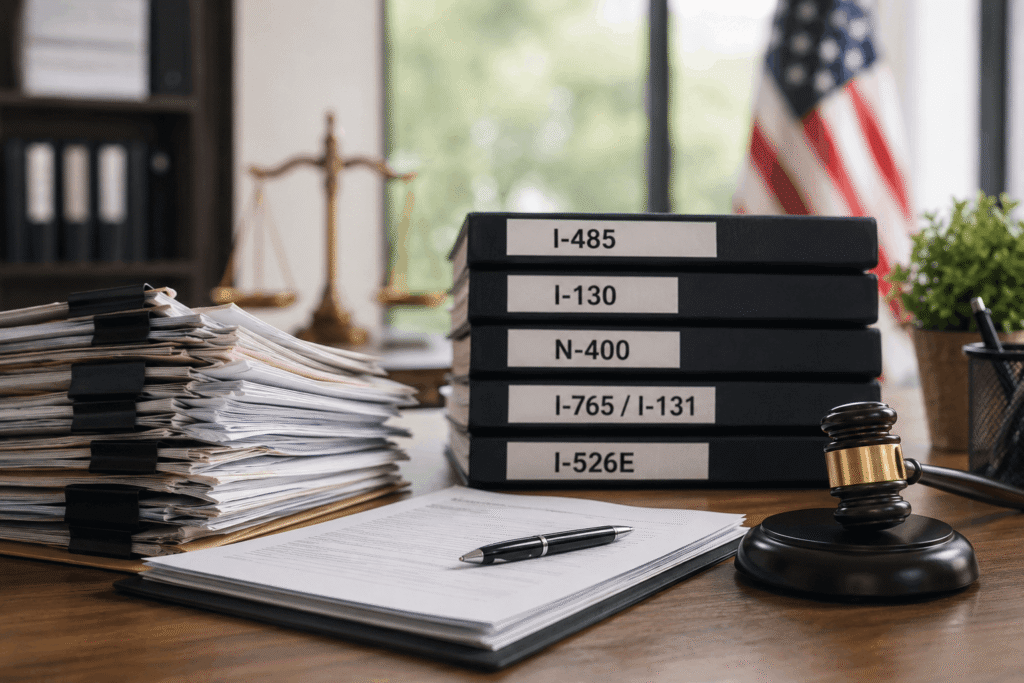
An APA §706(1) claim can arise in different USCIS contexts, but the legal theory must match the case type. A delayed green card application, a delayed family petition, and a delayed naturalization case may all involve USCIS inaction, but each has a different procedural background and different litigation risks.
| USCIS Filing | Typical Delay Concern | Possible APA Theory |
|---|---|---|
| Form I-485 | Adjustment of status remains pending after interview, biometrics, or background checks | USCIS has unreasonably delayed adjudication of a pending application |
| Form I-130 | Family petition remains pending while relatives stay separated | USCIS has failed to move a properly filed petition toward decision |
| Form N-400 | Naturalization case is delayed before interview or after key processing steps | USCIS has unreasonably delayed required naturalization processing |
| Form I-765 / I-131 | Work permit or travel document remains pending too long | Delay causes practical hardship and prevents use of requested immigration benefit |
| Form I-526E | Investor petition remains pending for an extended period | USCIS delay affects investment-based immigration planning and adjudication |
For I-485 cases, an applicant may have completed biometrics, responded to all RFEs, attended an interview, and still see no decision. If your green card application is stuck, our I-485 delay mandamus lawsuit guide explains how these cases are often evaluated in federal court.
For family petitions, prolonged I-130 delay can mean years of separation between spouses, parents, and children. Our I-130 delay mandamus lawsuit guide discusses how family-based delays may become strong litigation candidates when USCIS gives no meaningful answer.
For naturalization, the analysis depends heavily on timing. Some N-400 cases involve standard mandamus or APA theories before the interview, while certain post-interview delays may involve 8 U.S.C. §1447(b). Our N-400 delay citizenship lawsuit guide explains that distinction in more detail.
What Facts Make a USCIS Delay Stronger or Weaker?
A strong APA 706 USCIS delay case is rarely based on delay length alone. Courts often look at the whole factual picture, including how long the case has been pending, what USCIS has done, what the applicant has done, and whether the delay has created real-world harm.
- Length of delay: A longer delay may strengthen the case, especially if it exceeds the ordinary range for that form and office.
- Case history: Biometrics, interviews, RFEs, service requests, and prior updates help show where the case is stuck.
- USCIS explanation: Generic responses may be less persuasive than a specific, documented reason for delay.
- Applicant diligence: Prior service requests, congressional inquiries, or Ombudsman efforts may show that you tried to resolve the issue before suing.
- Hardship: Work authorization loss, travel limits, family separation, business disruption, or emotional strain may help explain why the delay matters.
USCIS publishes official case processing times, and its e-Request tool allows certain applicants to submit inquiries when a case is outside normal processing time. These tools do not decide whether a federal lawsuit is valid, but they can provide important context for evaluating whether the delay is ordinary or excessive.
| Fact Pattern | Usually Helps? | Why It Matters |
|---|---|---|
| Case is far outside normal processing time | Often yes | Shows the delay may be more than routine backlog |
| Multiple service requests with no meaningful answer | Often yes | Shows applicant diligence and agency silence |
| Recent RFE or recent interview notice | Sometimes weaker | May show USCIS is actively working on the case |
| Documented hardship from delay | Often yes | Helps explain the human and practical impact |
| Applicant has unresolved eligibility issues | Potential risk | Litigation may trigger a decision before the case is ready |
Your USCIS delay may be more than just frustrating. If your case has been pending for months or years with no meaningful action, an APA §706(1) lawsuit may be a way to demand accountability. Contact My Mandamus Lawyer for a free case evaluation or call (862) 799-2200.
What Can a Federal Court Order USCIS to Do?
The most common misunderstanding is that an APA lawsuit asks a judge to grant the immigration benefit. In most delay cases, the lawsuit asks the court to require agency action, not to substitute the judge’s decision for USCIS adjudication.
A court may be asked to order USCIS to move the case forward, complete adjudication, schedule a necessary step, or issue a decision within a reasonable timeframe. The exact requested relief depends on the case type, the procedural posture, and the legal duty involved.
A federal court can pressure USCIS to act. But in most APA §706(1) delay cases, the court is not being asked to approve the immigration benefit itself.
| Possible Result After Filing | What It Means | Important Note |
|---|---|---|
| Approval | USCIS approves the pending filing after litigation begins | Possible, but never guaranteed |
| Denial | USCIS issues an unfavorable decision | Litigation can force action, not guarantee outcome |
| RFE or NOID | USCIS requests more evidence or signals concerns | The case moves, but more response work may be needed |
| Interview scheduled | USCIS takes a delayed procedural step | Common in some naturalization or adjustment contexts |
| Government motion to dismiss | The government argues the case should not proceed | The complaint must be carefully framed from the start |
This is why case screening matters. Filing too early, filing with weak facts, or filing when the applicant has serious unresolved eligibility issues may create unnecessary risk. A careful review should look at both the strength of the delay claim and the substance of the immigration case.
How This Differs from a General Mandamus vs. APA Analysis
This article is intentionally narrower than a general mandamus-versus-APA comparison. The broader comparison asks whether a case should be framed under the Mandamus Act, the APA, or both. This article asks a more specific question: when does USCIS delay become a potential APA §706(1) agency inaction claim?
In practice, many immigration delay lawsuits include both APA and mandamus theories. The American Immigration Council and National Immigration Litigation Alliance describe delay actions as cases often brought under both the Mandamus Act and the Administrative Procedure Act. For common questions about mandamus filings, see our Mandamus Lawsuit for Immigration FAQ.
- This article: USCIS-specific APA §706(1) delay analysis.
- Broader comparison article: APA vs. mandamus legal theories.
- Case-type articles: I-485, I-130, N-400, asylum, EB-5, and other delay-specific guides.
That separation matters for SEO and for readers. Someone searching “APA lawsuit USCIS delay” usually wants to understand agency duty to act, while someone searching “mandamus vs APA” wants to compare two legal frameworks.
Frequently Asked Questions About APA §706(1) Lawsuit
Can an APA lawsuit force USCIS to approve my case?
Usually, no. An APA §706(1) lawsuit generally asks the court to compel USCIS action, not to guarantee case approval. USCIS may approve, deny, request evidence, schedule an interview, or take another legally available action.
Is being outside normal processing time enough to sue?
Not always. Being outside normal processing time can be important evidence, but courts usually look at the full context, including case history, agency activity, prior inquiries, hardship, and whether the delay is reasonable under the circumstances.
Should I file USCIS service requests before suing?
In many cases, service requests can help build the record. They may show applicant diligence and create documentation that USCIS has not provided a meaningful response. But every case is different, and some urgent situations may require faster legal review.
Can APA §706(1) help with background check delays?
It may, depending on the facts. Background checks are often cited as a reason for delay, but a generic reference to security review does not always explain years of inaction. The strength of the claim depends on timing, documentation, and case history.
Is APA different from mandamus in USCIS delay cases?
Yes, but they often overlap. APA §706(1) focuses on agency action unlawfully withheld or unreasonably delayed, while mandamus focuses on compelling an officer or agency to perform a clear nondiscretionary duty. Many delay complaints include both theories.
What happens if USCIS acts after the lawsuit is filed?
If USCIS takes the requested action after filing, the government may argue the case is moot. That can still mean the lawsuit achieved the practical goal of forcing movement, but the legal impact depends on what action USCIS took and whether any dispute remains.
Conclusion
An APA 706 USCIS delay lawsuit is not about asking a federal judge to hand you an immigration benefit. It is about challenging unreasonable agency inaction when USCIS has left a pending filing unresolved for too long without meaningful progress.
The strongest cases usually involve more than a long wait. They involve a specific pending filing, a clear procedural history, repeated efforts to get answers, and real hardship caused by the delay. If your USCIS case has remained stuck, the next step is a case-specific review, not a generic answer from a processing time chart.
Your case delay is not your fault. A mandamus or APA lawsuit may be a legal remedy against unreasonable USCIS delays and can help move a stalled case toward action. Contact My Mandamus Lawyer for a free case evaluation or call (862) 799-2200.
Legal Disclaimer
This article is provided for general informational purposes only and does not constitute legal advice. Every immigration case has unique circumstances. For legal guidance specific to your situation, we recommend consulting with an experienced immigration attorney. The information in this article reflects laws and policies as of the publication date; subsequent changes may affect its accuracy.
Sources
- 5 U.S.C. §706 — Scope of Review, Cornell Legal Information Institute.
- Norton v. Southern Utah Wilderness Alliance, 542 U.S. 55 (2004), Justia U.S. Supreme Court Center.
- USCIS Case Processing Times, U.S. Citizenship and Immigration Services.
- USCIS e-Request: Check Case Processing, U.S. Citizenship and Immigration Services.
- Mandamus and APA Delay Cases: Avoiding Dismissal and Proving the Case, American Immigration Council / National Immigration Litigation Alliance, February 22, 2021.