
If your immigrant visa case has been stuck at the National Visa Center for months with no meaningful update, an NVC delay lawsuit may be an option to consider. For many families, workers, investors, and sponsored applicants, an NVC delay is not just an administrative inconvenience. It can separate spouses, delay employment plans, disrupt children’s lives, and leave the entire immigration process frozen without a clear explanation.
Some delays are part of normal immigrant visa processing, but others may become unreasonable government delays. In those situations, a writ of mandamus may be used to ask a federal court to require the government to take action on the pending case.
A mandamus lawsuit does not ask the judge to approve the visa. Instead, it asks the court to address unreasonable inaction and require the responsible federal officials to move the case forward. That difference is important because mandamus is about action, not a guaranteed immigration benefit.
In This Article
- What Is an NVC Delay Lawsuit?
- What Does the National Visa Center Do?
- Common Types of NVC Delays
- When Mandamus May Apply to an NVC Delay
- When Mandamus May Not Be the Right Option
- How Courts Review Unreasonable Immigration Delays
- Who May Be Sued in an NVC Delay Lawsuit?
- The NVC Mandamus Lawsuit Process
- Possible Outcomes of an NVC Delay Lawsuit
- Documents That May Help Evaluate Your Case
- Frequently Asked Questions About NVC Delay Lawsuits
- Speak With an Immigration Mandamus Lawyer
What Is an NVC Delay Lawsuit?
An NVC delay lawsuit is usually a federal lawsuit asking the court to address a delayed immigrant visa process involving the National Visa Center, the Department of State, or related federal officials. In many cases, this type of case is filed as a mandamus and unreasonable-delay lawsuit.
The legal argument is not that the applicant is automatically entitled to visa approval. The argument is that the government has a duty to process the case within a reasonable period of time, and the delay has become unreasonable under the circumstances.
Key point: An NVC delay lawsuit does not ask the court to approve the visa. It asks the court to address unreasonable delay and require the government to take meaningful action on the pending case.
Federal mandamus jurisdiction comes from 28 U.S.C. § 1361, which gives federal district courts authority over actions seeking to compel a federal officer or employee to perform a duty owed to the plaintiff. In immigration delay cases, this statute is often paired with broader unreasonable-delay arguments.
- Mandamus may seek action, not a guaranteed approval.
- The lawsuit may target delay, not the merits of the visa eligibility decision.
- The outcome depends on the case stage, agency activity, and the specific facts.
- The government may respond by acting, defending the delay, or asking the court to dismiss the case.
What Does the National Visa Center Do?
The National Visa Center, often called NVC, plays a central role after USCIS approves many immigrant visa petitions and before the case is ready for a consular interview. NVC usually does not decide whether the visa should be approved. Its role is to prepare the case for consular processing.
After USCIS approves a petition, the case may be transferred to NVC. NVC may then create the case, issue CEAC login information, collect fees, receive the DS-260, review the Affidavit of Support, review civil documents, and determine whether the file is documentarily complete or documentarily qualified.
The Department of State explains that NVC reviews submitted fees, forms, and supporting documents before interview scheduling. Interview scheduling then depends on appointment availability at the relevant U.S. embassy or consulate. That means a delay can happen at more than one stage.
| NVC Stage | What Happens | Possible Delay Issue |
|---|---|---|
| Case creation | NVC creates the case number and invoice ID. | USCIS approved the case, but NVC has not created access. |
| CEAC access and fees | Applicant pays required fees and accesses forms. | Fee invoice, payment, or login problems block progress. |
| Document review | NVC reviews financial and civil documents. | Documents remain pending for an extended period. |
| Documentarily qualified | NVC confirms required documents are accepted. | The case waits for interview scheduling. |
| Consular scheduling | Embassy or consulate interview capacity becomes relevant. | No interview date is issued for months or longer. |
Understanding the exact stage is essential. A case creation delay is different from a documentarily qualified NVC delay, and both may require different litigation analysis.
Common Types of NVC Delays
Not every NVC processing delay looks the same. Some cases stall before CEAC access is available, while others stall after every required document has already been accepted. The type of delay affects whether mandamus for NVC delays may be worth evaluating.
Case Creation Delays
A case creation delay may occur after USCIS approves the immigrant petition but before NVC creates the case number and invoice ID. The applicant may have a USCIS approval notice, but no NVC welcome letter, no invoice ID, and no CEAC access.
- Common sign: USCIS approval exists, but NVC has not created the case.
- Potential issue: The file may be stuck between USCIS and NVC.
- Useful evidence: USCIS approval notice, transfer notices, and NVC inquiry responses.
Fee Payment or CEAC Access Delays
Some delays involve fee invoice problems, CEAC login issues, payment confirmation failures, or account errors. These issues can prevent the applicant from submitting forms and documents, even when the case should be moving through NVC processing.
- Common sign: Fees cannot be paid or are not showing as processed.
- Potential issue: Technical or administrative blockage prevents the case from moving.
- Useful evidence: CEAC screenshots, payment receipts, and support messages.
Document Review Delays
A NVC document review delay may occur when the applicant has submitted the DS-260, civil documents, financial evidence, and Affidavit of Support, but NVC does not review them for an extended period. The official NVC Timeframes page can help show whether NVC is currently reviewing documents submitted around a particular date.
- Common sign: Documents were uploaded, but no review decision has issued.
- Potential issue: NVC has not completed a required review step.
- Useful evidence: Submission confirmations, CEAC screenshots, and NVC messages.
Documentarily Qualified but No Interview
A documentarily qualified NVC delay is one of the most frustrating scenarios. NVC has accepted the documents, but no interview has been scheduled. The applicant may be told the case is waiting for an appointment, yet months pass with no meaningful progress.
- Common sign: NVC issued a Documentarily Qualified notice, but no interview date follows.
- Potential issue: Interview scheduling may be delayed by NVC, consular post capacity, or visa availability.
- Useful evidence: DQ notice, IV Scheduling Status Tool results, and embassy communications.
Transfer-to-Consulate Delays
In some cases, the issue is not document review but the transfer of the case to the appropriate embassy or consulate. The file may appear ready, but the applicant cannot proceed because the case has not reached the stage where the consular post can act.
- Common sign: The case appears ready, but the consulate has not received or acted on it.
- Potential issue: NVC and consular coordination may be stalled.
- Useful evidence: NVC notices, consular emails, and public inquiry responses.
Takeaway: Before asking whether you can sue for an NVC delay, identify where the case is stuck. The stronger analysis begins with the exact delay stage, not just the total waiting time.
When Mandamus May Apply to an NVC Delay
A NVC mandamus lawsuit may be considered when the delay is long, unexplained, and harmful enough that ordinary waiting no longer seems reasonable. The key question is not only how long the case has been pending. The stronger question is whether the government has failed to take meaningful action despite a case-ready posture.
Mandamus may be worth evaluating when NVC has not acted for many months, when inquiries produce only generic responses, when the delay cannot be explained by normal processing times alone, or when the applicant is suffering serious family, financial, medical, employment, or humanitarian harm.
- The case has been inactive for an extended period.
- NVC inquiries receive only generic answers or no meaningful response.
- The applicant has submitted required documents and the case should be moving forward.
- The Visa Bulletin is current, if visa availability is relevant to the category.
- The delay is causing documented hardship, such as family separation or financial harm.
- The delay is not clearly caused by missing documents, a recent request, or applicant-side inaction.
| Situation | Mandamus May Apply? | Why |
|---|---|---|
| Case has been stuck at NVC for many months with no update | Possibly | Long inactivity may support an unreasonable delay argument. |
| Documents were submitted but not reviewed for an extended period | Possibly | NVC has a role in reviewing submitted documents before interview scheduling. |
| Case is documentarily qualified but no interview has been scheduled | Depends | Consular capacity, case category, location, and delay length all matter. |
| Visa Bulletin is not current | Usually weaker | The delay may be caused by statutory visa availability limits. |
| NVC recently requested missing documents | Usually weaker | The agency may still be actively processing the file. |
| Applicant wants the court to approve the visa | No | Mandamus does not guarantee visa approval. |
Your immigrant visa case should not sit in silence indefinitely. If your NVC case has been delayed for months with no meaningful progress, our team can review your timeline and help determine whether a federal mandamus lawsuit may be appropriate.
When Mandamus May Not Be the Right Option
Not every National Visa Center delay lawsuit is strong. A careful legal evaluation should identify both the facts that support filing and the facts that may make the case weaker. This honest analysis is what separates a serious mandamus strategy from a generic “just sue” approach.
Mandamus may not be appropriate when the applicant’s priority date is not current, when the delay is caused by Visa Bulletin retrogression, when NVC recently issued a checklist, or when the case remains close to posted processing timeframes.
- Visa Bulletin is not current: The delay may be tied to statutory visa limits.
- Documents are missing: NVC may be waiting for applicant-side action.
- NVC recently acted: A recent checklist or message may show active processing.
- The delay is still short: Courts may view ordinary waiting differently from long inactivity.
- The requested relief is visa approval: Mandamus does not force approval.
Key point: The strongest NVC delay cases are not built on frustration alone. They are built on a clear timeline, documented inactivity, and a realistic legal theory.
A case may also be more complicated when the delay is mainly caused by consular appointment capacity. The Department of State notes that interview scheduling depends on the operating status and capacity of the relevant consular section, so a delayed interview may require a more careful analysis than a simple document review delay.
How Courts Review Unreasonable Immigration Delays
Federal courts do not treat every immigration delay the same way. In many unreasonable-delay cases, courts consider practical factors similar to the TRAC factors, which help evaluate whether agency delay has become legally unreasonable rather than merely administratively frustrating.
- Length of delay: How long has the case remained inactive?
- Rule of reason: Is there a reasonable timetable for agency action?
- Human impact: Does the delay affect health, family unity, employment, or welfare?
- Competing priorities: What government workload or policy priorities may be involved?
- Applicant harm: How specifically has the delay harmed the applicant or petitioner?
- Bad faith: Bad faith is not always required to challenge an unreasonable delay.
This is why an immigration delay lawsuit FAQ can be useful, but it cannot replace a case-specific legal review. Two applicants may both say “my NVC case is delayed,” yet one may have a stronger federal court argument because of the timeline, evidence of hardship, inquiry history, document status, and consular post conditions.
| Court Question | Why It Matters | Useful Evidence |
|---|---|---|
| How long has the delay lasted? | Longer inactivity may strengthen the unreasonable-delay argument. | Timeline, CEAC screenshots, NVC notices |
| Has the agency acted recently? | Recent action may weaken the claim that the case is stalled. | Checklist letters, NVC messages, inquiry responses |
| Is the applicant harmed? | Human impact can make the delay more serious. | Medical records, separation evidence, financial records |
| Is the case actually ready? | Missing documents or unavailable visa numbers may weaken the claim. | DQ notice, Visa Bulletin, document confirmations |
Who May Be Sued in an NVC Delay Lawsuit?
The proper defendants in an NVC delay lawsuit depend on the posture of the case. There is no single defendant list that fits every immigrant visa delay because the responsible officials may vary depending on whether the case is stuck at NVC review, consular scheduling, transfer, or post-interview processing.
Depending on the facts, a complaint may name federal officials connected to the Department of State, the National Visa Center, the Secretary of State, the relevant embassy or consulate, or other government actors involved in the delayed process.
- Department of State officials may be relevant in consular processing delays.
- NVC-related officials may be relevant when the file is stuck before interview scheduling.
- Consular post officials may be relevant when the case is delayed at embassy or consulate level.
- Other federal officials may be named depending on the exact case posture.
The goal is not to name agencies randomly. The goal is to identify the officials with responsibility for the delayed action. This is one reason working with an mandamus immigration lawyer matters, because defendant selection, venue, jurisdiction, and requested relief can affect the government’s response.
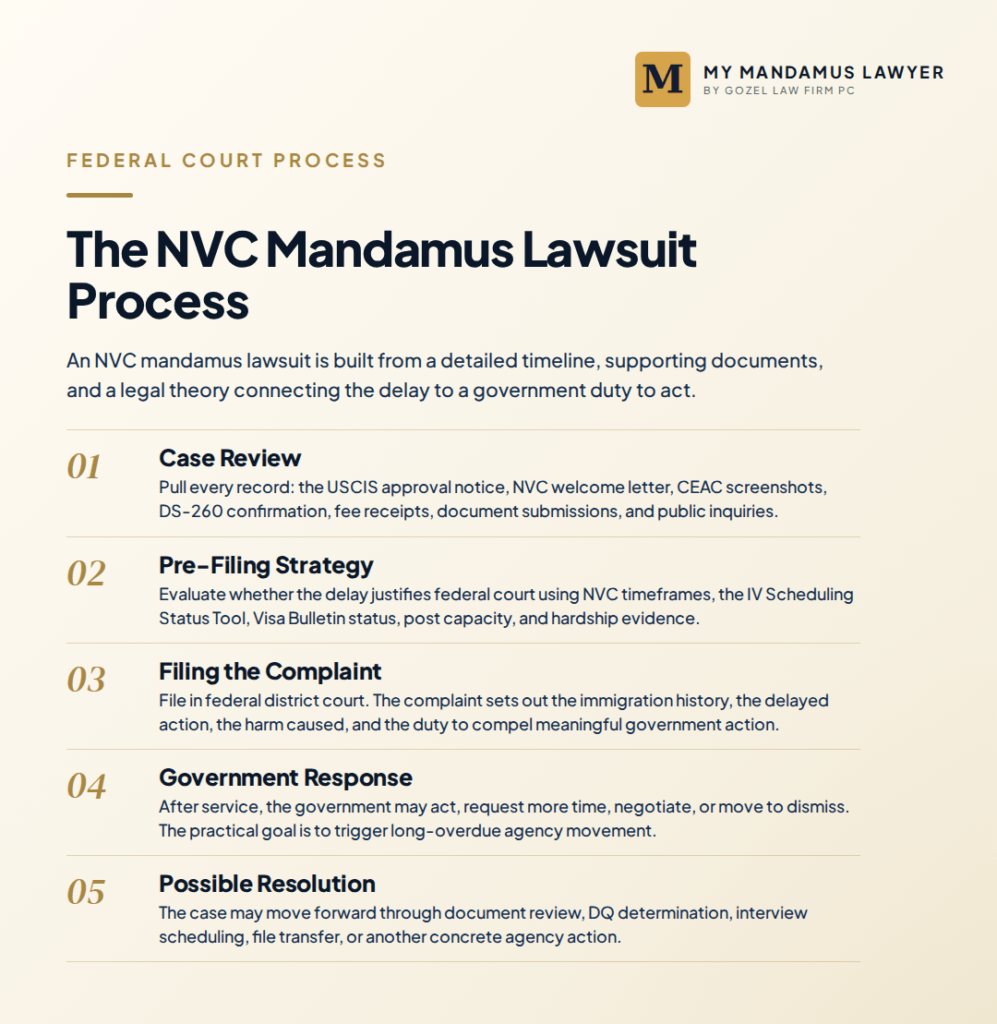
The NVC Mandamus Lawsuit Process
An NVC mandamus lawsuit is not just a complaint saying the case is taking too long. It should be built from a detailed timeline, supporting documents, and a legal theory connecting the delay to a government duty to act.
1. Case Review
The first step is reviewing the complete case history. This includes the USCIS approval notice, NVC welcome letter, CEAC screenshots, DS-260 confirmation, fee payment records, document submission dates, NVC messages, and public inquiry responses.
2. Pre-Filing Strategy
Before filing, the attorney evaluates whether the delay is strong enough for federal court. This review may include the NVC timeframe page, the IV Scheduling Status Tool, Visa Bulletin status, consular post capacity, prior agency activity, and hardship evidence.
3. Filing the Complaint
If the case is appropriate, the lawsuit is filed in federal district court. The complaint explains the applicant’s immigration history, the delayed agency action, the harm caused by the delay, and the legal basis for asking the court to compel meaningful government action.
4. Government Response
After the government is served, it may respond in several ways. It may take action on the case, request more time, negotiate a resolution, or file a motion to dismiss. In many immigration delay cases, the practical goal is to trigger long-overdue agency movement.
5. Possible Resolution
The case may move forward through document review, DQ determination, interview scheduling, file transfer, an additional document request, or another concrete government action. The exact result depends on the case stage and the facts of the immigrant visa file.
| Step | Purpose | What the Applicant Provides |
|---|---|---|
| Case review | Identify the delay type and timeline. | USCIS, NVC, CEAC, and consular records |
| Pre-filing analysis | Evaluate whether mandamus may be appropriate. | Hardship evidence and inquiry history |
| Complaint filing | Ask federal court to address unreasonable delay. | Signed documents and factual timeline |
| Government response | Government acts, responds, or challenges the lawsuit. | Attorney handles litigation response |
| Resolution | Case may move forward or be resolved procedurally. | Follow-up documents if requested |
Possible Outcomes of an NVC Delay Lawsuit
A mandamus lawsuit may help move a delayed case forward, but it does not guarantee visa approval. This message should be clear before anyone decides to file. The purpose is to challenge unreasonable delay, not to make the judge serve as the visa officer.
- NVC may complete document review after prolonged inactivity.
- The case may become documentarily qualified if required documents are accepted.
- NVC may move toward interview scheduling if the case is ready and current.
- The file may be transferred to the consulate or embassy.
- The government may request additional documents or updated information.
- The lawsuit may resolve through settlement, agency action, or dismissal after action occurs.
- The visa may still be approved, refused, or placed into another processing stage depending on the facts.
Takeaway: Mandamus may help end silence and force movement, but it does not control the final visa decision. A lawsuit may produce agency action, not a guaranteed visa approval.
This is why a strong mandamus evaluation focuses on the goal of ending unreasonable inaction. If the government acts, you may finally know the next step. That next step may be positive, but it may also be a request, refusal, interview notice, or additional processing.
Documents That May Help Evaluate Your Case
A case evaluation is stronger when the attorney can see the full timeline. If you are considering a federal lawsuit for immigration delay, gather documents that show what happened, when it happened, and how long the case has been inactive or unresolved.
- USCIS approval notice
- NVC welcome letter
- CEAC screenshots
- Fee payment records
- DS-260 confirmation page
- Affidavit of Support submission confirmation
- Civil document submission confirmation
- NVC messages and notices
- Documentarily Qualified notice
- Consulate or embassy emails
- Prior public inquiry responses
- Visa Bulletin category and priority date information
- Evidence of hardship caused by the delay
Hardship evidence can include family separation, lost work opportunities, medical issues, financial harm, aging-out concerns, or other facts showing that the delay has real consequences. These facts do not guarantee that a lawsuit will succeed, but they help counsel evaluate whether the delay is legally significant and strategically worth pursuing.
| Document Type | Why It Helps |
|---|---|
| USCIS approval notice | Shows when the petition moved beyond USCIS. |
| NVC welcome letter | Shows when NVC created the case. |
| CEAC screenshots | Shows current case status and document status. |
| DQ notice | Shows the case was accepted as documentarily qualified. |
| Inquiry responses | Shows whether NVC gave meaningful answers or generic replies. |
| Hardship proof | Shows the human impact of the delay. |
Frequently Asked Questions About NVC Delay Lawsuits
Can I sue the NVC for a delay?
In some cases, yes. A federal mandamus or unreasonable-delay lawsuit may be considered when an NVC case has been delayed for an extended period without meaningful action. Whether your case is strong depends on the delay type, case stage, timeline, agency activity, and reason for the delay.
Does a mandamus lawsuit guarantee visa approval?
No. A mandamus lawsuit does not guarantee visa approval. It usually asks the court to require the government to act on the pending case. The final action may be approval, refusal, interview scheduling, document review, transfer, or another case-specific step.
How long should I wait before considering an NVC delay lawsuit?
There is no single fixed waiting period that applies to every case. The right timing depends on the category, priority date, NVC stage, document status, inquiry history, consular post, and harm caused by the delay. A case that has been completely inactive for many months may deserve closer legal review and timeline analysis.
Can I file mandamus if my case is documentarily qualified but no interview has been scheduled?
Possibly. A documentarily qualified case with no interview may be evaluated for mandamus, but the analysis must consider consular capacity, Visa Bulletin availability, the specific embassy or consulate, and how long the case has been waiting after DQ. This is a fact-specific question, not an automatic lawsuit trigger.
Is mandamus available if the Visa Bulletin is not current?
Usually, that situation is more difficult. If a visa number is not available because the priority date is not current, the delay may be tied to statutory visa limits rather than agency inaction. That does not mean no legal issue can ever exist, but it often makes a mandamus theory weaker and a lawsuit less suitable.
Who is sued in an NVC delay lawsuit?
The defendants depend on the posture of the case. They may include federal officials connected to the Department of State, NVC, the Secretary of State, or the relevant consular post. The correct parties should be selected after reviewing where the case is stuck and which officials may be responsible.
Can an NVC delay lawsuit hurt my visa case?
Filing a lawsuit is a lawful way to challenge unreasonable delay. Still, every case should be evaluated carefully before filing. An attorney should review your immigration history, case posture, admissibility concerns, and litigation risks before recommending a federal mandamus lawsuit or alternative strategy.
Speak With an Immigration Mandamus Lawyer
Every NVC delay case is different. A case creation delay, document review delay, documentarily qualified interview delay, and consular transfer delay may require different strategies. The strongest next step is to have the timeline reviewed by a team that understands both immigrant visa processing and federal mandamus litigation.
If your NVC case has been delayed for an extended period with no meaningful progress, our team can review the timeline and help determine whether a mandamus lawsuit may be appropriate. Bring your NVC notices, CEAC screenshots, inquiry responses, and proof of hardship so we can evaluate the case carefully and strategically.
Is Your NVC Case Stuck?
Your case delay is not always your fault. A mandamus lawsuit may be a legal remedy against unreasonable immigration delays and may help move your case forward. Contact us for an NVC delay lawsuit evaluation and a case-specific review.
Legal Disclaimer
This article is provided for general informational purposes only and does not constitute legal advice. Every immigration case has unique circumstances. For legal guidance specific to your situation, we recommend consulting with an experienced immigration attorney. The information in this article reflects laws and policies as of the publication date; subsequent changes may affect its accuracy.
Sources
- NVC Timeframes, U.S. Department of State.
- NVC Processing, U.S. Department of State.
- IV Scheduling Status Tool, U.S. Department of State.
- Appointment Guidance for Immigrant Visa Interviews, U.S. Department of State.
- 28 U.S.C. § 1361, Cornell Legal Information Institute.