
If your immigration case has been stuck for months or years, the first practical question is often simple: how much does a mandamus lawsuit cost, and is it worth it? A mandamus lawsuit can be a powerful tool when USCIS, the Department of State, NVC, or another agency has delayed action on a pending immigration case. But before filing, you should understand the court filing fee, attorney fees, case expenses, and timeline that may affect your decision.
This guide explains the main cost categories, why fees vary, what a transparent estimate should include, and how the cost compares with the real-world burden of continued waiting. If you are still learning the legal remedy itself, our guide on what a writ of mandamus is in immigration delays explains what mandamus can and cannot force the government to do.
In This Article
- The Short Answer: What Does a Mandamus Lawsuit Usually Cost?
- The Main Cost Categories in a Mandamus Lawsuit
- Why Attorney Fees Differ From Case to Case
- Mandamus Cost vs. the Cost of Waiting
- How Long Does a Mandamus Lawsuit Take?
- What Should Be Included in a Transparent Fee Estimate?
- Pre-Filing Checklist Before You Ask for a Cost Estimate
- Frequently Asked Questions
The Short Answer: What Does a Mandamus Lawsuit Usually Cost?
A mandamus lawsuit usually involves two broad categories of expense: court-related costs and attorney fees. Court-related costs include the federal civil filing fee, service of process, and possible administrative expenses. Attorney fees depend on the type of delay, the agency involved, the complexity of the record, and the amount of litigation work expected.
The federal civil action filing fee is based on the U.S. district court fee framework. Federal law requires a $350 filing fee for civil actions, and federal courts may also collect an additional administrative fee under the Judicial Conference fee schedule. The U.S. Courts fee schedule currently lists a $55 administrative fee for filing a civil action in district court. :contentReference[oaicite:0]{index=0}
| Cost Item | What It Covers | Usually Paid To |
|---|---|---|
| Federal filing fee | Opening the civil action in U.S. district court | Federal court clerk |
| Service of process | Properly serving government defendants | Process server, mail carrier, or related provider |
| Attorney fees | Case review, complaint drafting, filing, service coordination, government communication, litigation work | Law firm or attorney |
| Document costs | Translations, certified copies, printing, mailing, or supporting exhibits | Third-party provider or law office |
Key point: The cheapest mandamus quote is not always the safest option. A strong filing requires accurate facts, proper defendants, correct venue, and clean service.
The Main Cost Categories in a Mandamus Lawsuit
Understanding the total cost starts with separating the different fee categories. A clear estimate should not simply say “mandamus fee.” It should explain whether the quote includes court costs, attorney time, service expenses, and possible follow-up litigation if the government contests the case.
Federal Court Filing Fee
A mandamus lawsuit is filed in U.S. federal district court. The filing fee is separate from attorney fees and is paid to the court when the complaint is filed. This cost is part of the basic lawsuit budget, but it does not cover legal drafting, case strategy, service of process, or attorney communications with the government.
Attorney Fees
Attorney fees usually represent the largest part of the mandamus lawsuit cost. These fees may cover the initial legal review, identifying proper defendants, drafting the complaint, preparing exhibits, filing the action, coordinating service, responding to government counsel, and monitoring agency action. A transparent attorney fee should explain what is included and what may cost extra.
Service of Process, Translations, and Other Expenses
After the lawsuit is filed, the government must be properly served. Service rules matter because mistakes can slow the case down or create procedural problems. Depending on the case, additional costs may include certified mailing, process service, translations, document preparation, and exhibit organization. These are usually smaller than attorney fees, but they should still be discussed before filing.
- Service costs may vary depending on how many defendants must be served.
- Translation costs may apply if key supporting documents are not in English.
- Mailing or delivery costs may apply when serving federal agencies and officials.
- Additional legal work may be needed if the government files a motion to dismiss.
Why Attorney Fees Differ From Case to Case
Two mandamus cases can look similar on the surface but require very different legal work. For example, a straightforward delayed Form I-485 case may be different from a consular delay involving administrative processing, security checks, multiple agencies, or complicated prior immigration history. The fee should reflect the actual work required, not just the name of the lawsuit.
Case Type and Agency Involved
Mandamus cases may involve USCIS, the Department of State, NVC, DHS, FBI-related background checks, or consular processing delays. Each agency structure can affect strategy, defendants, venue, and litigation risk. If your case involves a visa stuck after 221(g) administrative processing, our article on 221(g) administrative processing delays explains why consular delay cases may require a different analysis than ordinary USCIS delays.
Amount of Pre-Filing Work
Before filing, the attorney should review the case timeline, receipt notices, prior inquiries, agency responses, immigration history, and the harm caused by the delay. Some cases are ready to file quickly. Others require a deeper factual record. The more preparation needed, the more the fee may reflect pre-filing analysis and evidence organization.
Expected Litigation Risk
Some mandamus lawsuits resolve soon after filing because the agency takes action. Others may involve a government motion to dismiss or extended court briefing. A fee estimate should clarify whether the quoted attorney fee covers only the initial filing or also includes motion practice, court conferences, and continued litigation if the government fights the case.
Not sure whether the cost makes sense for your case?
Your delay may involve more than a filing fee. A proper review looks at how long you have waited, which agency is responsible, what harm the delay is causing, and whether a mandamus lawsuit is strategically appropriate.
Mandamus Cost vs. the Cost of Waiting
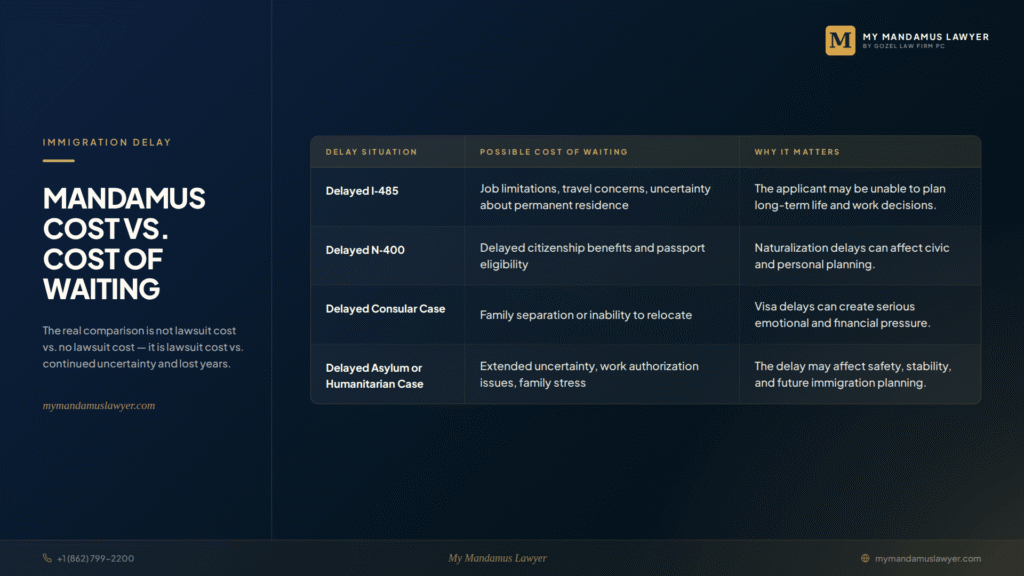
The cost of a mandamus lawsuit should be compared with the cost of continued delay. For many applicants, waiting is not just inconvenient. It can affect employment, family unity, travel, business plans, naturalization eligibility, education, or the ability to move forward with long-term life decisions. In that sense, the true comparison is not only lawsuit cost vs. no lawsuit cost, but lawsuit cost vs. continued uncertainty.
For example, a delayed green card case may prevent a person from accepting a better job, traveling freely, or planning long-term residence. A delayed visa case may keep a family separated. A delayed naturalization case may affect voting, federal employment, or passport eligibility. These personal consequences do not automatically make a mandamus case strong, but they help explain the human impact of delay and the practical value of resolution.
| Delay Situation | Possible Cost of Waiting | Why It Matters |
|---|---|---|
| Delayed I-485 | Job limitations, travel concerns, uncertainty about permanent residence | The applicant may be unable to plan long-term life and work decisions. |
| Delayed N-400 | Delayed citizenship benefits and passport eligibility | Naturalization delays can affect civic and personal planning. |
| Delayed consular case | Family separation or inability to relocate | Visa delays can create serious emotional and financial pressure. |
| Delayed asylum or humanitarian case | Extended uncertainty, work authorization issues, family stress | The delay may affect safety, stability, and future immigration planning. |
A mandamus lawsuit does not buy an approval. It asks a federal court to require the government to take action after an unreasonable delay.
How Long Does a Mandamus Lawsuit Take?
Many immigration mandamus cases move faster than ordinary civil litigation because the lawsuit focuses on agency inaction. After filing and proper service, the government typically has a response deadline. In many cases, the agency may act before the court reaches a final ruling. Still, the timeline depends on the court, the agency, the strength of the record, and whether the government contests the case. A realistic estimate should discuss both typical resolution windows and possible delays.
Many cases may see movement in roughly 30 to 90 days, especially when the agency chooses to act instead of litigating the delay. However, this is not guaranteed. Some cases take longer if the government files a motion to dismiss, the court sets a briefing schedule, or the underlying immigration issue is complicated. The safest expectation is that mandamus is meant to create legal pressure for action, not a guaranteed approval date.
| Stage | What Happens | Timeline Consideration |
|---|---|---|
| Pre-filing review | Attorney reviews receipts, timeline, inquiries, and case history | Can be quick if documents are organized |
| Complaint preparation | Legal complaint, exhibits, summonses, and civil cover sheet are prepared | Depends on complexity and evidence |
| Filing | The lawsuit is filed in federal district court | Filing fee is paid at this stage |
| Service of process | Government defendants are formally served | Proper service is critical |
| Government response | Agency may act, answer, file a motion, or negotiate resolution | Often the most important phase |
| Resolution or continued litigation | Case may become moot, settle, or continue in court | Depends on agency response |
For a broader step-by-step explanation of the filing process, you can also review this external guide from Gozel Law on how to file a mandamus lawsuit, which explains the filing steps, service process, and common procedural issues. This article focuses specifically on cost transparency and timeline expectations.
If you want to understand how the process works specifically through our office, review our page on how the mandamus lawsuit process works. That internal guide explains the practical steps from initial case review to filing and government response.
What Should Be Included in a Transparent Fee Estimate?
A transparent mandamus fee estimate should tell you what the attorney will do, what expenses are included, and what events may trigger additional fees. You should not have to guess whether the quote covers filing, service, government communication, or a motion to dismiss response. The best estimate explains the scope of representation and possible extra costs before you sign an attorney-client agreement.
- Case review: Does the fee include reviewing your receipt notices, timeline, inquiries, and immigration history?
- Complaint drafting: Does the fee include drafting the federal complaint and legal claims?
- Exhibits: Does the fee include organizing supporting documents and delay evidence?
- Filing: Is the federal court filing fee included or paid separately?
- Service: Does the fee include serving the government defendants?
- Government communication: Does the attorney handle contact with the U.S. Attorney’s Office?
- Motion practice: What happens if the government files a motion to dismiss?
- Dismissal after agency action: Does the fee include closing the federal case after USCIS or DOS acts?
Practical tip: Ask whether the quote is a flat fee, staged fee, or hourly arrangement. The answer can change your total budget and your risk if litigation continues.
Pre-Filing Checklist Before You Ask for a Cost Estimate
The more organized your documents are, the more accurate your cost estimate can be. A lawyer cannot evaluate the strength, urgency, or complexity of the case without knowing what was filed, when it was filed, what the agency has done, and what steps you already tried. A strong consultation starts with clear documents and a reliable timeline.
| Document or Information | Why It Helps |
|---|---|
| Receipt notices | Shows filing date, case type, and agency jurisdiction |
| Case status screenshots | Shows current agency status and lack of movement |
| Interview notices or cancellations | Helps identify where the delay occurred |
| Service requests | Shows prior attempts to resolve the delay without litigation |
| Congressional or Ombudsman inquiries | Shows escalation efforts before suing |
| Agency responses | Helps evaluate whether the delay explanation is generic or specific |
| Personal hardship timeline | Explains the real impact of the delay |
Before requesting a quote, prepare a short timeline with the filing date, biometrics date, interview date if any, last agency update, and all follow-up attempts. You should also explain why the delay matters now. This helps the attorney evaluate both legal reasonableness and practical urgency.
- Write down every major date, including filing, biometrics, interview, RFE, inquiry, and last update.
- Save proof of all follow-ups, including USCIS service requests, NVC messages, emails, and congressional inquiries.
- Identify the harm, such as job loss, family separation, travel restrictions, or expiring status concerns.
- Be honest about complications, including prior denials, criminal history, removal history, or missing documents.
Applicants often ask whether legal standards like TRAC factors affect the cost or strategy of a delay lawsuit. They can. If the delay is factually or legally complex, our article on TRAC factors and unreasonable delay explains how courts evaluate whether agency delay may be legally unreasonable.
Frequently Asked Questions
How much does a mandamus lawsuit cost?
The cost depends on court fees, attorney fees, service expenses, and case complexity. A simple case may require less legal work than a contested or multi-agency case. A clear estimate should separate court-related costs from attorney fees.
Is the federal court filing fee included in attorney fees?
Not always. Some law firms include court costs in a quoted package, while others bill them separately. Before signing, ask whether the quote includes the federal filing fee, service of process, and other expenses.
Can I recover attorney fees from the government?
In some federal cases, fee recovery may be discussed under specific legal standards, but applicants should not assume reimbursement. Most people should evaluate mandamus based on whether the lawsuit is worth the upfront legal cost and practical value of agency action.
Does a higher fee mean a faster result?
No. A higher fee does not guarantee faster processing or approval. The timeline depends on the agency, court, service, government response, and case facts. The attorney’s role is to prepare a strong filing and manage the litigation, not to promise a specific outcome or guaranteed approval date.
How long does mandamus usually take?
Many immigration mandamus cases see movement within a few months, and some may move within 30 to 90 days. But complex or contested cases can take longer. A realistic timeline should include both typical resolution windows and possible litigation delays.
Is mandamus worth the cost?
Mandamus may be worth considering when the delay is long, the agency has no meaningful update, and the delay is causing real harm. The decision should compare the lawsuit cost with the cost of continued waiting and the strength of the legal claim.
Conclusion
A mandamus lawsuit is a serious legal step, and the cost should be clear before you file. The total budget usually includes court costs, attorney fees, service expenses, and possible additional litigation work if the government contests the case. The right question is not only “What is the price?” but also whether the delay has become unreasonable, whether the case is well documented, and whether federal court action is a sensible next step. A transparent review should give you a realistic fee estimate and a practical timeline for your specific case.
Get a clear cost and timeline estimate for your delayed case
Your case delay is not always your fault. A mandamus lawsuit may be a legal remedy against unreasonable immigration delays, but the cost, timeline, and strategy should be reviewed before filing. Contact us for a free case evaluation and a case-specific estimate.
Legal Disclaimer
This article is provided for general informational purposes only and does not constitute legal advice. Every immigration case has unique circumstances. For legal guidance specific to your situation, we recommend consulting with an experienced immigration attorney. The information in this article reflects laws and policies as of the publication date; subsequent changes may affect its accuracy.