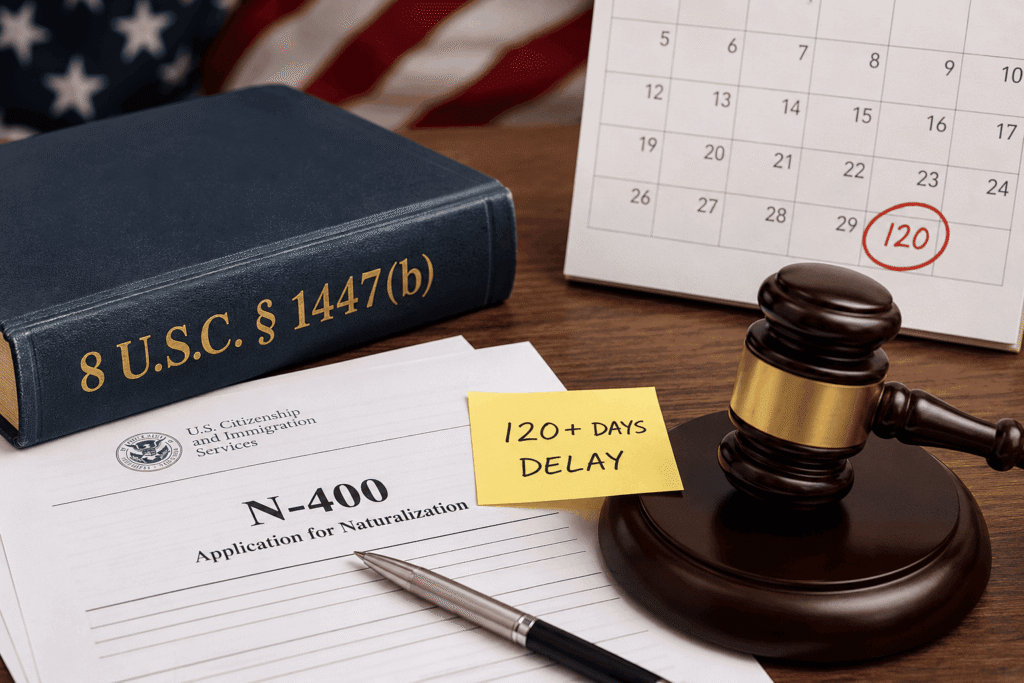
You passed your citizenship interview, answered the officer’s questions, and left expecting the final step to come soon. Then nothing happened. If more than 120 days have passed since your N-400 interview, your case may no longer be just a routine delay. A 1447b lawsuit naturalization delay case can ask a federal district court to step in when USCIS has not issued a decision after the naturalization examination.
This article explains what 8 U.S.C. § 1447(b) does, when the 120-day clock starts, how it differs from a standard mandamus lawsuit, what a federal judge can do, and what documents you should gather before filing. It is written for applicants whose N-400 delay after interview has already crossed the line from frustrating to legally actionable.
In This Article
What Is 8 U.S.C. § 1447(b)?
8 U.S.C. § 1447(b) is a special federal statute for delayed naturalization cases. It applies when USCIS has conducted the naturalization examination but has not made a decision within the required time. In that situation, the applicant may file in the United States district court for the district where the applicant resides.
This is different from a general immigration delay lawsuit. A standard writ of mandamus for immigration delays usually asks the court to order the agency to act. A 1447(b) action is narrower, but in the right naturalization case, it can be more direct because Congress gave the court specific authority over the stalled citizenship application.
The statute allows the district court to hold a hearing on the matter. The court may either determine the naturalization application itself or send the case back to USCIS with appropriate instructions. That is why a post-interview N-400 delay is not analyzed the same way as a delayed I-485, I-130, asylum interview, or consular processing case.
Why 1447(b) is different from a standard delay lawsuit
The key difference is timing. A 1447(b) lawsuit becomes relevant only after the naturalization examination has occurred and the 120-day period has passed. If USCIS has not yet scheduled your interview, the stronger path is usually a standard mandamus or APA delay lawsuit, not 1447(b). For a broader overview of that process, see our guide on the federal court process for immigration delays.
The 120-Day Rule After the N-400 Interview
The 120-day rule is the center of a citizenship delay lawsuit after interview. USCIS policy states that the agency has 120 days from the date of the initial naturalization interview to issue a decision. The federal regulation at 8 CFR § 335.3 also says that a grant or denial should be made at the initial examination or within 120 days after that examination.
For many applicants, the confusion begins when USCIS continues the case, asks for more documents, or says that a background check is still pending. Those facts may matter, but they do not automatically erase the importance of the original interview date. The first question is practical: what date appears on your N-400 interview notice, and how many days have passed since that interview took place?
Does the clock start at the interview or after additional evidence?
Courts can analyze the word “examination” differently depending on the facts and the jurisdiction. Many applicants calculate the clock from the initial naturalization interview. USCIS may argue that the examination continued if the officer requested additional evidence or scheduled another appearance. That is why your timeline, notices, and post-interview communications matter.
Common causes of post-interview N-400 delays
- Pending background or security checks that USCIS says are not complete.
- A-file or records issues when the officer needs older immigration history.
- Request for Evidence responses that were submitted but not reviewed.
- Supervisor review after a complicated eligibility issue arose at the interview.
- Oath ceremony delays after approval appears likely but no final step is scheduled.
1447(b) Lawsuit vs. Mandamus: Which One Fits Your Case?
Applicants often use the word “mandamus” for any lawsuit against USCIS delay. In naturalization cases, the better question is more specific: has the N-400 interview already happened? If yes, and 120 days have passed with no decision, 1447(b) may be the more targeted remedy. If no interview has happened, a standard mandamus or APA claim may fit better.
| Situation | Likely legal path | Why it matters |
|---|---|---|
| N-400 pending before interview | Mandamus or APA delay lawsuit | The 1447(b) clock has usually not started because the examination has not occurred. |
| N-400 interview completed and 120+ days passed | 1447(b) lawsuit | The statute gives the district court special authority over the delayed naturalization application. |
| N-400 denied after interview | Different review path | 1447(b) is for failure to decide, not for direct review of a denial. |
| Applicant has removal proceedings or complex eligibility issues | Case-specific analysis required | Naturalization law has special limits that should be reviewed before filing. |
The practical point is simple: a lawsuit should match the exact stage of your case. If you are still waiting for an interview, read our broader N-400 delay lawsuit guide. If you already completed the interview and 120 days have passed, the 1447(b) analysis should be front and center.
Your citizenship case should not sit unanswered after the interview. If more than 120 days have passed since your N-400 interview, a 1447(b) lawsuit may move your case from a USCIS waiting room into federal court.
Contact My Mandamus Lawyer for a free case evaluation or call (862) 799-2200.
What Can the Federal Court Do in a 1447(b) Case?
A federal judge in a 1447(b) case has two main options. The court can determine the matter, meaning it can decide the naturalization application. Or the court can remand the matter to USCIS with appropriate instructions. In real practice, many cases resolve when the lawsuit creates pressure for USCIS to finish the decision-making process.
That does not mean every case ends in approval. The lawsuit asks for a decision and lawful action. If the N-400 has eligibility problems, such as unresolved good moral character concerns, criminal history issues, tax problems, selective service issues, extended travel, or a pending removal matter, those issues must be reviewed before filing.
In some cases, the best outcome is a prompt approval and oath scheduling. In other cases, the court may send the case back to USCIS with a deadline or instructions. The right strategy depends on the strength of the underlying N-400 application, not just the number of days that have passed.
What Documents Do You Need Before Filing?
Before filing, your attorney needs to reconstruct the full naturalization timeline. A strong review does not start with the complaint. It starts with the file. The cleaner your record is, the easier it is to confirm whether the 120-day mark has passed and whether your case has any risk factors.
- Form N-400 receipt notice.
- Biometrics notice, if available.
- N-400 interview notice.
- Any interview results notice or Form N-652.
- Requests for Evidence and your responses.
- USCIS online account screenshots showing case status.
- Service request confirmations and responses.
- Congressional inquiry or Ombudsman inquiry records, if any.
- Any documents related to arrests, citations, taxes, travel, child support, or selective service issues.
Do not assume that a clean interview means the lawsuit is automatically risk-free. Naturalization requires a full eligibility review. A lawyer should look at both the delay and the merits before recommending litigation.
Risks, Limits, and Realistic Expectations
A 1447(b) lawsuit is powerful, but it is not a shortcut around citizenship eligibility. It does not erase problems in the file. It does not guarantee approval. It does not stop USCIS or the court from reviewing the legal requirements for naturalization. What it does is force the delay into a legal forum where the government can no longer leave the case unanswered indefinitely.
The main strategic risk is not retaliation. The bigger issue is readiness. If your case contains an unresolved eligibility problem, litigation may bring that problem to the surface faster. That can still be useful in some cases because it ends uncertainty, but it should be an informed decision. Our mandamus lawsuit FAQ explains similar risk questions for delayed immigration cases.
Timing also matters. If you are at day 90 after the interview, the better move may be preparation rather than immediate filing. If you are at day 150, day 300, or a year after the interview with no decision, the case deserves a serious legal review. The longer USCIS remains silent after the statutory period, the more important it becomes to document the delay and evaluate federal court options.
Frequently Asked Questions
Can I file a 1447(b) lawsuit before 120 days?
Usually no. The point of 1447(b) is that USCIS failed to make a decision within 120 days after the naturalization examination. If fewer than 120 days have passed, the statutory trigger usually has not occurred.
What if USCIS says my background check is still pending?
A pending background check is one of the most common explanations for N-400 delay after interview. It may explain the delay, but it does not automatically mean you must wait forever. The legal question is whether USCIS has failed to decide within the period Congress provided.
Can the judge approve my citizenship directly?
The statute gives the district court authority to determine the matter or remand it to USCIS with instructions. Whether the judge decides the application directly depends on the facts, the record, and the court’s approach.
How long does a 1447(b) lawsuit take?
Many delayed immigration lawsuits move quickly after filing because the government must respond. The exact timeline depends on the court, the U.S. Attorney’s Office, USCIS, and the complexity of the N-400 file. Some cases resolve through agency action; others require further litigation.
Is 1447(b) only for N-400 cases?
Yes, it is a naturalization-specific remedy. It is not the right tool for delayed green cards, consular visas, asylum interviews, or family petitions. Those delays may require mandamus, APA, or another federal court strategy.
Conclusion
If your N-400 interview happened more than 120 days ago and USCIS still has not issued a decision, you may have a specific federal court remedy under 8 U.S.C. § 1447(b). The strongest next step is not guessing. It is reviewing the interview date, the notices, the USCIS record, and any eligibility issues before deciding whether to file.
Your case delay isn’t your fault. A 1447(b) lawsuit may be the right legal remedy if your citizenship case has stalled more than 120 days after the N-400 interview. Contact My Mandamus Lawyer for a free case evaluation or call (862) 799-2200.
Legal Disclaimer
This article is provided for general informational purposes only and does not constitute legal advice. Every immigration case has unique circumstances. For legal guidance specific to your situation, we recommend consulting with an experienced immigration attorney. The information in this article reflects laws and policies as of the publication date; subsequent changes may affect its accuracy.
Sources
- Chapter 4 – Results of the Naturalization Examination, USCIS Policy Manual, accessed June 5, 2026.
- 8 U.S.C. § 1447 – Hearings on denials of applications for naturalization, Cornell Legal Information Institute, accessed June 5, 2026.
- 8 CFR § 335.3 – Determination on application; continuance of examination, eCFR, accessed June 5, 2026.
- Application for Naturalization, USCIS, accessed June 5, 2026.
- Check Case Processing Times, USCIS, accessed June 5, 2026.
- How to Get Judicial Relief Under 8 U.S.C. § 1447(b) for a Stalled Naturalization Application, American Immigration Council, October 23, 2013.