
A pending U-Visa case can remain silent for years, but the phrase “my U-Visa is delayed” does not always identify what USCIS has actually failed to do. Your petition may be waiting for a bona fide determination, a waiting-list decision, or final adjudication, and each stage raises a different legal question.
Understanding the delayed stage matters because a bona fide determination is not a final U-Visa approval, waiting-list placement is not the same as receiving U nonimmigrant status, and a work permit does not necessarily show that USCIS has completed the full eligibility review. Before considering federal litigation, you should identify the exact agency action that remains pending.
In This Article U-Visa Delay Stages
- The U-Visa Process Has More Than One Decision Stage
- Is Your Case Waiting for a Bona Fide Determination?
- Is Your Case Waiting for Waiting-List Placement?
- Is Your Case Waiting for Final U-Visa Adjudication?
- How Can You Identify the Delayed Stage?
- Which U-Visa Delay Stage May Be Suitable for Mandamus?
- What Can a Mandamus Lawsuit Request?
- Frequently Asked Questions
The U-Visa Process Has More Than One Decision Stage
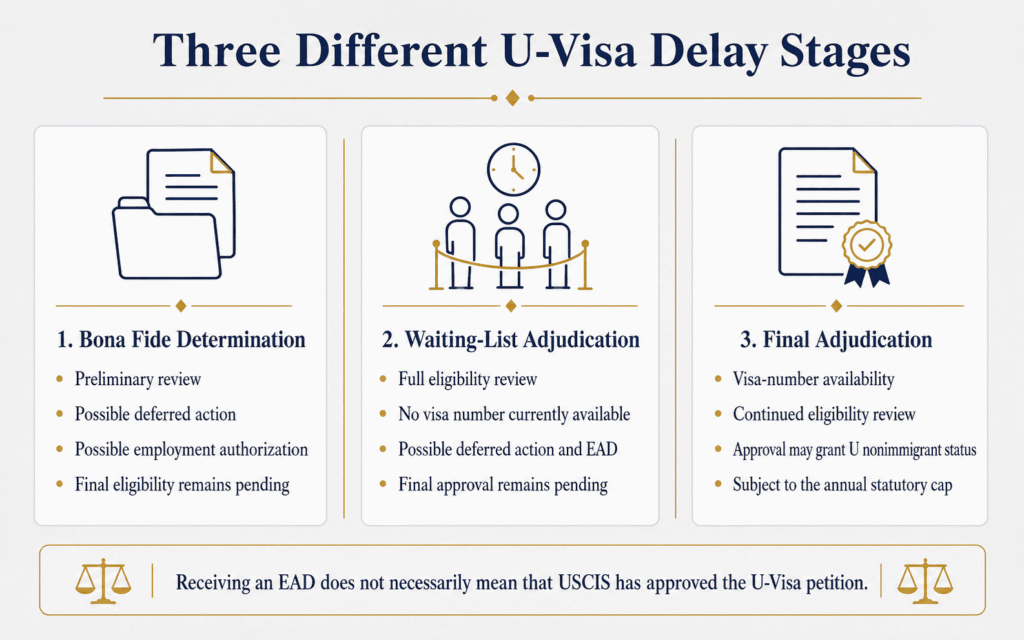
The U-Visa process is not a simple sequence in which every petitioner automatically receives a BFD, enters the waiting list, and then receives a final decision. According to the USCIS Form I-918 guidance, petitioners do not necessarily pass through three separate adjudications. USCIS created the BFD process as an additional way for certain petitioners in the United States to receive deferred action and possible employment authorization while their petitions remain pending.
| Stage | What USCIS Reviews | Possible Interim Benefit | What Remains Pending |
|---|---|---|---|
| Bona fide determination | Initial completeness, required evidence, background checks, and discretion | Deferred action and possible EAD | Full eligibility and final U-Visa adjudication |
| Waiting-list adjudication | Full U-Visa eligibility when no visa number is available | Deferred action and possible employment authorization | Availability of a U-Visa number |
| Final adjudication | Continued eligibility and visa-number availability | U nonimmigrant status if approved | No further U-Visa merits decision |
A petitioner who receives a BFD EAD may move into the queue for final adjudication without first receiving a separate waiting-list decision. By contrast, USCIS may conduct a waiting-list adjudication for a petitioner who does not receive BFD benefits. The practical question is therefore not simply how long the petition has been pending, but which review USCIS has or has not completed.
Is Your Case Waiting for a Bona Fide Determination?
The USCIS Policy Manual’s BFD chapter explains that USCIS first reviews whether the petition contains the required initial evidence and whether security checks reveal disqualifying concerns. The agency also considers whether the petitioner merits a favorable exercise of discretion before granting BFD-related deferred action and employment authorization.
What USCIS Reviews During BFD
A BFD review may involve the properly completed Form I-918, the required personal statement, a valid Form I-918 Supplement B certification, biometrics, background checks, and any required filing related to admissibility. A petition can be bona fide without being fully adjudicated, because USCIS does not necessarily complete every final merits issue before making the preliminary BFD assessment.
BFD Employment Authorization and Deferred Action
If a qualifying petitioner is living in the United States, USCIS may grant deferred action and approve employment authorization after a favorable BFD. These benefits are temporary protections during the pending process; they do not establish that the petitioner has received U nonimmigrant status or that final approval is guaranteed.
Signs of a Possible BFD Delay
Your case may still be awaiting BFD review if USCIS has received the Form I-918 but has not issued a BFD notice, deferred-action notice, waiting-list notice, or related employment authorization decision. USCIS states that it generally reviews eligible non-waitlisted petitions in receipt-date order beginning with older filings, although individual cases may require additional evidence, security review, or case-specific discretionary analysis.
A BFD is an interim determination, not a U-Visa approval. It may provide deferred action and a work permit while the full petition remains pending.
Is Your Case Waiting for Waiting-List Placement?
Waiting-list adjudication generally involves a more complete eligibility review than the BFD process. Under the USCIS waiting-list guidance, an officer evaluates whether the petitioner qualifies for U nonimmigrant status but cannot receive final approval because no U-Visa number is currently available. USCIS may issue an RFE or NOID if the record does not establish full eligibility for waiting-list placement.
Petitioners placed on the waiting list may receive deferred action and may apply for employment authorization. However, waiting-list placement still means that final U-Visa status has not been granted. The petitioner remains subject to the statutory numerical limit and must wait until a visa number becomes available.
Is Your Case Waiting for Final U-Visa Adjudication?
Federal law limits USCIS to approving no more than 10,000 principal U-1 petitions per fiscal year. Derivative family members are not counted against that principal cap, but the annual limit creates a long queue for principal petitioners. USCIS explains that it has repeatedly reached the cap and continues to conduct BFD and waiting-list reviews after the cap is reached.
When U-Visa numbers become available, the USCIS final-adjudication policy states that the agency draws from both BFD recipients and waitlisted petitioners, generally prioritizing cases by filing date. A person may therefore have deferred action and a valid EAD while still waiting for final U nonimmigrant status, sometimes for a substantial period caused by the statutory cap and filing-date queue.
How Can You Identify the Delayed Stage?
The USCIS online status page may provide only a general pending message, so you should review the complete notice history rather than relying on one status update. A reliable stage analysis usually requires comparing the filing date, receipt notices, employment-authorization records, and all written USCIS correspondence.
- Form I-918 and Form I-918 Supplement A receipt notices;
- Biometrics appointment and completion notices;
- Form I-765 receipt and approval notices;
- Bona fide determination or deferred-action notices;
- Waiting-list placement notices;
- Requests for Evidence or Notices of Intent to Deny;
- Case-status screenshots and service-request responses;
- Congressional, Ombudsman, or other agency inquiry records.
Do not assume that the EAD category by itself proves whether you received a BFD or were placed on the waiting list. Both processes may involve employment authorization connected to deferred action, so the accompanying USCIS notice is often more informative than the card alone. When the notices are unclear, an attorney can reconstruct the procedural history of the petition.
Do you know which U-Visa stage is delayed? The answer may change your legal options.
A BFD delay, waiting-list delay, and final-adjudication delay do not present the same legal issue. Our team can review your notices, filing date, EAD history, and USCIS correspondence to identify the specific action that remains pending and whether federal litigation should be considered.
Which U-Visa Delay Stage May Be Suitable for Mandamus?
A federal delay lawsuit is not evaluated solely by counting the number of years since the Form I-918 was filed. Courts may consider the nature of the requested agency action, the agency’s queue, statutory limits, competing priorities, the petitioner’s hardship, and whether USCIS owes a legally reviewable duty to act. These issues are commonly analyzed through the TRAC unreasonable-delay factors and the specific law of the federal jurisdiction.
Delayed BFD Review
A BFD-delay claim may focus on USCIS’s failure to conduct the threshold review required by its process. The analysis may be stronger when the petition has been pending for an unusually long period, required documents are complete, inquiries have produced no meaningful explanation, and the petitioner suffers documented work or humanitarian hardship. The government may respond that BFD timing involves queue management, security screening, or discretionary employment-authorization decisions.
Delayed Waiting-List Determination
A waiting-list claim may focus on whether USCIS has unreasonably delayed the full eligibility determination required before placement. In Barrios Garcia v. Department of Homeland Security, the Sixth Circuit recognized that certain U-Visa waiting-list and delay claims could be judicially reviewed. However, the ruling does not control every federal court, and different jurisdictions may reach different conclusions regarding reviewability and agency discretion.
Delayed Final U-Visa Decision
A final-decision claim can be more difficult when USCIS is following the statutory cap and generally processing petitions by filing date. Courts are often cautious about ordering an agency to move one applicant ahead of others, particularly where the request could reorder a congressionally limited queue. Still, an unexplained departure from the queue or extraordinary case-specific delay may require a more individualized legal analysis.
Delayed Work Authorization Alone
A request aimed only at forcing USCIS to grant a work permit may face additional obstacles because employment authorization and deferred action can involve discretion. A stronger lawsuit often distinguishes between asking USCIS to perform a required procedural review and demanding that USCIS grant a particular discretionary benefit.
Because these distinctions can determine jurisdiction and case strategy, U-Visa litigation should be screened by a mandamus lawyer who understands both federal unreasonable-delay standards and the structure of the U-Visa adjudication process.
Mandamus asks for lawful agency action, not automatic approval. The court may address an unreasonable delay, but USCIS retains authority over the merits.
What Can a Mandamus Lawsuit Request?
A properly framed mandamus or Administrative Procedure Act claim generally asks a federal court to require USCIS to take action that has been unlawfully withheld or unreasonably delayed. The requested relief should identify the precise pending agency duty and avoid asking the judge to substitute the court’s judgment for USCIS’s substantive immigration decision.
| A Lawsuit May Request | A Lawsuit Cannot Guarantee |
|---|---|
| Completion of a legally required BFD or waiting-list review | A favorable BFD result |
| Agency action on an unreasonably delayed stage | Employment authorization |
| A lawful decision within a reasonable period | Waiting-list placement or U-Visa approval |
| An explanation of the agency’s position in federal court | Immediate access to a capped U-Visa number |
Litigation may result in an approval, denial, RFE, NOID, waiting-list decision, BFD decision, or another agency action depending on the case. Before filing, petitioners should understand both the possible benefits of forcing movement and the risks of accelerating substantive review. Our guides explain more about U-Visa delay litigation and the cost and timeline of a mandamus lawsuit.
Frequently Asked Questions
Is a bona fide determination the same as U-Visa approval?
No. A BFD is an interim review of a pending petition that may support deferred action and employment authorization. USCIS must still complete the final eligibility adjudication before granting U nonimmigrant status.
Can I receive a work permit before being placed on the waiting list?
Potentially, yes. Certain petitioners in the United States may receive a BFD-based EAD and deferred action without first receiving waiting-list placement. Eligibility depends on the petition, security checks, discretion, and the required Form I-765 filing.
Does a BFD mean USCIS found me fully eligible?
No. A favorable BFD means USCIS found the petition bona fide under its preliminary process and made a favorable discretionary determination for interim benefits. It does not replace the complete U-Visa merits review or guarantee waiting-list placement or final approval.
Can mandamus force USCIS to issue my work permit?
Not necessarily. Courts are generally more willing to consider a request for completion of a required agency action than a demand for a particular discretionary outcome. Whether an EAD-related delay can be challenged depends on the legal duty, stage, and jurisdiction.
Does the annual U-Visa cap excuse every delay?
No single fact automatically decides an unreasonable-delay case. The cap and filing-date queue may provide USCIS with a significant explanation for final-adjudication timing, but a court may also examine whether the agency followed its process and whether a separate preliminary determination remains unreasonably delayed.
Will suing USCIS cause an automatic denial?
Filing a lawsuit does not legally require USCIS to deny the petition, but litigation may cause the agency to review the case more quickly. That faster review may produce an approval, denial, RFE, or other decision, which is why attorneys should assess the underlying eligibility and litigation risks before filing.
Identify the Delayed Stage Before Choosing a Strategy
A U-Visa petition can be delayed at the BFD stage, during waiting-list adjudication, or while awaiting final approval under the annual cap. Those stages may look similar from the outside, but they involve different USCIS duties and discretionary decisions. The first step is to determine exactly what has already occurred and which action remains outstanding.
A case-specific review should examine the filing date, notices, EAD history, agency inquiries, hardship, jurisdiction, and the relief a federal complaint would request. Mandamus may be an option in some cases, but delay length alone does not establish a claim, and no lawsuit can promise a favorable U-Visa outcome.
Has your U-Visa petition remained pending without meaningful action? Find out which stage is holding your case.
Our federal litigation team can review your Form I-918 receipt, BFD or waiting-list notices, work-permit history, inquiries, and hardship evidence. We will evaluate whether USCIS has delayed a review it must perform and whether mandamus or APA litigation fits your circumstances.
Legal Disclaimer: This article is provided for general informational purposes only and does not constitute legal advice. Every immigration case has unique circumstances. For legal guidance specific to your situation, we recommend consulting with an experienced immigration attorney. The information reflects laws and policies as of the publication date; subsequent changes may affect its accuracy.
Sources
- USCIS — Form I-918, Petition for U Nonimmigrant Status
- USCIS Policy Manual — Bona Fide Determination Process
- USCIS Policy Manual — Waiting List
- USCIS Policy Manual — Final Adjudication
- USCIS — Victims of Criminal Activity: U Nonimmigrant Status
- 8 U.S.C. § 1184 — U-Visa Statutory Framework and Annual Cap
- 8 C.F.R. § 214.14 — U Nonimmigrant Regulations
- Barrios Garcia v. Department of Homeland Security, Sixth Circuit