
Your immigration case has been pending for months or years, but the government still has not made a decision. You may be asking a simple question: when does a long delay become legally unreasonable? In federal immigration delay lawsuits, courts often answer that question by looking at the TRAC factors unreasonable delay framework.
The TRAC factors do not create a magic number of months. They help a court evaluate whether USCIS, the Department of State, a consulate, or another agency has taken too long to act. This article explains where the TRAC factors come from, how all six factors work, and how they connect to mandamus and APA lawsuit for immigration delays.
In This Article
- What Are the TRAC Factors?
- The Legal Basis: APA §706(1), Reasonable Time, and Mandamus
- The Six TRAC Factors Explained One by One
- How the TRAC Factors Apply to Immigration Delay Lawsuits
- Why “Long Delay” Does Not Always Mean “Unreasonable Delay”
- What to Gather Before a TRAC-Based Case Evaluation
- Frequently Asked Questions About TRAC Factors
What Are the TRAC Factors?
The TRAC factors are a six-part legal framework courts use to evaluate whether an agency delay has become unreasonable under the law. The name comes from Telecommunications Research & Action Center v. FCC, a 1984 D.C. Circuit case involving delayed action by the Federal Communications Commission.
That case did not involve immigration. But the same basic problem appears in immigration cases every day: a person files a valid application, petition, visa request, FOIA request, or related filing, and the agency leaves the matter pending without a clear decision or a meaningful explanation. The TRAC framework gives courts a structured way to ask whether that waiting period is still reasonable.
TRAC is not a stopwatch. It is a framework courts use to decide whether the government’s delay still makes legal sense.
Why a telecommunications case matters in immigration delays
TRAC became important because federal agencies across the government have duties to act within a reasonable time. In immigration litigation, lawyers often use TRAC factor analysis to explain why a delay is not just frustrating, but legally actionable. The same framework may appear in delayed green card cases, naturalization delays, U visa delays, asylum interview delays, EB-5 delays, consular administrative processing, and FOIA delays.
Why TRAC is not a simple day-counting test
Applicants often ask, “How many months do I need to wait before filing?” That question matters, but it is not the whole test. A court usually looks at delay length, case type, agency explanation, hardship, congressional timing signals, and practical consequences. A two-year delay may look serious in one case and less persuasive in another.
| Common Question | TRAC-Based Answer |
|---|---|
| Is there one fixed number of months? | No. Courts look at the facts, not only the calendar. |
| Does being outside processing time help? | Often, yes. But it is only one part of the analysis. |
| Does hardship matter? | Yes. Human welfare and real-world harm can be important. |
| Do I need to prove bad faith? | No. Bad faith is not required under TRAC. |
The Legal Basis: APA §706(1), Reasonable Time, and Mandamus
The TRAC factors usually appear in cases filed under the Administrative Procedure Act, mandamus, or both. The APA says that a reviewing court shall “compel agency action unlawfully withheld or unreasonably delayed” under 5 U.S.C. § 706. Another APA provision, 5 U.S.C. § 555(b), states that agencies shall proceed to conclude matters presented to them within a reasonable time and without unreasonable delay.
Mandamus works from a related but distinct legal theory. Under 28 U.S.C. § 1361, federal district courts have jurisdiction over actions in the nature of mandamus to compel a federal officer or agency to perform a duty owed to the plaintiff. In immigration delay cases, the practical request is often the same: the applicant asks the court to require government action.
The key point is this: a federal delay lawsuit usually asks for agency action, not guaranteed approval. The court can be asked to require movement, but the agency still decides the substance of the immigration benefit.
That distinction matters. A mandamus or APA lawsuit does not ask the judge to approve a green card, visa, naturalization application, U visa, asylum filing, or FOIA request. Instead, it usually asks the court to address agency inaction and require the government to make a lawful decision.
That is why many immigration delay complaints include both APA and mandamus claims. The APA focuses on agency action that has been unlawfully withheld or unreasonably delayed. Mandamus focuses on a clear duty to act. For a broader comparison, see our guide on mandamus and APA lawsuit for immigration delays.
The Six TRAC Factors Explained One by One
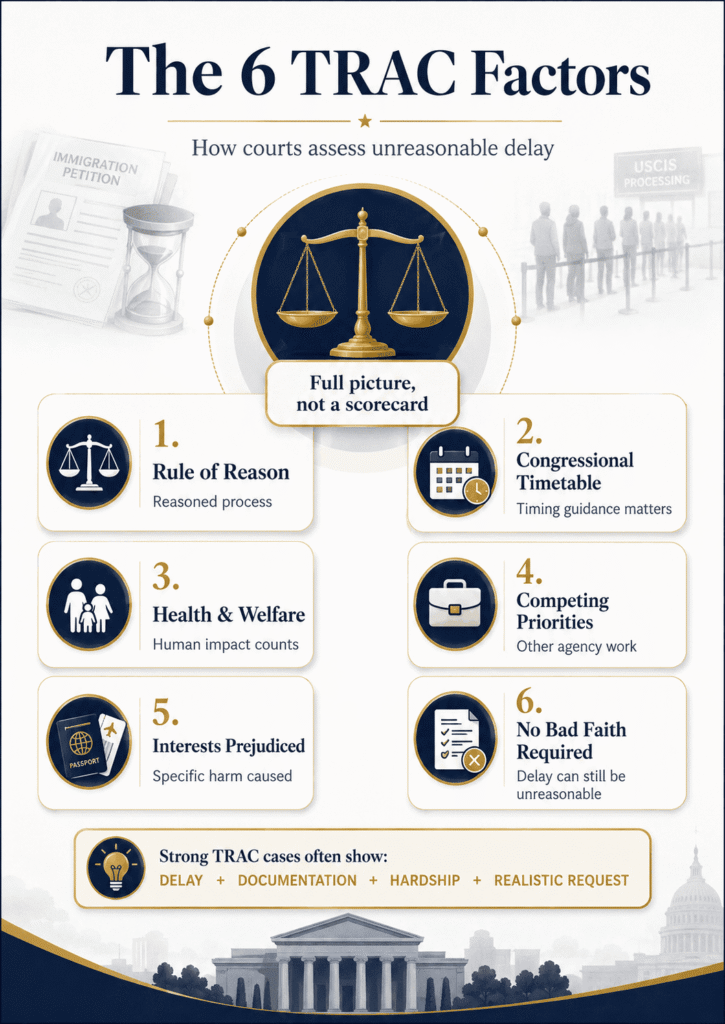
The six TRAC factors work together. Courts do not usually count them like points on a scoreboard. Instead, a judge looks at the full picture and asks whether the agency’s pace is reasonable under the circumstances.
| TRAC Factor | Plain-English Meaning | Immigration Example |
|---|---|---|
| 1. Rule of reason | The agency’s timeline should be governed by a reasoned process. | USCIS cannot simply leave a case pending indefinitely without a coherent explanation. |
| 2. Congressional timetable | If Congress gave timing guidance, courts may weigh that heavily. | A naturalization case delayed more than 120 days after examination may raise special concerns. |
| 3. Human health and welfare | Delays affecting people’s lives may receive more weight than purely economic delays. | Family separation, medical hardship, employment loss, or inability to travel can matter. |
| 4. Competing priorities | The court considers how expediting one case may affect other agency work. | The government may argue that moving one applicant ahead affects the queue. |
| 5. Interests prejudiced | The court looks at the specific harm caused by delay. | A pending green card, work permit, or visa may affect family unity, income, education, or safety. |
| 6. No bad faith required | The applicant does not need to prove improper motive. | A delay can be unreasonable even if no officer acted maliciously. |
Factors 1–2: the rule of reason and statutory timetable
The first factor is often the most important. The government may argue that it uses a reasonable queue, background check process, security review, or workload system. The applicant may respond that an open-ended delay with no projected action is not a true rule of reason.
The second factor asks whether Congress supplied a timetable or other timing signal. Not every immigration benefit has a clear statutory deadline. But where Congress has given timing guidance, that can help define what reasonable speed should look like. This is why the same length of delay can be viewed differently across different case types.
Factors 3–4: human welfare and competing agency priorities
The third factor recognizes that delay can harm real people. Immigration delays often affect family unity, employment, lawful status, education, medical stability, travel, safety, and financial planning. A strong case evaluation should identify these harms clearly rather than relying only on the number of months pending.
The fourth factor is often the government’s strongest response. Agencies argue that courts should not reorder their priorities or push one applicant ahead of others. A well-prepared complaint should explain why the case is not merely asking for unfair line-jumping, but challenging unreasonable inaction in a specific, documented situation.
The strongest TRAC arguments usually combine delay, documentation, hardship, and a realistic request for action.
Factors 5–6: the interests harmed and why bad faith is not required
The fifth factor overlaps with human welfare but focuses on the nature and extent of the interests harmed by delay. For example, a delayed Form I-485 may affect work, travel, and permanent residence planning. A delayed consular case may separate spouses, parents, or children for months or years.
The sixth factor is important for applicants who worry they cannot prove misconduct. TRAC does not require proof that USCIS, DOS, or another agency acted in bad faith. The issue is whether the delay has become unreasonable. An agency can act without bad intent and still take too long.
How the TRAC Factors Apply to Immigration Delay Lawsuits
TRAC factor analysis changes depending on the case type. A delayed I-485 adjustment of status case does not look exactly like a delayed U visa bona fide determination, an asylum interview delay, an EB-5 petition, a 221(g) administrative processing case, or a FOIA request. The legal theory may be similar, but the facts must be tailored to the specific delay.
For example, an employment-based green card delay may involve career disruption, employer sponsorship, international travel limits, and dependent family consequences. A consular delay may involve prolonged family separation and uncertainty outside the United States. A FOIA delay may matter because the applicant needs the A-file to prepare a defense, correct records, or evaluate eligibility.
| Case Type | TRAC Issue to Examine | Possible Harm to Document |
|---|---|---|
| I-485 adjustment of status | Length of delay, last action, background checks, interview status | Work, travel, family planning, status uncertainty |
| Consular / 221(g) delay | Administrative processing length and lack of case-specific explanation | Family separation, job disruption, inability to relocate |
| Naturalization delay | Post-interview delay and any statutory timing issue | Voting, employment, travel, security clearance, family petitions |
| FOIA delay | Statutory timing, agency backlog, unanswered requests | Inability to prepare immigration defense or correct records |
| U visa / asylum delay | Stage of case, agency silence, humanitarian impact | Work authorization, safety, medical need, family stability |
Stronger fact patterns
- The case has been pending far beyond expected or typical processing patterns.
- The applicant has made repeated inquiries without meaningful response.
- The agency cannot provide a case-specific explanation for the delay.
- The delay causes documented hardship, not just inconvenience.
- The requested relief is action on the case, not guaranteed approval.
Weaker fact patterns
- The case has been pending only a short time compared with the case type.
- The applicant recently filed or recently received an agency update.
- The agency is waiting for documents, biometrics, security checks, or applicant action.
- The complaint does not explain concrete harm from the delay.
- The requested relief sounds like a demand for approval rather than a decision.
This is why a TRAC-based case evaluation should be fact-specific. If you are still learning what federal litigation can and cannot do, start with our overview of what a mandamus lawsuit for immigration delays can and cannot do. The goal is to understand whether your delay is legally actionable, not simply whether you have waited a long time.
A long delay deserves more than a guess. If your case has no clear movement, the TRAC factors can help determine whether the delay may be legally unreasonable. Get a free case evaluation before deciding whether to keep waiting or consider federal court.
Free Case Review or call (862) 799-2200.
Why “Long Delay” Does Not Always Mean “Unreasonable Delay”
A long delay matters. But length alone is rarely enough. Courts usually want to know what kind of case it is, what the agency has done, whether Congress gave timing guidance, whether the applicant has tried ordinary channels, and how the delay is affecting the person’s life and the requested immigration benefit.
Think of two applicants who have both waited 18 months. One filed a case type that often takes longer, recently received a request for evidence, and has no urgent hardship. The other has no update, no explanation, repeated unanswered inquiries, loss of work authorization, family separation, and serious financial harm. The calendar number is the same, but the TRAC analysis may be very different.
This does not mean you should wait forever. It means the lawsuit should be built around facts, not frustration alone. If the case is strong, the complaint should explain the delay with a clear timeline, documented harm, and a realistic request for action. For timing expectations after filing, see our guide to the mandamus lawsuit timeline.
| Delay Fact | Helpful for TRAC? | Why It Matters |
|---|---|---|
| Long silence after filing | Often helpful | Shows lack of visible progress. |
| Recent RFE or agency notice | Sometimes less helpful | May show the agency is still actively processing. |
| Repeated unanswered inquiries | Helpful | Shows attempts to resolve the issue before litigation. |
| Hardship evidence | Helpful | Supports TRAC factors involving human welfare and prejudice. |
| Demand for approval | Risky | Courts are more likely to compel action than dictate approval. |
What to Gather Before a TRAC-Based Case Evaluation
A strong TRAC factor analysis starts with a clear record. Before requesting a case evaluation, gather the documents that show what was filed, when it was filed, what the agency has done, and how the delay affects you. This helps an attorney evaluate both the legal standard and the practical litigation strategy.
- Receipt notices for all pending applications, petitions, or requests.
- Biometrics notices, interview notices, RFEs, NOIDs, or other agency correspondence.
- Online case status screenshots showing the history of updates.
- USCIS, DOS, embassy, Ombudsman, congressional, or service-request inquiries.
- Proof of hardship, such as job loss, financial records, medical records, school records, or family separation evidence.
- A simple timeline listing filing date, last agency action, inquiries, and current delay length.
Our process starts with a free review of your case type, filing date, processing timeline, and the impact the delay is having on your life. You can read more about how the mandamus lawsuit process works before deciding whether to move forward. A careful review can show whether your facts support a strong TRAC argument or whether more preparation is needed.
A strong TRAC case is built before filing. The clearer your timeline and evidence, the easier it is to explain why the delay has become unreasonable.
Frequently Asked Questions About TRAC Factors
Are TRAC factors only used in immigration cases?
No. TRAC began outside immigration law and can apply to different types of agency delay. In immigration practice, the framework is commonly used to evaluate whether delays by USCIS, DOS, consulates, or other agencies have become unreasonable under federal law.
How many TRAC factors must favor the applicant?
There is no fixed number. Courts weigh the factors together. Some factors may matter more than others depending on the case type, the delay length, the agency’s explanation, and the harm caused by waiting.
Does USCIS bad faith need to be proven?
No. One TRAC factor specifically recognizes that a court does not need to find bad faith or improper motive before finding delay unreasonable. The focus is on whether the agency’s delay is legally unreasonable under the circumstances.
Can TRAC factors help in consular delay cases?
They can. Consular delay cases can involve additional legal issues, including arguments about consular nonreviewability and the limits of judicial review. Still, unreasonable delay analysis often discusses the same basic question: has the government taken too long to act?
Should I wait until I am outside normal processing time?
Being outside normal processing time can help, but it is not the only issue. A case evaluation should also consider hardship, case history, prior inquiries, agency silence, and whether the delay has crossed from ordinary backlog into unreasonable inaction. For more general answers, see our common questions about mandamus lawsuits and review whether your case has documented harm.
Conclusion
The TRAC factors are not a stopwatch. They are a legal framework for asking whether a delay is reasonable in context. The strongest immigration delay cases usually combine a long or unexplained delay with a clear record, concrete harm, prior efforts to get answers, and a realistic request for agency action.
If your immigration case has been stuck for months or years, the next step is not guessing. The next step is a fact-specific review of how your timeline, case type, and hardship fit the TRAC factors and the unreasonable delay standard.
Your case delay is not your fault. A mandamus lawsuit is a legal remedy against unreasonable USCIS, DOS, or consular delays and can push the government to take action. Find out for free whether your case is strong on the TRAC factors, or call (862) 799-2200.
Legal Disclaimer
This article is provided for general informational purposes only and does not constitute legal advice. Every immigration case has unique circumstances. For legal guidance specific to your situation, we recommend consulting with an experienced immigration attorney. The information in this article reflects laws and policies as of the publication date; subsequent changes may affect its accuracy.
Sources
- Telecommunications Research & Action Center v. FCC, 750 F.2d 70, U.S. Court of Appeals for the D.C. Circuit, October 24, 1984.
- 5 U.S.C. § 706 — Scope of Review, Legal Information Institute, current U.S. Code.
- 5 U.S.C. § 555 — Ancillary Matters, Legal Information Institute, current U.S. Code.
- 28 U.S.C. § 1361 — Action to Compel an Officer of the United States to Perform a Duty, Legal Information Institute, current U.S. Code.
- Mandamus and APA Delay Cases: Avoiding Dismissal and Proving the Case, American Immigration Council / National Immigration Litigation Alliance, 2021 practice advisory.