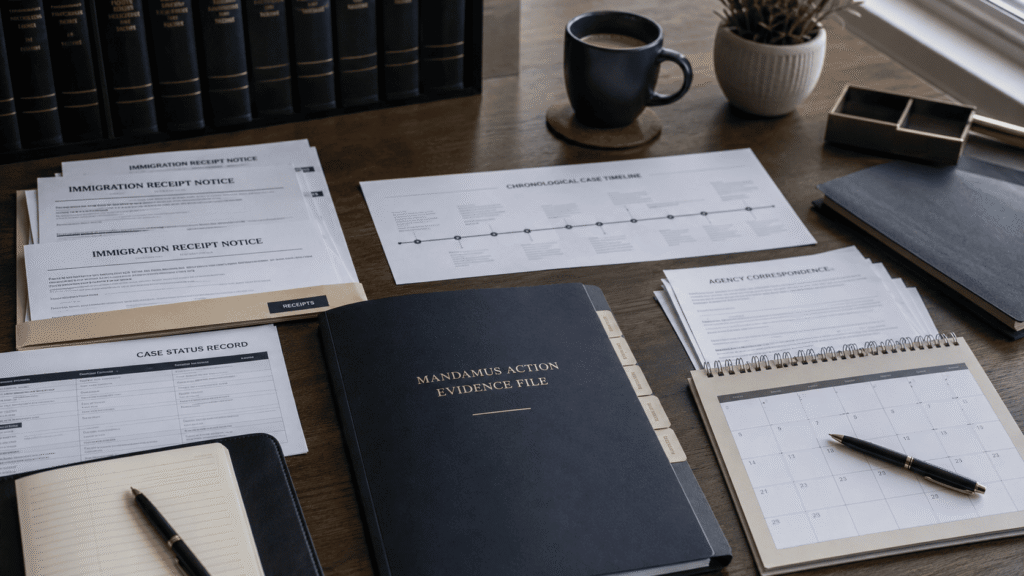
Your immigration case has been pending for months or years, but the records are scattered across notices, email folders, government accounts, and saved screenshots. Before federal litigation can be evaluated, those materials must show what the government received, what action remains unfinished, and how long that step has remained pending.
The evidence for a mandamus lawsuit should connect the case history, agency responsibility, follow-up efforts, and consequences of delay. This guide explains how to turn those records into a clear chronological case file.
In This Article Mandamus Evidence Checklist
- Why Evidence Matters in a Mandamus Lawsuit
- Core Immigration Records to Collect
- How to Prove the Length and History of the Delay
- Evidence of Follow-Up Attempts
- Evidence of Harm Caused by the Delay
- How to Build a Mandamus Case Timeline
- What Each Document Helps Establish
- Evidence That Is Usually Weak or Unhelpful
- Pre-Filing Organization Checklist
- Frequently Asked Questions
Why Evidence Matters in a Mandamus Lawsuit
A federal delay complaint must identify the action allegedly withheld or delayed. 28 U.S.C. § 1361 addresses actions seeking to compel a federal officer or agency to perform a duty owed to the plaintiff, while 5 U.S.C. § 706(1) addresses agency action unlawfully withheld or unreasonably delayed.
The evidence identifies which agency controls the next step, whether the applicant completed every requirement, and whether the delay can be shown through verifiable dates. It also supports the legal theory discussed in our guide to APA § 706(1) lawsuits for USCIS delays. A large file does not guarantee a strong claim; the records must help assess whether the delay is actionable.
A strong evidence file answers three questions: What did you complete, what has the government not completed, and what documents prove the difference?
Core Immigration Records to Collect
Begin with the records that establish the identity of the case, the filing date, and the procedural stage. The exact checklist changes depending on whether the delay is with USCIS, NVC, or a U.S. embassy or consulate.
| Case Stage | Core Records | Key Date to Confirm |
|---|---|---|
| USCIS | Receipt notices, biometrics notices, interview notices, transfer notices, RFE or NOID records, and proof of response | Receipt date and last meaningful agency action |
| NVC | USCIS approval notice, NVC Welcome Letter, fee records, DS-260 confirmation, Affidavit of Support records, civil-document history, and CEAC messages | Documentarily complete or documentarily qualified date |
| Consular Post | Interview notice, 221(g) sheet, DS-5535 request, proof of document submission, CEAC history, and embassy correspondence | Interview date and date every requested item was submitted |
For a USCIS case, the receipt notice usually identifies the form, receipt number, receipt date, and processing office. USCIS allows applicants to use that number in its Case Status Online system. Also include the underlying filing and every response to an RFE, NOID, 221(g) request, or supplemental questionnaire. These records help show whether an applicant obligation remains outstanding or the next step belongs to the government.
How to Prove the Length and History of the Delay
A complaint should not rely only on the statement that the case has been pending “for too long.” Build the history from objective dates. Start with the original filing or submission date, then identify every meaningful event through the present.
Useful records include:
- The receipt, submission, or documentarily complete date;
- Dated USCIS or CEAC status records;
- Interview, biometrics, transfer, RFE, NOID, or 221(g) dates;
- Proof of delivery for requested evidence;
- Processing-time screenshots showing the form, office, and capture date;
- The agency’s last case-specific communication.
USCIS processing-time data provides context and changes over time. Save a screenshot showing the form, office, and capture date, but do not treat the estimate as a binding legal deadline. Preserve older USCIS and CEAC records because online histories may later change.
Do your records show a long delay but no clear explanation?
Our federal litigation team can review your notices, status history, inquiries, and hardship records to identify the unfinished government action and evaluate a mandamus or APA strategy.
Evidence of Follow-Up Attempts
Prior inquiries can help show that the applicant sought information or action before filing. They may also reveal the government’s stated explanation, whether the response was individualized, and whether the agency repeatedly sent the same general message.
Collect:
- USCIS service-request confirmation numbers and responses;
- Contact Center emails, callback records, or written summaries created immediately after a call;
- Expedite requests, supporting evidence, and agency decisions;
- Congressional inquiry authorizations, submissions, and responses;
- CIS Ombudsman Form 7001 submissions and correspondence;
- NVC Public Inquiry Form confirmations and responses;
- Embassy or consulate emails, webform submissions, and reply messages.
USCIS maintains an official Case Inquiry portal for matters such as cases taking longer than expected and missing notices. The CIS Ombudsman’s Form 7001 process may assist with unresolved USCIS problems. For NVC-stage cases, the Department of State directs applicants to use CEAC for current case information and the NVC Public Inquiry Form for correspondence.
These steps are not required in every case, but they can show what the applicant asked, what the government answered, and whether the delay continued afterward.
Evidence of Harm Caused by the Delay
Hardship evidence explains the human consequences of agency inaction. It does not replace the need to identify a legally reviewable delay, but it can make the factual record more complete and show why continued waiting matters.
| Type of Harm | Potential Supporting Records |
|---|---|
| Family separation | Travel history, children’s records, caregiving evidence, communication history, and declarations |
| Employment or financial loss | Employer letters, lost job offers, unpaid-leave records, contracts, invoices, tax records, and additional household expenses |
| Medical or humanitarian concerns | Medical records, physician letters, treatment schedules, disability records, and caregiving plans |
| Educational or professional disruption | Admission letters, enrollment deadlines, licensing requirements, research commitments, and professional correspondence |
| Safety concerns | Country-condition records, police reports, threats, relocation evidence, or other case-specific documentation |
Use specific dates and records rather than broad statements. When appropriate, counsel may use a declaration signed under penalty of perjury consistent with 28 U.S.C. § 1746. The evidence should distinguish documented consequences from speculation.
How to Build a Mandamus Case Timeline
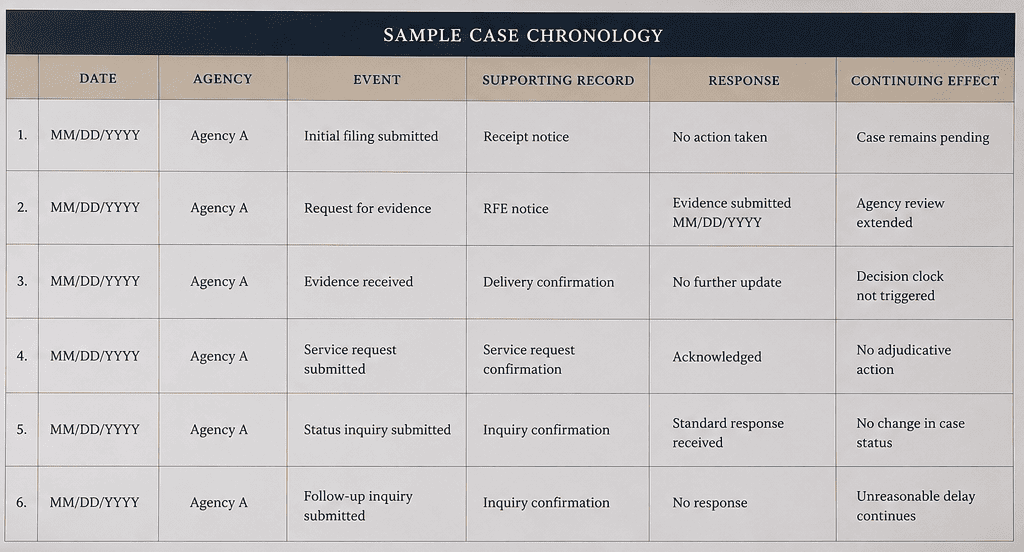
A timeline allows counsel to understand the case without reconstructing years of emails from scratch. Use one row for each meaningful government action, applicant submission, inquiry, or hardship event.
| Date | Agency / Office | Event | Supporting Record | Response / Effect |
|---|---|---|---|---|
| July 7, 2025 | USCIS | Application received | Form I-797 receipt notice | Case opened; no merits decision |
| March 12, 2026 | USCIS | Outside-normal-processing-time inquiry | Service request confirmation | Generic response; case remained pending |
| June 4, 2026 | Employer | Job opportunity withdrawn because work authorization remained unresolved | Employer email | Documented financial and professional harm |
Keep entries factual, use exact dates where available, and make file names chronological. For example:
2025-07-07_I-130_Receipt_Notice.pdf2026-03-12_USCIS_Service_Request.pdf2026-03-28_USCIS_Response.pdf2026-06-04_Employer_Hardship_Letter.pdf
For related family cases, use separate folders by applicant and receipt number, plus a master index showing how the filings connect.
What Each Document Helps Establish
Federal Rule of Civil Procedure 8 generally requires jurisdictional grounds, a claim for relief, and a demand for that relief. The record supports those factual allegations.
| Evidence | What It May Help Establish |
|---|---|
| Receipt notice | Filing date, receipt number, form type, and agency possession |
| Transfer or interview notice | Responsible office and completion of a procedural step |
| RFE, 221(g), or DS-5535 response | What the government requested and whether the applicant complied |
| Dated status record | Current status and the absence of later case-specific action |
| Inquiry response | Prior follow-up, agency explanation, or repeated generic responses |
| Hardship record | Concrete consequences of continuing delay |
| Master chronology | A coherent procedural history and the agency’s last meaningful action |
Not every record must be filed as an exhibit. Counsel first uses the complete set to select the strongest relevant facts while avoiding unnecessary disclosure of sensitive or duplicative documents.
Evidence That Is Usually Weak or Unhelpful
The following materials often add little unless connected to reliable dates or official records:
- Undated screenshots that do not show the case number, agency, or page source;
- Personal estimates of processing time without the correct form, category, and office;
- Repeated copies of the same service request or automated response;
- Unverified statements about why the agency is delaying the case;
- Online complaints from unrelated applicants with different forms or offices;
- Hardship claims with no dates, details, or supporting records;
- Documents unrelated to the pending government action;
- Altered, cropped, or incomplete correspondence that removes important context.
Another mistake is assuming that evidence of a long delay automatically proves the legal claim. Our guide to the TRAC factors for unreasonable immigration delay explains why courts evaluate more than elapsed time. The evidence should be organized around the correct procedural stage, not around a comparison to a different applicant’s case.
Pre-Filing Organization Checklist
Before sending the case to a mandamus lawyer, complete this practical checklist:
- Create a master case sheet. List every applicant, petitioner, receipt number, form, agency, office, and current status.
- Gather all immigration notices. Include receipt, biometrics, transfer, interview, approval, RFE, NOID, and 221(g) records.
- Save current online records. Download or capture USCIS, CEAC, NVC, or consular status pages with visible dates.
- Collect proof of compliance. Include delivery confirmations and copies of every response submitted to the government.
- Organize inquiry records. Match each service request, congressional inquiry, Ombudsman request, or NVC inquiry with its response.
- Prepare a chronology. Use one row for each meaningful agency event, submission, inquiry, or hardship development.
- Document concrete harm. Use records that show dates, amounts, deadlines, medical needs, travel, or family consequences.
- Separate multiple cases. Keep each applicant and receipt number in a clearly labeled folder.
- Remove unnecessary duplicates. Preserve originals, but avoid sending the same notice repeatedly.
- Identify missing records. Tell counsel which notices or communications cannot be located rather than guessing what they said.
Do not postpone an evaluation solely because one document is missing. Counsel may identify an alternative record or determine that the item is not essential.
The goal is not the largest document file. The goal is a reliable record showing the pending duty, the history of delay, and the consequences of continued inaction.
Frequently Asked Questions
Do I need to file every document with the complaint?
No. Counsel uses the complete set to verify the allegations and decide which records should support the pleading. Local rules and strategy affect what is filed.
Are USCIS service requests required before filing mandamus?
Not in every case. Their value depends on the claim, agency, court, and procedural history.
Do hardship documents determine whether I can file?
No. Hardship does not itself establish jurisdiction or a duty to act, but it may show the real effects of continued delay.
Should I save screenshots from my USCIS account?
Yes. Save dated screenshots or PDFs showing the receipt number, status, history, and page source so the image can be tied to the correct case and capture date.
What evidence is needed for an NVC or consular delay?
Collect the USCIS approval, NVC Welcome Letter, CEAC history, DQ notice, inquiry records, interview notice, 221(g) sheet, DS-5535 response, and embassy correspondence, as applicable.
Are Your Mandamus Records Ready for Review?
A useful mandamus evidence file identifies the responsible agency, documents the applicant’s compliance, preserves the delay history, and explains the effects of continued waiting.
The record should support a precise theory: the agency received these materials on these dates, the applicant completed the required steps, and this government action remains unfinished. For more context, review our guides to mandamus lawsuits for immigration delays, the mandamus lawsuit timeline, and a documented I-485 case study.
Do you have receipt notices, inquiry records, and a clear delay timeline?
Send us the records you have, even if the file is incomplete. Our team can identify what additional documents are needed and whether federal litigation fits your circumstances.
Phone: +1 (862) 799-2200
Legal Disclaimer: This article is provided for general informational purposes only and does not constitute legal advice. Every immigration case has unique circumstances. For legal guidance specific to your situation, we recommend consulting with an experienced immigration attorney. The information reflects laws and policies as of the publication date; subsequent changes may affect its accuracy. Prior results do not guarantee a similar outcome.
Sources
- 28 U.S.C. § 1361 — Action to Compel an Officer of the United States to Perform a Duty
- 5 U.S.C. § 706 — Scope of Review Under the Administrative Procedure Act
- 28 U.S.C. § 1746 — Unsworn Declarations Under Penalty of Perjury
- United States Courts — Federal Rules of Civil Procedure, Amended Through December 1, 2025
- USCIS — Checking Your Case Status Online
- USCIS — Case Processing Times
- USCIS — Case Inquiry
- Department of Homeland Security — DHS Form 7001, Request for Case Assistance
- Department of State — NVC Public Inquiry Form
- Department of State — Consular Electronic Application Center Processing