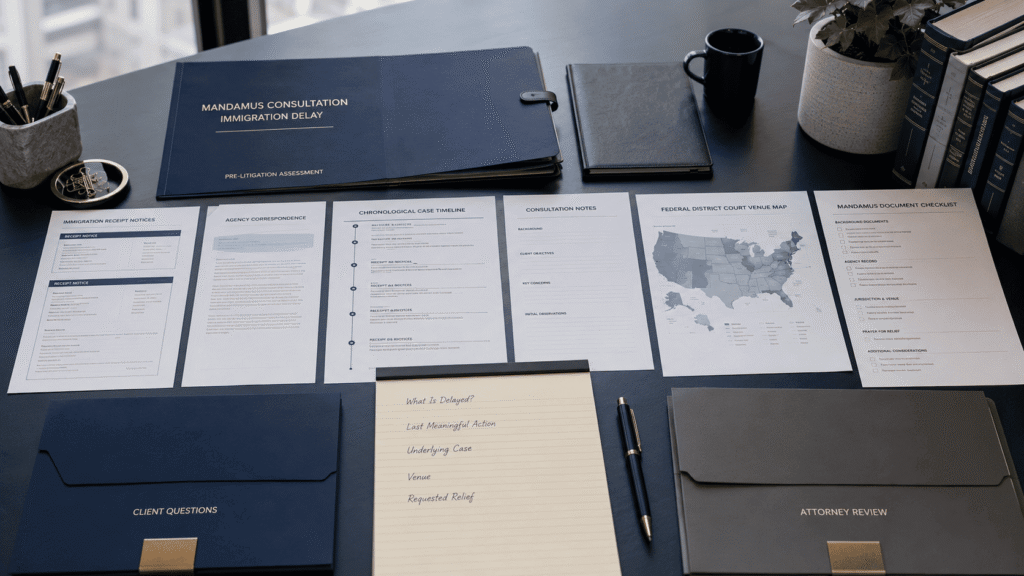
A prospective client often begins a mandamus consultation with one urgent question: “My immigration case has been pending for months or years. Can you file a lawsuit?”
A careful attorney should not answer that question based only on the number of months shown on a calendar. Before recommending federal litigation, the lawyer should identify the exact application, the government agency responsible for the next step, the last meaningful action in the case, the history of the underlying immigration matter, and the result the client realistically expects.
In other words, a meaningful mandamus consultation should be a two-way evaluation. You should evaluate the attorney’s experience and proposed strategy, but the attorney must also evaluate whether the facts of your case support filing a federal lawsuit.
In This Article Inside a Mandamus Consultation
- Why a Consultation Should Be More Than a Sales Call
- What Exactly Is Delayed?
- How Is the Case Timeline Evaluated?
- What Has the Government Already Told You?
- Which Documents Should the Lawyer Review?
- What Risks Exist in the Underlying Immigration Case?
- How Is the Delay Affecting You?
- Where Could the Lawsuit Be Filed?
- What Could the Government Do After Filing?
- Is Filing Now the Best Strategic Decision?
- What Should You Bring to the Consultation?
- A Sample Client–Lawyer Conversation
- Frequently Asked Questions
A Mandamus Consultation Should Be More Than a Sales Call
A consultation should not be limited to a fee quote, a general description of federal litigation, and a prediction that filing a complaint will quickly move the immigration case. Before recommending litigation, the attorney should investigate what has happened, what remains unfinished, who controls the next step, and whether court intervention is legally and strategically appropriate.
A productive consultation may begin like this:
Client: My immigration case has been pending for almost two years. Can we file a mandamus lawsuit?
Lawyer: Possibly, but the length of the delay is only the beginning of the analysis. I first need to understand what you filed, which agency controls the next step, what the government has done so far, and what could happen if processing resumes.
The questions asked during the consultation can reveal whether the filing recommendation is based on a genuine case evaluation or merely on the length of the wait. A lawyer who immediately recommends filing without asking about the documents, procedural history, venue, or underlying immigration issues may not yet have enough information to assess the case responsibly.
You should also arrive prepared to evaluate the attorney. Our guide on questions to ask when choosing a mandamus lawyer addresses experience, legal strategy, fee scope, litigation risks, and warning signs before retaining counsel.
This article examines the other side of that conversation: What should the lawyer ask you before recommending a lawsuit?
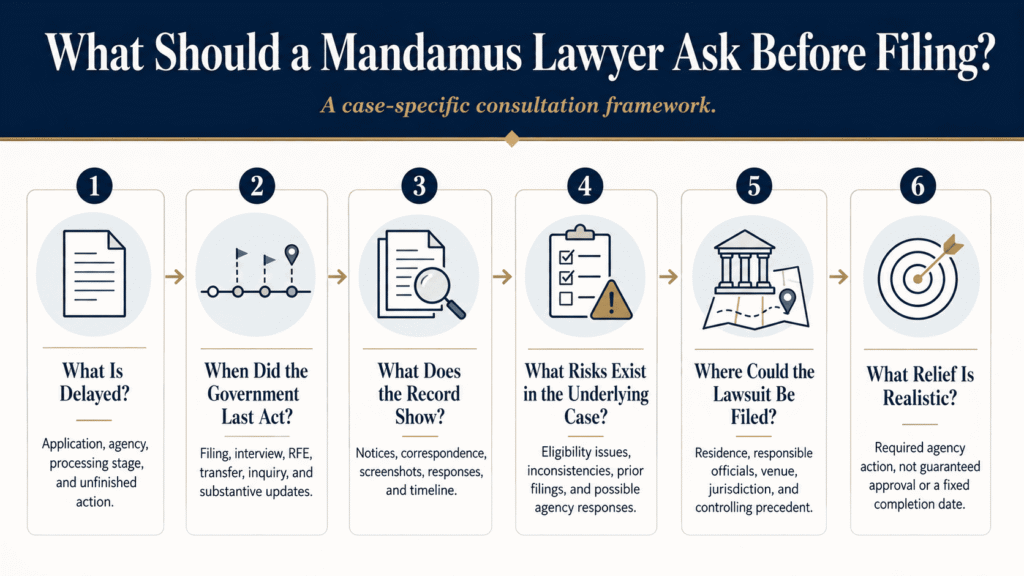
The First Question: What Exactly Is Delayed?
The statement “my immigration case is delayed” is usually too broad for a reliable federal litigation analysis. A delayed I-485 application, a naturalization case awaiting an oath ceremony, an asylum application awaiting an interview, and an immigrant visa case in administrative processing may all involve different agencies, procedural stages, legal duties, and potential defenses.
Client: My case has been stuck for a long time.
Lawyer: Which application or petition is pending, where is it pending, and what specific government action are you waiting for?
The lawyer should begin by identifying the exact form, petition, visa application, or government process that remains pending. The consultation should establish when it was filed, who the applicant or beneficiary is, whether another petition controls eligibility, and whether multiple applications are pending together.
For example, an I-485 adjustment application may depend on an I-130 or I-140 petition. A consular case may have completed the NVC document stage but still be waiting for an interview appointment. A naturalization applicant may have completed the interview but still be waiting for a decision or oath ceremony. The name of the application is only the starting point; the lawyer must determine the exact stage at which the process stopped moving.
Which Agency Controls the Next Step?
The consultation should also identify whether the unfinished action is controlled by USCIS, the National Visa Center, a U.S. embassy or consulate, the Department of State, a field office, an asylum office, or another federal component involved in background or security review.
Responsibility may also be divided. For example, one agency may hold the file while another agency or consular post controls appointment capacity or background screening. This distinction matters because a federal complaint should identify the specific government action that remains unfinished and the officials who have authority to complete it.
What Action Is the Client Waiting For?
The lawyer should translate the client’s general frustration into a clearly defined unfinished action. The client may be waiting for an interview, a decision after an interview, an oath ceremony, a visa appointment, completion of administrative processing, action after an RFE response, or transfer of the case to the appropriate office.
A reliable mandamus analysis cannot begin until the lawyer can answer a basic question: What legally required government action is allegedly being withheld or unreasonably delayed?
“How Long Has It Been Pending?” Is Not the Only Timing Question
The original filing date matters, but it does not tell the entire procedural story. A case may have been pending for two years while receiving recent interviews, requests for evidence, transfers, or other substantive action. Another case may have been pending for a shorter period but received no meaningful government action for most of that time.
Client: I filed 22 months ago, so the delay must be unreasonable.
Lawyer: The filing date is important. When did the agency last take meaningful action, and what happened between filing and today?
A careful attorney should reconstruct the case chronologically. Important dates may include the original filing, receipt notice, biometrics appointment, interview, request for evidence, response submission, case transfer, beginning of administrative processing, service requests, and the latest case-specific communication.
This timeline allows the lawyer to distinguish between total case age and the period of actual inactivity. That distinction can materially affect the evaluation. A recently issued RFE, for example, may show that the agency is actively reviewing the case even though the original filing occurred long ago.
Meaningful Action Versus Automated Activity
Not every online status update means that the agency has substantively advanced the application. An interview, document request, case transfer, or case-specific explanation may constitute meaningful action. A generic message stating that the case remains under review may confirm that the application is still pending without showing what work has occurred.
The legal analysis therefore requires more than subtracting the filing date from today’s date. Courts examining unreasonable delay often consider the nature of the process, the government’s explanation, congressional timing guidance, competing agency priorities, and the prejudice caused by continued inaction. Our guide to the TRAC factors for immigration delays explains that broader framework.
The oldest case is not automatically the strongest mandamus case. The lawyer should examine both the total case age and the period of unexplained inactivity.
What Has the Government Already Told You?
The consultation should not rely solely on the public case-status page. A lawyer may need to review every case-specific explanation or response the government has provided.
Client: USCIS has never explained why my case is delayed.
Lawyer: Have you received any service request responses, congressional correspondence, consular emails, background-check references, or notices describing additional review?
Relevant records may include service request responses, USCIS online messages, congressional inquiry correspondence, Ombudsman communications, NVC responses, embassy emails, CEAC history, expedite decisions, FOIA records, and notices issued after an interview.
These materials may show that the agency has identified a security review, missing document, transfer issue, staffing limitation, background check, or another reason for the delay. They may also reveal repeated generic responses, inconsistent explanations, or the absence of any case-specific reason.
Do All Administrative Options Have to Be Completed First?
A lawyer should avoid presenting service requests, congressional inquiries, and Ombudsman requests as a universal checklist that must be exhausted in every case. Their legal importance depends on the agency, procedural history, relief requested, and controlling law.
Nevertheless, prior inquiries can provide useful evidence. They may show how long the applicant has requested assistance, whether the agency acknowledged the delay, whether the government offered a meaningful explanation, and whether informal efforts produced any movement.
A paper trail does not automatically establish a successful federal claim. It can, however, help document what the applicant did, how the government responded, and whether the delay continued without a case-specific explanation.
A Careful Lawyer Will Ask to See the Documents
A client’s explanation provides necessary context, but the attorney should compare that explanation with the official record.
Client: I remember everything that happened and can explain it during the call.
Lawyer: Your explanation gives us the context. The notices and correspondence allow us to verify the procedural history and identify facts that may affect litigation.
For many cases, the lawyer will want to review receipt notices, approval notices for related petitions, interview notices, requests for evidence, notices of intent to deny, copies of submitted responses, transfer notices, NVC or consular correspondence, and inquiry records.
Additional documents may be needed depending on the underlying immigration matter. These can include passport and I-94 records, prior immigration applications, immigration court records, criminal court dispositions, marriage records, financial sponsorship documents, employment petition materials, or medical evidence.
The appropriate document set depends on the case. The central principle is that a lawyer should not recommend federal litigation while ignoring the immigration record that will return to active review if the government begins processing the case again.
Our mandamus evidence checklist explains how notices, inquiry records, screenshots, timelines, and hardship evidence may help document a delayed case.
Preparing a One-Page Timeline
A concise chronological table can make the consultation more efficient and help identify missing documents:
| Date | Event | Agency or Office | Supporting Document |
|---|---|---|---|
| January 15, 2024 | Application filed | USCIS | Receipt notice |
| August 20, 2024 | Interview completed | Field office | Interview notice |
| March 3, 2025 | Service request submitted | USCIS Contact Center | Confirmation and response |
The dates above are only an organizational example. The client’s actual timeline should identify meaningful events and connect each event to a supporting record whenever possible.
What Is Happening in the Underlying Immigration Case?
A mandamus or APA lawsuit concerns delayed government action, but it does not replace the agency’s review of eligibility. The attorney should therefore examine more than the waiting period. The consultation should also consider what may happen when the government begins actively processing the application again.
Client: I am only asking the government to make a decision.
Lawyer: That distinction is important. We should still examine whether resumed processing could lead to an approval, an interview, an RFE, a notice of intent to deny, a denial, or additional review.
Potential issues may include missing documents, inconsistencies between current and prior filings, status violations, unauthorized employment, unlawful presence, criminal history, prior removal proceedings, misrepresentation concerns, financial sponsorship problems, marriage bona fides questions, or other admissibility issues.
Not every issue applies to every applicant. The purpose of discussing these matters is not to assume that a problem exists. It is to determine whether accelerating adjudication could expose a known or unresolved risk that should be addressed before filing.
What Could Happen When Processing Resumes?
The agency may approve the application, schedule an interview, request additional evidence, issue a notice of intent to deny, transfer the file, continue background review, or deny the application. A lawyer should discuss these possibilities before the client decides whether to seek faster government action.
Under 28 U.S.C. § 1361, federal district courts have jurisdiction over actions in the nature of mandamus seeking to compel a federal officer, employee, or agency to perform a duty owed to the plaintiff. The Administrative Procedure Act separately authorizes reviewing courts to compel agency action unlawfully withheld or unreasonably delayed under 5 U.S.C. § 706(1).
These provisions may support a request for government action. They do not generally convert the federal judge into the immigration adjudicator or guarantee a favorable agency decision.
A delay lawsuit may seek adjudication or another required agency action. It should not be presented as a guarantee of approval.
How Is the Delay Affecting Your Life?
A lawyer should ask about the practical consequences of the delay. Documented hardship can help explain why continued inaction matters, although hardship alone does not automatically create a successful lawsuit.
Client: Does personal hardship matter in a mandamus case?
Lawyer: It can help show the real-world prejudice caused by continued delay, but we should describe the hardship accurately and support it with records where possible.
The delay may be separating spouses, children, or parents. It may prevent a person from accepting employment, beginning school, traveling, assisting an ill family member, obtaining stable insurance coverage, or making long-term family decisions. Some cases also involve financial losses, safety concerns, repeated renewal expenses, or age-out risks.
The strongest hardship explanation is usually specific. Rather than stating only that the delay has caused stress, the client should explain what happened, when it happened, who was affected, and what records support the account.
Employer letters, medical records, school documents, financial statements, travel records, family declarations, and evidence of lost opportunities may help demonstrate the practical effect of continued delay.
What Have You Already Done to Address the Delay?
A lawyer should review previous efforts chronologically rather than simply counting how many inquiries were submitted.
Client: I contacted USCIS many times, but nothing changed.
Lawyer: Let us identify exactly what was submitted, when it was submitted, what the agency said, and whether the response revealed anything about the case.
For each service request, congressional inquiry, Ombudsman request, expedite request, NVC inquiry, or embassy email, the attorney should determine when it was submitted, what was requested, and what response was received.
Five generic inquiries do not necessarily establish a stronger case than one focused request that identifies a specific discrepancy or unexplained hold. The quality and content of the record matter more than the raw number of contacts.
Where Could the Lawsuit Be Filed?
A federal complaint cannot necessarily be filed in any district the client or lawyer prefers. Venue, jurisdiction, defendants, and controlling precedent should be considered before the complaint is drafted.
Client: Can you file the lawsuit in whichever federal court appears most favorable?
Lawyer: We must first determine which federal districts have a legally supportable connection to you, the defendants, and the government action at issue.
The lawyer may need to examine where the client resides, which field office or service center handles the case, where the relevant federal officials perform their duties, and whether the file has moved between offices or agencies.
This analysis can be especially important when the applicant, petitioner, beneficiary, service center, and government officials are located in different places. Choosing a forum without a supportable venue theory may lead to a transfer request, dismissal argument, or additional litigation expense.
Consular Cases May Require Additional Analysis
When a case is pending at a U.S. embassy or consulate, the lawyer should determine whether a visa decision has already been made, whether the applicant is awaiting a first interview, and whether the case is in post-interview administrative processing.
The attorney may also need to evaluate which officials control the remaining action, whether the requested relief is judicially reviewable, and whether consular nonreviewability arguments could affect the case. A pre-interview scheduling delay therefore presents a different record from a post-interview 221(g) administrative processing delay.
What Result Is the Client Actually Seeking?
The consultation should separate the client’s personal objective from the relief that a federal court may be asked to provide.
| Client’s Personal Goal | Possible Litigation Objective |
|---|---|
| Receive a green card | Seek adjudication of a pending I-485 |
| Bring a spouse to the United States | Seek completion of an unfinished petition, scheduling, or visa-processing step |
| Become a U.S. citizen | Seek action on a delayed naturalization application or oath stage |
| End administrative processing | Seek completion of required action without demanding a predetermined visa decision |
A responsible lawyer should make clear that a request for adjudication is not the same as a request that the court order approval.
For a broader comparison of the legal theories commonly used in delay cases, see our guide to an immigration mandamus lawsuit versus an APA claim.
What Could the Government Do After Filing?
The consultation should prepare the client for more than one possible response. In some cases, the agency acts after the complaint is filed and properly served. In other cases, the government contests the lawsuit or takes an intermediate step rather than issuing a final decision.
Client: Once the complaint is filed, will the agency simply decide my case?
Lawyer: The agency may act, but the government may also defend the delay, challenge the legal claim, request more time, contest venue, or file a motion.
The agency may schedule an interview, issue a decision, request additional evidence, transfer the file, initiate additional review, or provide a more detailed explanation. The government’s attorneys may instead file an answer, move to dismiss, challenge jurisdiction or venue, seek transfer, argue that the delay is reasonable, or contend that the requested action is discretionary.
The government may also argue that later agency action has made the lawsuit moot. For example, if the client asked the court to compel an interview and the agency later schedules that interview, the government may argue that there is no longer a live dispute regarding that particular request.
Understanding the Scope of Representation
Before retaining counsel, the client should understand whether the quoted fee covers only case evaluation and complaint filing or also includes service, communication with government counsel, responses to motions, venue disputes, and other contested litigation.
The client should also ask what happens if the agency acts after filing, if the case is transferred to another district, or if the government files a motion to dismiss. Clear fee and scope terms can prevent misunderstandings after the litigation becomes more complex.
The existing guide to choosing a mandamus lawyer discusses these retention and fee-scope questions in greater detail.
Has your immigration case remained pending without meaningful action?
A useful legal review begins with the application type, filing date, last substantive agency action, official notices, inquiry history, hardship evidence, underlying immigration record, venue facts, and the specific government action you want completed.
Is Filing Now the Best Strategic Decision?
The relevant question is not merely whether a complaint can be drafted. The consultation should determine whether filing now is the most appropriate strategy for this particular client and this particular immigration record.
Client: If my case may qualify, why would a lawyer recommend waiting?
Lawyer: Because recent agency action, unresolved evidence, an underlying eligibility issue, or a weak jurisdictional position may affect whether filing now serves your interests.
A substantial period without meaningful action, completion of every applicant-controlled step, repeated generic responses, and documented hardship may support further litigation review. A clearly identifiable government duty and a legally supportable forum may also strengthen the evaluation.
By contrast, the attorney may recommend additional investigation when the agency recently issued an RFE, the response was submitted only a short time ago, important records are missing, or the responsible agency and unfinished duty remain unclear.
The lawyer may also advise against filing when the client seeks a result the court cannot provide, the requested action is entirely discretionary, the available documents materially contradict the client’s account, or accelerating adjudication creates an unresolved risk.
A lawyer who does not immediately recommend filing may be conducting a more careful evaluation—not offering weaker representation.
What Should You Bring to a Mandamus Consultation?
Organized records can help the lawyer identify both the strongest and weakest parts of the potential case. At a minimum, the client should be prepared to provide the application or petition type, filing date, receipt number, current place of residence, responsible agency or office, and date of the last meaningful action.
The client should also collect receipt notices, interview notices, RFE or NOID documents, agency correspondence, inquiry responses, online status screenshots, and prior decisions related to the same immigration history.
A short timeline and a concise hardship summary are often especially helpful. The timeline should state what happened and when. The hardship summary should explain how the delay is affecting the client or family without exaggeration.
Information the Client Should Not Hide
The consultation should include prior denials, arrests, immigration court history, unauthorized employment, status violations, visa refusals, inaccurate information in earlier filings, and significant changes in family or employment circumstances.
Disclosing a difficult fact does not automatically make litigation impossible. Hiding it, however, can prevent the attorney from evaluating the case accurately and may create avoidable problems after filing.
Consultation Preparation Tip
Organize the records chronologically and name each file with its date and purpose. A clear timeline can help the lawyer distinguish ordinary processing, recent agency activity, unexplained inactivity, and potential underlying risks.
Signs of a Thorough Mandamus Consultation
A thorough consultation usually feels different from a sales call. The lawyer asks case-specific questions, requests official documents, distinguishes total waiting time from unexplained inactivity, and discusses both the favorable and unfavorable aspects of the case.
The lawyer should also separate agency action from approval, explain that multiple government responses are possible, and identify what additional research or documentation is needed before a final recommendation can be made.
| What the Lawyer Does | Why It Matters |
|---|---|
| Identifies the exact application and delayed stage | Different stages may involve different duties, agencies, defendants, and defenses. |
| Asks about the last meaningful action | Total case age may not equal the period of government inactivity. |
| Requests official records | The documents may reveal facts that do not appear in the online status. |
| Reviews underlying immigration risks | Resumed processing may produce an RFE, NOID, denial, or additional review. |
| Discusses venue and possible government defenses | The complaint must be filed in a legally supportable forum with realistic expectations. |
A consultation should leave the client with a clearer understanding of the legal and factual questions that remain, even when the lawyer cannot provide an immediate filing recommendation.
A Sample Mandamus Consultation Conversation
Consider a marriage-based adjustment applicant whose I-485 has been pending for approximately two years. The applicant completed an interview one year ago, submitted several service requests, and now wants a federal judge to order USCIS to approve the green card.
A superficial consultation might stop at the two-year wait. A more careful conversation would continue:
Client: My green card case has been pending for two years. I want to file mandamus immediately.
Lawyer: When was the I-485 filed, and was it filed together with an I-130?
Client: They were filed together. The interview was about a year ago.
Lawyer: Did USCIS issue any notice after the interview?
Client: We received an RFE several months later, but we answered it.
Lawyer: I will need the RFE, your complete response, proof of delivery, and any online status showing that USCIS received it. Did the agency send anything after that?
Client: Only a message saying that the case remains under review.
Lawyer: Have you moved since filing, and did you update your address?
Client: Yes, we moved after the interview.
Lawyer: We should verify the address-change record and confirm that no notice was sent to the former address. I also need to ask about your prior immigration history, any unauthorized employment, arrests, earlier applications, or other facts that could affect the underlying case.
Client: I thought the judge would simply order USCIS to approve the green card.
Lawyer: A delay action would generally seek agency action, not guaranteed approval. USCIS could approve the case, request more evidence, issue a notice of intent to deny, deny the application, or take another step. We should evaluate those possibilities before filing.
Client: What happens next?
Lawyer: Once I review the notices, RFE response, inquiry history, address records, immigration history, hardship evidence, and venue facts, I can assess whether filing now is appropriate and what risks should be addressed first.
The important question is not simply whether the application has been pending for two years. The more useful analysis asks what action remains unfinished, when the government last acted, whether the applicant completed every required step, and what may happen if adjudication resumes.
This is the difference between a calendar-based sales conversation and a case-specific federal litigation assessment.
Frequently Asked Questions
What happens during a mandamus consultation?
The lawyer should identify the delayed application, responsible agency, unfinished government action, procedural timeline, available documents, underlying immigration risks, hardship, potential venue, requested relief, and possible government responses.
Some matters can be evaluated preliminarily during the initial meeting. Others require additional document review or jurisdiction-specific legal research before the attorney can responsibly recommend filing.
Does a long delay automatically mean I have a mandamus case?
No. The length of the delay is important, but it is not the only consideration. The lawyer should also evaluate the case type, processing stage, recent agency activity, reason for the delay, applicant compliance, available forum, and controlling precedent.
Can a lawyer evaluate my case without reviewing documents?
A lawyer may provide a preliminary impression based on basic information. A reliable filing recommendation, however, may require receipt notices, government correspondence, inquiry responses, prior decisions, and a verified timeline.
Should I complete service requests before speaking with a lawyer?
You do not necessarily need to postpone the consultation while completing every possible inquiry. The lawyer can assess which efforts have already been made and whether another focused request could provide useful information or evidence.
Will the lawyer tell me during the first call whether I should sue?
Possibly, but not always. A straightforward record may support an early recommendation. A more complex case may require document review, venue research, or analysis of the underlying immigration history.
Can filing guarantee that my case will move faster?
No attorney can reliably guarantee a particular agency response, court schedule, decision date, or favorable immigration outcome. A lawyer can evaluate possible claims, explain the procedural stages, and discuss likely responses based on the specific record.
Can a federal judge approve my immigration application?
A delay lawsuit generally seeks completion of a required government action rather than a predetermined favorable immigration decision. The agency or consular officer ordinarily retains responsibility for evaluating eligibility and deciding the underlying application.
What happens if the lawyer identifies a problem in my immigration case?
The lawyer may recommend investigating or addressing the issue before filing. Depending on its nature, the issue may change the timing, requested relief, litigation strategy, or decision to accept the case.
What if I do not have every document?
Provide the records you have and identify what is missing. The attorney may recommend obtaining documents from a prior lawyer, an online account, a government inquiry, or a FOIA request. Missing information should be investigated rather than ignored.
Does the government always have exactly 60 days to resolve the immigration case?
No. The Federal Rules generally provide the United States or a federal officer or agency with a period to serve a responsive pleading after proper service. That litigation response period is not a guarantee that the underlying immigration application will be completed or approved within the same period.
The Questions You Receive Matter Too
Choosing an attorney requires asking careful questions, but the consultation also works in the opposite direction. The questions the lawyer asks can reveal whether the filing recommendation is based on a complete review of the delay, the underlying immigration record, the responsible agency, the available evidence, the litigation forum, and the possible risks.
A meaningful consultation should leave you with more than a fee quote. You should understand what government action is delayed, what documents still need to be reviewed, what relief may realistically be available, what risks exist in the underlying application, and whether filing now is the best strategic decision.
Before requesting an evaluation from a mandamus lawyer, organize your notices, government correspondence, inquiry records, immigration history, hardship evidence, and case timeline. A careful consultation should examine both the government’s delay and the case that will return to active processing if the lawsuit produces action.
Ready for a case-specific mandamus consultation?
Contact our team for an evaluation of your filing history, government correspondence, period of inactivity, hardship evidence, underlying immigration record, available venue, and possible mandamus or APA claims.
Phone: +1 (862) 799-2200
Legal Disclaimer: This article is provided for general informational purposes only and does not constitute legal advice. A consultation does not create an attorney-client relationship unless the lawyer and client enter into a written representation agreement. Every immigration delay and federal lawsuit presents case-specific legal, procedural, jurisdictional, and strategic considerations. The information reflects laws and rules available as of the publication date; subsequent legal or policy changes may affect its accuracy. Prior results do not guarantee a similar outcome.
Sources
- 28 U.S.C. § 1361 — Action to Compel a Federal Officer, Employee, or Agency to Perform a Duty
- 5 U.S.C. § 555(b) — Agency Duty to Conclude Matters Within a Reasonable Time
- 5 U.S.C. § 706(1) — Agency Action Unlawfully Withheld or Unreasonably Delayed
- 28 U.S.C. § 1391 — Venue Generally
- United States Courts — Federal Rules of Civil Procedure
- Telecommunications Research & Action Center v. FCC, 750 F.2d 70 (D.C. Cir. 1984)