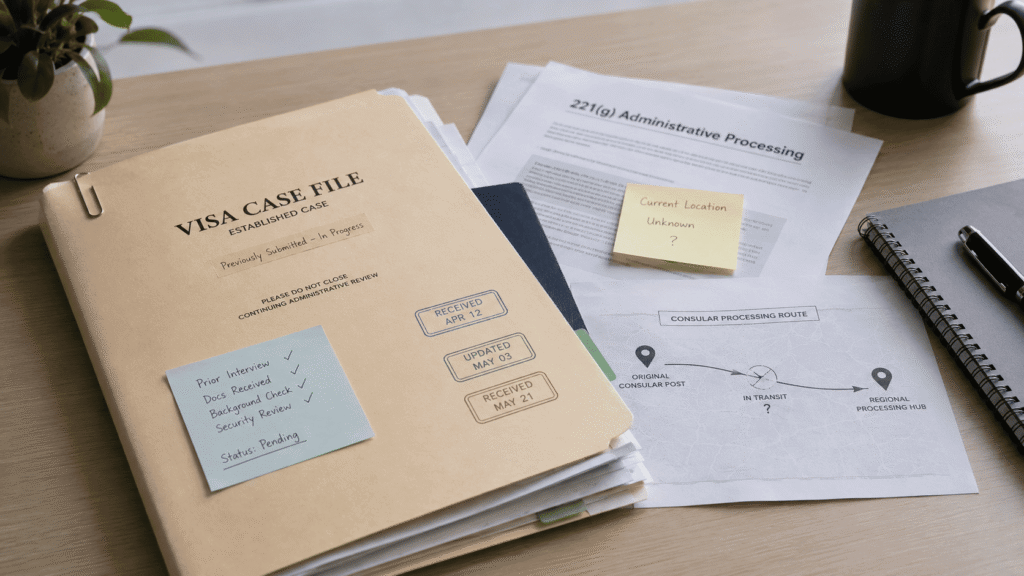
On August 1, 2026, the U.S. Department of State began realigning routine visa services at multiple African consular posts to designated regional hubs. For applicants preparing for a new visa interview, the change is relatively straightforward: they must follow the Department’s instructions about where to apply. For someone whose interview already happened, however, the practical questions can be much harder.
What happens if your visa was already refused under INA § 221(g) and placed in administrative processing before your original post stopped providing routine visa services? Does the file move? Does the prior interview still count? Should you communicate with the original embassy or the new regional hub?
The Department of State has explained the new regional processing structure, but its public regional-hub announcement does not provide a separate universal procedure for every case already pending in post-interview administrative processing. That makes the applicant’s own notices, emails, 221(g) sheet, CEAC history, and post-specific instructions especially important.
In This Article Regional Hubs and Pending Visa Cases
- What Changed on August 1, 2026?
- What Does DOS Say About Pending 221(g) Cases?
- What If Your Visa Interview Already Happened?
- What Does a Regional Hub Transfer Reset?
- How Should You Document a Case Spanning Two Posts?
- What About Separate Visa Restrictions?
- What If the Case Remains Stuck After the Realignment?
- Frequently Asked Questions
What Changed With the State Department Regional Consular Hubs on August 1, 2026?
The Department of State announced on July 15 that it was realigning routine visa operations in Africa to regional visa hubs, effective August 1, 2026.
The policy affects numerous posts where routine visa services are being shifted to designated processing locations. According to the Department, the change covers both nonimmigrant and immigrant visa processing, including tourist and business visas, petition-based nonimmigrant visas, immediate-relative and family-preference immigrant visas, employment-based visas, K visas, Diversity Visas, adoptions, and certain follow-to-join cases.
The Department also makes an important distinction: realignment of routine visa processing does not mean that the affected U.S. embassies and consulates are closing. Those posts may continue other diplomatic and consular functions even when routine visa processing moves elsewhere.
For applicants beginning a new visa process after August 1, the State Department directs them to the appropriate designated processing location. But cases that were already underway can present more difficult factual questions.
| Situation | What the Published Guidance Says |
|---|---|
| New application after August 1 | Use the designated processing post for the applicant’s nationality or residence, as applicable. |
| Appointment already scheduled at an affected post | The regional-hub notice tells affected applicants to check their email for country-specific instructions. |
| Current valid visa | The regional realignment itself does not invalidate an existing valid visa. |
| Interview completed and case in 221(g) administrative processing | The public regional-hub announcement does not give one universal transfer rule for this specific procedural posture. |
What Does the State Department Say About a 221(g) Case Already in Administrative Processing?
The answer requires separating two different policies.
The regional-hub announcement explains where routine visa services will be performed after August 1. The Department’s separate administrative processing guidance explains what happens when a consular officer cannot issue a visa because more information or further government review is required.
Under that guidance, a visa application refused under INA § 221(g) can later be reconsidered after additional information is received or administrative processing is completed.
But the regional-hub notice does not separately explain, for every post and visa category, whether an already-interviewed 221(g) file will remain operationally assigned to the original post, be handled through the regional hub, or require some other internal processing arrangement.
That distinction is critical.
A regional hub announcement tells applicants where routine visa operations are being realigned. It should not be read as proof that every pending 221(g) case follows the same automatic transfer procedure.
Applicants should therefore avoid relying on assumptions such as “my file definitely transferred on August 1” or “the original consulate must still control my case.” The stronger approach is to identify what the Department actually communicated about the individual file.
For a broader explanation of the underlying refusal and administrative processing stage, see our guide to 221(g) administrative processing delays.
What If Your Visa Interview Already Happened Before the Realignment?
If the interview occurred before August 1, begin with the records created during that interview rather than assuming the process starts over.
Review:
- The 221(g) sheet or refusal notice given at the interview;
- Any request for additional documents;
- Proof that requested materials were submitted;
- Any DS-5535 request and proof of response;
- Emails from the original embassy or consulate;
- Emails received after the regional-hub announcement;
- CEAC status history and screenshots; and
- Any instruction identifying a different processing location.
The State Department’s regional-hub FAQ specifically tells applicants with appointments at affected posts to check their email for individual instructions. Separate Department guidance also says that existing immigrant and nonimmigrant visa appointments generally will not automatically be cancelled, although post-specific changes can occur.
For immigrant visa cases, the Department provides an additional transfer rule in its current country-of-residence guidance: when an applicant wants to transfer an immigrant visa case to a new processing post after NVC has scheduled the appointment, the applicant should contact NVC through its Public Inquiry Form rather than directly requesting the transfer from the consular section.
That rule is useful for applicant-requested immigrant visa transfers. It does not, however, answer every operational question about a 221(g) case already interviewed before a government-directed regional realignment.
Do Not Submit the Same Documents Again Unless Instructed
A transfer concern can create pressure to resend everything to every possible post. That can create a confusing record.
If you already supplied a passport copy, civil document, financial record, employment document, or DS-5535 response, keep proof of the original submission and wait for a case-specific instruction before duplicating it, unless the Department tells you otherwise.
The goal is to create a clean record showing what was requested, what you provided, when you provided it, and which post acknowledged it.
What Does a Regional Hub Transfer Reset, and What Does It Not Automatically Reset?
This is where applicants should be especially cautious with online speculation.
The State Department’s published regional-hub notice does not say that an operational realignment automatically:
- Cancels a completed visa interview;
- Erases an existing 221(g) refusal;
- Invalidates documents previously submitted;
- Terminates administrative processing already underway;
- Creates a new interview requirement in every pending case; or
- Restarts a universal administrative-processing clock.
At the same time, applicants should not assume that nothing changes. The office responsible for communicating with the applicant or completing particular processing steps may be affected by operational instructions that are not fully described in the public announcement.
That is why written case-specific guidance matters more than a general statement that visa services were “moved.”
For applicants whose cases involve supplemental security information, our separate DS-5535 administrative processing guide addresses that narrower delay category without treating every 221(g) case as a security-check case.
How Should You Document a Visa Delay That Now Spans Two Consular Posts?
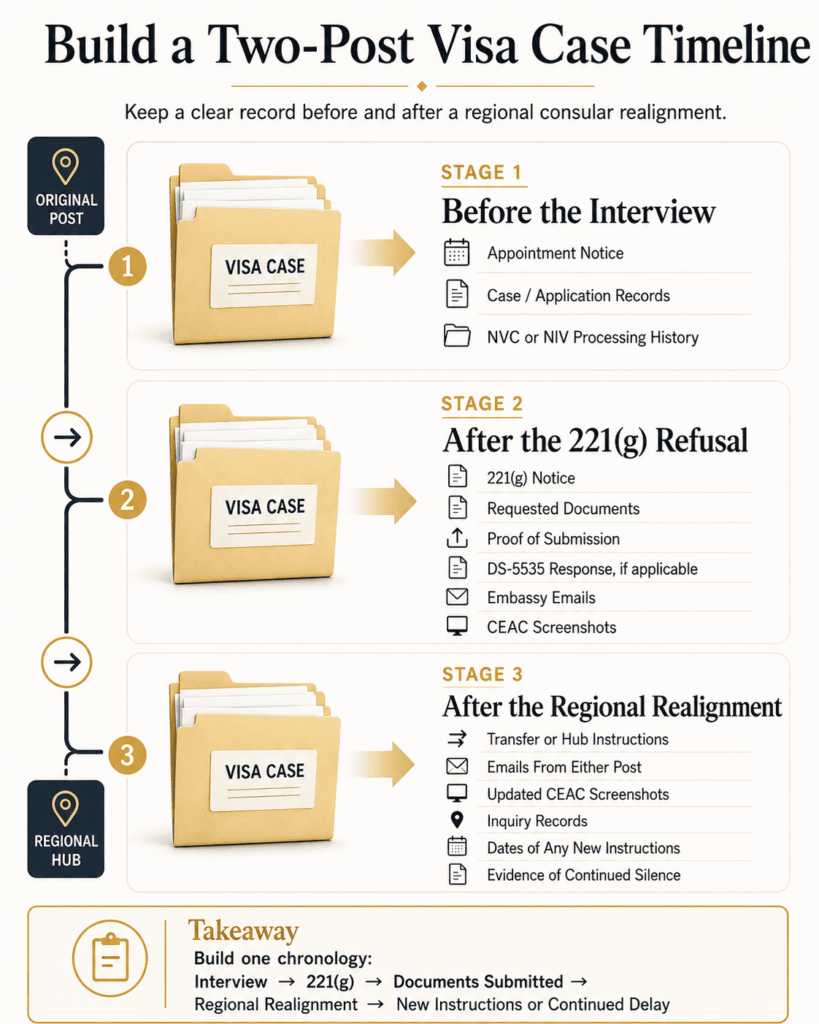
A case that crosses a regional realignment needs a timeline that separates the applicant’s actions from the government’s operational changes.
| Record | What It Helps Establish |
|---|---|
| Interview appointment notice | Where and when the consular interview occurred. |
| 221(g) notice | What the officer said was incomplete or remained under review. |
| Document or DS-5535 submission proof | Whether the applicant completed the requested follow-up. |
| Pre-August 1 embassy correspondence | What the original post communicated before realignment. |
| Regional-hub or transfer email | Whether DOS gave case-specific instructions after the policy change. |
| CEAC screenshots | How the case status and update history appeared over time. |
| Post-August 1 inquiries and responses | Whether either post identified the unfinished processing step. |
Create a simple chronology with three sections:
- Before the interview: filing, NVC or NIV application history, appointment scheduling;
- After the interview but before August 1: 221(g), requested documents, DS-5535, administrative processing, correspondence; and
- After the regional realignment: transfer notices, new instructions, inquiries, CEAC changes, and any continued silence.
This approach prevents an important problem: treating the entire waiting period as one unexplained block of time when the procedural history may involve different posts and different government actions.
Was your visa already in 221(g) administrative processing when routine services moved to a regional hub?
Our team can review your interview record, 221(g) notice, document submissions, CEAC history, consular emails, transfer communications, and the period of inactivity before and after the August 1 realignment.
Does the Regional Hub Policy Override Other Visa Restrictions?
No. The Department of State expressly states that the regional realignment does not eliminate separate visa restrictions that may independently apply.
Its July 15 announcement notes that visa suspensions under Presidential Proclamation 10998, visa bond requirements, and immigrant visa pauses applicable to certain nationalities remain separate from the regional-hub change.
This matters because two applicants whose original consular posts were both realigned may still have very different cases.
One applicant may simply need operational guidance about where processing will continue. Another may also be affected by a nationality-based visa restriction, additional vetting requirement, document issue, or other separate policy.
A regional-hub transfer therefore should not be treated as the sole explanation for every visa delay that continues after August 1.
What If Your Visa Case Remains Stuck After the Regional Realignment?
The first objective is to identify what government action is actually unfinished now.
A case still in post-interview administrative processing is different from a case waiting at NVC for its first interview. Our comparison of USCIS, NVC, and consular delays explains why identifying the procedural stage matters before evaluating any federal action.
If your case is already documentarily qualified but no interview has happened, that is also a different problem. Our NVC delay guide addresses that pre-interview stage.
For a case already refused under 221(g), useful questions after the realignment include:
- Has DOS told you which post is handling the pending case?
- Did the original post request documents that you already supplied?
- Has the regional hub requested anything new?
- Has either post acknowledged the pending administrative processing?
- Has the CEAC record shown any meaningful change?
- Are inquiries receiving case-specific responses or only generic language?
- Has the operational change created additional documented harm or uncertainty?
A regional transfer by itself does not establish that a delay is legally unreasonable. Likewise, the existence of a new processing hub does not necessarily justify indefinite silence about an already-interviewed case.
Where a long-pending 221(g) case continues without meaningful action, a legal review may examine whether mandamus, an Administrative Procedure Act unreasonable-delay claim, or another strategy is appropriate. That review should focus on the actual procedural record rather than assuming that the August 1 policy change automatically strengthens or weakens the case.
After a consular realignment, the key question is not simply “Which embassy handles my country now?” It is “Which government office controls the unfinished action in my already-interviewed case, and what has happened since responsibility changed?”
Frequently Asked Questions
Did the State Department close the embassies affected by the regional hub policy?
No. The Department states that realigning routine visa processing does not change the operating status of the affected embassies and consulates. They may continue performing other diplomatic and consular functions even though routine visa services are handled differently.
Does every pending 221(g) case automatically transfer to the regional hub?
The published regional-hub announcement does not establish one universal rule for every already-interviewed 221(g) case. Applicants should review case-specific emails and instructions rather than assume that a transfer did or did not occur.
Do I need another visa interview because my original post stopped routine visa services?
Not necessarily. The Department’s public announcement does not state that every previously completed interview must automatically be repeated. Follow any case-specific instruction from the Department, original post, regional hub, or NVC.
Should I resend my 221(g) documents to the new regional hub?
Do not assume duplicate submission is required. Preserve proof of what you already sent and follow the Department’s case-specific instructions. Sending duplicate records without direction can make the procedural history harder to track.
What if I had an immigrant visa appointment already scheduled?
Department guidance states that existing immigrant visa appointments generally are not automatically rescheduled or cancelled. The regional-hub announcement separately directs applicants at affected posts to monitor their email for specific instructions.
What if I want to move my immigrant visa case to another post?
Current Department guidance states that once NVC has scheduled an immigrant visa appointment, an applicant seeking a post-to-post transfer should contact NVC through its Public Inquiry Form rather than contacting the new consular section directly.
Does regional realignment end a 221(g) refusal?
No automatic rule in the regional-hub announcement says that an existing 221(g) refusal disappears because routine visa services moved. A 221(g) application may remain subject to document review or administrative processing until the Department takes further action.
Can a mandamus lawsuit force the regional hub to approve my visa?
A delay lawsuit generally seeks required government action rather than a predetermined visa approval. Whether federal litigation is available or strategically appropriate depends on the procedural history, length and cause of the delay, requested relief, responsible officials, jurisdiction, and other case-specific facts.
A Regional Hub Changes the Processing Structure, but Your Individual Case Record Still Controls
The August 1 realignment created a new processing structure for visa applicants in numerous affected countries. For new applicants, the Department has published designated processing locations. For people whose interviews already occurred and whose applications remain under 221(g), the individual procedural record becomes more important because the public announcement does not answer every post-interview transfer question.
Preserve the 221(g) notice, document submissions, DS-5535 records if applicable, CEAC history, emails from the original post, and every communication received after August 1. Do not assume that the case automatically restarted, automatically remained at the old post, or automatically moved to the hub.
If prolonged silence continues, the next analysis should focus on what action remains unfinished and which government component is responsible for completing it.
Has your visa case remained in administrative processing through the regional consular hub transition?
Contact our team for an evaluation of your 221(g) history, interview records, consular communications, transfer instructions, CEAC updates, document submissions, continued delay, and available federal court options.
Phone: +1 (862) 799-2200
Legal Disclaimer: This article is provided for general informational purposes only and does not constitute legal advice. Every immigration case has unique circumstances. For legal guidance specific to your situation, we recommend consulting with an experienced immigration attorney. The information in this article reflects laws, policies, and publicly available Department of State guidance as of August 14, 2026; subsequent policy or operational changes may affect its accuracy. Prior results do not guarantee a similar outcome.
Sources
- U.S. Department of State — Realignment of U.S. Visa Services in Africa to Regional Hubs
- U.S. Department of State — Administrative Processing Information
- U.S. Department of State — Adjudicating Immigrant Visa Applicants in Their Country of Residence
- U.S. Department of State — Adjudicating Nonimmigrant Visa Applicants in Their Country of Residence
- U.S. Department of State — National Visa Center Processing