
Receiving a DS-5535 administrative processing delay notice after a visa interview can feel confusing, especially when the case status shows “Refused” under 221(g) but the consulate has not issued a final denial. For many applicants, DS-5535 means the consular officer wants additional background, travel, employment, address, or identity-related information before the visa case can move forward.
The problem is that administrative processing often comes with very little explanation and no clear timeline. If your case has been pending for months after submitting DS-5535, it may be time to understand what the form means, how it connects to 221(g) visa refusal, and when a mandamus or APA lawsuit may become a serious option.
In This Article
- What Is Form DS-5535?
- Does DS-5535 Mean Your Visa Was Denied?
- Why DS-5535 Can Cause Long Administrative Processing
- How DS-5535 Relates to 221(g)
- When Does a DS-5535 Delay Become Unreasonable?
- Can Mandamus or APA Help After DS-5535?
- Documents to Collect Before Considering a Lawsuit
- Frequently Asked Questions
What Is Form DS-5535?
Form DS-5535 is a supplemental questionnaire used by the U.S. Department of State in certain visa cases. It asks for additional information that may not already appear in the applicant’s DS-160 or DS-260, including travel history, address history, employment history, passport details, family information, and other background-related details.
Not every visa applicant receives DS-5535. The form is generally requested when a consular officer determines that additional review is needed before deciding whether the applicant is eligible for the visa. In other words, DS-5535 is not a routine form for every case; it is a case-specific request.
Who Usually Receives a DS-5535 Request?
DS-5535 can be requested in both immigrant visa and nonimmigrant visa cases. Applicants may receive it after an interview, by email, or as part of a 221(g) instruction sheet from the consulate.
- Applicants placed into security-related administrative processing.
- Applicants whose travel, work, or address history requires additional review.
- Applicants whose visa eligibility cannot be decided immediately after the interview.
- Applicants instructed by the consulate to provide supplemental background information.
What Information Does DS-5535 Ask For?
The form may ask for 15 years of travel history, address history, employment history, passport information, names and dates of birth of certain relatives, and prior social media identifiers. The goal is to give the Department of State enough information to complete security screening and eligibility review.
| DS-5535 Category | What It Usually Covers | Why It Matters |
|---|---|---|
| Travel History | Countries visited, dates, and sometimes source of funding. | Helps the consulate review international movement and possible security concerns. |
| Address History | Places where the applicant lived during the requested period. | Can affect background checks and police certificate review. |
| Employment History | Past employers, duties, and work locations. | May be relevant to technology, security, government, or sensitive-sector review. |
| Family and Identity Details | Names and dates of birth for certain relatives and passport information. | Supports identity verification and eligibility review. |
Does DS-5535 Mean Your Visa Was Denied?
A DS-5535 request does not automatically mean your visa was finally denied. In many cases, the consulate uses 221(g) administrative processing while it reviews the additional information. This is why a case may appear as “Refused” in the CEAC system even though the consulate is still processing the application.
This distinction is important. A temporary 221(g) refusal is different from a final finding of ineligibility. If the consulate requests DS-5535, documents, or additional information, the applicant should respond carefully because the case may still be capable of moving forward after administrative review.
Why CEAC May Show “Refused”
Many applicants panic when they see “Refused” online after the interview. However, in a 221(g) context, that status can mean the consulate has not yet completed review. The applicant may still be waiting for security checks, document review, or additional instructions.
221(g) vs. Final Visa Denial
A final visa denial usually identifies a specific ground of ineligibility. By contrast, a 221(g) administrative processing case often means the consulate cannot issue the visa yet because more review is pending. The key question is whether the case is moving or whether it has become trapped in open-ended silence.
A DS-5535 request is not the end of your visa case. But if months pass with no meaningful update, the delay itself may become the legal problem.
Why DS-5535 Can Cause Long Administrative Processing
DS-5535 delays often happen because the consulate is not reviewing only the form itself. The information may trigger or support interagency security checks, background screening, database review, or additional internal clearance. These steps can take time, especially when multiple agencies or sensitive facts are involved.
The difficult part for applicants is that consulates rarely explain the exact reason for the delay. You may receive a general response saying the case remains in administrative processing, without a detailed timeline or specific next step. That lack of communication can make the process feel like a dead end.
Security Checks and Background Screening
Security checks may involve reviewing travel history, employment background, identity records, passport history, family relationships, and prior immigration information. The more complicated the background, the more likely the case may require additional clearance before the consulate acts.
Why the Consulate May Stop Communicating
Once a DS-5535 case enters administrative processing, the consulate may provide only limited updates. This does not always mean the case has been forgotten, but repeated generic responses can become significant when the delay is very long and there is no evidence of active movement.
Stuck after submitting DS-5535?
Your case may need more than another inquiry. A legal review looks at how long the case has been pending, what the consulate has communicated, whether the delay is causing hardship, and whether federal litigation may be appropriate.
How DS-5535 Relates to 221(g)
DS-5535 is often connected to 221(g) administrative processing. Section 221(g) is commonly used when the consular officer cannot issue the visa immediately because something remains unresolved, such as missing documents, further review, or additional administrative processing.
For applicants, the practical result is the same: the interview is over, the passport may or may not be retained, and the case remains pending. If you want a broader explanation of this process, our guide on 221(g) administrative processing delay explains how these cases are usually handled and why some delays become actionable.
DS-5535 is a more specific subcategory within this larger problem. It often signals that the case involves security-related review or background screening. That does not mean the applicant did anything wrong, but it can make the delay more difficult to predict and harder to resolve through routine inquiries.
When Does a DS-5535 Delay Become Unreasonable?
There is no automatic rule that every DS-5535 case becomes unreasonable after a fixed number of days. Courts usually look at the full context, including the length of the delay, the reason for the delay if known, the agency’s activity, and the harm caused by continued waiting. A short delay may be normal, while a long and unexplained delay may require legal analysis.
In immigration delay litigation, courts often evaluate unreasonable delay through practical factors similar to the TRAC factors. Those factors consider whether the agency’s timeline is reasonable, whether Congress has provided a timetable, how the delay affects human welfare, and whether compelling action would interfere with agency priorities.
Why There Is No Automatic Deadline
The Department of State generally warns that administrative processing timing depends on the circumstances of each case. That means applicants should avoid relying on a single deadline or internet rumor. The stronger question is whether the delay has become factually unreasonable when measured against the case history, prior inquiries, hardship, and agency silence.
Facts That Can Strengthen a Delay Case
A DS-5535 delay may be more concerning when the applicant has responded completely, the case has been pending for many months, the consulate gives only generic replies, and the delay causes concrete harm. Examples include family separation, job loss, business disruption, medical hardship, educational interruption, or inability to reunite with a U.S. citizen or lawful permanent resident family member.
- The DS-5535 response was submitted fully and on time.
- The applicant has saved proof of submission and consular correspondence.
- The case has remained pending for a substantial period with no meaningful update.
- The applicant made reasonable inquiries before considering litigation.
- The delay is causing documented hardship to the applicant or U.S.-based family.
Can Mandamus or APA Help After DS-5535?
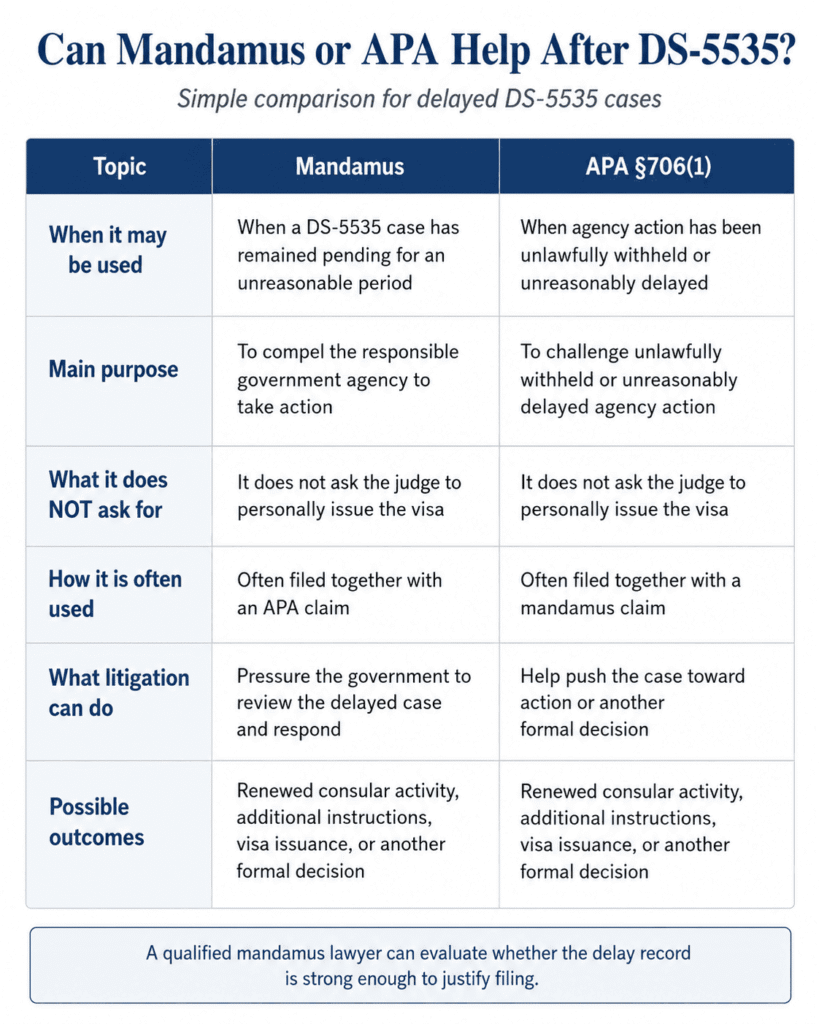
A federal lawsuit may be considered when a DS-5535 case has remained pending for an unreasonable period. These lawsuits often include a claim under the writ of mandamus and may also include an Administrative Procedure Act claim under APA §706(1), which addresses unlawfully withheld or unreasonably delayed agency action.
The purpose of the lawsuit is not to ask the judge to personally issue the visa. Instead, the goal is to compel the responsible government agency to take action on a case that has been sitting too long. Our article on APA §706(1) immigration delay cases explains why these claims are often used together.
What Federal Litigation Can Do
A mandamus or APA lawsuit can pressure the government to review the delayed case, respond to the complaint, and decide whether to move the case forward. In some cases, litigation leads to renewed consular activity, additional instructions, visa issuance, or another formal decision. A qualified mandamus lawyer can evaluate whether the delay record is strong enough to justify filing.
What Federal Litigation Cannot Guarantee
Federal litigation cannot guarantee visa approval. A court generally cannot order the consulate to approve a visa if the applicant is not legally eligible. The realistic goal is agency action, not a guaranteed outcome. This is why a case review must separate the delay problem from the underlying visa eligibility issue.
| Question | Why It Matters |
|---|---|
| How long has the case been pending after DS-5535? | The length of delay is a central part of unreasonable-delay analysis. |
| Did the applicant submit a complete DS-5535 response? | Incomplete or unclear answers may weaken the litigation posture. |
| Has the consulate provided any meaningful update? | Repeated generic replies may support an agency-silence argument. |
| Is there documented hardship? | Hardship can help show why continued delay has real-world consequences. |
Documents to Collect Before Considering a Lawsuit
Before filing a mandamus or APA lawsuit, the case record should be organized. A strong review depends on documents, dates, and proof, not only frustration. The more clearly you can show what happened, when it happened, and how the government responded, the easier it is to evaluate the legal strength of the delay claim.
Applicants should save the DS-5535 request, proof of submission, 221(g) slip, CEAC screenshots, emails from the consulate, public inquiry responses, congressional inquiry responses, and hardship documents. If there has been a meaningful update, that should be saved too because it may affect whether the case is truly stalled or still actively moving.
- DS-5535 request and completed response.
- 221(g) refusal sheet or interview instruction notice.
- CEAC case status screenshots showing dates and status changes.
- Email correspondence with the consulate or embassy.
- Public inquiry submissions and responses.
- Congressional inquiry records, if any.
- Medical, financial, employment, education, or family hardship evidence.
- A simple timeline from interview date to present.
Do not wait until filing day to build the record. In DS-5535 cases, saved emails, screenshots, and inquiry history can become the foundation of the unreasonable-delay argument.
Frequently Asked Questions
How long does DS-5535 administrative processing take?
There is no guaranteed timeline for DS-5535 administrative processing. Some cases move within weeks or months, while others remain pending much longer because of security checks or interagency review.
Does DS-5535 always mean a security problem?
Not necessarily. DS-5535 usually means the consulate wants supplemental background information. It may be connected to security screening, but receiving the form does not automatically mean the applicant has a legal inadmissibility problem.
Can I submit extra documents after DS-5535?
You should follow the consulate’s instructions carefully. If the consulate requested only DS-5535, submit a complete and accurate response. Extra documents may help in some cases, but unnecessary submissions can create confusion if they are not organized or clearly relevant.
Can mandamus force the consulate to issue my visa?
Mandamus generally seeks to force agency action, not guaranteed visa approval. A lawsuit may push the government to act on a delayed case, but it cannot guarantee that the final decision will be approval.
When should I speak with a mandamus lawyer?
You should consider legal review if your case has been pending for a long time after DS-5535, the consulate gives only generic updates, and the delay is causing real harm. A case review can determine whether your facts support a consular delay lawsuit or whether continued waiting is still the better strategy.
Conclusion
DS-5535 is not automatically a final denial, but it can lead to a long and frustrating administrative processing period. The key is to understand whether your case is still moving or whether it has become trapped in unreasonable delay. If the consulate has stayed silent for months after a complete DS-5535 response, your next step should be a careful review of the timeline, evidence, and litigation options.
Is your visa case stuck after DS-5535?
Your delay may not be your fault. If your case remains in administrative processing after DS-5535, our team can review your timeline, documents, consular communications, and hardship evidence to determine whether mandamus or APA litigation may be appropriate.
Legal Disclaimer
This article is provided for general informational purposes only and does not constitute legal advice. Every immigration case has unique circumstances. For legal guidance specific to your situation, we recommend consulting with an experienced immigration attorney. The information in this article reflects laws and policies as of the publication date; subsequent changes may affect its accuracy.