
You walked out of your U.S. visa interview with a pink notice and no visa in your passport. The most important question now is not what the color means. It is what you are supposed to do next.
A pink slip after a U.S. visa interview may come with a request for documents, instructions to wait while the case undergoes administrative processing, supplemental questions, or another case-specific direction. The written notice controls what you should do next. Your response, submission records, consular emails, and case history can become increasingly important if the process continues for months.
This article focuses exclusively on the post-interview process after you already received the pink notice: how to read the instructions, respond correctly, track the case, understand the waiting period, and recognize when prolonged silence raises a separate legal question. If you are trying to understand the differences among the various 221(g) notice colors, see our separate guide to blue, white, and pink 221(g) slips.
In This Article After a Pink Slip Visa Interview
- Start With the Instructions on Your Pink Notice
- What Should You Check Before Sending Anything?
- What Happens After You Submit the Requested Information?
- How Do You Track a Visa Case After a Pink Slip?
- How Long Can a Pink Slip Case Take?
- What Records Should You Preserve?
- Which Mistakes Can Complicate the Process?
- When Does a Long Pink Slip Delay Become a Different Legal Question?
- Frequently Asked Questions
Start With the Instructions on Your Pink Notice
Before sending an email, uploading documents, or submitting a new visa application, read the notice you received at the interview line by line.
Under Department of State guidance on administrative processing, a visa application refused under INA § 221(g) may later be reconsidered if the applicant provides requested information or if required administrative processing is completed. The consular officer should tell the applicant whether additional documentation is required or whether the case requires further administrative processing.
That distinction determines your immediate next step.
| What the Notice Tells You | Your Immediate Priority |
|---|---|
| Specific documents or information are requested | Identify every requested item, the submission method, and any deadline before responding. |
| Administrative processing is required, with no documents requested | Preserve the notice, monitor official communications and CEAC, and follow post-specific instructions. |
| Supplemental questions are requested | Respond accurately and consistently using the method specified by the consulate. |
| DS-5535 or similar supplemental information is requested | Treat the response as a detailed factual submission and preserve proof of exactly what was sent. |
Do not substitute advice from another applicant’s case for the instructions on your own notice. Consular procedures can vary by post, visa category, and case circumstances.
Once you have the pink notice, the safest starting point is the written instruction in your own case, not an assumption about what the color usually signals.
What Should You Check Before Sending Anything?
If the consulate requested documents or information, responding quickly can matter. Responding incompletely can create a different problem.
Before submitting anything, confirm four points:
- What exactly was requested? Separate each document, form, answer, or supporting item into a checklist.
- How must it be submitted? The notice may direct you to email, an online system, courier delivery, a document collection service, or another post-specific channel.
- Is there a deadline? Follow the date written on the notice or in subsequent consular instructions.
- Does your response match your existing immigration record? Dates, employment history, travel history, education, addresses, and other factual information should be reviewed for accuracy and consistency.
The Department of State states that when a 221(g) refusal specifically requires additional information, the applicant should provide a complete response as soon as possible. Its general guidance also provides a one-year period from the refusal date to submit requested information before a new application and fee may become necessary, although applicants should follow the specific instructions applicable to their case.
If You Receive DS-5535 Questions
A DS-5535 request requires additional biographical and background information and may be associated with extended administrative processing. If your pink notice or later consular communication requests DS-5535 information, do not treat the response as a casual questionnaire.
Review names, addresses, travel history, employment, contact information, social media identifiers, and other requested information carefully before submission. For the narrower issues involved in these cases, see our verified DS-5535 administrative processing guide.
What Happens After You Submit the Requested Information?
Submitting the requested material does not necessarily mean that a visa will be issued immediately.
The Department of State’s Foreign Affairs Manual recognizes that a 221(g) refusal may be overcome when additional evidence allows the case to be reopened and readjudicated or when required administrative processing is completed. In practical terms, the next stage may involve document review, additional internal review, interagency processing, another request for information, or a later visa decision.
Your best evidence that you completed your part of the process is a clean submission record.
- Save the final version of every document you sent.
- Save the email containing the submission.
- Save delivery or courier confirmation.
- Record the date of submission.
- Save any automatic acknowledgment or embassy response.
- Keep later requests separate from your original submission.
This becomes especially important when months pass and you need to establish whether the government is still waiting for something from you or whether the remaining step is entirely on the government side.
How Do You Track a Visa Case After a Pink Slip?
After responding to the consulate, create a routine for monitoring the case without relying on memory.
The Department of State’s official CEAC Visa Status Check allows applicants to check a U.S. visa application using the relevant application ID or case number.
When you monitor the case:
- Save dated screenshots instead of simply checking the page and closing it;
- Preserve every consular email;
- Note the date of each document submission;
- Record any passport request, new document request, or interview request;
- Keep copies of inquiries and the responses you receive; and
- Do not treat a single online status label as a substitute for the written instructions in your case.
A useful timeline should make it possible for someone reviewing the file months later to understand the entire post-interview history without reconstructing it from scattered emails.
How Long Can a Pink Slip Case Take?
There is no universal number of days that determines how long a pink slip case should take. Department of State guidance says the duration of administrative processing varies according to the individual circumstances of each case.
This is why promises such as “pink slips take 30 days” or “every case must finish within 60 days” should be treated cautiously. Visa category, the information being reviewed, the consular post, additional documentation, security-related checks, and other case-specific circumstances can affect timing.
The Current 180-Day Inquiry Guidance
The Department of State’s current central visa processing guidance states that, except in emergency travel situations involving serious illness, injury, or death in the immediate family, applicants generally should wait at least 180 days before making an inquiry about the status of administrative processing.
The 180 days are measured from the interview or the submission of supplemental documents, whichever occurred later.
That is an inquiry guideline, not a promise that the case will be completed within 180 days. It also does not replace any different case-specific instruction given by the embassy or consulate handling your application.
| Timing Question | Better Approach |
|---|---|
| Is there a guaranteed pink-slip processing time? | No. Administrative processing is case-specific. |
| Does 180 days guarantee a decision? | No. It is current general DOS guidance about when applicants should make status inquiries, absent emergency circumstances. |
| What if I submitted documents after the interview? | For the central DOS inquiry guideline, the later supplemental-document submission date matters. |
| What if the consulate gave me different instructions? | Follow the instructions applicable to your specific post and case. |
Did you respond to your pink notice, but your visa case is still sitting in administrative processing?
Our team can review your interview history, pink 221(g) notice, document submissions, DS-5535 response if applicable, CEAC history, consular communications, and the length of the continued delay.
What Records Should You Preserve After a Pink Slip?
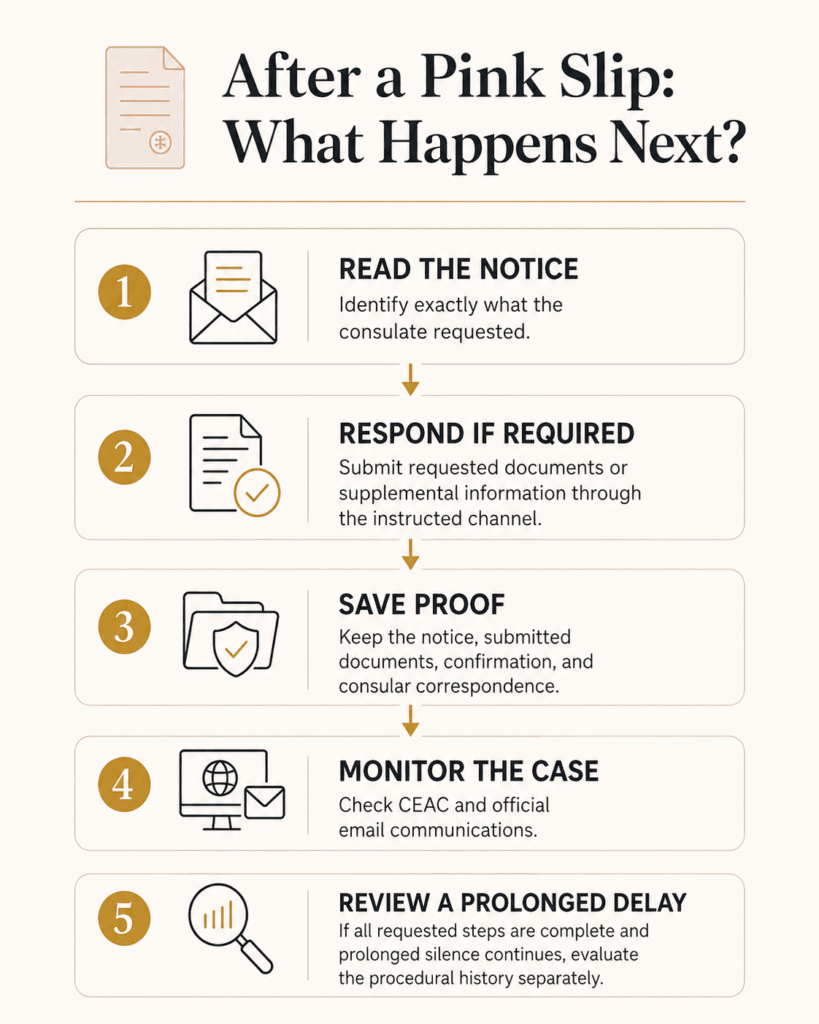
A well-organized record serves two purposes. It helps you respond accurately while the consular process is ongoing, and it creates a reliable timeline if the delay later requires legal review.
| Record | Why It Matters |
|---|---|
| Interview appointment record | Establishes when and where the interview occurred. |
| Pink 221(g) notice | Shows the actual instructions given by the consular officer. |
| Requested documents | Shows what you submitted in response. |
| Submission confirmation | Helps establish that you complied and when. |
| DS-5535 response, if applicable | Preserves the exact supplemental information provided. |
| CEAC screenshots | Creates a dated record of how the online case appeared over time. |
| Consular correspondence | Shows inquiries, government responses, and any additional instructions. |
Which Mistakes Can Complicate the Process?
After a stressful visa interview, it can be tempting to take every possible action at once. More activity is not always better.
Sending an Incomplete Response
If several documents are requested, verify whether the consulate expects a complete package. A partial response can make it harder to determine whether the government still considers the applicant’s submission incomplete.
Using a Submission Method That Was Not Requested
If the notice directs you to a particular email address, portal, courier, or document service, follow that channel unless the consulate instructs you otherwise.
Giving Inconsistent Supplemental Information
Employment dates, travel dates, addresses, education, research activities, and other details may already appear in visa forms or other government records. Review supplemental answers carefully for factual accuracy.
Reapplying Without Understanding the Existing Case
A new application does not automatically resolve the issue affecting an existing 221(g) case. Before starting over, understand what remains pending and whether the consulate has asked you to take a specific step.
Losing Proof of Submission
If a case later remains pending for a long period, being able to establish exactly when you complied with the consulate’s request can be important.
When Does a Long Pink Slip Delay Become a Different Legal Question?
At some point, the issue may shift.
The original question was: What do I need to do after receiving this notice?
After you have supplied everything requested, preserved proof, monitored the case, and waited through a substantial period without meaningful progress, the question may become: Is the government taking an unreasonable amount of time to complete the remaining action?
That is a separate issue from interpreting the pink notice itself.
Facts that may become relevant in a later delay analysis include:
- How long the case has remained pending;
- When you submitted the last requested document;
- Whether the consulate says anything remains missing;
- Whether inquiries receive case-specific answers or only generic responses;
- Whether there has been any meaningful procedural activity; and
- What documented harm the continued delay is causing.
Our separate guide to 221(g) administrative processing delays addresses the delay analysis, including when federal litigation may be considered. Keeping that issue separate is important: receiving a pink notice does not by itself establish that a delay is unreasonable or that a lawsuit is appropriate.
The key transition occurs when the applicant has completed every requested step but the government action remains unfinished. At that point, the history of the delay matters more than the color of the paper received at the interview.
Frequently Asked Questions
What should I do first after receiving a pink slip at my U.S. visa interview?
Read the written notice carefully and identify whether the consulate requested documents, supplemental information, administrative processing, or another specific action. Follow the instructions in your own case rather than relying on another applicant’s experience.
How should I submit documents requested after a pink 221(g) notice?
Use the submission method identified by the embassy or consulate. Before sending the response, confirm that every requested item is included and save proof showing what you submitted and when.
How can I check my visa status after receiving a pink slip?
You can use the Department of State’s CEAC Visa Status Check with the applicable case number or application information. Keep dated screenshots and continue monitoring consular email for case-specific instructions.
How long does administrative processing take after a pink slip?
There is no universal processing period. Department of State guidance says administrative processing time varies according to the circumstances of the individual case.
Should I contact the embassy after 60 days?
Do not assume 60 days is the current universal inquiry point. Current central Department of State guidance generally tells applicants, except in emergency circumstances, to wait at least 180 days from the interview or submission of supplemental documents, whichever occurred later, before making an administrative-processing status inquiry. Always check instructions from the specific post handling your case.
Should I file a new visa application while my pink slip case is pending?
Not automatically. A new application does not necessarily eliminate the issue affecting the existing case. First determine what the consulate requested and whether your current application remains subject to further review.
What records should I keep after responding to the pink notice?
Preserve the notice, interview information, copies of requested documents, submission confirmation, DS-5535 response if applicable, CEAC screenshots, emails, inquiry records, and any later consular instructions.
Can a long pink slip delay be reviewed for a mandamus lawsuit?
Potentially, but the pink notice itself does not establish a mandamus case. A legal review looks at the length and procedural history of the delay, whether the applicant completed all requested steps, government responses, hardship, jurisdiction, and other case-specific facts. A lawsuit seeks government action, not guaranteed visa approval.
Your Next Step After a Pink Slip Depends on the Record, Not the Color Alone
Once your U.S. visa interview is over and you have received a pink notice, focus on the procedural record in front of you. Identify exactly what the consulate requested, respond through the correct channel, preserve proof of compliance, monitor CEAC and email, and keep a dated case timeline.
If the case moves into administrative processing, remember that there is no universal completion deadline. The Department of State’s current inquiry guidance uses a 180-day benchmark for most non-emergency status inquiries, but the facts and instructions in your own case still control.
If you completed every requested step and the case later remains inactive for a substantial period, the next question is no longer simply how to respond to a pink slip. It may be whether the continued government delay warrants a separate legal evaluation.
Has your visa case remained pending after you completed everything requested on your pink notice?
Contact our team for an evaluation of your 221(g) notice, interview history, document submissions, DS-5535 response if applicable, CEAC records, consular communications, length of delay, and possible federal court options.
Phone: +1 (862) 799-2200
Legal Disclaimer: This article is provided for general informational purposes only and does not constitute legal advice. Every immigration case has unique circumstances. For legal guidance specific to your situation, we recommend consulting with an experienced immigration attorney. The information in this article reflects laws, policies, and publicly available Department of State guidance as of August 14, 2026; subsequent changes may affect its accuracy. Prior results do not guarantee a similar outcome.
Sources
- U.S. Department of State — Administrative Processing Information
- U.S. Department of State — Visa Appointment Wait Times and Administrative Processing Inquiry Guidance
- U.S. Department of State — CEAC Visa Status Check
- U.S. Department of State Foreign Affairs Manual — 9 FAM 403.10, Nonimmigrant Visa Refusals
- U.S. Department of State Foreign Affairs Manual — 9 FAM 504.11, Immigrant Visa Refusals