
You have reached the point where you may be eligible for U.S. citizenship, but USCIS still has not decided your Form I-751. The practical question is simple: should you keep waiting, or can you move forward with Form N-400?
If you are ready to file N-400 while I-751 is pending, a pending removal-of-conditions petition does not, by itself, mean you must postpone an otherwise timely naturalization filing. But the two cases are connected. USCIS generally cannot approve naturalization until the agency has reviewed and approved the pending Form I-751.
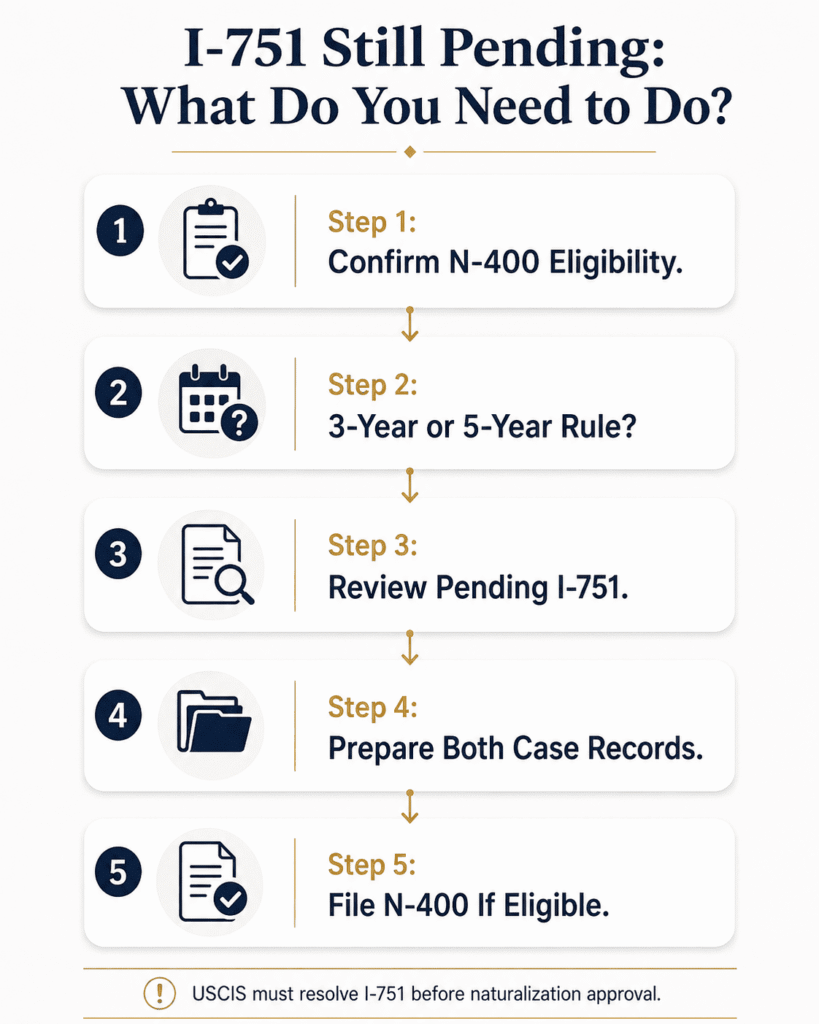
That means the right strategy is not simply “file N-400 and hope the I-751 moves.” You should first confirm your naturalization eligibility, identify whether you are filing under the three-year or five-year rule, review the basis of your I-751, organize the records USCIS may need for both cases, and prepare for the possibility that the two filings will be addressed together.
This guide focuses on what you need to do when N-400 eligibility arrives before your I-751 is approved. It does not repeat the broader question of when a delayed I-751 may justify federal litigation. For that issue, see our separate I-751 delay mandamus lawsuit guide.
In This Article N-400 With a Pending I-751
- First, Confirm That You Are Actually Eligible for N-400
- Do You Have to Wait for I-751 Approval Before Filing N-400?
- What Should You Do Before Filing N-400?
- Joint I-751 or Waiver I-751: Why the Difference Matters
- What Documents Should You Have Ready?
- What Happens After You File N-400 With I-751 Still Pending?
- Should You Prepare for Both Cases at the Interview?
- What If Filing N-400 Does Not Resolve the I-751 Delay?
- A Simple Decision Checklist
- Frequently Asked Questions
First, Confirm That You Are Actually Eligible for N-400
Before focusing on the pending I-751, confirm that you have actually reached the correct N-400 filing window.
USCIS generally provides two naturalization timelines that are especially relevant here. Many lawful permanent residents apply after five years of permanent residence. Certain spouses of U.S. citizens may qualify after three years if they satisfy the additional marriage-based naturalization requirements.
USCIS also permits eligible applicants in these categories to file Form N-400 up to 90 calendar days before completing the applicable continuous-residence requirement. The official USCIS Form N-400 page provides the current filing rules and instructions.
| Possible N-400 Basis | What You Need to Check |
|---|---|
| Three-year rule | Confirm that you qualify for naturalization based on marriage to a U.S. citizen, including the applicable marriage, marital-union, residence, physical-presence, and citizenship requirements. |
| Five-year rule | Confirm that you satisfy the general five-year permanent-residence requirement and the other naturalization requirements. |
| 90-day early filing | Calculate the early filing window carefully. Filing early does not waive other eligibility requirements that must already be satisfied. |
If you plan to use the three-year spouse rule, do not look only at the date printed on your Green Card. USCIS requires additional conditions tied to the U.S. citizen spouse and the marriage. The USCIS Policy Manual guidance for spouses of U.S. citizens explains those requirements in more detail.
A pending I-751 is only one part of the analysis. Your first question should be whether you independently qualify to file N-400 on the date you plan to submit it.
Do You Have to Wait for I-751 Approval Before Filing N-400?
Not necessarily. If you are otherwise eligible to file Form N-400, the fact that Form I-751 remains pending does not automatically require you to wait for the 10-year Green Card before submitting your naturalization application.
But filing and approval are different issues.
The USCIS Policy Manual on conditional permanent resident spouses and naturalization explains that when the petition to remove conditions is pending, USCIS may adjudicate Form I-751 before or concurrently with the naturalization application. USCIS must resolve the removal-of-conditions issue before it can approve naturalization.
In practical terms, your case may look like this:
I-751 pending → N-400 becomes timely → N-400 filed → USCIS addresses the pending I-751 → naturalization continues if both cases are approvable.
This is why simply waiting for the physical 10-year Green Card is not always the only available approach. At the same time, filing N-400 should not be treated as a guaranteed way to accelerate the I-751.
What Should You Do Before Filing N-400?
If your I-751 is still pending when your N-400 filing window opens, review both cases as one immigration history before submitting anything new.
- Confirm your exact N-400 eligibility date. Determine whether you are using the three-year spouse rule, the general five-year rule, or another applicable naturalization provision.
- Check the current status of your I-751. Review your USCIS online account, receipt notice, interview notices, RFEs, and any other correspondence.
- Identify how the I-751 was filed. Was it a joint petition with your spouse, or was it filed under a waiver provision?
- Review whether anything important changed after the I-751 filing. A separation, divorce, death of a spouse, address change, new criminal issue, extended travel, or other material event can affect how the two cases should be approached.
- Review the evidence already submitted with I-751. You should know what USCIS already has and whether significant facts or documents have changed since filing.
- Prepare the N-400 based on your current facts. Do not simply copy older dates or answers without checking whether they remain accurate.
- Organize records for both cases. If USCIS addresses the I-751 during the naturalization process, you want the relevant file history immediately available.
The goal is consistency. Your N-400 becomes part of the same immigration record USCIS is reviewing in connection with the pending I-751.
If You Filed I-751 Jointly and Are Using the Three-Year N-400 Rule
This is the most closely connected scenario. Your I-751 asks USCIS to determine whether the qualifying marriage supporting your conditional residence met the legal requirements. Your N-400 under the three-year rule also relies on your relationship to a U.S. citizen spouse.
USCIS may therefore need to examine facts relevant to both filings before naturalization can be approved.
Before filing N-400, make sure the information about your marriage, residence history, addresses, travel, and spouse is consistent with the I-751 record and reflects your current circumstances.
If You Are Separated or Divorced
Do not assume that reaching the third anniversary of permanent residence automatically makes the three-year naturalization route available.
If your marriage ended or your circumstances changed after filing I-751, both the basis of the pending I-751 and the basis for N-400 eligibility need to be reviewed.
USCIS allows certain conditional residents to seek a waiver of the joint I-751 filing requirement in qualifying circumstances. Its official removal-of-conditions guidance explains joint petitions, waiver requests, divorce situations, and changes that can arise while Form I-751 remains pending.
Someone who no longer qualifies for the marriage-based three-year naturalization provision may eventually qualify under the general five-year rule if all requirements are met. The correct route depends on the facts of the case.
If Your I-751 Is Already a Waiver Case
A waiver-based I-751 does not automatically prevent future naturalization. But it can make it especially important to identify which naturalization provision you are using and whether the factual record in the two filings is consistent.
Do not treat “I have had my Green Card for three years” as the entire eligibility test.
What Documents Should You Have Ready?
You should not send documents USCIS did not request merely because your I-751 is pending. But before filing N-400, organize the records you may need if USCIS reviews the two cases together.
| Record | Why It Matters |
|---|---|
| I-751 receipt notice | Confirms the pending petition and provides the receipt number and filing history. |
| Expired conditional Green Card | Documents the underlying conditional permanent resident status. |
| I-751 RFEs, responses, and interview notices | Shows what USCIS has already questioned or requested in the removal-of-conditions case. |
| Updated marriage evidence, when relevant | May be relevant if USCIS still needs to adjudicate a jointly filed I-751. |
| Marriage or divorce records | Helps establish your current marital status and the legal basis relied upon in the filings. |
| Travel and residence history | Naturalization requires a separate review of continuous residence and physical presence. |
| N-400 supporting evidence | Documents the specific naturalization basis and other eligibility requirements you are claiming. |
A properly filed I-751 currently comes with a receipt notice extending the validity of conditional permanent resident status and work authorization for 48 months beyond the expiration date on the Green Card. USCIS also explains what to do if the petition remains pending beyond that extension period.
What Happens After You File N-400 With I-751 Still Pending?
After you file N-400, do not assume USCIS will treat the naturalization application and I-751 as completely independent files.
USCIS policy specifically addresses concurrently pending Forms I-751 and N-400. If the petition to remove conditions remains pending when the naturalization case is ready for adjudication, USCIS is expected to address the I-751 before or concurrently with the N-400.
Several procedural sequences are possible:
- USCIS may adjudicate the I-751 before the N-400 interview;
- USCIS may need the I-751 file transferred to the office handling naturalization;
- USCIS may address issues from both cases in connection with the same appointment;
- USCIS may request additional evidence before deciding the I-751; or
- The N-400 may remain pending while USCIS completes the required I-751 adjudication.
The key legal point is that USCIS cannot simply skip the unresolved conditional-residence issue and approve naturalization without first determining that the conditions have been properly removed.
Is your I-751 still pending now that you are eligible for N-400?
Our team can review your I-751 filing history, current marital circumstances, N-400 eligibility basis, USCIS notices, length of the pending I-751, and whether the two cases require a coordinated strategy.
Should You Prepare for Both Cases at the Interview?
Yes, if your I-751 is still pending when USCIS schedules your naturalization interview, you should prepare for the possibility that the officer may need to address both filings.
This is sometimes informally called a “combo interview,” but applicants should not assume that every pending I-751 and N-400 will be handled in exactly the same way.
USCIS policy allows the I-751 to be adjudicated before or concurrently with the N-400. That means a naturalization interview may also require the officer to resolve questions connected to the removal-of-conditions petition.
If your I-751 was filed jointly, review the interview notice carefully and prepare for the possibility that the petitioning spouse may need to participate in the I-751 portion of the process. USCIS has historically instructed joint I-751 petitioners and their petitioning spouses to appear when an I-751 interview is required.
Before the appointment:
- Read every USCIS interview notice carefully;
- Bring the records specifically requested in the notice;
- Keep your I-751 receipt and filing history available;
- Bring updated evidence relevant to the pending I-751 when appropriate;
- Review the facts in both applications for consistency; and
- If your marriage or filing basis changed, obtain case-specific advice before the interview rather than trying to explain a complex change for the first time at the appointment.
Do not prepare for the N-400 interview as though the pending I-751 does not exist. Until the conditions are removed, the two cases remain legally connected.
What If Filing N-400 Does Not Resolve the I-751 Delay?
Filing Form N-400 is not a guarantee that USCIS will immediately adjudicate the pending I-751.
If the I-751 continues to sit without meaningful action, the issue may eventually shift from how to coordinate I-751 and N-400 to whether USCIS is taking an unreasonable amount of time to perform the required adjudication.
That is a different analysis.
Our existing I-751 mandamus guide addresses prolonged removal-of-conditions delays and federal litigation. We intentionally keep that issue separate here because becoming eligible for N-400 does not automatically establish that a mandamus lawsuit is appropriate.
If the naturalization case itself later becomes delayed, the available legal question also depends on the stage of the N-400 process. Applicants who are still waiting for an interview face a different procedural situation from applicants who have completed the naturalization examination and are waiting for a decision.
Our verified N-400 delay guide explains that broader distinction. If USCIS has already conducted the naturalization examination and then fails to make a determination within the statutory period, our separate 1447(b) guide for post-interview N-400 delays addresses that remedy in detail.
The important point is not to merge all of these issues into one rule. A pending I-751, a pending N-400 before interview, and a naturalization case stalled after examination can involve different procedural and legal considerations.
A Simple Decision Checklist
If your N-400 eligibility date arrives while your I-751 remains pending, use this sequence:
| Question | What to Do Next |
|---|---|
| Have you reached the correct N-400 filing window? | If not, calculate the proper filing date before submitting Form N-400. |
| Are you relying on the three-year or five-year rule? | Confirm that you meet every requirement for the naturalization basis you selected. |
| Is I-751 still pending? | Review its status, filing basis, notices, RFEs, and any changed circumstances. |
| Are you otherwise eligible for N-400? | A pending I-751 does not automatically require you to postpone an otherwise timely filing. |
| Has USCIS scheduled your N-400 interview? | Prepare for the possibility that the pending I-751 will also need to be addressed. |
| Do both cases remain stalled? | Evaluate the delay based on the procedural stage of each case rather than assuming one remedy applies to both. |
Frequently Asked Questions
Can I file N-400 while my I-751 is still pending?
A pending I-751 does not automatically prevent an otherwise eligible applicant from filing Form N-400. USCIS policy provides for the pending I-751 to be adjudicated before or concurrently with the naturalization application. However, USCIS must resolve and approve the required removal-of-conditions petition before approving naturalization.
Do I need to receive my 10-year Green Card before filing N-400?
Not necessarily. The important questions are whether you are legally eligible to file N-400 and whether the underlying conditional-residence requirements can be resolved. Receiving the physical 10-year card is not the same issue as USCIS legally approving Form I-751.
Will filing N-400 make USCIS approve my I-751 faster?
There is no guarantee. A pending I-751 may need to be addressed as part of the naturalization process, but filing N-400 should not be presented as a guaranteed way to accelerate Form I-751.
Can USCIS approve my N-400 before deciding my I-751?
USCIS generally must approve the required petition to remove conditions before approving naturalization. USCIS policy allows the I-751 to be adjudicated before or concurrently with the N-400.
What happens if my N-400 interview is scheduled while I-751 is still pending?
Prepare for the possibility that USCIS will need to address both cases. Bring the documents required by your interview notice and keep your I-751 records available. Depending on the case, USCIS may address the pending removal-of-conditions petition in connection with the naturalization appointment.
Should my spouse come to the interview if our joint I-751 is still pending?
If your I-751 was jointly filed and remains pending, review the notices carefully and prepare for the possibility that USCIS will need your petitioning spouse for the I-751 adjudication. Do not assume that an appointment labeled as an N-400 interview means the pending joint I-751 will be ignored. If the notice is unclear or your circumstances have changed, obtain case-specific guidance before the appointment.
Can I file N-400 if my I-751 is based on a divorce waiver?
A waiver-based I-751 does not automatically eliminate future naturalization eligibility. However, someone who is divorced generally should not assume eligibility under the three-year spouse-of-a-U.S.-citizen provision. The applicant may need to qualify under the general five-year rule or another applicable provision. The exact analysis depends on the person’s immigration and marital history.
What if both my I-751 and N-400 remain pending for a long time?
The next step depends on where each case is procedurally. A prolonged I-751 delay may raise a federal unreasonable-delay question. An N-400 delayed before interview differs from an N-400 that remains undecided after the naturalization examination. The timeline and remedy should be evaluated separately for each stage.
Becoming Eligible for N-400 Changes the Question, but It Does Not Make the I-751 Disappear
If you become eligible for naturalization while Form I-751 is still pending, do not assume your only option is to wait for the 10-year Green Card. Start by confirming the correct N-400 filing basis and filing date. Then review how the I-751 was filed, whether your circumstances have changed, and whether the records in both cases remain consistent.
If you are otherwise eligible to file N-400, USCIS has a process for dealing with the concurrently pending cases. But the I-751 still matters: the agency generally must resolve the conditions on residence before naturalization can be approved.
The most useful approach is therefore not simply “file another form.” It is to prepare the two cases as one connected immigration history and know what you will do if USCIS still does not act.
Eligible for N-400, but your I-751 is still pending?
Contact our team for an evaluation of your I-751 filing basis, naturalization eligibility date, three-year or five-year N-400 strategy, USCIS notices, pending-case history, and whether prolonged agency delay requires a separate federal court analysis.
Phone: +1 (862) 799-2200
Legal Disclaimer: This article is provided for general informational purposes only and does not constitute legal advice. Every immigration case has unique circumstances. For legal guidance specific to your situation, we recommend consulting with an experienced immigration attorney. The information in this article reflects laws, policies, and publicly available USCIS guidance as of August 19, 2026; subsequent changes may affect its accuracy. Prior results do not guarantee a similar outcome.
Sources
- USCIS Policy Manual, Volume 12, Part G, Chapter 5 — Conditional Permanent Resident Spouses and Naturalization
- USCIS — Form N-400, Application for Naturalization
- USCIS Policy Manual, Volume 12, Part G, Chapter 3 — Spouses of U.S. Citizens Residing in the United States
- USCIS Policy Manual, Volume 12, Part D, Chapter 2 — Lawful Permanent Resident Admission for Naturalization
- USCIS — Removing Conditions on Permanent Residence Based on Marriage