
You attended your adjustment of status interview. The officer reviewed your documents, asked questions, and may have told you that the case looked fine. Then nothing happened.
Weeks passed. Maybe months. Your online case status still says the case is being reviewed. No approval notice arrived. No Request for Evidence came in the mail. No denial was issued either.
This is where many I-485 applicants feel stuck. The interview often feels like the last major step in the green card process, but USCIS does not always make a decision the same day. A short delay after the interview can be normal. A long period of silence, however, may raise a different question: is USCIS still actively reviewing your case, or has your file stalled?
This guide explains why USCIS may delay a decision after the interview, when that delay may become unreasonable, and how a mandamus lawsuit may help move the case toward a final decision.
In This Article
- What the Adjustment of Status Interview Is Supposed to Do
- Why USCIS May Delay a Decision After the Interview
- When Waiting After the Interview Becomes a Problem
- Can a Mandamus Lawsuit Help After an Adjustment of Status Interview?
- What You Should Do Before Considering Mandamus
- Common Mistakes After a Green Card Interview Delay
- Frequently Asked Questions
What the Adjustment of Status Interview Is Supposed to Do
Adjustment of status is the process that allows an eligible person already in the United States to apply for lawful permanent resident status without leaving the country for consular processing. USCIS explains this process on its official Adjustment of Status page.
The adjustment of status interview gives USCIS a chance to review your file in person. The officer may look at your identity, immigration history, admissibility, supporting documents, and eligibility for the green card category.
In many cases, the interview focuses on questions such as:
- Do the documents in the file match the applicant’s testimony?
- Is the applicant still eligible for adjustment of status?
- Are there any inadmissibility issues that need review?
- Is the underlying petition still valid?
- Does USCIS need updated evidence before making a final decision?
The interview is not always the final step
Many applicants expect a decision right after the interview. Sometimes that happens. The officer may approve the case, the online status may update soon after, and the green card may arrive by mail.
But that is not guaranteed. USCIS is not required to approve the case at the interview simply because the interview took place.
According to the USCIS Policy Manual on adjudicative review, officers review several issues before approving adjustment of status. These include the basis for adjustment, continued eligibility, visa availability when required, admissibility, and discretion where applicable.
That review can continue after the interview if USCIS believes something still needs to be checked.
Why the officer may not give a decision the same day
A same-day non-decision does not automatically mean your case is in trouble. The officer may need a supervisor to review the file. A background check may still be pending. A document may need to be matched with your A-file. USCIS may also need updated medical evidence, especially because Form I-693 can be reviewed during an interview or requested before a final decision, as noted on the official Form I-485 page.
Common post-interview issues include:
- A pending background or security check
- A missing immigration file or incomplete record
- A need for supervisor review
- An unresolved issue in the underlying petition
- A possible Request for Evidence
- A field office backlog
The real issue is not whether USCIS decided your case on the interview day. The real issue is what happens after that day. A short period of review may be normal. Months of silence, repeated generic responses, and no meaningful case movement can point to a more serious delay.
Still waiting after your adjustment of status interview? A short case review can help determine whether your delay is still normal or may be legally unreasonable. My Mandamus Lawyer reviews I-485 timelines, interview history, and USCIS follow-up records to assess whether federal court action may help move the case toward a decision.
Why USCIS May Delay a Decision After the Interview
There are several reasons USCIS may delay a decision after an adjustment of status interview. Some are routine. Others may suggest that the case is not moving as it should.
| Possible Reason | What It May Mean | Why It Matters |
|---|---|---|
| Background checks | Security or identity checks may still be unresolved. | USCIS generally will not approve I-485 until required checks are complete. |
| File transfer or missing A-file | The officer may not have every record needed to finish review. | This can create administrative delay even after a clean interview. |
| RFE or medical issue | USCIS may need updated evidence before deciding. | A missing or expired document can pause final adjudication. |
| Supervisor review | The officer may need approval from a senior officer. | This is common in complex or sensitive cases. |
| No clear explanation | The case remains pending with only generic updates. | This may become important for a mandamus evaluation. |
Pending background or security checks
USCIS often cites background checks as a reason for delay. In some cases, that explanation may be legitimate. The government must verify identity, immigration history, criminal records, and security-related information before granting permanent residence.
But “background checks pending” should not become a phrase that explains away every delay forever. If USCIS repeats the same sentence for months without meaningful progress, the history of the case matters.
A mandamus review usually looks at questions like:
- How long has the I-485 been pending?
- How much time has passed since the interview?
- Has USCIS issued any RFE or specific explanation?
- Have service requests produced only generic responses?
- Is there a known issue that explains the delay?
Missing or unresolved file issues
Sometimes the delay is not caused by the applicant. A file may be waiting for transfer between offices. A prior immigration record may need to be located. An approved I-130 or I-140 may need to be verified.
If the case involves prior removal proceedings, past immigration violations, arrests, or complicated travel history, the officer may need additional review before issuing a decision. That does not mean the case should remain pending indefinitely. It means the facts need to be reviewed carefully before deciding whether the delay is unreasonable.
Request for Evidence or internal review
If USCIS sends a Request for Evidence, the next step is clear: respond carefully and on time. But many applicants never receive an RFE. Their case simply remains pending.
That lack of visibility is what makes a post-interview delay so difficult. You may have attended the interview, brought the requested documents, answered the officer’s questions, and still have no way to know what is happening behind the scenes.
When Waiting After the Interview Becomes a Problem
Not every green card interview delay is legally unreasonable. USCIS handles many applications, and each case depends on the applicant’s category, field office, evidence, background, and immigration history. The official USCIS Case Processing Times tool allows applicants to check estimated processing information by form, category, and office.
Still, processing times do not tell the whole story. A case may be within a broad USCIS range but still show signs of being stuck. Another case may be outside normal processing times while USCIS continues to provide only generic responses.
The practical question is simple: is your case moving toward a decision, or is it sitting unresolved?
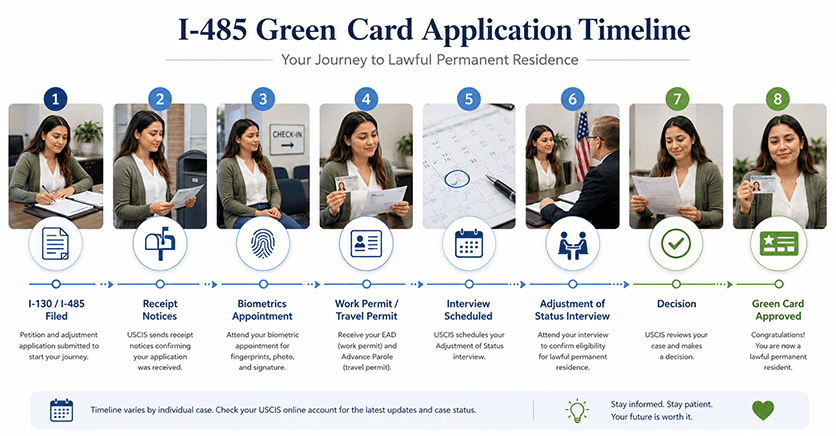
Normal delay vs. unreasonable delay
A normal delay usually has some context. For example, USCIS recently requested evidence, your interview was only a few weeks ago, or there is a known issue that must be resolved.
An unreasonable delay looks different. It often involves long silence after the interview, repeated service requests with no real answer, and no clear legal or factual reason why USCIS has not made a decision.
Warning signs may include:
- Your interview was completed months ago.
- No RFE, NOID, approval, or denial has been issued.
- Your online case status has not meaningfully changed.
- USCIS responses are generic and repetitive.
- Congressional or Ombudsman inquiries have not moved the case.
- Your case is causing serious work, travel, family, or financial consequences.
For many applicants, the strongest concern arises when all major steps are complete. Biometrics were taken. The interview happened. The documents were submitted. No RFE is pending. Yet the case remains in limbo.
What USCIS processing times can and cannot tell you
USCIS processing times are useful, but they do not explain everything. They are broad estimates based on completed cases. They do not always tell you why your specific I-485 is delayed after an interview. USAGov also directs applicants to check USCIS case status and processing information through official USCIS tools, but those tools may not provide a detailed explanation for post-interview silence.
That is why your own case history matters. If your I-485 delay remedies have already included USCIS inquiries, congressional follow-up, or Ombudsman efforts with no meaningful result, your delay may deserve a more serious legal review.
If your green card interview is over but USCIS still has not issued a decision, the next question is not only “How long should I wait?” The better question is whether the delay still has a reasonable explanation.
Can a Mandamus Lawsuit Help After an Adjustment of Status Interview?
A mandamus lawsuit can be an option when USCIS has unreasonably delayed action on a pending immigration case. In the I-485 context, this can include cases where the adjustment of status interview is complete but USCIS still has not issued a final decision.
The key point is important: mandamus does not ask the judge to approve your green card. It asks the federal court to require the agency to do its job and make a decision.
That decision may be:
- An approval
- A denial
- A Request for Evidence
- A Notice of Intent to Deny
- Another lawful agency action
For a case that is otherwise well prepared and eligible, forcing USCIS to make a decision can end months of uncertainty.
Mandamus asks for action, not guaranteed approval
This distinction matters. A mandamus lawsuit for immigration is not a shortcut around eligibility rules. It cannot erase inadmissibility issues, missing evidence, or a weak underlying case.
But it can challenge the government’s failure to act when the agency has had a reasonable opportunity to complete its work.
For applicants who have already completed the interview, the argument may be stronger. USCIS has had direct access to the applicant. The officer reviewed the file. Questions were asked. Documents were presented. If no RFE is pending and months pass without a decision, the delay may become harder to justify.
Why post-interview I-485 delays can be strong mandamus candidates
A post-interview I-485 delay may be strong for mandamus review because the case has already passed several major milestones. USCIS accepted the application, scheduled biometrics, called the applicant for an interview, and had the opportunity to review testimony and documents.
When that process still ends in silence, the applicant may have a stronger argument that USCIS should be required to finish adjudication.
This does not mean every post-interview delay is ready for court. Timing, category, field office, prior immigration history, pending checks, and evidence issues all matter. But if the delay has become prolonged, and ordinary follow-up has failed, it may be time to review how a mandamus lawsuit works and whether your case fits the legal strategy.
What You Should Do Before Considering Mandamus
Before filing a lawsuit, gather the record of your delay. A strong mandamus review depends on facts, not just frustration. The more clearly you can show the timeline, the easier it is to evaluate whether USCIS has acted within a reasonable period.
- Save your interview notice. Keep the Form I-797C interview notice and any rescheduling notice.
- Write down the interview date. Record what happened, what the officer asked, and whether any document was requested.
- Check your online case status. Save screenshots showing case updates or lack of updates.
- Track service requests. Keep confirmation numbers and USCIS responses.
- Document congressional inquiries. Save emails or letters from your representative’s office.
- Keep RFE records. If USCIS requested evidence, save the notice, response, delivery proof, and receipt confirmation.
- Review your full timeline. Compare your filing date, biometrics date, interview date, and current wait.
Look at the whole case, not just the interview date
The delay after the interview is important, but it is not the only factor. USCIS and courts may consider the total case timeline. A case that has been pending for two years, with an interview completed eight months ago, is different from a case filed nine months ago with an interview completed two weeks ago.
This is why applicants should avoid relying on one date alone. The full pattern matters:
- When the I-485 was filed
- When biometrics were completed
- When the interview took place
- Whether USCIS requested more evidence
- How USCIS responded to follow-up efforts
- How the delay affects your work, travel, and family life
Those details also help an attorney assess the likely mandamus lawsuit timeline if federal court action becomes appropriate.
Consider the impact of the delay
Post-interview delay can affect more than immigration paperwork. It may limit job stability, travel plans, family security, driver’s license renewals, financial decisions, or emotional peace of mind.
In a marriage-based green card delay, the uncertainty may also place pressure on the couple’s daily life, finances, and long-term plans.
Mandamus cases focus on government delay, but the real-world impact of that delay helps explain why the case matters. You are not just waiting for a card. You are waiting for the stability that permanent residence is supposed to provide.
Common Mistakes After a Green Card Interview Delay
When USCIS stays silent after an interview, many applicants feel pressure to do something immediately. Taking action is understandable, but the wrong action can create confusion or make the file harder to evaluate.
- Submitting duplicate filings without legal advice: A new filing may not solve the delay and can create procedural complications.
- Ignoring USCIS mail: A missed RFE, Notice of Intent to Deny, or address update problem can damage the case.
- Assuming silence means denial: No decision does not automatically mean the case will be denied.
- Assuming silence means approval: A friendly interview does not guarantee approval until USCIS issues the decision.
- Relying only on online status: Online updates are often limited and may not reflect every internal step.
- Waiting indefinitely: Patience is important, but endless waiting can allow an unreasonable delay to continue unchecked.
The safer approach is to keep records, monitor the case, follow up through proper channels, and seek a legal review if the delay becomes prolonged. A mandamus review does not require panic. It requires a clear timeline and a careful look at whether USCIS has failed to act within a reasonable time.
Frequently Asked Questions
How long after an adjustment of status interview should I wait?
There is no single answer for every case. Some applicants receive a decision within days or weeks. Others wait longer because of background checks, file review, missing evidence, or office workload. If months pass after the adjustment of status interview with no clear explanation, it may be time to evaluate whether the delay is still reasonable.
Does no decision mean my green card case will be denied?
No. A delayed decision does not automatically mean denial. USCIS may still be reviewing the file. However, if there is a legal or factual issue in your case, it is better to identify it early rather than assume the delay will resolve itself.
Can I sue USCIS after my I-485 interview?
In some cases, yes. If USCIS has delayed a decision for an unreasonable period after your I-485 interview, a mandamus lawsuit may be an option. The strength of the case depends on your full timeline, USCIS responses, pending issues, and the reasonableness of the delay.
Will mandamus hurt my green card case?
Mandamus is a lawful way to ask a federal court to require agency action. It does not ask for special treatment and does not ask the court to approve the green card. USCIS must still decide the case under immigration law and the facts in the record.
What if USCIS says background checks are pending?
Pending background checks can be a real reason for delay. But if USCIS repeats the same explanation for a long period without details or movement, that may deserve closer review. The question is whether the delay remains reasonable in your specific circumstances.
Can mandamus force USCIS to approve my I-485?
No. Mandamus generally seeks a decision, not a guaranteed approval. If your case is legally strong and USCIS has no valid reason to keep delaying, forcing a decision may result in approval. But the lawsuit itself does not require USCIS to grant the green card.
Final Thoughts
An adjustment of status interview can feel like the last step in the green card process. When USCIS does not issue a decision afterward, the silence can be confusing and exhausting.
Some delays are temporary. Others become unreasonable when the agency has already had enough time and information to act.
If you completed your interview and your I-485 remains pending with no meaningful update, do not evaluate the delay in isolation. Look at your full timeline, your follow-up history, and whether USCIS has given a real explanation. If the case appears stuck, mandamus may be the legal tool that moves it from silence to a final decision.
Still Waiting After Your Green Card Interview?
Your case delay is not your fault. A mandamus lawsuit is a legal remedy against unreasonable USCIS delays and often helps move a stalled case toward a final decision. Contact My Mandamus Lawyer for a free case evaluation.
Or call us directly: (862) 799-2200
Legal Disclaimer
This article is provided for general informational purposes only and does not constitute legal advice. Every immigration case has unique circumstances. For legal guidance specific to your situation, we recommend consulting with an experienced immigration attorney. The information in this article reflects laws and policies as of the publication date; subsequent changes may affect its accuracy.
Sources
- Adjustment of Status, USCIS, accessed May 15, 2026.
- Application to Register Permanent Residence or Adjust Status, USCIS, accessed May 15, 2026.
- Policy Manual, Volume 7, Part A, Chapter 6: Adjudicative Review, USCIS, accessed May 15, 2026.
- Case Processing Times, USCIS, accessed May 15, 2026.
- Policy Manual, Volume 7: Adjustment of Status, USCIS, current as of February 3, 2026.
- How to Check Your Immigration Case Status and Find Processing Times, USAGov, accessed May 15, 2026.