
If your asylum clock stopped, you may worry that your whole asylum case is frozen. That is a common fear, but the asylum EAD clock and the asylum interview timeline are different issues. The EAD clock affects when you may qualify for a work permit based on a pending asylum application. The interview timeline involves when USCIS schedules, reviews, or decides your Form I-589 asylum case.
The distinction can change your next step. You may have enough EAD clock days to apply for work authorization and still wait years for an asylum interview. You may also see a stopped clock because of a rescheduling request, a continuance, or another delay attributed to you. This guide explains how to tell these problems apart and when a mandamus for asylum delay may be worth reviewing.
What Is the Asylum EAD Clock?
The asylum EAD clock is a timing system tied to employment authorization for certain people with pending asylum applications. It does not mean USCIS is reviewing your asylum claim each day. It tracks whether enough qualifying time has passed for you to request or receive a work permit based on pending asylum.
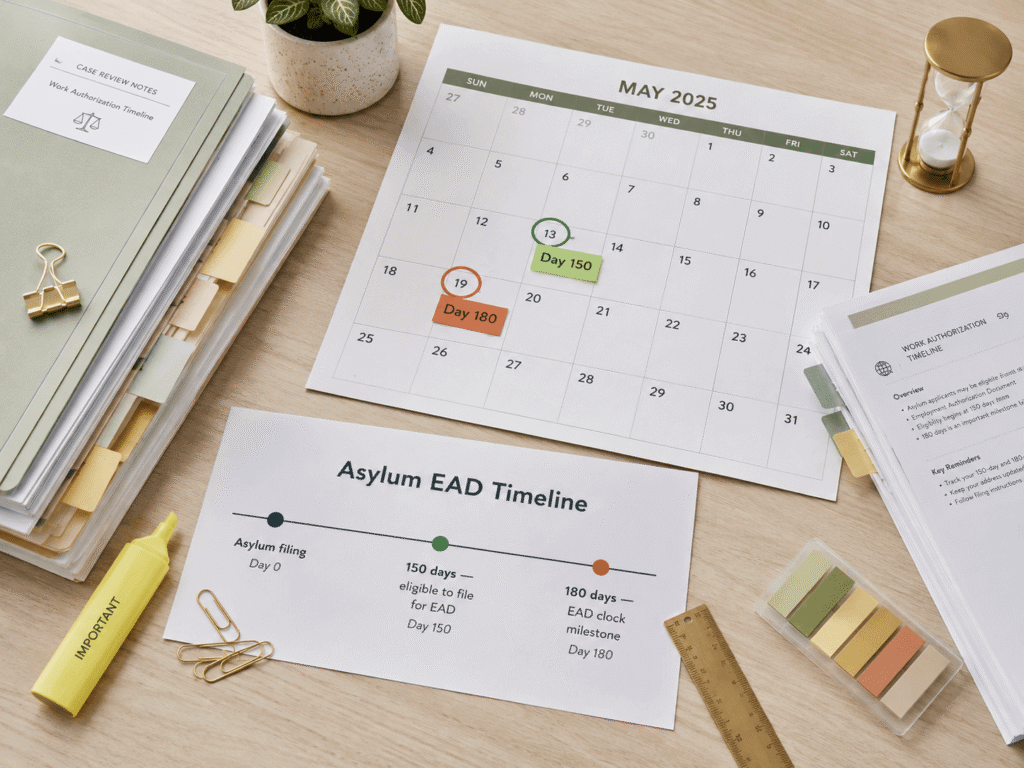
Under the familiar asylum EAD framework, an asylum applicant generally may file Form I-765 after the asylum application has been pending for 150 days. USCIS generally may not approve the EAD until 180 days have passed. EOIR’s OPPM 25-01 explains how the clock runs, stops, and may be corrected in immigration court proceedings.
The 150-day filing point
The 150-day point is easy to misunderstand. It is not an interview deadline. It does not mean USCIS must schedule your asylum interview soon. It is usually the point when many pending asylum applicants may become eligible to file the work permit application.
The 180-day eligibility rule
The 180-day point is also limited. It relates to whether a pending asylum EAD can be approved. It does not mean your asylum case must be approved, denied, or interviewed by that date.
Why the EAD clock is not the same as case progress
Think of the EAD clock as a work authorization timer. Your asylum interview timeline is a separate USCIS scheduling and adjudication issue. The clock helps you understand work permit eligibility. It does not show whether your Form I-589 is moving toward an interview or final decision.
Why Does the Asylum Clock Stop?
An asylum clock can stop when the delay is attributed to the applicant. This is often called an applicant-caused delay. The analysis depends on whether your case is with USCIS, EOIR, or has moved between systems.
Applicant-caused delays
Examples may include asking to reschedule an interview, requesting a continuance in immigration court, failing to appear, or filing certain motions that delay proceedings. USCIS explains that applicant-attributed delay can stop time from accumulating toward the 180-day Asylum EAD Clock.
Not every delay is your fault. If the government, the immigration court, or DHS causes the delay, the clock may continue to run. The reason for the delay matters as much as the delay itself.
USCIS vs. EOIR clock issues
Clock issues can become more confusing when an affirmative asylum case is referred from USCIS to immigration court. EOIR guidance explains that its clock may begin with days already accrued before referral. After that, it may run or stop depending on court events.
How to request a clock correction
If you believe the clock is wrong, the first step is usually not a mandamus lawsuit. Identify which agency controls the relevant record and request correction through the proper channel. EOIR has published correction-request instructions, and the Garcia Perez FAQ explains certain clock information and correction rights.
A stopped EAD clock is a technical eligibility issue. An asylum interview delay is a government inaction issue. The legal strategy depends on which problem you actually have.
What Is an Asylum Interview Delay?
An asylum interview delay happens when your Form I-589 remains pending but USCIS does not schedule your interview, does not move your case in a meaningful way, or does not issue a decision after the required steps have taken place. This problem is separate from whether your work permit clock has reached 150 or 180 days.
The remedy is different because the problem is different. If your EAD clock is stopped because of an incorrect applicant-caused delay entry, you may need a correction request. If your I-765 is pending far beyond normal processing, you may need to evaluate an EAD delay mandamus lawsuit. If your asylum case has been waiting years for an interview or decision, the issue may be unreasonable USCIS delay.
Pending asylum does not always mean active movement
A pending asylum case may remain in the system for years with little visible movement. The DHS Office of Inspector General reported in July 2024 that USCIS faced challenges meeting statutory timelines and reducing the affirmative asylum backlog. Oversight reporting on the same audit stated that at the end of fiscal year 2023, USCIS had more than one million asylum cases pending determination, including more than 786,000 affirmative asylum cases pending longer than 180 days.
Why some cases stay pending for years
Some cases are affected by backlog, shifting scheduling priorities, office workload, security checks, file transfers, or administrative inertia. These reasons may explain the delay, but they do not automatically give USCIS unlimited time.
Waiting years for an asylum interview? A stopped EAD clock and a delayed asylum case require different legal strategies. If USCIS has left your Form I-589 pending for an unreasonable period, contact us for a free case evaluation or call (862) 799-2200.
Free Case Review
EAD Delay vs. Clock Problem vs. Interview Delay
Before choosing a legal strategy, identify which delay you are facing. These three problems can feel similar because all of them involve waiting. Legally, they are different.
| Problem | What it usually means | First thing to check | Possible next step |
|---|---|---|---|
| Asylum clock stopped | Your EAD clock may not be accumulating days | USCIS Case Status, EOIR hotline, ECAS, adjournment history | Clock correction request if the stop appears wrong |
| EAD delay | Your Form I-765 is pending after you became eligible | USCIS I-765 receipt, category, processing time, prior RFEs | Service request, expedite request, or EAD delay review |
| Asylum interview delay | Your I-589 remains pending without interview or decision | Filing date, asylum office, prior notices, interview history | Mandamus evaluation if the delay is unreasonable |
For example, if your clock shows only 90 days because you requested a reschedule, an asylum interview lawsuit may not fix your EAD eligibility issue. If your clock shows more than 180 days and your I-765 has been pending for months, the problem may be the work permit application itself.
This is where a careful legal review matters. The wrong diagnosis can lead to the wrong filing, wasted time, and more frustration.
When Can Mandamus Help an Asylum Delay?
A writ of mandamus is a federal court action used to compel a government agency to act on an unreasonably delayed matter. In the immigration delay context, it usually asks the court to require the agency to decide, schedule, or otherwise move the case. It does not ask the judge to grant asylum. It asks the government to stop leaving the case in limbo.
For asylum applicants, mandamus may become relevant when the problem is years of inaction on the asylum case itself, rather than a clock calculation. Multi-year affirmative asylum delays may qualify for federal court review depending on filing date, case history, harm caused by delay, and whether the applicant has done everything required. You can also review the firm’s broader USCIS mandamus for asylum delay guide for more context.
When the problem is USCIS inaction
Mandamus may be worth evaluating if your Form I-589 has been pending for years, you have no meaningful interview movement, and normal inquiries have not produced action. Serious hardship, including family separation or work instability, can make review even more important.
When mandamus may not be the right tool
Mandamus is not a universal fix for every asylum-related problem. It may not be the right tool if the main issue is a correct EAD clock stoppage caused by your own delay, if your I-765 is still within normal processing, if you recently filed the I-589, or if the case is paused because USCIS is waiting for information you have not provided. It also does not guarantee approval. If USCIS acts after a lawsuit, the result can be an approval, denial, interview notice, request, or other lawful action depending on the record.
What Should You Do If Your Case Is Not Moving?
If your asylum case is not moving, start by separating the facts. The more specific you are, the easier it is to identify the right solution.
- Check your asylum filing date. Confirm when USCIS or the immigration court received your Form I-589.
- Check your EAD clock status. Use USCIS Case Status if your case is with USCIS, or EOIR systems if your case is in immigration court.
- Review any delay events. Look for rescheduling requests, continuances, missed appointments, motions, or other events that may have stopped the clock.
- Check your I-765 status. If you filed for work authorization, confirm the receipt date, category, and current processing context.
- Separate work permit delay from asylum delay. A delayed EAD and a delayed asylum interview may require different legal strategies.
- Evaluate mandamus only after identifying the real delay. If the issue is long-term USCIS inaction on your asylum case, review whether a mandamus lawsuit is appropriate.
In some cases, the next step is a correction request. In others, it may be an EAD-focused strategy. For long-pending asylum cases, a mandamus lawsuit timeline review may determine whether federal court pressure could move the case.
Frequently Asked Questions
Does a stopped asylum clock mean my asylum case is denied?
No. A stopped asylum EAD clock usually relates to work permit eligibility timing. It does not automatically mean your asylum case has been denied.
Can I file for an EAD if my asylum clock is below 150 days?
In most pending asylum situations, filing before the 150-day point is premature. Confirm your category, clock status, and any exceptions before filing.
Can I sue USCIS if my asylum interview is delayed?
Possibly. If your affirmative asylum case has been pending for years without meaningful action, mandamus may be an option. The analysis depends on your timeline, case history, prior requests, and the harm caused by the delay.
Will mandamus force USCIS to approve my asylum case?
No. Mandamus seeks action, not guaranteed approval. The goal is to force the government to move or decide the case while USCIS still applies asylum law to your facts.
What if the government says the backlog is the reason for delay?
Backlog is common, but it does not always justify indefinite delay. Courts look at the facts, the length of delay, the agency’s duties, the impact on the applicant, and other factors.
Is the February 2026 asylum EAD rule already final?
The February 23, 2026 Federal Register item discussed here is a proposed rule. Proposed rules can change before becoming final, so applicants should not treat a proposal as final law unless DHS completes the rulemaking process.
Conclusion
If your asylum case is not moving, do not assume every delay has the same cause. A stopped asylum EAD clock, a pending I-765, and a delayed asylum interview are different problems. Each one requires a different strategy. The first step is to identify whether the issue is clock calculation, EAD processing, or long-term USCIS inaction on your Form I-589.
Once the delay is correctly identified, you can decide whether to request a correction, follow up on the EAD, or evaluate a mandamus lawsuit. For applicants waiting years, mandamus may provide a structured way to challenge unreasonable government delay.
Legal Disclaimer
This article is provided for general informational purposes only and does not constitute legal advice. Every immigration case has unique circumstances. For legal guidance specific to your situation, we recommend consulting with an experienced immigration attorney. The information in this article reflects laws and policies as of the publication date; subsequent changes may affect its accuracy.
Sources
- OPPM 25-01: Asylum EAD Clock in Immigration Court Proceedings, Executive Office for Immigration Review, December 19, 2024.
- The 180-Day Asylum EAD Clock Notice, U.S. Citizenship and Immigration Services.
- Garcia Perez Settlement FAQ, Executive Office for Immigration Review, updated June 17, 2025.
- Application for Employment Authorization, Form I-765, U.S. Citizenship and Immigration Services.
- USCIS Faces Challenges Meeting Statutory Timelines and Reducing its Backlog of Affirmative Asylum Claims, DHS Office of Inspector General, July 3, 2024.
- Employment Authorization Reform for Asylum Applicants, Federal Register, February 23, 2026.