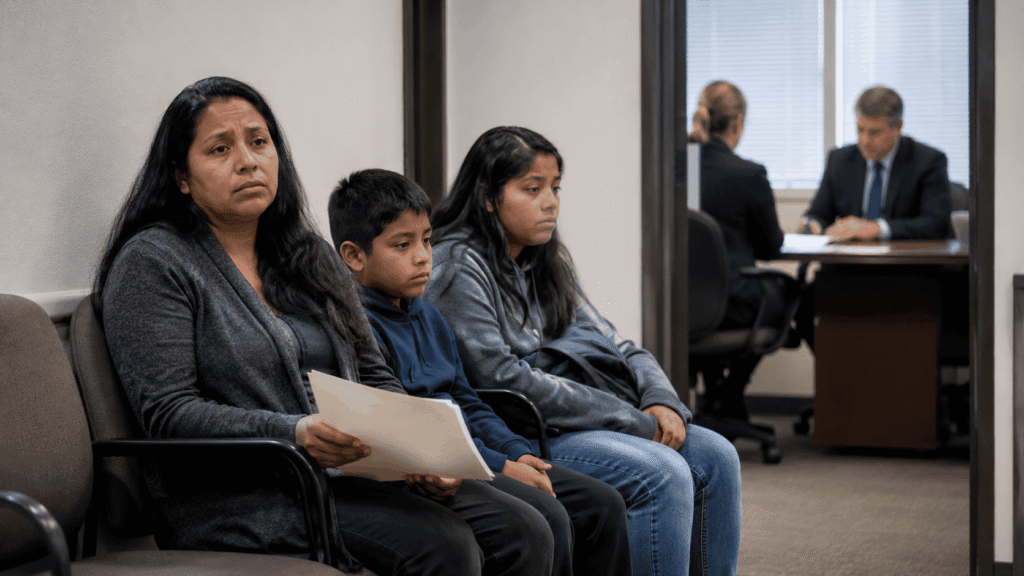
Approximately 1.5 million affirmative asylum applications were pending before U.S. Citizenship and Immigration Services (USCIS) at the end of fiscal year 2025. Average processing time reached 22.8 months in FY 2024, and many applicants who filed five or more years ago still have no interview scheduled. If your Form I-589 has been sitting in this backlog, waiting indefinitely is not your only option. A federal asylum interview delay mandamus lawsuit can compel USCIS to schedule your interview or issue a decision on a case that has been adjudicated but not finalized. This guide explains when the remedy applies, how courts evaluate the delay, and what filing actually means for your case.
In This Article
The affirmative asylum process and the current backlog
The affirmative asylum process is available to people physically present in the United States who are not in removal proceedings. Applicants file Form I-589, complete biometrics within several weeks, and wait to be scheduled for an interview at one of the eight USCIS asylum offices. After the interview, an asylum officer either grants asylum, denies it and refers the case to immigration court, or leaves the file pending while background checks and supervisory review continue.
Federal law sets out a clear expectation. Under 8 U.S.C. § 1158(d)(5)(A), the initial interview “shall commence not later than 45 days after the date an application is filed,” and final adjudication “shall be completed within 180 days.” Both deadlines carry the qualifier “in the absence of exceptional circumstances.”
The reality has diverged sharply. Average processing time for affirmative cases reached 22.8 months in FY 2024, and applicants stuck in the oldest segments of the backlog have often waited four, five, or more years for an interview notice. The 2025 to 2026 policy environment compounded the problem: USCIS imposed a sweeping adjudicative hold on affirmative asylum cases from late November 2025 through March 30, 2026, when the Department of Homeland Security partially lifted the freeze for applicants who are not from travel-ban countries.
The 45-day and 180-day statutory benchmarks are not directly enforceable, but federal judges call them “instructive” when evaluating whether a delay has become unreasonable.
LIFO vs. FIFO scheduling: why is your case waiting?
USCIS schedules affirmative asylum interviews under a “Last-In, First-Out” (LIFO) approach, originally adopted in 1995. The agency briefly switched to “First-In, First-Out” (FIFO) in December 2014, then returned to LIFO in January 2018, where the system remains today.
Under the current framework, the USCIS Affirmative Asylum Interview Scheduling Bulletin sets out a clear priority order:
- Cases that were previously scheduled but rescheduled at the applicant’s request or by USCIS;
- Applications pending 21 days or fewer;
- All other pending applications, starting with newer filings and working back toward older ones.
The stated rationale is deterrence. By scheduling recently filed cases first, USCIS aims to discourage applications filed primarily to obtain employment authorization. Newly filed applicants whose claims lack merit can be placed quickly into removal proceedings rather than gaining years of work authorization while their files sit unadjudicated.
The practical effect for everyone who filed years ago is straightforward: newer cases keep jumping the queue. USCIS runs a parallel “second track” assigning some officers to the oldest pending cases in chronological order, but new filings consistently outpace that effort.
This dynamic is central to any asylum interview delay mandamus claim. Federal courts do not require proof that USCIS acted in bad faith; they evaluate whether the delay itself, viewed alongside the consequences for the applicant, has become unreasonable.
Pre-interview vs. post-interview delays: which is stronger for mandamus?
Asylum delays fall into two distinct categories, and the strength of a mandamus claim differs considerably between them.
Pre-interview delays
A pre-interview delay occurs when Form I-589 has been filed but USCIS has not scheduled the interview. Many applicants at this stage have been waiting three, four, five, or more years.
Federal courts have generally been receptive to mandamus claims once the delay reaches four to five years. The American Immigration Council’s practice advisory outlines the factors courts consider: the gap between the actual wait and the 45-day statutory expectation, the consequences of indefinite uncertainty for the applicant and family members, and any case-specific justification for the delay. Courts have not accepted the argument that backlog alone defeats a mandamus claim. The Sixth Circuit’s observation in Barrios Garcia v. DHS is now widely cited: “We find it unhelpful to fixate on the average snail’s pace when comparing snails against snails in a snails’ race.”
Post-interview delays
A post-interview delay occurs when the interview has been completed but no decision has been issued. This stage tends to produce the strongest mandamus claims. Once the interview has happened, USCIS has gathered the information it needs to adjudicate. Continued silence, typically beyond four to six months, suggests the delay is driven by administrative bottlenecks rather than the merits.
Post-interview delays often involve background check completion, supervisory review, or quality assurance procedures that USCIS has not made transparent. A mandamus action does not order USCIS to approve the application. It orders the agency to complete the decision-making process and issue a final ruling.
How a mandamus lawsuit affects your asylum case

A mandamus lawsuit is filed in U.S. District Court under 28 U.S.C. § 1361, typically paired with a claim under 5 U.S.C. § 706(1) of the Administrative Procedure Act (APA). It asks the court to compel USCIS and DHS to act on the application. It does not ask the court to grant asylum or decide the merits.
To evaluate whether a delay is “unreasonable,” federal courts apply the six-factor framework from Telecommunications Research & Action Center v. FCC, 750 F.2d 70 (D.C. Cir. 1984), commonly called the TRAC factors. See our overview of what mandamus is and how courts apply it. Asylum cases tend to score well on several factors:
- Congressional timetable. Section 1158(d)(5)(A) sets 45-day and 180-day expectations that courts treat as instructive.
- Human health and welfare. Asylum waits frequently involve family separation, mental health impacts, and the psychological weight of an unresolved persecution claim.
- Nature of the interests prejudiced. Applicants typically have fled serious persecution and cannot return to their countries of origin while their cases remain pending.
After the complaint is filed and served, the government has 60 days to respond. In the majority of unreasonable-delay cases, the Department of Justice elects to resolve the matter administratively, by scheduling the interview or issuing the decision, rather than defending the delay in court.
Possible outcomes and risks
The most common outcome is administrative action within weeks of the government being served. A less common possibility is that the government files a motion to dismiss; federal courts have generally treated unreasonable-delay claims as fact-intensive and not appropriate for resolution at that stage.
Filing a mandamus lawsuit does not retaliate against the applicant or change the substantive standards for asylum. The one-year filing deadline, the persecution requirement, the bars to asylum, and every other substantive doctrine remain identical. Only the timing changes.
Frequently asked questions
How long should I wait before considering an asylum interview delay mandamus?
Most attorneys consider applications pending four to five years without an interview, or four to six months post-interview without a decision, to be strong candidates. Health issues, family separation, or derivative children aging out can support earlier action.
Can a mandamus lawsuit grant me asylum?
No. A mandamus lawsuit orders USCIS to act on your application but does not direct the agency to approve it. The legal standards for asylum, including the persecution requirement and the one-year filing deadline, remain unchanged.
Will filing a mandamus hurt my asylum case?
Federal law prohibits retaliation against applicants who exercise their right to seek judicial relief. Courts have repeatedly recognized mandamus as a legitimate, commonly used remedy for delayed adjudications.
What happens if USCIS denies my asylum case after I file mandamus?
A denial after mandamus is treated the same as any other affirmative denial. The case is typically referred to an immigration judge, where you have a second opportunity to present your claim de novo. Mandamus does not foreclose any substantive defenses you would otherwise have.
How long does an asylum mandamus lawsuit take?
Most asylum mandamus matters resolve within 60 to 90 days of filing. The government has 60 days to respond, and in the majority of cases the agency takes action rather than defending the delay.
What does an asylum mandamus lawsuit cost?
The federal court filing fee is currently $405, paid directly to the U.S. District Court. Attorney fees are typically structured on a flat-fee basis and depend on factors including the case’s procedural posture and the length of the delay. We can provide a specific estimate after reviewing your situation.
Conclusion
Waiting years for an asylum interview is no longer the only path available to applicants who have exhausted USCIS service requests, ombudsman inquiries, and congressional contacts. Federal courts have repeatedly recognized that pre-interview delays approaching four to five years, or post-interview delays of four to six months, can satisfy the unreasonable-delay standard under the APA. An asylum interview delay mandamus does not change what you must prove to win asylum; it changes whether your file continues to sit untouched.
Your case delay isn’t your fault. A mandamus lawsuit is a legal remedy against unreasonable USCIS delays and often speeds up your case significantly. Contact us for a free case evaluation.
Legal Disclaimer
This article is provided for general informational purposes only and does not constitute legal advice. Every immigration case has unique circumstances. For legal guidance specific to your situation, we recommend consulting with an experienced immigration attorney. The information in this article reflects laws and policies as of the publication date; subsequent changes may affect its accuracy.
Sources
- Affirmative Asylum Interview Scheduling, U.S. Citizenship and Immigration Services, updated 2024.
- The Affirmative Asylum Process, U.S. Citizenship and Immigration Services, updated October 17, 2025.
- 8 U.S. Code § 1158 – Asylum, Cornell Legal Information Institute.
- 28 U.S. Code § 1361 – Action to compel an officer of the United States to perform his duty, Cornell Legal Information Institute.
- 5 U.S. Code § 706 – Scope of review, Cornell Legal Information Institute.
- Barrios Garcia v. U.S. Department of Homeland Security, 25 F.4th 430, U.S. Court of Appeals for the Sixth Circuit, February 10, 2022.
- Practice Advisory: Delay Actions in the Asylum Context, American Immigration Council, updated July 2025.
- New Proposed DHS Rule Effectively Ends Work Authorization for Asylum Applicants, Transactional Records Access Clearinghouse, April 22, 2026.