
Your i-130 priority date current status may feel like the moment your case should finally move. You check the Visa Bulletin, see that your date appears available, and expect USCIS, the National Visa Center, or the consulate to take the next step. Then nothing happens.
This silence can be confusing. A current priority date is important, but it does not always mean an automatic approval, interview, or green card. The real question is more practical: is your case still within a normal waiting period, or has it become the kind of unexplained delay where a mandamus lawsuit may be worth considering?
This article explains what a current I-130 priority date means, why your case may still be stuck, when waiting may still make sense, and when mandamus may become a serious option.
In This Article
- What Does “I-130 Priority Date Current” Actually Mean?
- Why There May Still Be No Action After Your Priority Date Becomes Current
- When Waiting May Still Make Sense
- When Mandamus May Become a Serious Option
- Mandamus or Wait? A Practical Decision Matrix
- What a Mandamus Lawsuit Can and Cannot Do in an I-130 Case
- What to Check Before Filing Mandamus
- FAQ: I-130 Priority Date Current But No Action
What Does “I-130 Priority Date Current” Actually Mean?
Your priority date is generally the date USCIS received the family-based immigrant petition, such as Form I-130. In family preference categories, that date controls your place in line for an immigrant visa number.
When a priority date becomes “current,” it usually means that a visa number may be available for your category and country of chargeability, assuming you are otherwise eligible. USCIS explains that when a priority date becomes available, an applicant may be able to apply for adjustment of status or apply for an immigrant visa through the Department of State if outside the United States.
But there are two important limits.
- A current priority date is not the same as I-130 approval. If USCIS has not yet approved the I-130, the agency may still need to adjudicate the petition.
- A current priority date is not the same as final green card approval. You may still need NVC processing, consular interview scheduling, adjustment of status review, background checks, or additional document review.
Final Action Dates vs. Dates for Filing
The Department of State Visa Bulletin usually contains two different charts for family-sponsored cases: Final Action Dates and Dates for Filing. Final Action Dates relate to when immigrant visas may be finally issued. Dates for Filing relate to when applicants may be invited to assemble and submit documents to the National Visa Center.
That distinction matters. A category may appear favorable for filing purposes, but that does not always mean the government is ready to issue the immigrant visa or approve permanent residence that same day.
For June 2026, the Department of State Visa Bulletin explains that Dates for Filing allow eligible applicants to assemble and submit required documents to NVC when their priority date is earlier than the listed date. It also explains that a “C” listing means the category is current and applications may be filed regardless of priority date.
Why There May Still Be No Action After Your Priority Date Becomes Current
If your I-130 priority date is current but still no action has been taken, the first step is to identify where the case is stuck. A delay at USCIS is different from a delay at NVC. A delay at NVC is different from a consular interview delay. A delay in adjustment of status is different from consular processing.
USCIS may still need to adjudicate the I-130
In some cases, the priority date becomes current before USCIS has approved the I-130. This is frustrating, but it can happen. A current priority date does not automatically force an immediate I-130 decision. USCIS may still be reviewing the relationship evidence, prior immigration history, background issues, or a pending response to a Request for Evidence.
That said, if the I-130 has been pending far beyond normal processing and USCIS gives only generic responses, the delay may deserve closer review. Our broader guide on mandamus lawsuits for immigration delays explains how a federal court action can be used to challenge unreasonable agency inaction.
NVC may still need to create or review the case
If the I-130 is approved and the beneficiary is outside the United States, the case usually moves to the National Visa Center. NVC must create the case, collect fees, review civil documents and financial documents, and determine whether the case is documentarily complete.
The Department of State publishes current NVC timeframes. Those timeframes help separate ordinary administrative processing from a case that has gone quiet for no clear reason.
The consulate may still delay interview scheduling
After NVC completes document review, the case may still wait for an interview appointment at the U.S. embassy or consulate. Local appointment capacity, security checks, country-specific conditions, and internal scheduling backlogs can affect timing.
For some families, this becomes the hardest stage. They have an approved I-130, a current priority date, and a documentarily complete case, but no interview date. Whether mandamus is appropriate depends on the full timeline, the agency involved, the reason for delay, and whether the case is truly ready for action.
Adjustment of status and consular processing are different tracks
If the beneficiary is in the United States and eligible to adjust status, the case may involve Form I-485. If the beneficiary is abroad, the case usually proceeds through NVC and a consulate. The legal strategy can differ depending on the path.
For adjustment cases, a long-pending I-485 may become the main problem. Our article on I-485 delay and mandamus lawsuits explains how a stalled green card application may be evaluated when USCIS has not issued a decision.
When Waiting May Still Make Sense
Mandamus is a powerful tool, but it is not the right answer for every delay. Sometimes the better move is to wait a short period, respond to a pending request, or confirm that the case is actually ready for adjudication.
Recent RFE or document submission
If USCIS recently issued a Request for Evidence, Notice of Intent to Deny, or document request, the agency may still be within a reasonable review window. The same applies if you recently submitted financial documents, civil documents, or a DS-260 to NVC.
In that situation, filing too quickly may weaken the argument that the government is refusing to act. The better first step may be to document the submission, confirm receipt, and monitor the posted timeframe.
Case still inside normal processing windows
If your case is still within posted processing times or only slightly beyond them, mandamus may be premature. Processing times are not always decisive, but courts often look at the overall timeline when deciding whether a delay is unreasonable.
Final Action Date is not actually current
Some applicants confuse Dates for Filing with Final Action Dates. If the relevant Final Action Date is not current, the government may not be able to issue the immigrant visa or approve the green card yet. Mandamus cannot create a visa number that is not legally available.
NVC or consular timing is still explainable
If NVC recently received the case from USCIS, recently reviewed documents, or recently marked the case documentarily complete, some additional waiting may be expected. The same may be true if the consulate has limited interview capacity and your case has only recently become ready for scheduling.
Mandamus May Become a Serious Option
Mandamus becomes more relevant when the delay is no longer just disappointing, but legally unreasonable. The key issue is not simply that you are tired of waiting. The question is whether the government has failed to perform a duty to act within a reasonable time.
The case is far outside normal processing
A long delay alone does not automatically win a mandamus case, but it matters. A family petition pending for years with no clear reason looks very different from a case that has been pending for a few months after recent activity.
My Mandamus Lawyer’s FAQ page notes that strong candidates often include cases with multi-year delays, documented hardship, or no explanation from USCIS. The facts still need to be reviewed carefully, but the length of delay is often the starting point.
No RFE, NOID, or clear reason explains the silence
If there is a pending RFE, security issue, missing document, or unresolved eligibility concern, the government may argue that it is still actively processing the case. But if there is no pending request, no clear obstacle, and no meaningful explanation, the delay may look harder to justify.
The agency only gives generic responses
Many families submit service requests, congressional inquiries, or NVC public inquiries and receive only standard responses. Generic language like “your case is pending review” may not explain why a current, otherwise ready case has not moved.
Those responses should be saved. They can help show that you tried to resolve the delay before filing suit.
The delay is causing real hardship
Family separation, inability to work, aging-out concerns, medical needs, financial strain, and prolonged uncertainty can all be relevant. Mandamus is not based only on hardship, but hardship helps explain why the delay matters and why waiting indefinitely is not a fair answer.
Not sure whether your current priority date means you should file or keep waiting? A short case review can help identify whether your delay is still explainable or whether mandamus should be evaluated. Contact My Mandamus Lawyer for a free case evaluation or call (862) 799-2200.
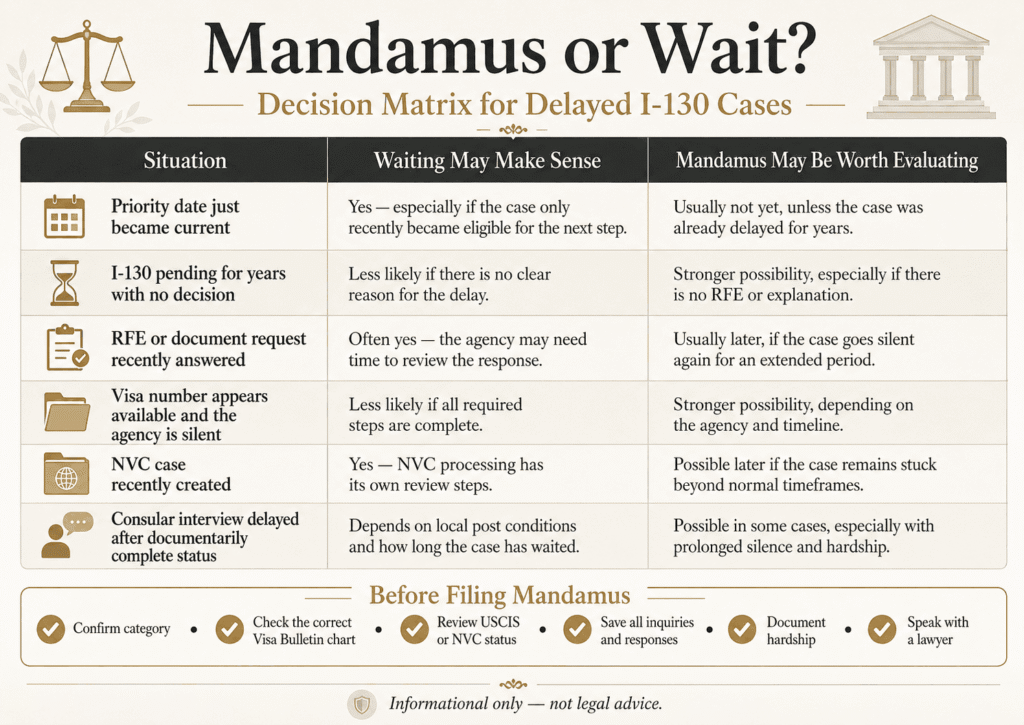
Mandamus or Wait? A Practical Decision Matrix
The table below is not a legal conclusion. It is a practical way to organize the first review of your case.
| Situation | Waiting may make sense | Mandamus may be worth evaluating |
|---|---|---|
| Priority date just became current | Yes, especially if the case recently became eligible for the next step. | Usually not yet, unless the case was already delayed for years. |
| I-130 pending for years with no decision | Less likely if there is no clear reason for the delay. | Stronger possibility, especially if there is no RFE or explanation. |
| RFE or document request recently answered | Often yes. The agency may need time to review the response. | Usually later, if the case goes silent again for an extended period. |
| Visa number appears available and agency is silent | Less likely if all required steps are complete. | Stronger possibility, depending on the agency and timeline. |
| NVC case recently created | Yes. NVC processing has its own review steps. | Possible later if the case remains stuck beyond normal timeframes. |
| Consular interview delayed after documentarily complete status | Depends on local post conditions and how long the case has waited. | Possible in some cases, especially with prolonged silence and hardship. |
What a Mandamus Lawsuit Can and Cannot Do in an I-130 Case
A mandamus lawsuit asks a federal court to compel the government to act on an unreasonably delayed case. In immigration delay cases, it is often paired with claims under the Administrative Procedure Act.
The American Immigration Council and the National Immigration Litigation Alliance describe immigration-related delay actions as federal district court cases that may be brought under the Mandamus Act and the APA. These cases require careful legal framing because the government may argue that the delay is reasonable, that the court lacks jurisdiction, or that the agency has discretion over timing.
Mandamus can push the government to act
The practical goal is movement. In an I-130 delay case, that may mean USCIS finally adjudicates the petition. In a related green card case, it may mean the agency takes action on the I-485, NVC stage, or consular processing issue, depending on the facts and defendants involved.
Our page on how the mandamus lawsuit process works explains the typical steps: case review, lawsuit preparation, filing and service, government response, and final agency action.
Mandamus does not guarantee approval
This is critical. Mandamus does not ask the judge to approve your I-130 or green card. It asks the court to require the agency to make a decision. That decision could be an approval, denial, RFE, NOID, interview scheduling, or another form of agency action.
Mandamus cannot create a visa number
If your category is not current under the correct chart, mandamus cannot make a visa number available. This is why the priority date analysis must be accurate before filing.
Mandamus may still help when the real problem is agency inaction
If the visa number is available, the case is ready, and the agency has no clear reason for prolonged silence, mandamus may become a practical tool. The strongest cases usually involve a clean record of delay, repeated unsuccessful inquiries, and a timeline that is difficult for the government to justify.
What to Check Before Filing Mandamus
Before filing a mandamus lawsuit, review the case carefully. Filing too early can waste time and money. Waiting too long can prolong a delay that may already be unreasonable.
- Confirm your category. Immediate relatives, F1, F2A, F2B, F3, and F4 cases are not the same.
- Check the correct Visa Bulletin chart. Review both Final Action Dates and Dates for Filing, and confirm which chart USCIS allows for adjustment filings that month.
- Review your USCIS case status. Check whether the I-130 is pending, approved, transferred, or tied to a pending I-485.
- Check NVC status if consular processing applies. Confirm whether the case was created, fees were paid, documents were submitted, and the case is documentarily complete.
- Save all inquiries and responses. Keep USCIS service requests, NVC public inquiries, congressional inquiry responses, and email notices.
- Identify hardship. Document family separation, financial loss, medical issues, job consequences, or other real-life impact.
- Speak with a mandamus lawyer. A delay that feels unreasonable may or may not be legally strong. The full record matters.
If you are still unsure, our mandamus lawsuit FAQ answers common questions about timing, risk, cost, and what happens after filing.
FAQ: I-130 Priority Date Current But No Action
Does a current priority date mean my green card should be approved immediately?
No. A current priority date means the case may be eligible to move forward if other requirements are met. It does not automatically approve the I-130, schedule a consular interview, or grant permanent residence.
Can I file mandamus if my I-130 is still pending?
Possibly. If the I-130 has been pending for an unusually long time and there is no clear reason for the delay, mandamus may be worth evaluating. The strength of the case depends on the full timeline, category, agency history, and evidence of prior inquiries.
Can mandamus help if my case is at NVC?
In some cases, yes. But first you need to confirm where the case is stuck. NVC case creation, document review, documentarily complete status, and interview scheduling are different stages.
What if my case is waiting for a consular interview?
A consular interview delay can sometimes be reviewed for mandamus, especially if the case has been documentarily complete for a long time and there is no meaningful explanation. Consular delay cases are fact-specific and should be reviewed carefully.
How long should I wait after my priority date becomes current?
There is no single rule. If the case just became current, waiting may be reasonable. If the case has already been pending for years, the current priority date may strengthen the argument that continued silence is unreasonable.
Can mandamus hurt my immigration case?
Mandamus is a lawful way to seek action on a delayed case. It does not ask for special treatment or an unlawful benefit. Still, the case should be filed only after careful review because the agency may respond by issuing any lawful decision, including a denial if the record does not support approval.
Conclusion
If your I-130 priority date is current but still no action has been taken, do not assume the answer is simply to wait forever. First, confirm what “current” means for your category and whether the correct Visa Bulletin chart applies. Then identify where the case is stuck: USCIS, NVC, the consulate, or adjustment of status.
Waiting may make sense when the case recently moved, a document request is pending, or NVC is still within normal timeframes. Mandamus may become a serious option when the case is ready, the delay is long, the agency provides no real explanation, and your family continues to suffer from uncertainty.
Your case delay is not your fault. A mandamus lawsuit is a legal remedy against unreasonable USCIS, NVC, and consular delays and often speeds up the path to a decision. Contact My Mandamus Lawyer for a free case evaluation or call (862) 799-2200.
Legal Disclaimer
This article is provided for general informational purposes only and does not constitute legal advice. Every immigration case has unique circumstances. For legal guidance specific to your situation, we recommend consulting with an experienced immigration attorney. The information in this article reflects laws and policies as of the publication date; subsequent changes may affect its accuracy.
Sources
- Visa Bulletin for May 2026, U.S. Department of State, May 2026.
- Visa Availability and Priority Dates, USCIS.
- Adjustment of Status Filing Charts from the Visa Bulletin, USCIS.
- NVC Timeframes, U.S. Department of State.
- Mandamus and APA Delay Cases: Avoiding Dismissal and Proving the Case, American Immigration Council and National Immigration Litigation Alliance, February 19, 2021.
- Immigration Processing Delays Prompt Record Number of Mandamus Lawsuits, TRAC Reports, May 15, 2023.