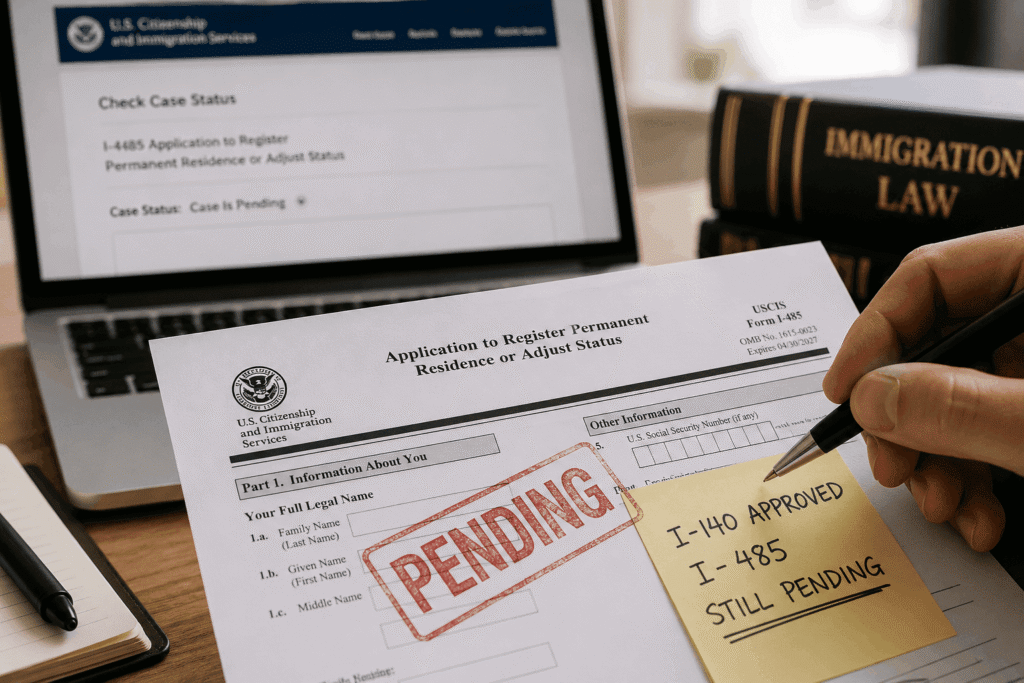
Your I-140 is approved. Your employer-sponsored green card case should feel close to the finish line. Yet your Form I-485 is still pending, your case status has not meaningfully changed, and every month of waiting makes your job, travel, family plans, and long-term security harder to manage.
An i-485 employment based delay can be especially frustrating because many applicants assume that I-140 approval means the hard part is over. In reality, the I-140 and I-485 are separate steps. USCIS still has to adjudicate your adjustment of status application before you become a lawful permanent resident.
This guide explains why employment-based I-485 cases get stuck, when a delay may no longer be normal, what to check before filing a lawsuit, and how a mandamus lawsuit may help force USCIS to make a decision.
In This Article
- The Specific Pattern: I-140 Approved, I-485 Still Pending
- Why Employment-Based I-485 Cases Get Stuck
- When Is an I-485 Employment-Based Delay No Longer Normal?
- What You Should Do Before Considering Mandamus
- How Mandamus Can Help End an I-485 Delay
- When Mandamus May Not Be the Right Move
- What a Strong Employment-Based I-485 Mandamus Case Looks Like
- Frequently Asked Questions About I-485 Employment-Based Delay
The Specific Pattern: I-140 Approved, I-485 Still Pending
Employment-based green card cases often involve several moving parts. The employer or self-petitioner may first need an approved immigrant petition, usually Form I-140. After that, the applicant may pursue adjustment of status through Form I-485 if they are eligible to apply from inside the United States.
The problem starts when the first major step is already done, but the final adjustment decision never comes. You may have an approved EB-1, EB-2, or EB-3 petition. You may have completed biometrics. You may have responded to every request from USCIS. Still, the I-485 remains pending month after month.
What I-140 approval actually means
I-140 approval means USCIS approved the immigrant worker petition. In most employment-based cases, that approval confirms the underlying employment-based classification, such as EB-1, EB-2, or EB-3. It does not, by itself, make you a green card holder.
Why I-485 is a separate decision
Form I-485 asks USCIS to grant lawful permanent residence through adjustment of status. USCIS may still review admissibility, visa availability, medical exam records, security checks, immigration history, and employment continuity before making a final decision.
Why “approved I-140” does not automatically mean green card approval
An approved I-140 is a strong foundation, but it is not the final step. That is why the phrase I-140 approved I-485 stuck describes a real and common problem. The petition is approved, but the adjustment application is still waiting for agency action.
| Stage | What It Means | What It Does Not Mean |
|---|---|---|
| I-140 Approved | USCIS accepted the employment-based immigrant petition. | It does not automatically approve the green card. |
| I-485 Pending | USCIS is still reviewing adjustment of status. | It does not always mean the case has a problem. |
| Priority Date Current | A visa number may be available under the relevant chart. | It does not guarantee immediate USCIS action. |
Why Employment-Based I-485 Cases Get Stuck
There is no single explanation for every EB-2 EB-3 I-485 delay. Some delays are tied to visa number availability. Others are tied to USCIS workload, security review, file transfers, outdated medical records, or unresolved requests for evidence.
The key question is whether USCIS has a legally defensible reason for the delay or whether the case has fallen into a period of unreasonable agency inaction.
Visa Bulletin and priority date issues
Employment-based green card cases are subject to numerical limits. The U.S. Department of State’s May 2026 Visa Bulletin explains that employment-based immigrant visas are divided by preference category and chargeability area. It also explains the difference between Final Action Dates and Dates for Filing.
If your priority date is not current under the chart USCIS is using for adjustment of status, USCIS may not be able to approve your I-485 even if your I-140 is approved. If your priority date is current and the file has no obvious missing item, the delay may deserve a closer look.
Background checks and security review
Some I-485 cases remain pending because USCIS is waiting on background checks, security screening, or internal review. That explanation may be legitimate for some period of time. But when the same vague explanation continues for years, the applicant may need to ask whether the agency is still actively working on the case.
RFE, medical exam, and file movement problems
An RFE can also explain part of a delay. So can a missing or outdated Form I-693 medical exam, a field office transfer, or a file that has moved between service centers. Before considering litigation, review your notices carefully.
- Check every USCIS notice to confirm whether a response is still pending.
- Review your medical exam history to see whether USCIS may request an updated Form I-693.
- Confirm your address history so you do not miss notices or interview letters.
- Track all service requests and save USCIS responses.
A delayed I-485 is not always a lawsuit-ready case. The stronger question is whether USCIS has everything it needs and still has not made a decision.
When Is an I-485 Employment-Based Delay No Longer Normal?
Applicants often ask a simple question: “How long is too long?” The honest answer is that time matters, but time alone is not the whole test. A 24-month delay may be serious in one case and less clear in another, depending on visa availability, pending requests, case complexity, and what USCIS has actually done during that time.
Pending time alone is not enough
A long wait is the starting point. It is not the full legal analysis. Courts often look at whether the agency has a reasonable explanation, whether Congress gave the agency a specific timetable, whether the delay affects health, welfare, employment, or family stability, and whether court action would improperly interfere with other agency priorities.
Priority date must be checked first
In an employment-based case, priority date analysis comes before mandamus strategy. If the Visa Bulletin does not permit final action on your category and country of chargeability, the lawsuit may not be able to force an approval. If the priority date is current, the question becomes stronger: why has USCIS not decided?
Is USCIS outside its own processing range?
USCIS publishes a processing time tool that allows applicants to check estimated processing ranges by form, category, and office. The tool is not the final word on whether a delay is legally unreasonable. Still, it is an important practical reference point before taking legal action.
Has the case been ready for decision?
A mandamus review becomes more compelling when the case appears ready for decision. That usually means the I-140 is approved, the I-485 has been pending for a long period, the priority date is current, there is no pending RFE, and the applicant has made reasonable follow-up efforts without receiving a meaningful answer.
| Delay Factor | Less Helpful for Mandamus | More Helpful for Mandamus |
|---|---|---|
| Priority Date | Not current | Current under the applicable chart |
| I-140 Status | Still pending or disputed | Approved and stable |
| I-485 Timeline | Recently filed | Pending 18 to 24+ months |
| RFE Status | Response still pending | No pending RFE or applicant-caused delay |
| USCIS Explanation | Specific and recent | Vague, repeated, or absent |
What You Should Do Before Considering Mandamus
Before filing an I-485 delay mandamus lawsuit, you should gather the facts. Mandamus is not just about being tired of waiting. It is about showing that the government has had enough time and enough information to act, yet still has not made a decision.
A practical pre-filing review should focus on the documents and facts that show your case is ready for adjudication.
- Confirm the I-140 approval date and employment-based category.
- Check whether your priority date is current under the correct Visa Bulletin chart.
- Review all I-485 receipt notices, biometrics notices, RFEs, and responses.
- Check whether your medical exam is still acceptable for the pending application.
- Save USCIS service request responses and congressional inquiry replies.
- Document job-related harm, travel limitations, family stress, or financial loss caused by the delay.
| Question | Why It Matters |
|---|---|
| Is your priority date current? | USCIS may not be able to approve the I-485 if a visa number is unavailable. |
| Is your I-140 approved? | The employment-based immigrant petition foundation is already resolved. |
| Has the I-485 been pending 18 to 24+ months? | A long delay can strengthen the unreasonable-delay argument. |
| Did USCIS issue an RFE? | A pending or recently answered RFE may explain part of the wait. |
| Have you made inquiries? | Prior follow-up efforts can show that waiting has not solved the problem. |
This review also helps avoid a common mistake: filing too early or filing with an incomplete record. A strong lawsuit usually starts long before the complaint is drafted. It starts with a clean timeline and a clear explanation of why the delay is no longer reasonable.
If USCIS has had your I-485 for years, your I-140 is approved, and your priority date is current, the issue may no longer be simple delay. It may be time to ask whether the delay has become legally unreasonable.
How Mandamus Can Help End an I-485 Delay
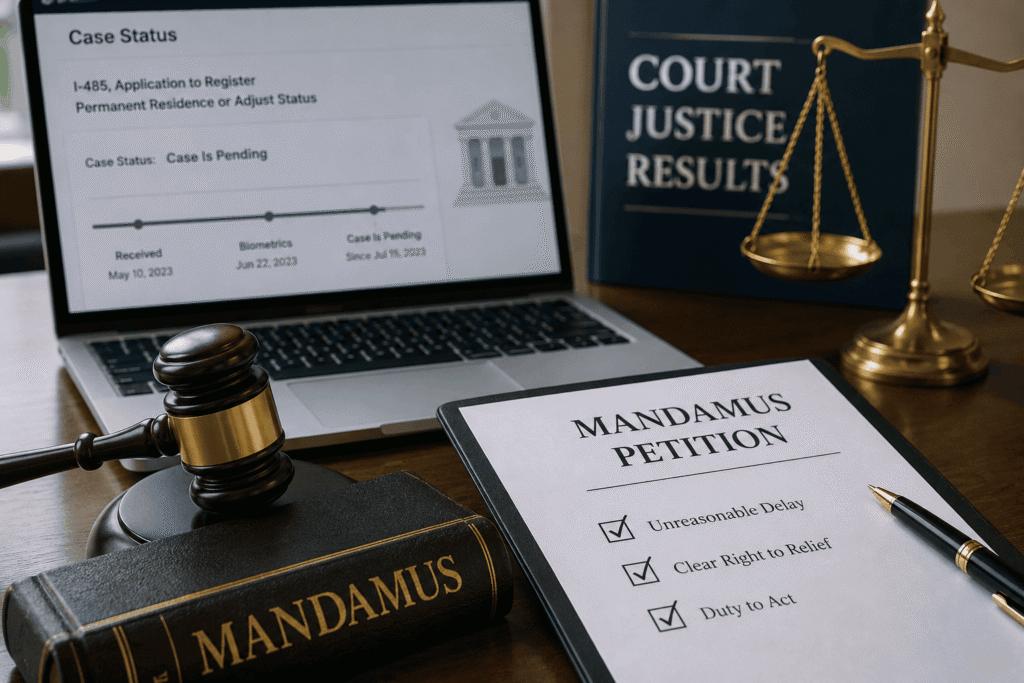
A writ of mandamus is a federal court action that asks a judge to compel a government agency to perform a duty it is legally required to perform. In immigration delay cases, the practical goal is usually to push USCIS to adjudicate the delayed application.
Mandamus does not ask the court to ignore eligibility rules. It does not ask the judge to rubber-stamp a green card. It asks the court to address the agency’s failure to act within a reasonable time.
Mandamus is about action, not guaranteed approval
This point matters. A mandamus lawsuit generally seeks a decision. That decision may be an approval, a denial, an RFE, a notice of intent to deny, or another concrete agency action. For many applicants, a decision is exactly what they need because years of silence have already caused serious harm.
Why federal court pressure can change the timeline
Once the lawsuit is filed and the government is served, the case receives attention from agency counsel and the U.S. Attorney’s Office. That does not mean every case resolves immediately. It does mean the delay is no longer just an internal USCIS queue issue. It becomes a federal court matter with deadlines and accountability.
Why employment-based cases can be strong mandamus candidates
Employment-based cases often involve clear paper records: I-140 approval, I-485 receipt, biometrics, priority date history, employer sponsorship, and evidence of long delay. When the priority date is current and USCIS has no obvious missing item, a long-pending EB-2 or EB-3 adjustment case may present a serious mandamus question.
The legal framework often includes the Administrative Procedure Act. Under 5 U.S.C. § 555, agencies are generally expected to conclude matters presented to them within a reasonable time. Under 5 U.S.C. § 706, a reviewing court may compel agency action unlawfully withheld or unreasonably delayed.
For a broader comparison, see our guide on mandamus and APA lawsuit strategy.
| What Mandamus Can Do | What Mandamus Cannot Promise |
|---|---|
| Ask a federal court to compel USCIS action. | Guarantee green card approval. |
| Bring legal pressure and deadlines into the case. | Erase eligibility or admissibility issues. |
| Push USCIS to review a long-pending file. | Make an unavailable visa number available. |
| Turn a silent delay into a litigated issue. | Control exactly how USCIS decides the case. |
If your I-140 is approved and your I-485 has been pending for years, the better question is not simply “why is USCIS delayed?” The real question is whether the delay has become legally unreasonable. A mandamus review can help you understand that line before you spend more months waiting.
When Mandamus May Not Be the Right Move
Mandamus is powerful, but it is not the right answer for every employment-based green card delay. A careful attorney should look for weaknesses before filing. That protects the applicant from spending money on a lawsuit that may not be strategically sound.
Your priority date is not current
If your priority date is not current, USCIS may be unable to approve the I-485 because an immigrant visa number is not available. In that situation, a mandamus lawsuit may face a major obstacle. The analysis may change if USCIS is failing to take a different required action, but the expectation must be realistic.
USCIS is waiting for your response
If USCIS issued an RFE and you have not responded, the delay is not simply agency inaction. The same is true if USCIS requested a medical exam, updated job offer evidence, or other documents and the response is still pending.
There are serious eligibility issues
Mandamus can force action, but it cannot erase admissibility problems, status violations, fraud concerns, criminal issues, or unresolved employment eligibility questions. If the record contains serious issues, filing a lawsuit may cause USCIS to act faster, but the action may not be favorable.
The delay is frustrating but still defensible
Some delays are painful but still within a range the government can defend. That is why a case-specific review matters. You want to know whether your facts support litigation before filing in federal court. If you already have an immigration attorney, you may still need a mandamus lawyer who focuses on federal delay litigation.
- Do not file blindly if the priority date is not current.
- Do not ignore USCIS notices that request documents or responses.
- Do not assume delay means approval is guaranteed once USCIS acts.
- Do not treat every case the same, especially if there are admissibility issues.
What a Strong Employment-Based I-485 Mandamus Case Looks Like
A strong I-485 mandamus employment based case usually has a clean and practical story. The applicant did what they were supposed to do. The employer or petitioner did what they were supposed to do. USCIS has the file, the priority date is available, and the delay has continued without a meaningful explanation.
- Approved I-140: The underlying immigrant worker petition has already been granted.
- Current priority date: The applicant appears eligible for final action under the relevant Visa Bulletin chart.
- Long I-485 delay: The adjustment application has been pending for an unusually long period, often 18 to 24 months or more.
- No pending RFE: USCIS is not waiting for the applicant to submit a missing response.
- Documented follow-up: The applicant has made service requests, inquiries, or other reasonable attempts to resolve the delay.
- Real harm: The delay affects employment, promotion opportunities, travel, family planning, or long-term security.
This is where a lawsuit can become more than a threat. It becomes a structured legal argument: USCIS has a duty to decide, the applicant has waited long enough, and the lack of action has become unreasonable under the facts.
The American Immigration Council and NILA’s practice advisory on Mandamus and APA Delay Cases also emphasizes the need to plead delay cases carefully and avoid dismissal risks. In practical terms, that means your complaint should not be generic. It should explain your timeline, the agency duty, the harm caused by the delay, and why the government’s silence is no longer reasonable.
| Strong Case Feature | How It Supports the Lawsuit |
|---|---|
| Approved I-140 | Shows that the employment-based petition has already been resolved. |
| Current Priority Date | Supports the argument that USCIS may be able to act now. |
| Long Pending I-485 | Helps show that the delay is more than routine processing time. |
| No Pending RFE | Reduces the chance that USCIS can blame the applicant for delay. |
| Documented Harm | Shows the real-world impact of government inaction. |
Frequently Asked Questions About I-485 Employment-Based Delay
Can I file mandamus if my I-140 is approved but I-485 is pending?
Possibly. An approved I-140 is helpful, but the full analysis depends on your priority date, I-485 timeline, USCIS processing history, pending requests, and whether the case appears ready for decision.
Does mandamus force USCIS to approve my green card?
No. Mandamus generally seeks agency action, not a guaranteed approval. USCIS may approve, deny, issue an RFE, or take another action. The goal is to end unreasonable silence and force the agency to move the case forward.
Can I file mandamus if my priority date is not current?
That is usually more difficult. If a visa number is unavailable, USCIS may have a strong defense for not approving the I-485. You should review the Visa Bulletin and USCIS adjustment chart before deciding whether litigation makes sense.
Is a 24-month I-485 delay enough for mandamus?
A 24-month delay can be significant, especially if the priority date is current and there is no pending RFE. But the strength of the case depends on the full record. Time matters, but it is not the only factor.
Will suing USCIS hurt my immigration case?
Filing a lawsuit is a legal right. USCIS must still decide the case based on the law and facts. That said, a lawsuit can bring attention to unresolved issues in the file, so the case should be reviewed carefully before filing.
Can EB-2 and EB-3 applicants use mandamus?
Yes, EB-2 and EB-3 applicants may be candidates for mandamus when their adjustment applications are unreasonably delayed. The strongest cases usually involve an approved I-140, a current priority date, a long-pending I-485, and no applicant-caused delay.
Conclusion: Waiting Is Not Always the Only Option
If your I-140 is approved and your I-485 is still pending, you are not wrong to feel stuck. But the right next step is not simply to file a lawsuit because you are frustrated. The right step is to determine whether your case is legally ready for action.
For employment-based applicants, that review starts with the priority date, Visa Bulletin category, I-140 approval, pending I-485 timeline, USCIS notices, and evidence of harm. If those facts line up, mandamus may be a serious way to end delay and push USCIS toward a decision.
Your case delay is not your fault. A mandamus lawsuit is a legal remedy against unreasonable USCIS delays and often speeds up the path to a decision. Contact My Mandamus Lawyer for a free case evaluation or call (862) 799-2200.
Legal Disclaimer
This article is provided for general informational purposes only and does not constitute legal advice. Every immigration case has unique circumstances. For legal guidance specific to your situation, we recommend consulting with an experienced immigration attorney. The information in this article reflects laws and policies as of the publication date; subsequent changes may affect its accuracy.
Sources
- USCIS Processing Times, U.S. Citizenship and Immigration Services, accessed May 22, 2026.
- While Your Green Card Application Is Pending with USCIS, U.S. Citizenship and Immigration Services, accessed May 22, 2026.
- Adjustment of Status Filing Charts from the Visa Bulletin, U.S. Citizenship and Immigration Services, accessed May 22, 2026.
- Visa Bulletin for May 2026, U.S. Department of State, May 2026.
- 5 U.S.C. § 555, Ancillary Matters, Legal Information Institute, Cornell Law School, accessed May 22, 2026.
- 5 U.S.C. § 706, Scope of Review, Legal Information Institute, Cornell Law School, accessed May 22, 2026.
- Mandamus and APA Delay Cases: Avoiding Dismissal and Proving the Case, American Immigration Council and National Immigration Litigation Alliance, January 2025.