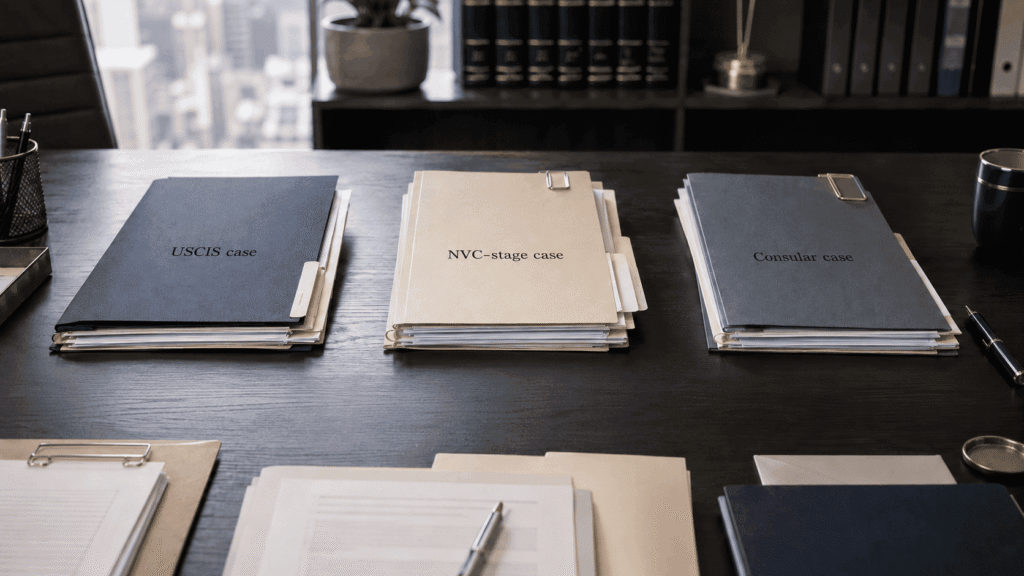
Your immigration case has been waiting for 18 months. That number sounds significant, but it does not reveal which agency controls the next step or what government action remains unfinished. An I-130 petition pending at USCIS, a documentarily complete immigrant visa case waiting for an interview, and a visa application in post-interview administrative processing may all have the same age while presenting very different legal issues.
This distinction matters because an immigration delay is not evaluated by elapsed time alone. The responsible agency, the procedural stage, visa availability, the applicant’s remaining obligations, the government’s explanation, and the consequences of continued waiting can all change the analysis. This guide compares three hypothetical 18-month cases to show why the same wait does not necessarily mean the same lawsuit.
In This Article Three Immigration Delay Scenarios
- Three Applicants, One 18-Month Wait
- Scenario One: An 18-Month USCIS Delay
- Scenario Two: An 18-Month NVC-Stage Delay
- Scenario Three: An 18-Month Consular Delay
- Why the Same 18 Months Carries Different Legal Weight
- USCIS, NVC, and Consular Delays Side by Side
- How the Evidence Changes at Each Stage
- What Would Each Lawsuit Ask the Court to Do?
- Common Mistakes When Comparing Delay Cases
- Frequently Asked Questions
Three Applicants, One 18-Month Wait
Consider three hypothetical applicants. Each has been waiting for 18 months, each has contacted the government, and each believes the case has stopped moving. Their timelines may sound similar, but they are not waiting for the same action, and they may not be waiting on the same government component.
| Scenario | Current Stage | What Appears to Be Pending |
|---|---|---|
| Case A | Form I-130 pending with USCIS | USCIS has not adjudicated the petition. |
| Case B | Documentarily complete immigrant visa case | No consular interview has been scheduled. |
| Case C | Interview completed; visa refused under INA § 221(g) | Administrative processing remains incomplete. |
The first question is therefore not simply, “How long have you waited?” A meaningful evaluation begins by asking where the file is now, which step remains incomplete, and which agency or office controls that step.
Scenario One: An 18-Month USCIS Adjudication Delay
In the first scenario, a U.S. citizen filed Form I-130 for a spouse abroad. USCIS issued a receipt notice 18 months ago, but the petition remains pending. There has been no approval, denial, Request for Evidence, or interview. The unfinished action is relatively clear: USCIS has not completed its adjudication, and the case has not yet reached the Department of State.
USCIS publishes processing-time information by form, category, and processing office. Its official tool instructs users to select the relevant form, category, and office shown on the receipt notice. These estimates provide useful context, but they are not universal statutory deadlines, and exceeding a published estimate does not automatically establish an unreasonable delay claim.
The USCIS timeline should include more than the original filing date. Relevant dates may include:
- The receipt date shown on Form I-797;
- Biometrics or interview dates, if applicable;
- The date USCIS issued an RFE or Notice of Intent to Deny;
- The date the applicant responded to an agency request;
- Any transfer between service centers or field offices;
- Service requests, congressional inquiries, or Ombudsman communications;
- The date of the agency’s last meaningful case-specific action.
USCIS may point to workload, background checks, processing priorities, missing records, fraud review, or applicant-attributed delay. A court evaluating agency delay may also consider how ordering action in one case would affect other cases in the agency’s queue. In Da Costa v. Immigration Investor Program Office, the D.C. Circuit emphasized that processing systems and competing priorities matter when evaluating delay, even where applicants have already waited for several years.
A USCIS lawsuit would not normally ask the federal judge to approve the I-130. It would seek an order requiring the agency to perform the legally required adjudicative action within a reasonable period, while leaving the substantive immigration decision to USCIS. Our guide to an APA § 706(1) lawsuit for USCIS delays explains this agency-action theory in greater detail.
Scenario Two: An 18-Month NVC-Stage Delay
The second applicant’s I-130 has already been approved. The fees, Form DS-260, Affidavit of Support, financial evidence, and civil documents were submitted, and NVC declared the case documentarily complete 18 months ago. The applicant is still waiting for an immigrant visa interview.
This situation is often described as an “NVC delay,” but that label may oversimplify responsibility. Under the Department of State’s Immigrant Visa Scheduling Status Tool guidance, NVC works with the assigned embassy or consulate to schedule interviews. The embassy provides available appointment dates, and NVC generally assigns those appointments based on the documentarily complete date and the availability of visa numbers and interview capacity.
Before treating the 18 months as government inaction, the file should be checked for several threshold issues:
- Did NVC formally mark the case documentarily complete?
- Does CEAC show every required fee and document as accepted?
- Is the beneficiary an immediate relative, or is the case subject to annual visa limits?
- If it is a preference case, is the priority date current under the Final Action Dates chart?
- Does the IV Scheduling Status Tool show that the embassy is scheduling cases with later documentarily complete dates?
- Has the embassy reduced or suspended immigrant visa services?
- Was a transfer request, category change, or derivative-family issue introduced?
NVC publishes separate weekly timeframes for case creation, document review, and responses to Public Inquiry Form submissions. As of July 20, 2026, the published case-creation and inquiry timeframes were measured in days, while document review covered submissions from the previous month. An individual file that has remained unresolved for 18 months therefore requires a case-specific explanation, not merely a comparison to the current general NVC workload.
A post-DQ interview delay may be influenced by embassy capacity, staffing, local conditions, case volume, transfer requests, visa availability, or vetting timelines. This means the litigation analysis must identify whether NVC is failing to perform a task it controls or whether the assigned consular post has not supplied an interview slot.
Your case is documentarily complete. Why is there still no interview?
Our federal litigation team can review your NVC notices, CEAC history, documentarily complete date, visa availability, Public Inquiry responses, embassy scheduling data, and the effects of continued family separation. We will identify which government component controls the next step and whether the delay may support federal litigation.
Scenario Three: An 18-Month Consular Administrative Processing Delay
The third applicant has already attended the visa interview. The consular officer refused the application under INA § 221(g), and the CEAC status now displays “Refused.” The applicant submitted every requested document, but 18 months have passed without a final resolution.
The Department of State explains that a 221(g) refusal may involve either missing information from the applicant or additional administrative processing by the government. Those situations must be separated. A person who has not submitted a requested police certificate, financial record, passport, or supplemental form is not in the same position as an applicant who completed every instruction and was told that no further action is required.
The word “Refused” on CEAC also does not necessarily mean the administrative process has ended. The Department of State changed CEAC terminology so that cases previously shown as “Administrative Processing” may appear as “Refused” because a 221(g) refusal has technically occurred. The application may later be reconsidered after the applicant submits the requested material or after the government completes its review.
Relevant records may include:
- The interview appointment notice;
- The written 221(g) notice;
- Any Form DS-5535 request and the completed response;
- Proof that requested documents were submitted;
- CEAC status screenshots and update dates;
- Embassy or consulate email responses;
- Passport-submission or passport-return requests;
- Evidence that no further applicant action remains outstanding.
Consular cases can present additional threshold disputes about reviewability, the effect of an existing refusal, and whether a discrete adjudicative action remains unfinished. In Mehneh v. Rubio, the D.C. Circuit affirmed the dismissal of unreasonable-delay complaints involving visa applications that had remained in administrative processing for seven and sixteen months. The decision illustrates that the passage of time does not decide the case by itself, particularly where the court considers the full procedural and agency context.
For a more detailed explanation of missing-document refusals, security screening, and prolonged post-interview processing, see our guide to 221(g) administrative processing delays.
Eighteen months is evidence, not a legal verdict. The real question is what remains pending, who controls it, and why that step has not been completed.
Why the Same 18 Months Carries Different Legal Weight
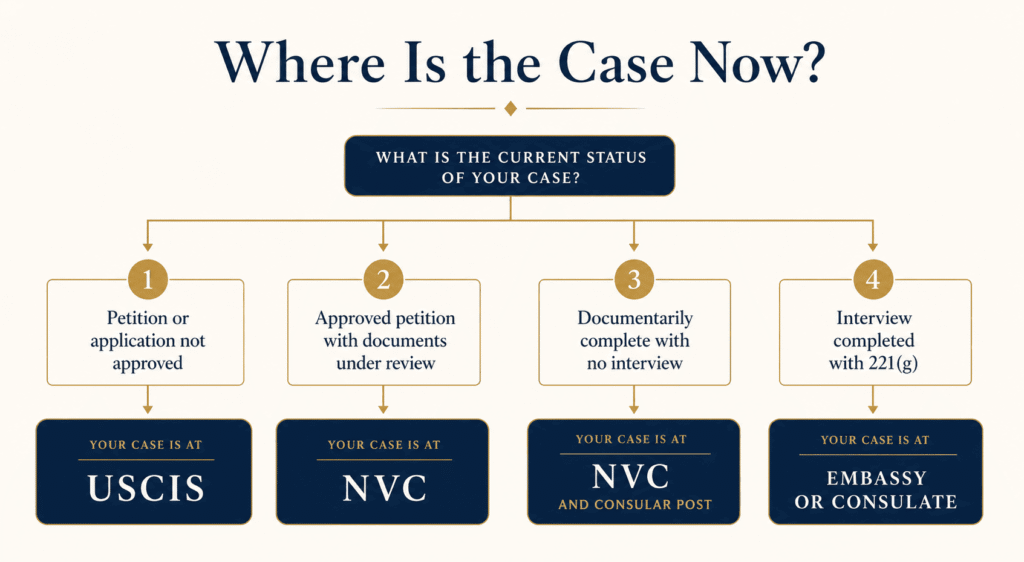
Federal courts commonly use the framework associated with Telecommunications Research & Action Center v. FCC to evaluate unreasonable agency delay. The complete six-factor analysis is covered in our existing guide to the TRAC factors for unreasonable immigration delay. This article does not repeat those six factors. Instead, it shows why the factual inputs change by agency stage and why the same length of time can lead to different conclusions.
The comparison turns on several practical questions:
- What action remains pending? USCIS adjudication, NVC processing, interview scheduling, or post-interview visa processing?
- Who controls the next step? USCIS, NVC, the assigned embassy, the Department of State, or another agency involved in vetting?
- Has the applicant completed every requirement? A missing response can materially change the timeline.
- Is a visa legally available? NVC cannot schedule certain preference cases when the priority date is not current.
- Is the case waiting in a general queue or on a case-specific hold? The government may rely on different explanations in each setting.
- What harm is the delay causing? Family separation, employment loss, medical hardship, safety concerns, or expiring eligibility may affect the factual presentation.
A long wait is therefore only the beginning of the analysis. The complaint must connect the procedural history to a government obligation and explain why continued inaction has become unreasonable in that particular case.
USCIS, NVC, and Consular Delays Side by Side
| Issue | USCIS Delay | NVC-Stage Delay | Consular Delay |
|---|---|---|---|
| Typical posture | Petition or application remains pending. | Approved petition is undergoing NVC processing or awaiting interview scheduling. | Interview occurred and the application is in 221(g) processing. |
| Primary government component | USCIS / DHS | NVC / Department of State, working with the consular post | Embassy or consulate / Department of State |
| Key dates | Receipt, interview, RFE response, last meaningful action | USCIS approval, NVC receipt, document submission, DQ date | Interview, 221(g), DS-5535, requested-document submission |
| Common explanation | Workload, security checks, evidence review, transfer, competing priorities | Document issues, visa availability, embassy capacity, scheduling queue | Additional documents, administrative processing, interagency vetting |
| Typical requested movement | Complete adjudication. | Complete the pending NVC-controlled step or move scheduling forward when legally available. | Complete processing and take lawful action on the visa application. |
The table shows why “my case has been delayed for 18 months” is not enough information for a federal litigation assessment. Each column requires a different procedural record, a potentially different set of defendants, and a differently framed request for relief.
How the Evidence Changes at Each Stage
A strong evaluation begins with a complete chronology, but the most important documents change depending on where the case is pending.
Evidence for a USCIS Delay
- Receipt, biometrics, transfer, and interview notices;
- RFE or NOID notices and proof of response;
- Case-status history and processing-time comparisons;
- Service requests and USCIS responses;
- Congressional or Ombudsman inquiry records;
- Evidence of family, medical, employment, or financial harm.
Evidence for an NVC-Stage Delay
- USCIS approval notice and NVC Welcome Letter;
- CEAC fee, form, and document records;
- The documentarily complete notice and date;
- Public Inquiry Form submissions and responses;
- Visa Bulletin records, if the category is numerically limited;
- IV Scheduling Status Tool results for the assigned post.
Evidence for a Consular Delay
- Interview appointment and 221(g) notices;
- DS-5535 or other supplemental questionnaire responses;
- Proof that every requested item was submitted;
- CEAC status screenshots and update history;
- Embassy correspondence and inquiry responses;
- Evidence of hardship caused by continued post-interview separation.
The goal is not to produce the largest possible stack of documents. The evidence should show what the applicant completed, what the government still has not completed, and whether there is a documented explanation for the gap.
What Would Each Lawsuit Ask the Court to Do?
A federal delay lawsuit must identify the agency action that has allegedly been unlawfully withheld or unreasonably delayed. Under 5 U.S.C. § 706(1), a court may compel agency action unlawfully withheld or unreasonably delayed. The Mandamus Act, 28 U.S.C. § 1361, provides jurisdiction over certain actions seeking to compel a federal officer or agency to perform a duty owed to the plaintiff.
The requested action may differ by scenario:
- USCIS case: Complete adjudication of the pending petition or application.
- NVC-stage case: Complete a delayed NVC-controlled processing step or move the case through scheduling when the legal and operational prerequisites are satisfied.
- Consular case: Complete the pending post-interview processing and take lawful action on the visa application.
These lawsuits generally seek agency action rather than guaranteed approval. The government may approve, deny, request evidence, schedule an interview, continue a lawful review, or take another action authorized by law. Our comparison of immigration mandamus and APA lawsuits explains why both claims are often considered in delayed immigration cases.
Because the correct defendants, requested relief, venue, and litigation risks depend on the procedural stage, applicants should consult a mandamus lawyer who can identify the actual source of the delay before asking a federal court to require faster action.
A delay lawsuit must target the unfinished government action. Naming the wrong stage or treating USCIS, NVC, and the consulate as one interchangeable system can weaken the factual and legal presentation.
Common Mistakes When Comparing Immigration Delay Cases
Applicants often focus on the total number of months because it is the easiest fact to measure. That number matters, but several common errors can distort the evaluation:
- Treating USCIS, NVC, and a consular post as the same agency;
- Assuming every post-DQ interview delay is controlled exclusively by NVC;
- Ignoring whether the priority date is current and a visa is available;
- Counting periods when the applicant had not submitted required documents;
- Using USCIS processing times as if they were mandatory court-enforceable deadlines;
- Assuming that every 221(g) notice involves the same type of security check;
- Relying on CEAC update dates without preserving the underlying notices and correspondence;
- Asking a court to order approval instead of identifying a delayed government action;
- Comparing the case to an unrelated form, visa category, embassy, or procedural stage.
Another mistake is assuming that a favorable result in one case predicts the result in another. Our mandamus case-results guide illustrates how I-485, asylum, and 221(g) delays may move after litigation, but prior results do not guarantee a similar outcome, and each underlying immigration case must be reviewed independently.
Frequently Asked Questions
Is an 18-month immigration delay automatically unreasonable?
No. Eighteen months may be significant, but the legal analysis also considers the type of case and procedural stage, the government’s explanation, competing priorities, applicant-caused delays, visa availability, and the harm caused by continued waiting.
Are USCIS processing times legal deadlines?
Generally, no. USCIS processing times show how long selected forms and cases usually take and when a case inquiry may be submitted. They provide important factual context, but exceeding the estimate does not by itself prove that a delay is legally unreasonable.
Is NVC responsible for every delay before the visa interview?
No. NVC reviews documents and coordinates interview scheduling, but the assigned embassy or consulate provides appointment capacity. Visa availability, staffing, local conditions, vetting, and the consular post’s operating capacity may all affect scheduling. The first task is to determine which component controls the next step and whether every prerequisite has been satisfied.
Is my visa application still pending if CEAC says “Refused”?
Possibly. A case refused under INA § 221(g) may display “Refused” while the applicant submits requested documents or the government conducts administrative processing. The notice and embassy instructions are more informative than the status label alone, and the record should show whether any applicant action remains outstanding.
Can a federal judge order USCIS or a consulate to approve the case?
A mandamus or APA delay lawsuit generally seeks completion of government action, not a predetermined approval. The agency retains authority to apply the substantive immigration or visa standards. Litigation may seek a lawful decision or completed process, but it cannot guarantee a favorable result.
Which of the three scenarios is strongest for litigation?
There is no automatic ranking. A USCIS case may involve a clear pending adjudication but a substantial agency queue. An NVC-stage case may turn on document completeness, visa availability, and embassy capacity. A consular case may include additional threshold disputes about the effect of 221(g) and reviewability. The strongest case is the one with a well-documented procedural history, no unresolved applicant obligation, a clearly identified government action, and facts supporting why continued delay is unreasonable.
Should You Consider Federal Litigation for Your Immigration Delay?
Three applicants can each wait 18 months and still present three materially different cases. The USCIS applicant is waiting for petition adjudication. The documentarily complete applicant may be waiting for NVC and the embassy to coordinate an interview slot. The post-interview applicant may be waiting for the government to finish 221(g) administrative processing. The number is the same, but the responsible office, legal posture, evidence, and requested relief are different.
The most useful first step is to reconstruct the complete timeline and identify the government’s last meaningful action. Once the correct agency stage is clear, counsel can evaluate published processing information, visa availability, agency communications, hardship, relevant jurisdiction, and litigation risk. A careful assessment asks not only how long the case has waited, but also why this particular government step remains unfinished.
Has your case been waiting for 18 months or longer? The agency stage may determine your legal strategy.
Our team can review your USCIS notices, NVC and CEAC history, documentarily complete date, consular records, prior inquiries, visa availability, and hardship evidence. We will identify what government action remains pending and evaluate whether mandamus or APA litigation fits your circumstances.
Phone: +1 (862) 799-2200
Legal Disclaimer: This article is provided for general informational purposes only and does not constitute legal advice. Every immigration case has unique circumstances. For legal guidance specific to your situation, we recommend consulting with an experienced immigration attorney. The information reflects laws and policies as of the publication date; subsequent changes may affect its accuracy. Prior results do not guarantee a similar outcome.
Sources
- 5 U.S.C. § 706 — Scope of Review Under the Administrative Procedure Act
- 28 U.S.C. § 1361 — Federal Mandamus Jurisdiction
- Telecommunications Research & Action Center v. FCC, 750 F.2d 70 (D.C. Cir. 1984)
- Da Costa v. Immigration Investor Program Office, 80 F.4th 330 (D.C. Cir. 2023)
- Mehneh v. Rubio, D.C. Circuit, January 16, 2026
- USCIS — Case Processing Times
- USCIS — More Information About Case Processing Times
- Department of State — NVC Timeframes
- Department of State — Begin National Visa Center Processing
- Department of State — Immigrant Visa Scheduling Status Tool
- Department of State — Administrative Processing Information
- Department of State — CEAC Case Status Change for 221(g) Refusals