
September 18, 2026 is more than the effective date of another immigration policy change. For adjustment of status applicants, it can determine which public charge framework USCIS uses and which edition of Form I-485 the agency will accept.
DHS has rescinded the 2022 Public Charge Final Rule, with the rescission taking effect on September 18, 2026. The transition rules draw an important line between applications properly filed before that date and applications submitted on or after it. USCIS has also announced that a revised Form I-485 will accompany the change.
For applicants preparing a filing now, the practical question is not simply, “What is the new public charge rule?” It is when was the I-485 filed, which framework applies, and was the correct form edition used?
In This Article September 18 Public Charge Transition
- What Changes on September 18, 2026?
- Filed Before vs. On or After September 18
- The Form I-485 Edition Trap
- What Does the Public Charge Test Look Like After the Change?
- What Should Applicants Filing Before September 18 Check?
- What If USCIS Sends an RFE During the Transition?
- What If Your I-485 Is Already Delayed?
- Frequently Asked Questions
What Changes on September 18, 2026?
The DHS final rule published in the Federal Register rescinds most of the regulatory framework created by the 2022 Public Charge Final Rule. The change becomes effective on September 18, 2026.
Under the new approach, public charge determinations will return to a broader, individualized analysis based on the statute, applicable precedent, and the totality of the applicant’s circumstances. DHS has stated that officers may consider the statutory factors, receipt of means-tested public benefits when applicable, and other case-specific information relevant to whether the applicant is likely at any time to become a public charge.
USCIS Guidance Is Still Part of the Transition
The final rule does not replace the 2022 regulations with another detailed regulatory checklist. Instead, DHS stated that USCIS will issue subregulatory guidance and policy tools on or before the effective date to help officers apply the new framework.
That distinction matters for an article published on August 10. Applicants should not assume that every implementation detail has already been finalized. USCIS guidance, form instructions, and the Form I-485 page should be checked again immediately before filing.
A Revised Form I-485 Is Coming
USCIS has separately announced that it will publish a revised Form I-485, Application to Register Permanent Residence or Adjust Status. Older editions postmarked or electronically submitted on or after September 18 will not be accepted.
As of August 10, 2026, the USCIS Form I-485 page still lists the 01/20/25 edition. Applicants filing closer to September 18 should therefore verify the USCIS page again rather than relying on a form downloaded weeks earlier.
Filed Before vs. On or After September 18: Which Rules Apply?
The filing date is the central transition issue. DHS specifically addressed what happens to applications already pending when the new rule takes effect.
| I-485 Situation | Public Charge Framework | Key Practical Issue |
|---|---|---|
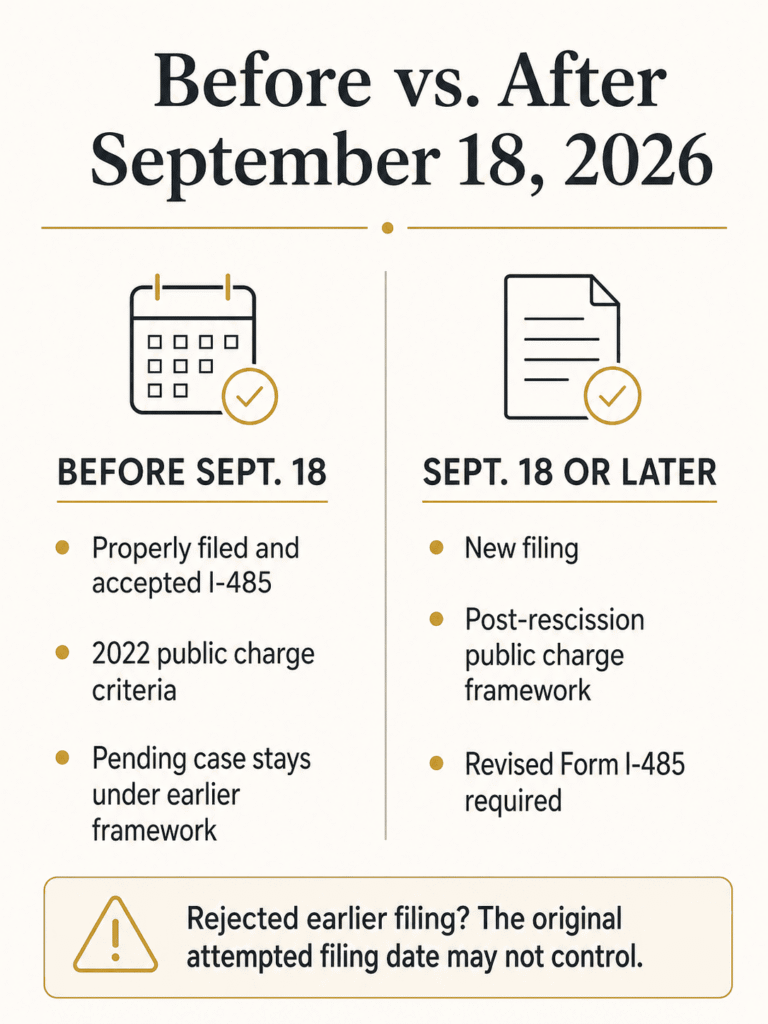
| Properly filed and accepted before Sept. 18 | 2022 Final Rule criteria | The case remains under the earlier framework even if still pending on Sept. 18. |
| Postmarked or electronically submitted Sept. 18 or later | New post-rescission framework | The revised public charge analysis and applicable Form I-485 edition matter. |
| Attempted filing before Sept. 18 but rejected by USCIS | Depends on the valid refiling date | A rejected earlier filing does not preserve its original postmark for this transition rule. |
| Preparing to file close to Sept. 18 | Timing dependent | Confirm both the filing date and the edition USCIS accepts on that date. |
The Federal Register is particularly clear about pending cases. An I-485 postmarked or electronically filed before September 18, accepted by USCIS and still pending on the effective date, will continue to be adjudicated using the criteria in the 2022 Final Rule.
September 18 does not automatically move every pending I-485 into the new public charge framework. A properly accepted pre-effective-date filing keeps the earlier framework.
The Form I-485 Edition Trap: Why Rejection Can Change the Analysis
The transition involves a second deadline risk: using the wrong edition of Form I-485. USCIS has announced that a revised form will be published and that older versions submitted on or after September 18 will not be accepted.
This can become more than a routine paperwork issue. The final rule states that, for transition purposes, DHS looks to the postmark or electronic submission date of the application that is actually before USCIS. It does not use the date of an earlier application USCIS rejected under its filing rules.
Consider an applicant who tries to file before September 18 but whose package is rejected. If the applicant must submit a new filing on or after September 18, the later filing may fall under the new framework. The details of any individual rejection should be reviewed carefully, but applicants should not assume that an unsuccessful attempt to file preserves the earlier regulatory treatment.
What to Verify Before Sending the Package
- Check the official USCIS Form I-485 page on the day you finalize the filing.
- Confirm the edition date listed as acceptable by USCIS.
- Make sure every page comes from the same form edition.
- Use the current filing instructions and correct filing location.
- Confirm the required fee and accompanying forms for your filing category.
- Preserve reliable proof of mailing or electronic submission.
USCIS currently warns that missing pages or pages taken from different editions can lead to rejection. During a regulatory transition, form-version control becomes especially important because the valid filing date can determine which public charge rules govern the case.
What Does the Public Charge Test Look Like After the Change?
The September rule does not create a single numerical test for public charge inadmissibility. Instead, DHS is returning to a case-by-case totality-of-the-circumstances approach.
For applicants subject to the public charge ground, the statute requires consideration of factors including age; health; family status; assets, resources, and financial status; and education and skills. An affidavit of support may also be required depending on the immigration category.
The final rule also permits officers to consider an applicant’s application for, approval or certification to receive, or receipt of means-tested public benefits as part of the overall analysis. DHS emphasizes that benefit receipt is one factor, not an automatic public charge finding.
There is another important timing rule. For benefits received before September 18, DHS states that treatment will remain consistent with the 2022 Final Rule. For the broader categories of means-tested benefits newly considered under the post-rescission framework, the final rule generally focuses on receipt on or after the effective date.
Public Charge Does Not Apply to Every I-485 Applicant
Some immigration categories are statutorily exempt from the public charge ground. The final rule explains that removing the regulatory list of exemptions does not eliminate exemptions Congress created by statute.
Examples include refugees and asylees adjusting under the applicable humanitarian provisions, certain VAWA self-petitioners, and qualifying T and U applicants. Applicants should identify their adjustment category before assuming that the new public charge analysis applies to them.
Filing Between Now and September 18: What Should Applicants Check?
Applicants considering an I-485 filing during the transition should focus on accuracy rather than rushing a defective package solely to beat a date.
- Identify whether the public charge ground applies to your adjustment category.
- Determine which filing date you are realistically working toward. A pre-September 18 filing only helps for transition purposes if USCIS accepts the filing.
- Verify the Form I-485 edition immediately before submission. Do not rely on an old saved PDF.
- Review the public charge questions against the framework applicable to your filing date.
- Keep filing evidence. Save tracking information, delivery confirmation, receipt notices, and electronic submission records.
- Watch for new USCIS guidance. DHS has stated that additional policy and interpretive guidance will be issued by the effective date.
The goal is not simply to file quickly. It is to submit a properly prepared application under the correct rules and form instructions.
What If USCIS Sends an RFE During the Transition?
An RFE issued after September 18 does not necessarily mean the new public charge framework applies to every pending case. The original valid filing date remains critical.
If USCIS accepted the I-485 before September 18 and the application remained pending on the effective date, DHS says that case will be adjudicated under the 2022 Final Rule criteria. An applicant responding to an RFE should therefore read the request carefully and confirm which legal framework governs the application before deciding what evidence is responsive.
Applicants should also avoid assuming that every financial or benefits-related RFE is the same. The request may involve public charge, Form I-864 sponsorship, household income, missing documentation, or another admissibility issue. The exact wording matters.
What If Your I-485 Is Already Delayed?
The September 18 public charge transition and an unreasonable USCIS delay are separate issues. A case may be governed by the 2022 framework and still remain pending for an extended period, or it may fall under the new framework and later experience an unexplained delay.
Our earlier article on the May 2026 USCIS green card policy addresses a different policy change involving discretionary review. That issue should not be confused with the September public charge transition.
If the main problem is prolonged USCIS inaction, review our guide to an I-485 delay and mandamus lawsuit. Applicants who have already completed an adjustment interview can also review our guide on delays after an adjustment of status interview.
A federal delay lawsuit does not determine that an applicant satisfies the public charge ground and does not guarantee approval. It addresses the government’s failure to take required agency action within a legally reasonable period. Before litigation, the underlying I-485 should be reviewed for public charge, admissibility, evidence, and other substantive issues that could surface once adjudication resumes.
Frequently Asked Questions
Does the new public charge framework apply to an I-485 filed before September 18, 2026?
Generally, no, if the application was properly postmarked or electronically filed before September 18, accepted by USCIS, and remains pending on the effective date. DHS states that those applications will be adjudicated under the criteria established by the 2022 Final Rule.
What happens if my I-485 is still pending on September 18?
A pending case does not automatically switch frameworks. If USCIS accepted the application based on a valid pre-September 18 filing, the 2022 criteria continue to govern it.
Can USCIS reject an old Form I-485 edition after September 18?
Yes. USCIS has announced that it will publish a revised Form I-485 and will not accept older editions postmarked or electronically submitted on or after September 18, 2026.
Has USCIS already released the new public charge Form I-485?
As of August 10, 2026, the USCIS Form I-485 page still lists the 01/20/25 edition. Because USCIS has announced another revised edition for the September transition, applicants should verify the official form page again immediately before filing.
Does receiving a public benefit automatically make someone inadmissible?
No. DHS states that the receipt of means-tested public benefits is one factor within the totality of the circumstances. Public charge determinations remain individualized and prospective rather than being based on one factor alone.
Does public charge apply to every adjustment of status applicant?
No. Congress has exempted several categories from the public charge ground, including certain humanitarian categories. The correct analysis depends on the legal basis for adjustment.
Can a mandamus lawsuit help if my I-485 remains pending during the transition?
Potentially, but the regulatory transition itself does not automatically make a delay unreasonable. A mandamus or APA delay analysis looks at the full timeline, procedural posture, agency explanation, available remedies, and the underlying immigration record.
September 18 Creates a Filing Line, Not a One-Size-Fits-All Answer
The most important takeaway is that September 18, 2026 creates a meaningful dividing line for adjustment of status cases. Properly accepted I-485 applications filed before the effective date remain under the 2022 public charge criteria, while filings submitted on or after that date enter the new framework.
Applicants filing near the transition also need to watch the revised Form I-485 carefully. A rejected filing can create consequences beyond lost time if the valid refiling falls on the other side of the September 18 cutoff.
Before filing, confirm the current USCIS form edition, filing instructions, applicable public charge framework, and any new implementation guidance. If your concern is not the transition itself but a long-pending I-485 with no meaningful USCIS action, the delay should be evaluated separately.
Has your I-485 remained pending well beyond the expected processing period?
Our team can review your filing timeline, USCIS notices, interview history, public charge issues, agency inquiries, and the risks and options involved in federal delay litigation.
Phone: +1 (862) 799-2200
Legal Disclaimer: This article is provided for general informational purposes only and does not constitute legal advice. Every immigration case has unique circumstances. For legal guidance specific to your situation, we recommend consulting with an experienced immigration attorney. The information in this article reflects laws and policies as of August 10, 2026; subsequent USCIS guidance, form revisions, litigation, or other policy changes may affect its accuracy. Prior results do not guarantee a similar outcome.
Sources
- Department of Homeland Security — Public Charge Ground of Inadmissibility Final Rule, 91 FR 45324, July 20, 2026
- USCIS — U.S. Citizenship and Immigration Services Rescinds 2022 Public Charge Regulation
- USCIS — Form I-485, Application to Register Permanent Residence or Adjust Status
- USCIS Policy Manual — Volume 8, Part G, Public Charge Ground of Inadmissibility
- 8 U.S.C. § 1182(a)(4) — Public Charge Ground of Inadmissibility