
You want to know whether a mandamus lawsuit will work before you spend money on one. Searching for a mandamus lawsuit success rate seems like the obvious place to start. But a percentage is only useful if you know what “success” means: a decision, an approval, an interview, or a court order.
Those outcomes are different. A delayed application can be decided without being approved. A lawsuit can close because the agency completed the requested action. An interview notice can move your case forward while leaving the final outcome unresolved.
Here is how to understand mandamus results, read a dismissal correctly, and ask questions that tell you more about your own case than an unexplained percentage.
In This Article
- What Is the Success Rate of a Mandamus Lawsuit?
- What Counts as Success in a Mandamus Case?
- Does a Dismissed Mandamus Lawsuit Mean It Failed?
- Why Outcomes Differ Across Immigration Case Types
- What to Ask Before Relying on a Success Rate
- What Matters When Evaluating Your Own Case?
- What Real Mandamus Results Can Show You
- Frequently Asked Questions
What Is the Success Rate of a Mandamus Lawsuit?
There is no single percentage we can responsibly offer as your chance of success against USCIS or a consulate. A meaningful rate needs a defined group of cases, a reporting period, and a clear explanation of the result being counted. Without those details, you cannot tell whether the number measures approvals, decisions, or any movement after filing.
The federal judiciary’s caseload reporting describes broad categories of immigration litigation. That reporting does not provide an application-approval rate following mandamus that you can apply to your own case.
A law firm’s experience also reflects the matters it accepts. Results from a practice focused on one application type or procedural stage may tell you little about a different kind of delay. Selected success stories illustrate possible outcomes, but do not supply the total number of cases needed to calculate a rate.
Ask what the number measures. “The agency issued a decision” and “the application was approved” answer different questions. A useful explanation identifies both the action obtained and the immigration result.
What Counts as Success in a Mandamus Case?
Start with the action the lawsuit seeks. 28 U.S.C. §1361 concerns compelling a federal duty owed to the plaintiff. APA §706(1) addresses agency action unlawfully withheld or unreasonably delayed. Neither provision makes approval the automatic result of filing a delay lawsuit.
For someone waiting on an application, obtaining a decision may end the particular delay being challenged. Whether that decision delivers the benefit the person wanted is a separate question. An honest account should preserve both facts, including when the decision is unfavorable.
| Reported outcome | What it shows | What it does not establish |
|---|---|---|
| Final decision issued | The agency decided the application. | That the decision was an approval. |
| Application approved | The applicant obtained a favorable immigration result. | That another applicant will receive the same result. |
| Interview or RFE issued | A processing step occurred. | That a final decision has been made or all requested relief obtained. |
| Action schedule agreed | A timetable has been established. | That the promised action is complete. |
| Court orders action | Judicial relief requiring action has been granted. | That the underlying application must be approved. |
These categories can overlap. An agency might schedule an interview, later approve the application, and then the parties might close the lawsuit. Those are stages in one matter, rather than three independent successful cases.
Ask what happened to the application and what happened to the lawsuit. Keeping those answers separate makes an outcome easier to understand.
Does a Dismissed Mandamus Lawsuit Mean It Failed?
No. The word “dismissed” tells you that a claim or case ended, but the reason matters. A dismissal following agency action describes a different situation from a court rejecting the plaintiff’s legal claim.
When the Agency Acts and the Delay Claim Becomes Moot
In Martins v. Mayorkas, the plaintiff reported that USCIS adjudicated his application to remove conditional resident status after he filed suit. He asked to close the matter, and the court’s July 1, 2024 order dismissed the case without prejudice under Rule 41.
The order records that adjudication occurred. It does not identify the decision as an approval. The example shows why a closed court file cannot, by itself, establish either an immigration denial or an immigration approval.
When the Court Rejects the Claim
A different outcome appears in Li v. Jaddou, an unpublished Fifth Circuit decision. The court noted that only two of the original 33 plaintiffs still had pending applications; adjudication had made the other delay claims moot. It nevertheless affirmed dismissal of the remaining plaintiffs’ claims.
That decision illustrates different procedural outcomes within one lawsuit. It supplies neither an approval rate nor a prediction for another applicant. If your application is denied after filing, our guide to USCIS denial after a mandamus lawsuit addresses the next questions separately.
Why Outcomes Differ Across Immigration Case Types
A combined “mandamus USCIS success rate” can conceal important differences. Two applicants may both report a long wait while seeking different actions under different legal rules. The first comparison should be the application and its procedural stage.
| Case group | Question to clarify |
|---|---|
| I-130, I-485, and other USCIS applications | Which application and specific action does the lawsuit address? |
| N-400 naturalization | Is the delay before or after the examination, and which legal remedy applies? |
| 221(g) and consular processing | What has already been decided, and what further action is legally required? |
| Affirmative asylum delays | Is the requested outcome an interview or a decision after an interview? |
Naturalization Has a Separate Post-Examination Remedy
8 U.S.C. §1447(b) provides a specific route when no determination is made within 120 days after the examination described in the statute. The district court may determine the matter or remand it with appropriate instructions. Results under that provision should be identified separately from ordinary mandamus or APA delay claims.
Consular Cases Require Their Own Analysis
In Karimova v. Abate, the D.C. Circuit affirmed dismissal because the applicant had not adequately alleged a duty to take the further action she sought. The judgment demonstrates why the precise duty matters. It should not be treated as a universal answer for every consular case or jurisdiction.
A useful comparison explains the requested action and legal route, rather than ranking application types from “easy” to “hard.”
What would a useful result look like in your case?
Our team can assess the delayed application and explain which government action a proposed lawsuit would seek.
What to Ask Before Relying on a Success Rate
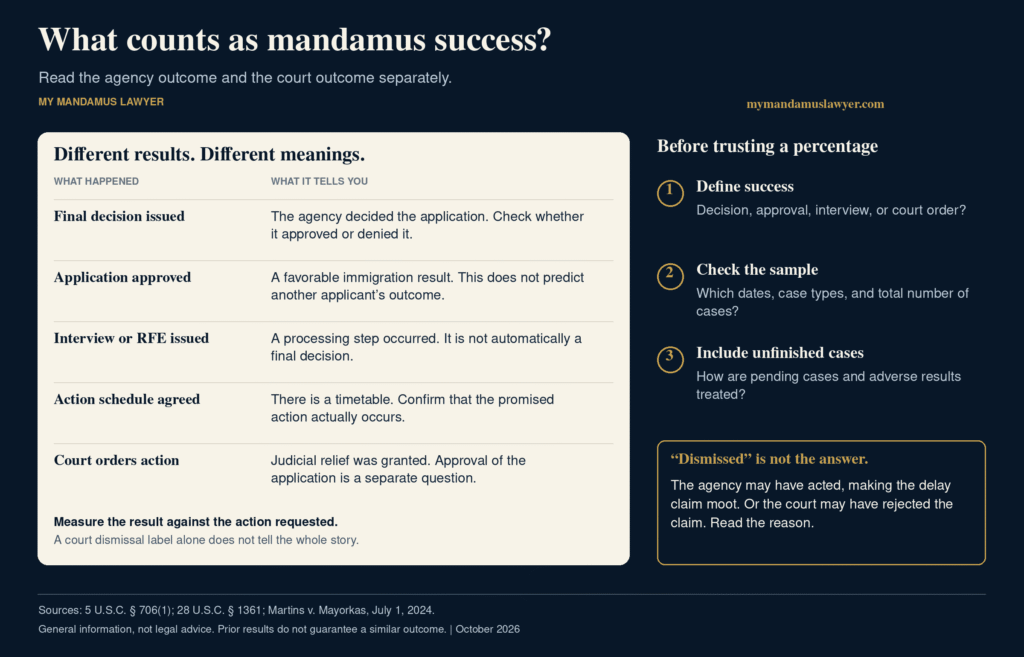
You do not need to be a statistician to ask for an understandable explanation. Before using a percentage to make a hiring or filing decision, ask these five questions:
- What counts as success? Ask whether the number measures final decisions, approvals, interviews, agreements, or court orders.
- Which dates does it cover? A defined reporting period helps you understand how current the experience is.
- What is being counted? Lawsuits, applications, and individual applicants are different units. One family lawsuit may involve several applications.
- How are unfinished and adverse cases treated? Ask whether pending matters are excluded and whether unfavorable decisions are included.
- How comparable are the cases? Look for the application type, procedural stage, and relevant jurisdiction.
Counting only closed cases can leave slower, unfinished matters out of view. Counting only selected stories leaves the denominator unknown. Neither necessarily makes the examples inaccurate, but each limits what you can infer from them.
Also distinguish sequence from proof of causation. A decision issued after filing establishes timing; that fact alone does not prove what would have happened without litigation. Our guide on how to choose a mandamus lawyer covers broader questions about representation.
What Matters When Evaluating Your Own Case?
Your review should begin with the unfinished action. In Norton v. Southern Utah Wilderness Alliance, 542 U.S. 55, 64 (2004), the Supreme Court explained that an APA failure-to-act claim requires a discrete agency action the agency is required to take. A frustrating wait alone does not answer that threshold question.
For a practical discussion with counsel, organize the following:
- The requested action: Identify the application and the step you want completed.
- The chronology: Record filing, interviews, evidence requests, responses, and inquiries.
- The legal setting: Ask which court may hear the claim and which decisions affect it.
- The continuing harm: Document concrete effects on employment, family life, health, or other circumstances.
- Readiness for a decision: Discuss unanswered requests and possible eligibility issues before seeking faster adjudication.
These are preparation questions, not a scoring system or guarantee of eligibility. Our evidence checklist for a mandamus lawsuit explains record preparation. Review the mandamus lawsuit cost guide separately when considering the financial commitment.
What Real Mandamus Results Can Show You
One example on our mandamus success stories page involves an I-730 Refugee/Asylee Relative Petition pending for more than three years and two months. After four administrative inquiries without a final decision, our office filed suit in the Southern District of Florida on April 17, 2026. USCIS approved the petition on May 28, 2026.
That account identifies the application, the filing date, and the favorable decision. It illustrates an outcome without establishing how often every I-730 case, or every mandamus case, reaches the same result.
You can also read our real mandamus results case studies. Use examples to understand possible paths and formulate questions about your own circumstances.
Frequently Asked Questions
Does mandamus guarantee that USCIS will approve my application?
No. Seeking required action under APA §706(1) or 28 U.S.C. §1361 does not establish eligibility for the underlying benefit. A decision can be favorable or unfavorable. Discuss potential application weaknesses before asking the agency to decide it sooner.
Is an interview notice or RFE a successful outcome?
It shows a processing step occurred. Whether it satisfies the lawsuit’s objective depends on the action requested and the case’s legal posture. If the objective is a final decision, describe an interview notice or Request for Evidence as an intermediate development rather than a completed adjudication.
Why would a mandamus case be dismissed as moot?
The agency may complete the action being challenged, leaving no live delay dispute for the court to resolve. The Li decision illustrates adjudication making delay claims moot. Read the underlying action and dismissal reason before interpreting the outcome.
Can I use another applicant’s result to predict my own?
A single example cannot establish your odds. Compare the application, requested action, procedural stage, and jurisdiction. A successful case may raise useful questions, but it does not replace review of your own record.
How soon will I know whether the lawsuit worked?
There is no guaranteed completion date. A government response deadline is a litigation deadline, not an automatic deadline to approve the immigration application. The government may respond by contesting the case. Our mandamus lawsuit timeline explains the process; procedural deadlines are governed by the Federal Rules of Civil Procedure and applicable court orders.
Get a Case-Specific Assessment
Find out which action remains unfinished and whether federal litigation may fit your circumstances. For an initial review, provide your USCIS Receipt Notice and current ZIP Code.
Phone: +1 (862) 799-2200
Legal Disclaimer: This article provides general information, not legal advice. Sources were reviewed October 19, 2026. It does not report a firm-wide or nationwide success percentage. Case examples illustrate individual outcomes and do not establish your likelihood of approval or relief. Available remedies depend on your facts, the requested action, jurisdiction, and applicable law. Prior results do not guarantee a similar outcome.
Sources
- 5 U.S.C. §706, Scope of Review, Office of the Law Revision Counsel.
- 28 U.S.C. §1361, Action to Compel a Federal Duty, U.S. Code, reproduced by Cornell Legal Information Institute.
- 8 U.S.C. §1447(b), Naturalization Determination Delays, Office of the Law Revision Counsel.
- Norton v. Southern Utah Wilderness Alliance, 542 U.S. 55, particularly p. 64, Supreme Court of the United States, June 14, 2004.
- Martins v. Mayorkas, No. 8:24-cv-902-CEH-AAS, Order, ECF No. 15, Middle District of Florida, July 1, 2024.
- Li v. Jaddou, No. 22-50756, Fifth Circuit, May 12, 2023, unpublished opinion.
- Karimova v. Abate, No. 23-5178, D.C. Circuit, July 24, 2024, unpublished judgment.
- U.S. District Courts, Judicial Business 2025, Administrative Office of the U.S. Courts; background on caseload categories, not an immigration approval-rate study.
- Federal Rules of Civil Procedure, U.S. Courts, particularly Rules 12 and 41.
- My Mandamus Lawyer Success Stories, I-730 petition example filed April 17, 2026 and approved May 28, 2026; firm-reported individual result.