
Your mandamus lawsuit forced a decision after months or years of silence, and the decision was a denial. The federal case is now closing, and it can feel like the immigration case closed with it.
That is not what happened. When USCIS denied your case after a mandamus lawsuit, two things occurred at once. The delay claim ended because the agency finally acted, and a new set of deadlines started running on the immigration side.
Those deadlines are short, which is why the days right after a denial notice matter more than all the months of waiting that came before.
This guide explains what a court could and could not order, why the lawsuit is dismissed as moot even when the decision goes against you, whether legal fees are recoverable, and which options a denial opens depending on the form that was denied.
In This Article After a Denial
- Does Filing a Lawsuit Make a Denial More Likely?
- What the Court Could Order, and What It Could Not
- What “Dismissed as Moot” Means for Your Case
- Can You Recover Legal Fees After a Mootness Dismissal?
- Start With the Denial Notice
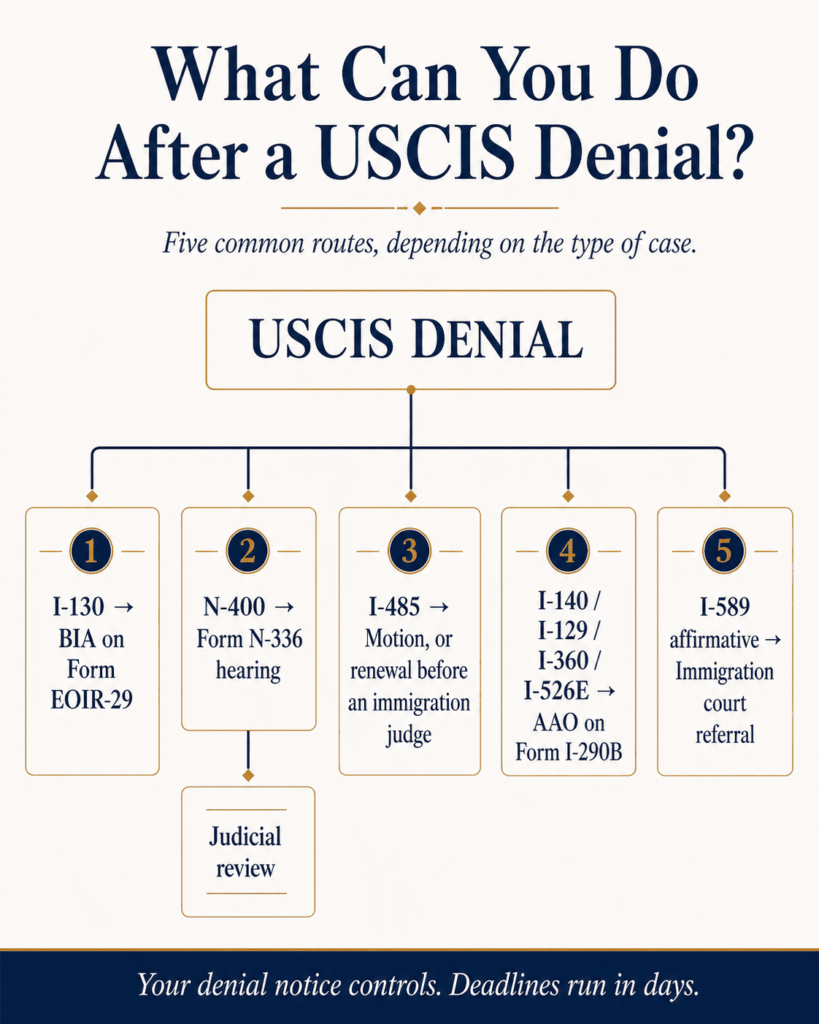
- What a Denial Opens Up, by Form Type
- Why a Decision Still Puts You Ahead of Silence
- Frequently Asked Questions
Does Filing a Lawsuit Make a Denial More Likely?
This is the question that keeps most people from filing at all, so it is worth answering first.
A mandamus lawsuit challenges timing, not eligibility. The complaint asks a federal court to address an agency’s failure to act within a reasonable period. It does not ask the court to evaluate whether you qualify, and it does not place new eligibility arguments in front of the officer who decides the case.
What the lawsuit changes is attention. A file sitting in a queue gets pulled, reviewed, and decided, and the officer applies the same eligibility standards that applied before the complaint was filed. If the record supported approval, the lawsuit did not weaken it. If it held an unresolved problem, that problem was already there.
That is why screening matters before a complaint is drafted. A lawsuit is a timing remedy for a case otherwise ready to be decided, not a repair for a substantive weakness. For the stages between filing and the government’s response, see our firm’s guide to what happens after a mandamus lawsuit is filed and our own guide to what a mandamus consultation covers.
One 2026 point matters for adjustment applicants: the DHS public charge rule taking effect September 18, 2026 applies to applications submitted on or after that date, so a case already pending is adjudicated under the earlier framework, as our separate post explains.
What the Court Could Order, and What It Could Not
Understanding why a denial is even possible starts with what the court was asked to do.
Under 28 U.S.C. § 1361, a district court has jurisdiction over an action to compel a federal officer or agency to perform a duty owed to the plaintiff. Under 5 U.S.C. § 706(1), a reviewing court may compel agency action unlawfully withheld or unreasonably delayed.
Read those provisions closely and the limit becomes obvious. Both are about action. Neither is about outcome.
The duty a delay lawsuit enforces is the duty to reach a decision, and the agency cannot decline it indefinitely. The content of that decision is a separate matter, because eligibility determinations involve judgment the statute commits to the agency. A judge can require USCIS to stop sitting on a file. A judge cannot substitute a favorable answer for the one the agency reaches.
This is why mandamus buys a decision rather than an approval. Our federal writ of mandamus guide explains the remedy in full, and our APA and mandamus decision tree covers how the two statutes work together.
This is why mandamus buys a decision rather than an approval. Our federal writ of mandamus guide explains the remedy, and our APA and mandamus decision tree covers how the two statutes work together. Whether the delay itself was legally unreasonable is a separate question, answered through the TRAC factors.
What “Dismissed as Moot” Means for Your Case
A federal court can only resolve a live dispute. If the relief you asked for was a decision, and the decision arrived, there is no further relief the court can grant.
Courts say this plainly. In one Eastern District of Michigan matter, plaintiffs sued to compel adjudication of a Form I-130 and USCIS issued its decision while the case was pending. The court noted that although the plaintiffs could appeal to the Board of Immigration Appeals, there was no relief the district court could grant, and dismissed the case as moot.
The word “dismissed” reads like a loss on the docket. Procedurally it is the opposite. The lawsuit asked for movement, and movement is what ended it.
Approval, Denial, or an RFE: Why Any of Them Can End the Delay Claim
An approval ends the delay claim because you received the benefit. A denial ends it because the agency performed the act the complaint said it had refused to perform. The case measured silence, and the silence stopped.
Interim steps are less clear cut. An interview notice, a Request for Evidence, or a transfer between offices is agency action, but not necessarily the final adjudication the complaint asked the court to compel. Whether such a step moots the case is fact specific, which is one reason the wording of the prayer for relief matters at the drafting stage.
Voluntary Cessation, and Why It Rarely Rescues a Delay Case
Applicants often ask whether the government can escape a lawsuit by acting at the last moment. Under the voluntary cessation exception, a defendant generally cannot moot a case by stopping the challenged conduct, because nothing would prevent it from resuming afterward.
The exception is narrow in delay litigation. In January 2026, the D.C. Circuit held moot the appeals of visa applicants whose visas were issued while those appeals were pending, rejected the voluntary cessation argument, and vacated the judgments below with instructions to dismiss. Once the government has completed the act, there is typically no ongoing conduct left to resume. Our firm’s overview of the first stages of a mandamus case covers the steps leading to this point.
Can You Recover Legal Fees After a Mootness Dismissal?
This comes up constantly and is almost never answered plainly. Recovery from the government is difficult, and the reason is a Supreme Court decision that has nothing to do with immigration.
In Buckhannon Board and Care Home, Inc. v. West Virginia Department of Health and Human Resources, the Court rejected the catalyst theory, which had treated a plaintiff as a prevailing party whenever the lawsuit brought about a voluntary change in the defendant’s conduct. After Buckhannon, prevailing party status generally requires a judicially sanctioned change in the legal relationship of the parties.
That rule reached immigration delay litigation directly. In a 2006 Eleventh Circuit case, plaintiffs sued to compel action on adjustment applications, the government granted permanent resident status voluntarily, and the district court dismissed the complaint as moot while awarding fees under the Equal Access to Justice Act on a catalyst rationale. The Eleventh Circuit reversed, holding that Buckhannon applies to the EAJA and that plaintiffs in that posture are not prevailing parties.
The consequence is narrow but important. A case ending because the agency acted, with no court order and no approved settlement, is the classic scenario in which fees are unavailable. What changes the analysis is a court order, a consent decree, or a stipulated agreement the court approves, and that is decided during the litigation rather than after the dismissal.
Denied after a lawsuit and unsure what comes next?
Our team can review the denial notice, the legal basis USCIS stated, the deadline that applies to your form type, and whether a motion, an appeal, or a new filing is the stronger path.
Start With the Denial Notice
Before considering strategy, read the notice. USCIS states that a denial or revocation notice includes information about appeal rights, and the notice controls what is available. Four items in that document determine everything that follows:
- Whether the decision can be appealed, and to which body.
- Which form is required, because it is not always Form I-290B.
- Where the filing must be submitted, often the issuing office rather than the reviewing body.
- The deadline, which is measured in days rather than months.
Read the substance as well as the instructions. The legal basis and factual findings determine whether the stronger response is a motion built on new evidence, a motion arguing legal error, an appeal, or a fresh filing. If the notice states that no appeal right exists, filing one anyway generally results in rejection and consumes a deadline you cannot recover.
What a Denial Opens Up, by Form Type
There is no single appeal route in immigration law. The path depends on which form was denied, and the differences are significant.
| Form Denied | Where Review Generally Goes |
|---|---|
| I-130, Petition for Alien Relative | Appeal to the Board of Immigration Appeals on Form EOIR-29, filed with the issuing office |
| N-400, Application for Naturalization | Hearing request on Form N-336, with judicial review available afterward |
| I-485, Adjustment of Status | Generally no direct appeal. A motion may be available, and the application may be renewable before an immigration judge |
| I-140, I-129, I-360, I-526E | Appeal or motion to the Administrative Appeals Office on Form I-290B |
| Affirmative I-589, Asylum | Referral to immigration court rather than an administrative appeal |
Treat this as orientation rather than instruction. Your notice governs your case, and eligibility for each route depends on the decision, the issuing office, and the posture of the file.
Motion to Reopen and Motion to Reconsider
These are two different tools and they are frequently confused. A motion to reopen is based on new facts, supported by evidence that was not part of the record. A motion to reconsider argues that the decision was legally or procedurally wrong on the record that already exists.
One point matters more than the rest. USCIS states that with certain exceptions, you may file a motion to reopen or reconsider even if you do not have appeal rights. Where a form carries no appeal route, that is often the only administrative option, and the deadline is short.
When the Denial Itself Can Be Challenged in Court
A denial can sometimes be reviewed in federal court, but that is a different lawsuit from the one you just finished. The delay case argued that the agency had not acted. A challenge to the denial argues that the action taken was unlawful or contrary to the record.
Naturalization has its own statutory route to district court after the hearing stage. Other categories may be reviewable under the Administrative Procedure Act, subject to jurisdictional limits, exhaustion requirements, and doctrines restricting review of certain discretionary and consular decisions.
Why a Decision Still Puts You Ahead of Silence
A denial is not a good outcome. It is, however, a different kind of problem from the one you had before.
An open, undecided file produces nothing you can act on. There is no legal basis to challenge, no factual finding to rebut, no deadline running, and no reviewing body with jurisdiction. Years can pass in that condition, which is why delay litigation exists at all.
A written decision changes the terrain. It states a legal basis, identifies what the agency found insufficient, opens a defined window for specific remedies, and creates the record any later motion, appeal, or court challenge is built on.
That is the honest case for forcing a decision. Not that the answer will be favorable, but that an answer can be worked with and silence cannot. For how a case reaches this stage, see our guide to the mandamus lawsuit timeline.
Frequently Asked Questions
Does a mandamus lawsuit affect how USCIS reviews my application?
The lawsuit addresses the failure to decide, not the merits. Officers apply the same eligibility standards that applied before it was filed. What changes is that the file receives attention rather than remaining in a queue.
My lawsuit was dismissed. Does that mean I lost?
Not necessarily. When a delay case is dismissed because the agency issued a decision, the dismissal reflects that the relief sought was obtained rather than refused. Courts call this mootness.
Can I file a second lawsuit if the agency goes quiet again?
A new delay claim requires a new period of unreasonable inaction on something the agency must decide. If a pending motion, appeal, or remanded matter sits without action for an unreasonable period, that may present a fresh claim, analyzed on the new facts.
Who pays my attorney if the government adjudicates the case?
Recovery under the Equal Access to Justice Act generally requires prevailing party status, which after Buckhannon ordinarily means a judicially sanctioned change in the parties’ legal relationship. A case ending because the agency acted voluntarily, with no court order, usually does not qualify.
Can a judge order USCIS to approve my application?
No. The statutes authorize a court to compel action unlawfully withheld or unreasonably delayed. They do not authorize a court to direct the outcome of an eligibility determination.
How long do I have to respond to a denial?
The deadline is stated in the notice and varies by form and by whether you are filing an appeal or a motion. These windows are measured in days, so the notice should be reviewed with counsel immediately.
A Denial Is a Decision, Not the End of the File
The lawsuit did what a delay lawsuit is built to do. It converted an open-ended wait into a dated, written decision with a stated legal basis.
What matters now is narrower and more urgent. Which form was denied, what the notice says about appeal rights, and how many days remain determine whether a motion, an appeal, a renewed application before an immigration judge, or a fresh filing is the right next step.
The one option no longer available is waiting. Unlike the delay that brought you to federal court, the clock on a denial runs against you.
What does your denial notice actually allow?
Contact our team for a case-specific review of the form that was denied, the appeal or motion rights stated in the notice, the deadline you are working against, and the administrative and federal options that remain open.
Phone: +1 (862) 799-2200
Legal Disclaimer: This article is provided for general informational purposes only and does not constitute legal advice. Appeal rights, motion eligibility, filing deadlines, and the availability of judicial review depend on the specific form, the ground of denial, and the procedural posture of each case. For legal guidance specific to your situation, we recommend consulting with an attorney experienced in federal immigration litigation. The information in this article reflects federal statutes, agency guidance, and publicly available decisions reviewed as of August 26, 2026; subsequent legal developments may affect its accuracy. Prior results do not guarantee a similar outcome.
Sources
- Questions and Answers: Appeals and Motions, U.S. Citizenship and Immigration Services, accessed August 26, 2026.
- When to Use Form I-290B, Notice of Appeal or Motion, U.S. Citizenship and Immigration Services, accessed August 26, 2026.
- 28 U.S.C. § 1361, Action to Compel an Officer of the United States to Perform His Duty, U.S. House of Representatives, Office of the Law Revision Counsel, accessed August 26, 2026.
- 5 U.S.C. § 706, Scope of Review, Legal Information Institute, Cornell Law School, accessed August 26, 2026.
- Buckhannon Board and Care Home, Inc. v. West Virginia Department of Health and Human Resources, 532 U.S. 598, Supreme Court of the United States, May 29, 2001.
- Morillo-Cedron v. District Director for the U.S. Citizenship and Immigration Services, 452 F.3d 1254, U.S. Court of Appeals for the Eleventh Circuit, June 21, 2006.
- Nejat v. U.S. Department of State, No. 25-5001, Opinion, U.S. Court of Appeals for the District of Columbia Circuit, January 16, 2026.
- Assaf v. District Director, USCIS Detroit, No. 10-10488, Opinion and Order, U.S. District Court for the Eastern District of Michigan, May 14, 2010.
- Requesting Attorneys’ Fees Under the Equal Access to Justice Act, American Immigration Council, practice advisory, accessed August 26, 2026.
- Public Charge Ground of Inadmissibility, 91 FR 45324, Department of Homeland Security, Federal Register, July 20, 2026.