You submitted a case inquiry, waited, and received a message telling you the case remains under review. Weeks passed and nothing changed. The useful question is no longer whether to escalate. It is which escalation is worth your time.
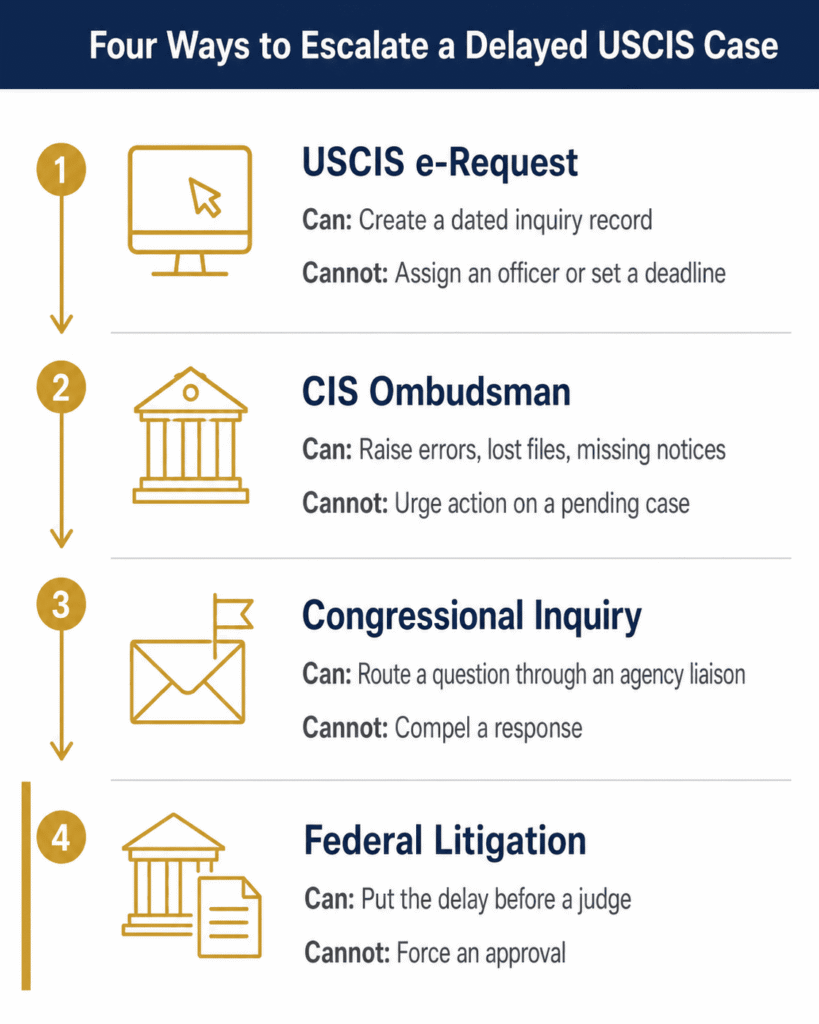
If your USCIS service request is not working, four options remain: the USCIS e-Request tool, case assistance from the CIS Ombudsman, a congressional inquiry, and federal litigation. They are not interchangeable, and they do not form a single ladder where each rung is stronger than the last.
Each one reaches a different part of the government and has a different limit. Two of them ask USCIS to look at your own file again. One asks a third party to ask on your behalf. One moves the question out of the agency entirely.
This guide covers what each option realistically achieves, how long to give it, and where the administrative path ends. It does not cover what to assemble for federal court. For that, see our evidence for a mandamus lawsuit guide.
In This Article Escalating a Delayed USCIS Case
- The Four Escalation Options and What Each One Is For
- Why Your USCIS Service Request Is Not Working
- Why Congressional Inquiries Often Return the Same Template Language
- How Long to Give Each Step Before Moving to the Next
- Why the Paper Trail Matters Even When the Answers Do Not
- The Point Where Administrative Options Are Exhausted
- Frequently Asked Questions
The Four Escalation Options and What Each One Is For
Escalation is not one process with four steps. Knowing which category an option belongs to explains why some produce a response and none produce a decision.
USCIS e-Request and the Outside Normal Processing Time Trigger
The e-Request tool is the agency’s own online inquiry channel, and you cannot use it whenever you choose. It unlocks only after your case passes what USCIS calls the case inquiry date, and that date is not the processing time shown on the website.
The published processing time is the period it took USCIS to complete 80 percent of adjudicated cases over the previous six months. The inquiry threshold sits further out. USCIS accepts inquiries only for cases taking longer than the time needed to complete 93 percent of adjudications. For the few forms still measured by cycle time, including Form I-129, the trigger is 130 percent of the cycle time.
That gap explains a common frustration: your case can sit past the published processing time and still count as within normal processing times for inquiry purposes. The processing times page gives you the exact date, which can shift as the data changes.
CIS Ombudsman Case Assistance
The Office of the Citizenship and Immigration Services Ombudsman is an independent office inside DHS and is not part of USCIS. You reach it by filing DHS Form 7001, and conditions apply: you must have contacted USCIS within the last 90 days and given the agency at least 60 days to resolve the problem.
The published limits matter more than the eligibility rules. The office states plainly that it cannot urge USCIS to take action on a pending application, cannot help while your case is within published processing times, and will not take a case if fewer than 30 calendar days have passed since a congressional representative inquired.
Capacity is a live question in 2026. The office was directed to cease operations in March 2025, as AILA documented at the time. It still accepts Form 7001 and maintains current guidance, but its own case assistance alerts ask requesters to expect a wait given the volume received.
The one thing most applicants want from the Ombudsman, a push toward a decision, is the one thing the office says it does not do.
Congressional Inquiry
A congressional inquiry is casework, not a legal proceeding. A staff member in your representative’s or senator’s district office submits a status request to the agency liaison unit after you sign a privacy release form.
Most offices apply the same gate USCIS does and will generally decline a status inquiry while your case remains within normal processing times, because that information already appears in your online account. The office asks a question on your behalf and has no authority to require an answer.
Federal Litigation
A delay lawsuit changes who is asked and who has to answer. Filing under 28 U.S.C. § 1361 and the Administrative Procedure Act moves the question from a service center queue to a federal judge, and from an agency liaison to an Assistant U.S. Attorney with a filing deadline. The statutory basis is direct: 5 U.S.C. § 555(b) requires each agency to conclude a matter presented to it within a reasonable time.
What it does not do is decide the case in your favor. A writ of mandamus compels a decision, not an approval, and the outcome can still be a denial or a request for evidence. For applicants stuck in silence, a decision is usually the point.
| Option | What It Can Do | What It Cannot Do | When You Can Use It |
|---|---|---|---|
| USCIS e-Request | Place a dated inquiry in your file and generate a service request number. | Assign an officer or set a deadline. | Only after your case inquiry date. |
| CIS Ombudsman | Raise errors, lost files, missing notices, and age-out risk with USCIS. | Urge action on a pending application. | 90 days after contacting USCIS, and 60 days after no resolution. |
| Congressional inquiry | Route a status question through an agency liaison unit. | Compel a response or a decision. | Generally only outside normal processing times. |
| Federal litigation | Put the delay before a judge and a U.S. Attorney. | Force an approval. | No waiting period required by statute. |
Why Your USCIS Service Request Is Not Working
A service request is a note attached to your file and routed to the office holding it, asking for a status check. That is the whole mechanism.
A service request does not assign an adjudicator, change your position in a queue, or create any obligation to act by a certain date.
The responses reflect that design. Applicants typically receive some version of a statement that the case is under active review, that it is outside normal processing times and remains in the queue, or that background checks are pending. A second and third request generally return the same language, because the office answering is reading the same case notes each time.
The USCIS Contact Center works the same way. Case status questions are handled at Tier 1 and are not escalated to Tier 2 unless something else makes the case complex. A delay alone does not count.
None of this makes the step pointless. The inquiry produces a dated record and a service request number, and the Ombudsman asks for those numbers on Form 7001. The value is documentary rather than practical.
Why Congressional Inquiries Often Return the Same Template Language
Applicants are often surprised when a congressional office returns a reply that reads almost identically to the service request response. The explanation is structural: the liaison unit answering congressional casework reads the same case notes the Contact Center reads, and its function is to respond rather than to adjudicate.
There are situations where this route genuinely helps. Lost files, notices that were issued but never delivered, misrouted transfers between offices, and documented emergencies that meet the agency’s expedite criteria all involve something an office can locate and fix. A person is able to act because something identifiable went wrong.
A complete file waiting in a queue is different. Nothing has gone wrong in a way a liaison can correct, so the reply confirms the case is pending and that processing times vary. There is also a timing cost: filing a congressional inquiry begins a 30-day period during which the Ombudsman will not accept your case.
How Long to Give Each Step Before Moving to the Next
Sequencing matters because several of these options have waiting periods built into the eligibility rules of the next one. Running them in the wrong order costs months.
| Step | How Long to Allow Before Moving On |
|---|---|
| Check your case inquiry date | Until you pass it, the e-Request form will not open and most congressional offices will decline the request. |
| After a service request | About 30 days. USCIS asks that you wait roughly that long before submitting another inquiry on the same issue. |
| Before the Ombudsman | 60 days. You must have contacted USCIS within the last 90 days and USCIS must have failed to resolve the issue within 60. |
| After a congressional inquiry | 30 to 60 days. The first 30 days also block an Ombudsman filing, so treat these as alternatives rather than parallel tracks. |
Worked through in order, the administrative path takes roughly four to six months to exhaust. That is time worth spending once.
One caution about how this record reads later. Courts do not measure unreasonableness by counting inquiries. They apply a multi-factor framework, and our guide to the TRAC factors and unreasonable delay covers that analysis.
Tried every inquiry and still no answer?
Our team can review your filing dates, every service request and response, Ombudsman or congressional correspondence, and whether the delay has reached the stage where a federal filing is realistic.
Why the Paper Trail Matters Even When the Answers Do Not
The responses you receive are close to worthless as information. The record of having received them is not. A dated sequence of inquiries, each answered with the same language, is evidence that the agency was on notice and that nothing changed.
That record shifts what the government has to explain. In delay litigation the usual position is that a case is moving normally through a resource-constrained system, and a file showing repeated contact and identical replies makes that harder to hold.
Build the record as it is created, not when you are already considering litigation. Our guide on what evidence you need before filing a mandamus lawsuit sets out what to assemble.
One procedural point is easy to miss. Filing a case assistance request with the Ombudsman does not pause any USCIS deadline. A response to a request for evidence, an appeal, or a motion is still due on the date in the agency’s notice.
The Point Where Administrative Options Are Exhausted
Administrative escalation is exhausted when it stops producing new information, which usually happens well before you run out of things to file. Repetition, not refusal, is the signal.
The pattern is recognizable. The same response arrives twice. An inquiry confirms the case is outside normal processing times and nothing follows. The Ombudsman declines or closes the request. A congressional office reports no substantive update. At that point each new filing adds a date without adding facts.
It is worth being clear about what the law requires. No statute obligates you to file a service request, contact the Ombudsman, or approach a congressional office before bringing a delay claim, and neither the mandamus statute nor the APA imposes an exhaustion requirement for unreasonable delay. Those steps matter because they document notice, not because they are prerequisites.
What replaces the inquiry cycle is an assessment of the file itself: which agency holds the case, what action remains outstanding, how long it has been pending, and what harm the delay is causing. Our walkthrough of what to expect in a mandamus consultation describes that review.
Frequently Asked Questions
USCIS service request not working: can I submit a second one?
Yes, and USCIS asks that you wait roughly 30 days first. Expect the same response unless something specific has changed, such as a notice you never received or a transfer to a different office.
Does the CIS Ombudsman still accept case assistance requests?
Yes. DHS Form 7001 remains open online, by email, and by mail, and the office’s guidance pages are current. Its own alerts ask requesters to expect a wait given the volume of requests received.
Can I file a congressional inquiry and an Ombudsman request at the same time?
Not effectively. The Ombudsman will not take a case if fewer than 30 calendar days have passed since a congressional representative inquired with USCIS, so the two run in sequence rather than together.
Do I have to try all of these before filing a lawsuit?
No statute requires it. Courts assessing an unreasonable delay claim do look at the overall record, and documented inquiries help establish that the agency was on notice, but they are not a legal precondition to filing.
Does an inquiry pause my USCIS deadlines?
No. A pending case assistance request does not extend the deadline for responding to a request for evidence, filing an appeal, or submitting a motion.
My case is past the published processing time but USCIS will not let me inquire. Why?
The two figures are calculated differently. The displayed processing time reflects 80 percent of completed cases, while the inquiry trigger is set at 93 percent. That leaves a window where a case is past one and not the other.
Escalation Builds a Record. Only Litigation Sets a Deadline.
The four options serve different purposes, and none of them can order USCIS to decide your case. Service requests and congressional inquiries generate a record. The Ombudsman addresses errors rather than pace. Federal litigation is the only route that puts a deadline in front of the government.
Once your inquiries start returning the same language, the administrative path has told you what it can. The remaining question is whether your delay meets the standard a federal court applies.
Your case delay is not your fault.
A mandamus lawsuit is a legal remedy against unreasonable USCIS delays and often moves a stalled case significantly. Contact our team for a free evaluation of your pending case and your inquiry history.
Phone: +1 (862) 799-2200
Legal Disclaimer: This article is provided for general informational purposes only and does not constitute legal advice. Every immigration case has unique circumstances. For legal guidance specific to your situation, we recommend consulting with an experienced immigration attorney. The information in this article reflects laws, policies, and publicly available USCIS and DHS guidance as of August 19, 2026; subsequent changes may affect its accuracy. Prior results do not guarantee a similar outcome.
Sources
- More Information About Case Processing Times, U.S. Citizenship and Immigration Services, accessed August 19, 2026.
- Check Case Processing Times, U.S. Citizenship and Immigration Services, accessed August 19, 2026.
- e-Request Self Service Tools, U.S. Citizenship and Immigration Services, accessed August 19, 2026.
- USCIS Contact Center, U.S. Citizenship and Immigration Services, updated April 2026.
- How to Submit a Case Assistance Request, CIS Ombudsman, U.S. Department of Homeland Security, accessed August 19, 2026.
- Case Assistance Alerts, CIS Ombudsman, U.S. Department of Homeland Security, accessed August 19, 2026.
- DHS Form 7001, Request for Case Assistance, U.S. Department of Homeland Security, accessed August 19, 2026.
- Policy Brief: Shuttering the CIS Ombudsman Closes the Door on Oversight and Accountability for USCIS, American Immigration Lawyers Association, 2025.
- 5 U.S.C. § 555, Ancillary Matters, Legal Information Institute, Cornell Law School, accessed August 19, 2026.