
You live in New Jersey. Your immigration case may be sitting with a USCIS service center in another state. The agency officials named in a lawsuit may work in Washington, D.C. So where does the federal case actually get filed?
That question is about venue, and it is one of the first procedural issues that has to be resolved before an immigration delay lawsuit is filed. The answer is not always the state where USCIS mailed your receipt notice. It is also not automatically Washington, D.C. simply because USCIS and DHS are federal agencies.
For many lawsuits against federal immigration officials, 28 U.S.C. § 1391(e) creates more than one possible venue. Where you live, where the relevant government action or inaction occurred, and where a defendant resides can all matter.
This guide explains where to file a mandamus lawsuit, why venue and jurisdiction are different, when a USCIS service center matters, and what happens when more than one federal district appears available.
In This Article Where a Mandamus Case Gets Filed
- Venue and Jurisdiction Are Not the Same Thing
- The Three Main Venue Rules for a Mandamus Lawsuit
- Can You File the Lawsuit Where You Live?
- Does the USCIS Service Center Decide Where You File?
- Why Washington, D.C. Is Not Automatically the Right Court
- What If More Than One Federal District Could Hear the Case?
- What About Consular Delay Cases?
- Does Your Mandamus Lawyer Have to Be Local?
- How to Find Your Federal District
- Frequently Asked Questions
Venue and Jurisdiction Are Not the Same Thing
The words jurisdiction and venue are often used as though they mean the same thing. They answer different questions.
Jurisdiction asks whether a federal court has legal authority to hear the type of claim being brought. For an action in the nature of mandamus against a federal officer, employee, or agency, the central statute is 28 U.S.C. § 1361. It gives federal district courts original jurisdiction over actions seeking to compel a federal officer or agency to perform a duty owed to the plaintiff.
Venue asks a different question: which federal district court is the proper place for that lawsuit?
For lawsuits against federal agencies and federal officers acting in their official capacities, that analysis frequently starts with 28 U.S.C. § 1391(e).
A court can therefore have subject-matter jurisdiction over a mandamus claim while the government still argues that the case was filed in the wrong district or should be transferred somewhere else.
That distinction becomes important quickly. Choosing a federal district is not simply an administrative detail on the civil cover sheet. It can become a contested issue before the court ever reaches the underlying immigration delay.
For a broader explanation of the remedy itself, see our federal writ of mandamus guide.
The Three Main Venue Rules for a Mandamus Lawsuit
Section 1391(e)(1) identifies three major connections that can establish venue in a civil action against a federal agency or federal official.
1. Where a Defendant Resides
Venue may be available in a judicial district where a defendant in the action resides.
In federal immigration litigation, complaints often name officials in their official capacities. Determining the relevant residence of a particular federal defendant can require a more careful analysis than simply looking at every city where the agency has an office.
This is one reason a complaint should not begin with the assumption that any district containing a USCIS building is automatically available.
2. Where a Substantial Part of the Events or Omissions Occurred
Venue may also lie where a substantial part of the events or omissions giving rise to the claim occurred.
The word omissions matters in a delay lawsuit. A mandamus case frequently alleges that an agency has failed to take a required action. The court may therefore examine where the relevant adjudication, processing, decision-making, or failure to act took place.
Depending on the case, that may lead to a USCIS service center, field office, another agency component, or a different federal district.
3. Where the Plaintiff Resides
When no real property is involved, § 1391(e)(1)(C) also permits venue in the district where the plaintiff resides.
For an individual, the statute’s residence provisions generally focus on domicile. For a company appearing as a plaintiff, however, § 1391(c)(2) provides a different rule: an entity plaintiff is treated as residing only in the judicial district where it maintains its principal place of business.
That distinction can matter in employment-based cases where a U.S. employer is a plaintiff alongside an employee or beneficiary.
| Possible Venue Connection | Practical Question |
|---|---|
| Defendant residence | Where does a relevant federal defendant legally reside for venue purposes? |
| Events or omissions | Where did the processing, adjudication, or alleged failure to act substantially occur? |
| Plaintiff residence | Where does the individual plaintiff reside, or where is a plaintiff company’s principal place of business? |
Can You File the Lawsuit Where You Live?
In many federal-agency cases, the plaintiff’s home district can be a proper venue under § 1391(e)(1)(C).
That does not mean every immigration lawsuit should automatically be filed there. It means the plaintiff’s residence is one legally recognized basis that should be included in the venue analysis.
A recent immigration case shows why getting the district right still matters.
In Sarker v. USCIS, filed in June 2026, the plaintiff sought action on a Form I-130. He filed the case in the Eastern District of Texas even though he lived in Garland, Texas, which is in the Northern District of Texas. The court concluded that the proper forum was the Northern District and transferred the case to its Dallas Division.
The lesson is simple: being in the correct state is not necessarily enough. Large states can contain several federal judicial districts, and the plaintiff’s actual residence must be matched to the correct one.
There can be additional complications when more than one plaintiff is involved.
For example:
- An individual applicant may live in one district while the petitioning spouse lives in another.
- An employer petitioner may have its principal place of business in one district while the beneficiary lives elsewhere.
- A petition may have been adjudicated or delayed at a USCIS office located in a third district.
Those facts can create more than one possible connection. They do not automatically make every connected district equally appropriate.
Does the USCIS Service Center Decide Where You File?
The location printed on a receipt notice does not create a universal rule that says the lawsuit must be filed wherever that service center is located.
But the office responsible for the challenged agency action or inaction can be highly relevant under the events-or-omissions part of § 1391(e).
A 2026 federal decision, FHAZZ LLC v. Alfonso-Royals, illustrates the point. That case involved review of an immigration petition decision rather than an unreasonable-delay mandamus claim, but its venue analysis is useful.
The plaintiffs lived in the Western District of North Carolina. Their immigration petition had been adjudicated at the California Service Center. The District Court for the District of Columbia concluded that the case could have been brought in either the plaintiffs’ home district or the Central District of California because those districts had separate statutory connections to the dispute.
In other words, the service center can matter without being the only place that matters.
That is especially important in modern immigration processing because a file can move among service centers, field offices, centralized units, and other agency components. A receipt notice address may not tell the full story of where the relevant omission occurred.
Before filing, the analysis should identify:
- which agency currently has responsibility for the case;
- which office has performed the most recent substantive action;
- where any interview or local adjudication occurred;
- whether the case was transferred between offices; and
- which government action the lawsuit is actually asking the court to compel.
This is also why a pre-filing review should examine the complete agency history rather than just the latest online case-status message. Our guide to what happens during a mandamus consultation explains the broader review.
Why Washington, D.C. Is Not Automatically the Right Court
Washington, D.C. appears naturally connected to federal litigation. Cabinet officials work there. Federal agencies maintain headquarters there. Many complaints name agency leadership.
That does not mean every individual immigration dispute belongs in the District of Columbia.
The distinction is between a district being legally available and a district being the place where the case will remain.
The 2026 FHAZZ decision makes that distinction unusually clear. The court stated that venue in the District of Columbia appeared facially proper because a federal defendant resided there. It nevertheless transferred the case to the Western District of North Carolina.
Why?
The individual immigration dispute had stronger connections elsewhere. The plaintiffs lived in North Carolina. The petition had been handled in California. The complaint did not identify meaningful case-specific involvement by officials in Washington beyond their general supervisory roles.
The court emphasized the danger of attempting to create a D.C. connection merely by naming senior government officials.
So “Can this case be filed in D.C.?” and “Should this individual case remain in D.C.?” are two different questions.
A policy challenge directed at national agency action may present a different analysis from a lawsuit involving one delayed I-485, I-130, I-129, N-400, or other individual immigration filing.
What If More Than One Federal District Could Hear the Case?
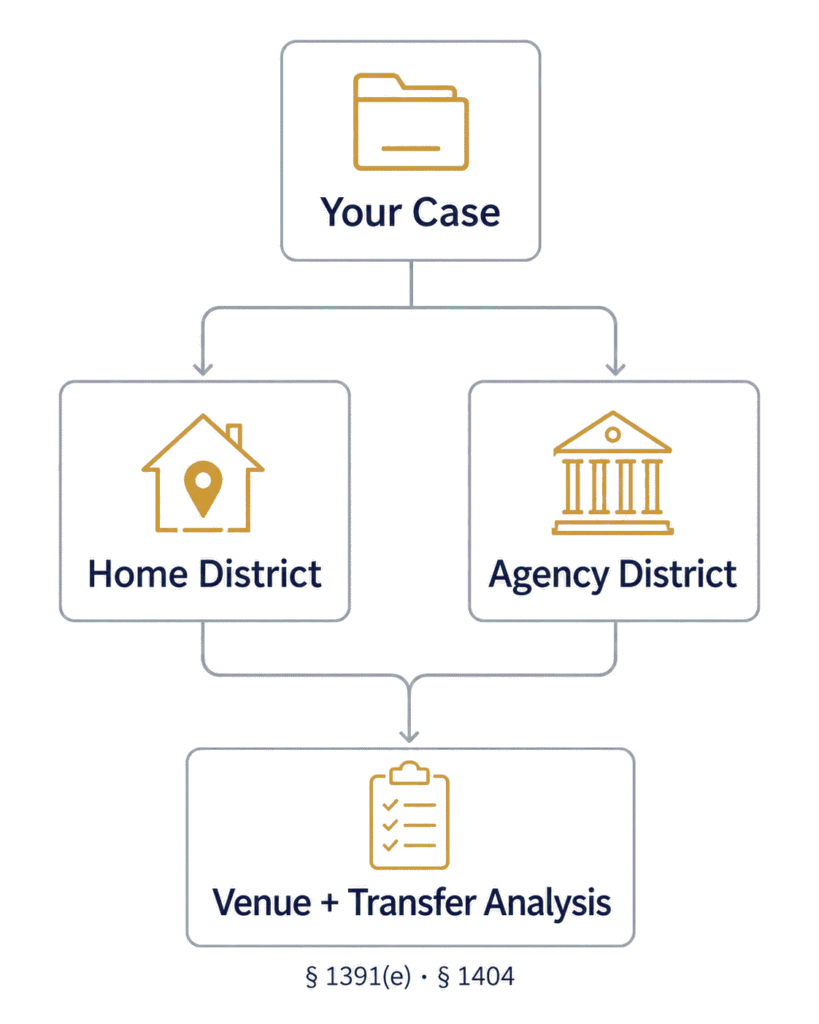
Section 1391(e) can produce more than one proper venue.
For example, the plaintiff may reside in one district while substantial agency activity occurred in another. When that happens, simply identifying two legally possible courts does not finish the analysis.
Under 28 U.S.C. § 1404(a), a federal court may transfer a civil action to another district where it could have been brought for the convenience of the parties and witnesses and in the interest of justice.
That means even a case filed in a proper venue can later be transferred.
Courts may examine facts such as:
- where the plaintiff lives;
- where the underlying agency conduct occurred;
- the connection each district has to the dispute;
- the parties’ preferred forums;
- convenience; and
- the local interest in resolving the controversy.
If venue was actually laid in the wrong district, 28 U.S.C. § 1406(a) provides another mechanism. The court may dismiss the case or, when the interest of justice supports it, transfer the action to a district where it could have been brought.
The practical consequence is important: venue is not just about where a complaint can initially be uploaded. It can affect whether the first stage of the litigation is spent addressing the immigration delay or fighting about where the case belongs.
Not sure which federal district is connected to your delay?
Our team can review where you live, which agency and office are handling the case, where the relevant processing occurred, and whether more than one federal venue may need to be evaluated before filing.
What About Consular Delay Cases?
Consular delay cases can make the venue analysis more complicated because the visa applicant may be outside the United States.
If the only plaintiff lives abroad, the plaintiff-residence provision may not provide the same U.S. district connection available to someone domiciled inside the country. The analysis may therefore place greater emphasis on the federal defendants and the location of the relevant government acts or omissions.
The situation can change when the lawsuit includes a U.S.-based petitioner or employer as a plaintiff.
A U.S. citizen spouse who filed an immigrant petition, for example, may have a domestic residence that is relevant to the analysis. An employer plaintiff may create a different residence question based on its principal place of business.
Consular cases can also involve several government components at different stages: USCIS, the National Visa Center, the Department of State, and an embassy or consulate abroad. The first task is therefore not to select a courthouse from a map. It is to identify which government action remains unfinished and who is legally responsible for it.
That issue can materially change the venue analysis.
Does Your Mandamus Lawyer Have to Be Local?
The location of the lawyer and the venue of the lawsuit are separate questions.
A federal district court has its own attorney-admission and local rules. Depending on the district and the lawyer’s existing admissions, counsel may already be admitted, may seek admission for the particular case, or may need to work with local counsel.
Those procedural requirements do not determine where the plaintiff’s lawsuit belongs under § 1391(e).
The better order of questions is:
- Which federal district or districts are legally available for this case?
- Which venue issues or transfer risks exist?
- What attorney-admission rules apply in that court?
For a fuller discussion of federal court admission and litigation experience, see our comparison of a mandamus lawyer vs. an immigration lawyer and our guide on how to choose a mandamus lawyer.
How to Find Your Federal District
Before analyzing whether your home district is a legally proper venue, you first need to identify what that district actually is.
The U.S. Courts maintains an official Federal Court Finder that allows users to search by address, city, state, ZIP code, or court name.
This is particularly important in states with multiple federal districts.
A person who says, “I live in Texas,” “I live in California,” or “I live in New York” has not yet identified a federal district. The city or ZIP code determines which district covers the residence.
But the Federal Court Finder answers only the geographic question.
It does not determine that your home court is necessarily the proper venue for your mandamus lawsuit. That still requires applying § 1391(e) to the plaintiffs, defendants, government conduct, and procedural posture of the actual case.
Frequently Asked Questions
Can I file a mandamus lawsuit in the state where I live?
Often, the plaintiff’s residence provides a possible venue under 28 U.S.C. § 1391(e)(1)(C) when no real property is involved. You still need to identify the correct federal judicial district within the state and determine whether other venue issues apply.
Do I have to sue where my USCIS service center is located?
Not necessarily. The service center may be relevant because substantial government acts or omissions occurred there, but § 1391(e) provides other possible venue connections as well. The plaintiff’s residence may be one of them.
Can I file my USCIS lawsuit in Washington, D.C.?
In some cases, a D.C.-based federal defendant can create a venue connection. That does not guarantee the case will remain there. Courts may transfer individual immigration disputes when another district has substantially stronger connections to the plaintiff or the agency action.
What if the petitioner and beneficiary live in different states?
The answer depends in part on who is actually a plaintiff in the lawsuit. Each plaintiff’s role, residence, and connection to the underlying immigration filing should be identified before venue is selected.
Can an employer’s location affect venue?
Yes, particularly when the petitioning company is a plaintiff. Under § 1391(c)(2), a plaintiff entity is treated as residing in the judicial district where it maintains its principal place of business.
Can more than one federal district be a proper venue?
Yes. Section 1391(e) can make multiple districts legally available. A court can still consider transferring a properly filed action under § 1404 based on convenience and the interest of justice.
What happens if a mandamus lawsuit is filed in the wrong district?
Under § 1406(a), the court may dismiss the action or transfer it to a district where it could have been brought if transfer is in the interest of justice. The result depends on the facts and procedural posture.
Does my mandamus lawyer have to practice in my state?
Not necessarily. Federal court admission is separate from the venue analysis. Each district has its own admission and local rules, and counsel may use an available admission procedure or local counsel where required.
The Right Court Depends on the Case
There is no single address on a USCIS notice that answers where to file a mandamus lawsuit.
Federal venue can depend on where the plaintiff resides, where a federal defendant resides, and where a substantial part of the government action or inaction occurred. More than one district can sometimes qualify, and a technically proper case can still face a transfer request.
The useful question is therefore not simply, “Where is USCIS located?” It is: which federal district has a legally supported connection to the specific delay you are asking a court to address?
Where would your immigration delay lawsuit be filed?
Contact our team for a case-specific review of your residence, petition structure, USCIS or government processing history, possible federal districts, and the venue issues that should be resolved before a complaint is filed.
Phone: +1 (862) 799-2200
Legal Disclaimer: This article is provided for general informational purposes only and does not constitute legal advice. Venue, jurisdiction, party selection, and transfer issues depend on the specific facts and claims in each federal lawsuit. For legal guidance specific to your situation, we recommend consulting with an attorney experienced in federal immigration litigation. The information in this article reflects federal statutes, court resources, and publicly available decisions reviewed as of August 24, 2026; subsequent legal developments may affect its accuracy. Prior results do not guarantee a similar outcome.
Sources
- 28 U.S.C. § 1361, Action to Compel an Officer of the United States to Perform His Duty, U.S. House of Representatives, Office of the Law Revision Counsel, accessed August 24, 2026.
- 28 U.S.C. § 1391, Venue Generally, U.S. House of Representatives, Office of the Law Revision Counsel, accessed August 24, 2026.
- 28 U.S.C. § 1404, Change of Venue, U.S. House of Representatives, Office of the Law Revision Counsel, accessed August 24, 2026.
- 28 U.S.C. § 1406, Cure or Waiver of Defects, U.S. House of Representatives, Office of the Law Revision Counsel, accessed August 24, 2026.
- Find a Federal Court, United States Courts, accessed August 24, 2026.
- Sarker v. United States Citizenship and Immigration Services, No. 4:26-cv-00678, Memorandum Opinion on Venue, E.D. Tex., June 26, 2026.
- FHAZZ LLC v. Alfonso-Royals, No. 25-cv-2219, Memorandum Opinion, D.D.C., June 26, 2026.