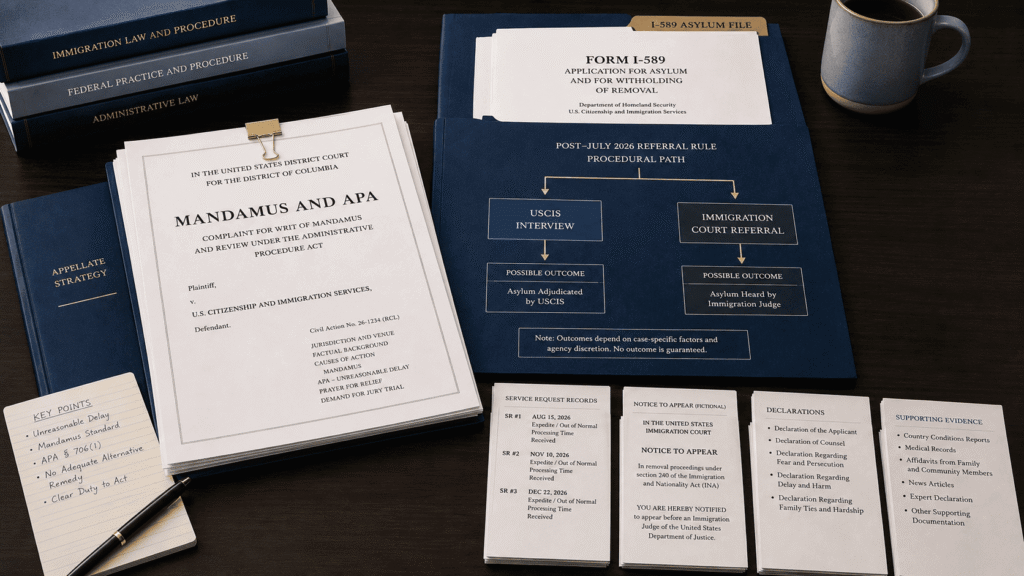
Your affirmative asylum application has been pending for years, but USCIS has not scheduled an interview. You may have submitted service requests, contacted a congressional office, checked your online account repeatedly, and received little more than confirmation that the case remains pending. A federal mandamus lawsuit may appear to offer a path out of that silence.
The legal calculation changed on July 28, 2026. A new Department of Homeland Security interim final rule now permits USCIS to refer certain affirmative asylum applications to immigration court without first conducting an asylum interview. As a result, asking USCIS to act may not always produce the procedural step an applicant expects.
Mandamus may still be an important remedy for an unreasonable asylum delay. But the central question is no longer only whether litigation can move the case faster. Applicants should also ask what USCIS may legally do once the delay ends, whether the existing Form I-589 record is ready for immediate review, and whether the applicant is prepared for a possible referral to removal proceedings.
In This Article Asylum Mandamus After the New Rule
- What Changed for Asylum Mandamus Cases?
- What Can a Mandamus Lawsuit Legally Do?
- Why Demanding a Specific Interview Is More Complicated
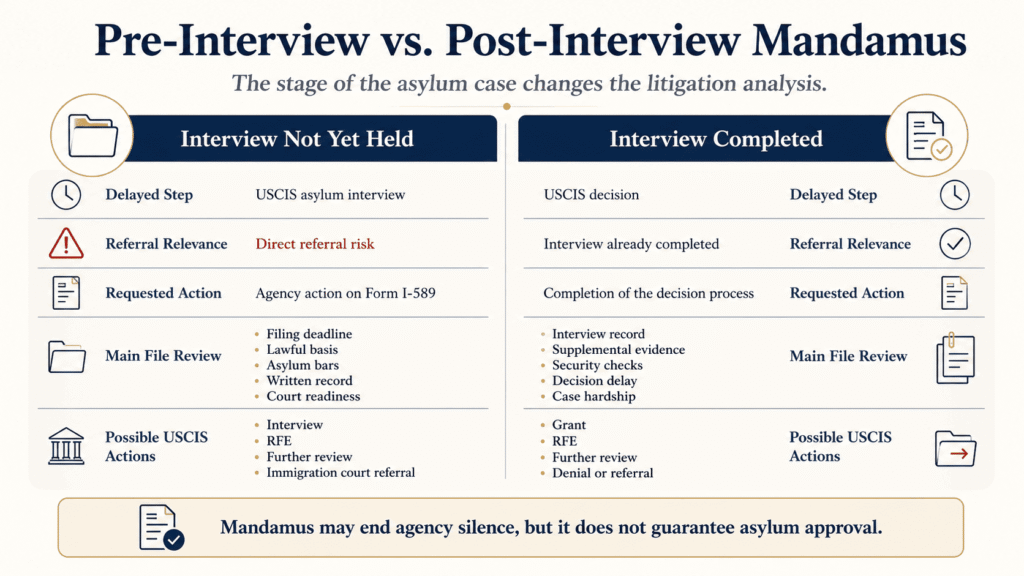
- Pre-Interview and Post-Interview Mandamus Are Different
- What Does Success Mean After the New Rule?
- The Referral-Risk Audit Before Filing
- Review Form I-589 Before Accelerating the Case
- How the TRAC Factors Apply
- When Mandamus May Still Be a Strong Option
- When You May Need to Prepare Before Filing
- What Happens If USCIS Refers the Case After Filing?
- A Decision Framework Before Filing
- Frequently Asked Questions
What Changed for Asylum Mandamus Cases?
Before the new rule, many pre-interview asylum delay cases were evaluated with a practical expectation that USCIS action might take the form of an interview notice. That expectation was never the same as a legal guarantee. Still, an interview was ordinarily part of the affirmative asylum process before USCIS granted, denied, or referred the application.
The July 2026 rule expands the actions USCIS may take. Under the amended regulation, an asylum officer may review the Form I-589, supporting documents, background-check information, agency records, and other relevant evidence and refer the application to an immigration judge without conducting an interview.
The interim final rule became effective on July 28, 2026. It does not require USCIS to refer every eligible file. The officer may still schedule an interview or request additional evidence when the record requires further development.
| Possible USCIS Action | What It Means | Does It Guarantee Asylum? |
|---|---|---|
| Schedule an interview | USCIS will take testimony and continue the affirmative asylum process. | No |
| Issue an RFE | USCIS requests evidence or clarification before deciding the next procedural step. | No |
| Continue agency review | The file may move into background, supervisory, security, or merits review. | No |
| Refer without interview | The asylum claim moves to an immigration judge and may become part of removal proceedings. | No |
| Grant or deny after interview | USCIS completes the agency-level merits determination. | Only a grant provides asylum |
Applicants who have waited years may still consider mandamus for an asylum delay. The difference is that the pre-filing analysis should now account for a broader range of legally available USCIS responses.
Mandamus can create movement, but movement is not necessarily an interview—and an interview is not the same as approval.
What Can a Mandamus Lawsuit Legally Do?
A mandamus lawsuit does not ask the federal judge to decide whether the applicant qualifies for asylum. It generally asks the court to address government inaction and require the responsible officials to perform a legally required duty.
Under 28 U.S.C. § 1361, federal district courts have jurisdiction over actions seeking to compel a federal officer, employee, or agency to perform a duty owed to the plaintiff.
Immigration delay complaints also frequently include a claim under the Administrative Procedure Act. Under 5 U.S.C. § 706(1), a reviewing court may compel agency action that has been unlawfully withheld or unreasonably delayed.
Our discussion of the difference between mandamus and an APA lawsuit explains why the two claims are often pleaded together. They arise from different statutes, but both may focus on the same unfinished government action.
The Court Usually Cannot Dictate a Discretionary Outcome
In Norton v. Southern Utah Wilderness Alliance, the Supreme Court explained that an APA failure-to-act claim must identify a discrete agency action that the agency is legally required to take. The court may address the failure to perform that action, but it generally cannot take over the agency’s discretionary decision-making process.
That distinction is critical in an asylum case. A complaint may seek lawful action on a delayed Form I-589. It ordinarily cannot require USCIS to:
- Approve the asylum application;
- Find the applicant credible;
- Accept a particular one-year filing exception;
- Ignore a statutory asylum bar;
- Exercise discretion favorably; or
- Guarantee that the next action will be an interview rather than another authorized step.
An APA § 706(1) lawsuit for a USCIS delay therefore should focus on the specific action allegedly withheld and the legal source requiring the agency to act.
The Asylum Processing Timetable Does Not Automatically Create a Private Lawsuit
Under 8 U.S.C. § 1158(d)(5), the asylum procedure includes timing language addressing when an initial interview or hearing should begin and when final administrative adjudication should ordinarily occur, absent exceptional circumstances.
However, § 1158(d)(7) states that the procedural provisions do not create a substantive or procedural right or benefit enforceable by a private party. Courts may therefore disagree about how the statutory timetable affects a particular mandamus or APA claim.
A careful complaint should not simply assert that every applicant has an independently enforceable right to an interview within 45 days. The analysis should instead address the complete legal framework, the agency’s duty to process the application, the length and circumstances of the delay, and controlling precedent in the relevant jurisdiction.
Why Demanding a Specific Interview Is More Complicated
The new rule does more than change an internal scheduling policy. It amends the asylum regulations to authorize referrals without interview and removes language that previously referred to a broader right to an interview.
This creates an important pleading question: is the plaintiff asking the court to require USCIS to act lawfully on the delayed Form I-589, or asking the court to require USCIS to use one specific procedural method?
| Requested Relief | Main Legal Question |
|---|---|
| Require USCIS to take legally required action on the pending Form I-589 | Has the agency unlawfully withheld or unreasonably delayed a required action? |
| Require USCIS specifically to conduct an asylum interview | Does current law impose a clear and enforceable duty to use that specific procedure in this applicant’s case? |
| Require USCIS to approve the application | Would the requested order improperly control the agency’s merits and discretionary determinations? |
The correct relief depends on the current regulations, the applicant’s procedural stage, any lawful basis to remain, and the legal source allegedly requiring USCIS action. Boilerplate complaint language written before July 28, 2026 may no longer capture the full range of agency authority.
The APA and mandamus decision framework begins with the same threshold question: what exact government action remains unfinished, and is the agency legally required to complete it?
Pre-Interview and Post-Interview Mandamus Are Different
The new referral authority is most important in cases where USCIS has not yet scheduled or completed the initial asylum interview. A post-interview delay presents a different procedural posture because USCIS has already taken testimony and developed at least part of the factual record.
| Case Stage | Main Delay | Effect of New Rule | Main Litigation Question |
|---|---|---|---|
| No interview scheduled | USCIS has not completed the interview stage. | Referral without interview may be a direct procedural possibility. | What could USCIS legally do if required to act now? |
| Interview already scheduled | A future interview date exists. | The rule primarily addresses applicants who have not yet been scheduled for an initial interview. | Is litigation still necessary or has meaningful action occurred? |
| Interview completed | USCIS has not issued a decision. | The no-interview authority is not the central procedural issue. | Has the post-interview decision delay become unreasonable? |
| Lawful basis to remain | Interview or adjudicative action remains pending. | USCIS states that it will continue to interview before granting or denying asylum. | Will that lawful basis remain valid when USCIS acts? |
| No lawful basis to remain | The affirmative case remains pending without interview. | Referral risk is more directly relevant. | Is the applicant ready for immigration court if USCIS refers the file? |
Pre-Interview Delay
In a pre-interview case, the applicant should assume that immediate USCIS review may include the filing deadline, statutory bars, discretionary concerns, merits of the claim, current lawful basis to remain, and consistency of the written record.
A delayed case does not become ready for litigation merely because the applicant has waited a long time. The record must also be ready for the agency action the lawsuit seeks to accelerate.
Post-Interview Delay
An asylum decision delay after the interview is different because the applicant has already testified before an asylum officer. The federal complaint may focus more directly on USCIS’s failure to complete the post-interview decision process.
A post-interview lawsuit still cannot guarantee a favorable result. USCIS may grant the application, request more evidence, conduct additional review, deny the application when the applicant remains in lawful status, or refer the claim when permitted by law.
What Does Success Mean After the New Rule?
The term “success” can be misleading in a delay lawsuit. Litigation success, procedural movement, and success on the immigration claim are three separate concepts.
| Result | Has USCIS Silence Ended? | Has the Applicant Won Asylum? |
|---|---|---|
| Interview notice | Partially | No |
| Request for Evidence | The case is moving | No |
| Interview completed | A major stage is complete | No |
| Referral to immigration court | The USCIS delay may end | No; the claim continues before EOIR |
| Asylum granted | Yes | Yes |
| Application denied | Yes | No |
A lawsuit may successfully establish that government action is overdue. USCIS may then complete a procedural step without granting the underlying benefit. Applicants should understand what USCIS mandamus for an asylum case may—and may not—accomplish before treating movement as a guaranteed immigration outcome.
A lawsuit may successfully end USCIS silence while producing a procedural result the applicant did not prefer.
The Referral-Risk Audit Before Filing
A pre-filing review should evaluate more than the age of the case. It should examine whether the written asylum record contains an issue that USCIS could identify immediately if federal litigation causes the file to receive prompt attention.
One-Year Filing Deadline
Asylum generally must be requested within one year after the applicant’s last arrival in the United States, unless a statutory exception applies. Before accelerating the case, confirm:
- The actual date of last arrival;
- The date USCIS received Form I-589;
- Whether the entry date is blank, incomplete, or incorrect;
- Whether the filing was submitted within one year;
- Whether changed circumstances apply;
- Whether extraordinary circumstances apply;
- Whether the application was filed within a reasonable period after the exception arose; and
- Whether the exception is explained and supported in the existing record.
The new rule identifies possible one-year filing issues as a major category for referral without interview. DHS estimated that hundreds of thousands of pending applications could require review because they appeared to have been filed more than one year after the last arrival or contained a blank entry date. That estimate does not mean every identified file will be referred.
Mandatory Bars and Sensitive History
USCIS may also identify a possible mandatory bar through the Form I-589, background checks, criminal records, government databases, prior immigration files, or other evidence.
The review should include:
- Arrests, charges, and convictions;
- Certified criminal dispositions;
- Alleged gang or organizational affiliations;
- Military, police, intelligence, or paramilitary activity;
- Possible involvement in persecution of others;
- Terrorism-related questions;
- Serious nonpolitical crime concerns; and
- Inconsistencies in previous disclosures.
An arrest does not automatically establish an asylum bar. The legal effect depends on the conduct, statute, disposition, record of conviction, and applicable immigration law. The issue should nevertheless be evaluated before requesting immediate agency action.
Merits of the Asylum Claim
The new rule also permits USCIS to consider whether the written record establishes asylum eligibility. A merits review should examine whether the filing adequately addresses:
- A protected ground;
- The connection between the protected ground and the feared harm;
- Past persecution or a well-founded fear of future persecution;
- The persecutor’s identity and motive;
- Government involvement or inability or unwillingness to provide protection;
- Internal relocation;
- Credibility and consistency;
- Corroborating evidence; and
- Current country conditions.
Discretionary Factors
Asylum remains a discretionary benefit. Even when a person meets the refugee definition and no mandatory bar applies, USCIS may consider positive and negative discretionary factors.
Those factors may include immigration violations, false statements, conduct that does not independently create a mandatory bar, humanitarian concerns, family ties, rehabilitation, community involvement, and the total circumstances of the applicant’s case.
Current Basis to Remain in the United States
The rule distinguishes applicants based partly on whether they maintain a lawful basis to remain. This may require review of:
- Valid nonimmigrant status;
- Parole;
- Temporary Protected Status;
- Deferred action;
- A pending adjustment or other application;
- The expiration date of any status or authorization; and
- Differences between the principal applicant and derivative family members.
The phrase “lawful basis to remain” should not be applied mechanically. Different forms of status, parole, protection, and authorized stay may produce different consequences under the regulation.
Is your asylum file ready for USCIS to act?
Before filing a federal delay lawsuit, review the Form I-589, one-year filing deadline, immigration history, possible asylum bars, supporting evidence, lawful-basis issues, and the consequences of a referral to immigration court.
Review Form I-589 Before Accelerating the Case
An applicant should obtain and review the exact version of the asylum filing that USCIS currently possesses. A recreated summary or recently rewritten declaration is not a substitute for the original record.
Obtain the Complete Filing
Collect:
- The signed Form I-589;
- The personal declaration;
- All exhibits and translations;
- The filing cover letter;
- The receipt notice;
- Every supplement submitted later;
- Any prior attorney submission; and
- Delivery or online-filing confirmation.
The evidence needed before filing a mandamus lawsuit should establish both the immigration case history and the specific government action that remains unfinished.
Compare the Filing With Other Government Records
USCIS may compare Form I-589 with:
- Visa applications;
- Form I-94 and travel records;
- Statements made to CBP;
- Credible-fear or reasonable-fear records;
- Prior USCIS applications and petitions;
- Immigration court records;
- Criminal and security records;
- Address and employment histories; and
- Other available government information.
Material inconsistencies should be evaluated before filing suit. The correct response is not always to send an immediate supplement. Any correction should identify the inaccurate information, explain how the error occurred, provide the correct information, and include supporting documentation when available.
Do Not Confuse an EAD Clock Problem With an Interview Delay
The asylum EAD clock and the asylum interview timeline measure different things. A stopped clock may require a correction request, while an unreasonably delayed Form I-589 may raise a separate agency-inaction question.
Applicants should understand the difference between an asylum EAD clock issue and an interview delay before choosing a federal litigation strategy.
Document the Delay and Its Consequences
A mandamus record may include:
- Receipt and filing dates;
- Dated case-status screenshots;
- Service-request confirmations and responses;
- Congressional inquiries;
- CIS Ombudsman submissions;
- Interview or rescheduling history;
- Medical and mental-health effects;
- Family separation;
- Employment or professional harm;
- Financial consequences; and
- Age-related concerns affecting derivative children.
Hardship does not create an agency duty by itself. It can, however, help explain why continued delay has serious human consequences and why the case deserves individualized review.
How the TRAC Factors Apply
Federal courts commonly analyze agency delay through the six-factor framework from Telecommunications Research & Action Center v. FCC. The TRAC factors for unreasonable immigration delay operate as a contextual balancing test rather than a fixed countdown.
Factor One: The Rule of Reason
The agency’s timeline should follow a rational process. Courts may consider the total delay, USCIS scheduling policies, the age and posture of the application, recent agency activity, and whether the file appears to have remained inactive without a case-specific explanation.
The new referral rule may affect the government’s explanation of how USCIS is managing the backlog. It does not automatically establish that every previous or continuing delay is reasonable.
Factor Two: Congressional Timing Guidance
Congress included timing language in the asylum statute, but also limited private enforcement of those provisions. A court may still consider congressional timing signals as part of the broader reasonableness analysis, depending on the legal claim and governing precedent.
Factors Three and Five: Human Welfare and Prejudice
Asylum delays can affect:
- Family unity;
- Mental and physical health;
- Ability to reunite with qualifying relatives;
- Employment and professional planning;
- Travel;
- Access to long-term stability; and
- The applicant’s ability to preserve evidence and witness recollection.
These consequences should be supported by records and declarations rather than described only in general terms.
Factor Four: Competing Agency Priorities
The government may argue that ordering action in one case interferes with USCIS’s ability to manage a large asylum backlog and moves one applicant ahead of others.
The applicant may respond that a general backlog does not necessarily justify extreme or unexplained individualized delay, particularly when the case has remained inactive for years and the applicant has documented substantial harm.
Factor Six: Bad Faith Is Not Required
An applicant does not necessarily have to prove that USCIS acted with an improper motive. Evidence of lost records, repeated misinformation, unusual transfers, or contradictory agency responses may still be relevant, but unreasonable delay can exist without a finding of bad faith.
When Mandamus May Still Be a Strong Option
The new rule does not eliminate asylum delay litigation. Mandamus or APA review may remain appropriate when the delay is unusually long, the government-controlled step is identifiable, and the applicant understands the possible consequences of agency action.
Factors that may support litigation readiness include:
- A multi-year pre-interview or post-interview delay;
- A complete and internally consistent Form I-589 record;
- Timely filing or a well-documented one-year exception;
- No apparent mandatory asylum bar;
- Repeated and unsuccessful attempts to obtain agency action;
- Documented family, medical, employment, or humanitarian harm;
- A clear understanding that mandamus does not guarantee approval;
- Preparation for the possibility of immigration court referral;
- An appropriate federal venue and properly selected defendants; and
- Realistic requested relief tied to a legally required action.
Example: A More Litigation-Ready Record
An applicant filed Form I-589 within one year of arrival, submitted a detailed declaration and corroborating records, has no known criminal or security issue, and has waited seven years without an interview. Multiple service requests and a congressional inquiry produced only standard responses. The applicant also has documented family and medical hardship.
These facts do not guarantee that a court will accept the claims or that USCIS will grant asylum. They may, however, present a more developed basis for evaluating unreasonable delay and the risks of immediate agency review.
When You May Need to Prepare Before Filing
Other cases may require record reconstruction or legal analysis before federal litigation should be considered.
Warning signs include:
- The application was filed late and contains no exception explanation;
- The date of last arrival is missing or incorrect;
- Form I-589 materially conflicts with a visa application or border statement;
- Criminal dispositions have not been obtained;
- A possible statutory bar has not been analyzed;
- The declaration omits a central element of the asylum claim;
- The applicant does not possess a complete copy of the filing;
- USCIS or EOIR addresses are outdated;
- The status of derivative family members is unclear;
- No plan exists for representation in immigration court;
- An interview was recently scheduled; or
- USCIS recently issued an RFE or another meaningful notice.
Example: Prepare the Record Before Accelerating
An applicant filed three years after the last arrival. Form I-589 contains no explanation for the delay, the entry date is inconsistent with Form I-94, and the original declaration differs materially from the applicant’s current account. The applicant has only a partial copy of the filing and is not prepared for removal proceedings.
In that situation, the first step may be a complete file review, records request, legal analysis of the filing deadline, controlled correction strategy, and immigration court readiness plan. Filing immediately because the case is old could expose issues that have not yet been evaluated.
What Happens If USCIS Refers the Case After Filing?
If USCIS refers the asylum application after a federal complaint is filed, the government may argue that the agency has taken the requested action and that some or all of the delay claim is now moot.
The result depends on:
- The exact claims pleaded;
- The government action challenged;
- The relief requested in the complaint;
- Whether USCIS completed the action the plaintiff asked the court to compel; and
- Whether any separate live controversy remains.
A complaint seeking general action on the Form I-589 may be affected differently from one seeking a specific interview. The July 2026 regulatory amendments may also affect whether an applicant can establish a clear duty to provide that specific interview.
Referral Is Not a Final Denial of Asylum
Under the USCIS description of the asylum process, an applicant who lacks legal immigration status may receive Form I-862, Notice to Appear, and be referred to an immigration judge.
The immigration judge conducts a de novo review. This means the judge independently considers the asylum application instead of simply reviewing the USCIS record for error.
The applicant may present:
- The asylum claim;
- Testimony and witnesses;
- Updated supporting evidence;
- Country-condition records;
- Evidence of a one-year filing exception;
- Withholding of removal; and
- Protection under the Convention Against Torture, when applicable.
The Applicant Must Be Ready for EOIR
Referral can require immediate attention to:
- The allegations and charges in the Notice to Appear;
- EOIR case-status information;
- Address-change obligations;
- Master calendar hearings;
- Pleadings and designated country of removal;
- Biometrics and filing compliance;
- Evidence deadlines;
- Witness preparation;
- Individual merits hearing strategy; and
- The immigration circumstances of derivative family members.
A person should not treat referral as a minor administrative transfer. It preserves an opportunity to pursue protection, but it also places the applicant in formal removal proceedings.
A Decision Framework Before Filing
The following questions can help organize a case evaluation. They do not replace legal analysis of the applicant’s facts, federal jurisdiction, venue, or controlling precedent.
| Decision Point | If Yes | If No or Unclear |
|---|---|---|
| 1. Has the interview already occurred? | Evaluate a post-interview decision delay. | Complete a pre-interview referral-risk review. |
| 2. Has USCIS scheduled the interview? | Reassess whether litigation is still necessary. | Continue to the lawful-basis and record review. |
| 3. Does the applicant maintain a lawful basis to remain? | Analyze how the interview and denial framework applies. | Referral risk is more directly relevant. |
| 4. Is Form I-589 complete and consistent? | Continue to the delay and hardship analysis. | Conduct a file audit before acceleration. |
| 5. Is there a possible filing bar, grant bar, or discretionary issue? | Resolve or evaluate the threshold issue before filing. | Proceed to the TRAC and jurisdictional analysis. |
| 6. Is the applicant prepared for immigration court? | The litigation decision can be made with the referral risk understood. | Develop an EOIR-readiness plan first. |
Possible conclusions may include:
- Potentially ready to file: The delay and record support further federal litigation analysis.
- Prepare the record, then reassess: Correctable or unexplored issues require attention first.
- Wait for scheduled agency action: USCIS has recently taken a meaningful step.
- Resolve a threshold legal issue: A filing deadline, statutory bar, jurisdictional problem, or lawful-basis issue controls the strategy.
- Use a different remedy: The main problem may involve an EAD clock, records request, court issue, or another action outside an asylum interview mandamus claim.
Frequently Asked Questions
Can mandamus still force USCIS to schedule an asylum interview?
The answer depends on the legal duty asserted, the current regulations, the applicant’s circumstances, and controlling precedent. After the July 2026 rule, a demand for general lawful action is different from a demand that USCIS use the specific procedure of an asylum interview.
Can USCIS refer my asylum case after I file a mandamus lawsuit?
Potentially. If USCIS reviews the case and determines that it may be referred without interview under the new rule, referral is one possible agency action. It is not automatic, and filing a lawsuit does not itself create a referral ground.
Does filing mandamus increase the legal basis for referral?
No. Filing a lawsuit does not create a new asylum bar or change the underlying eligibility rules. It may cause USCIS to review and act on the existing record sooner, which is why the record should be evaluated before litigation.
Is referral the same as an asylum denial?
No. Referral moves the claim to an immigration judge. The judge conducts an independent review, and the applicant may continue to seek asylum and other qualifying forms of protection.
Is a post-interview mandamus case safer?
The new authority to refer without conducting an interview is not the same central issue after the interview has already occurred. A post-interview applicant must still understand that the eventual decision may be favorable or unfavorable.
Should I supplement Form I-589 before filing?
Not automatically. A supplement should be accurate, legally relevant, consistent with the overall record, and accompanied by an explanation when it corrects or materially expands an earlier statement.
Will the federal judge decide my asylum claim?
Ordinarily, no. A federal delay lawsuit usually asks the court to address agency inaction. USCIS or the immigration judge retains responsibility for deciding asylum eligibility.
Does mandamus guarantee action within 60 days?
No. The federal government commonly has 60 days to respond after proper service, but that response deadline does not guarantee that the underlying immigration case will be resolved within the same period.
Where can I learn more about costs, timelines, and litigation risks?
Our mandamus lawsuit frequently asked questions address general process, timing, potential outcomes, and concerns applicants commonly raise before filing.
Informed Movement Matters More Than Speed Alone
The July 2026 asylum rule does not eliminate mandamus or APA litigation for delayed Form I-589 cases. It does make the strategy more fact-sensitive.
A pre-interview applicant should no longer assume that forcing USCIS to act necessarily means forcing USCIS to schedule an interview. Depending on the record, current immigration circumstances, and implementation of the new rule, agency action may include an interview, RFE, additional review, decision, or referral to immigration court.
The correct question is therefore not simply whether the asylum case has waited long enough. The better question is whether the record is ready for every lawful action USCIS may take when the delay ends.
Before sending your records to a mandamus lawyer, collect the complete Form I-589 filing, immigration history, one-year deadline evidence, agency communications, case-status records, hardship documentation, and any records relating to possible bars or inconsistencies.
Has your asylum case been waiting for years?
Contact our team for an evaluation of the delay, the existing Form I-589 record, referral risk under the new rule, possible APA and mandamus claims, and whether the case is ready for federal litigation.
Phone: +1 (862) 799-2200
Legal Disclaimer: This article is provided for general informational purposes only and does not constitute legal advice. Every immigration case has unique circumstances. For legal guidance specific to your situation, we recommend consulting with an experienced immigration attorney. The information reflects laws and policies as of the publication date; subsequent regulations, implementation guidance, litigation, or court orders may affect its accuracy. Prior results do not guarantee a similar outcome.
Sources
- Department of Homeland Security — Affirmative Asylum Referrals Without Interview, 91 Fed. Reg. 47101
- DHS — USCIS Announces Rule Change to Asylum System to Reduce Backlog
- 28 U.S.C. § 1361 — Action to Compel a Federal Officer or Agency to Perform a Duty
- 5 U.S.C. § 706 — Scope of Review Under the Administrative Procedure Act
- 5 U.S.C. § 555(b) — Agency Duty to Conclude Matters Within a Reasonable Time
- 8 U.S.C. § 1158 — Asylum
- Supreme Court of the United States — Norton v. Southern Utah Wilderness Alliance, 542 U.S. 55 (2004)
- Telecommunications Research & Action Center v. FCC, 750 F.2d 70 (D.C. Cir. 1984)
- USCIS — Obtaining Asylum in the United States
- USCIS — The Affirmative Asylum Process
- USCIS — Form I-589, Application for Asylum and for Withholding of Removal