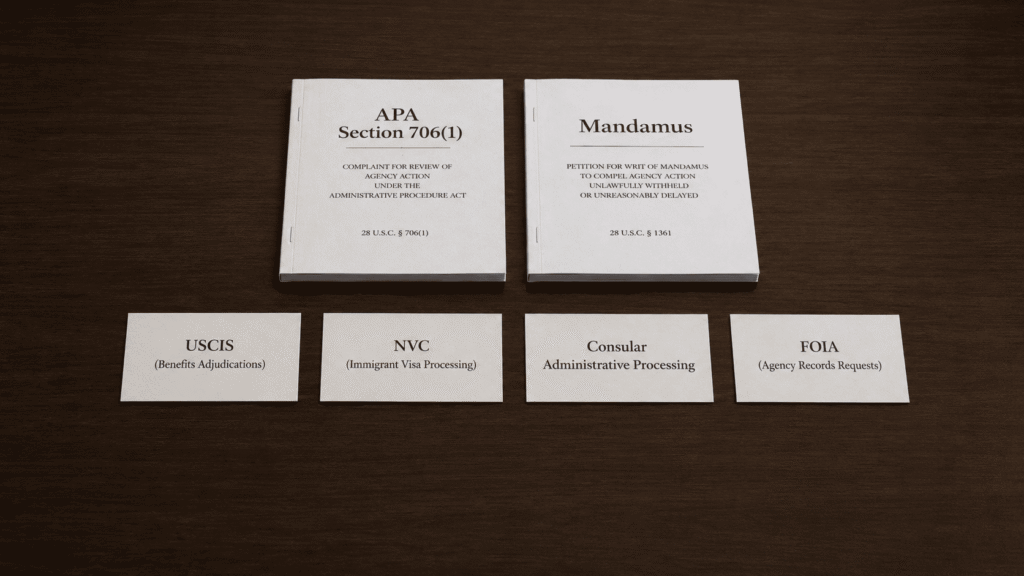
Your immigration case has remained pending despite status checks, agency inquiries, and months—or even years—of waiting. You may now be researching two federal litigation tools: an Administrative Procedure Act lawsuit and a writ of mandamus.
The choice is not always simply “APA or mandamus.” Immigration-delay complaints often rely on both. Before either claim can be evaluated, however, the case must involve a specific government action that remains unfinished and a legal basis for arguing that the agency is required to act.
This APA vs. mandamus decision tree explains how the analysis changes for USCIS adjudications, NVC processing, consular administrative processing, and FOIA requests.
In This Article APA vs. Mandamus Decision Tree
- APA and Mandamus in One Minute
- The Threshold Question: Is the Agency Required to Act?
- The APA vs. Mandamus Decision Tree
- Branch One: USCIS Adjudication Delays
- Branch Two: NVC Processing and Interview Delays
- Branch Three: Consular Administrative Processing
- Branch Four: FOIA Request Delays
- When the APA Is Especially Important
- When Mandamus Is Especially Important
- Why Immigration Complaints Often Plead Both
- Pre-Filing Decision Checklist
- Frequently Asked Questions
APA and Mandamus in One Minute
The Administrative Procedure Act and the Mandamus Act come from different statutes, but they can address overlapping forms of government inaction.
Under 5 U.S.C. § 706(1), a reviewing court may compel agency action that has been unlawfully withheld or unreasonably delayed. An APA claim therefore focuses on an agency’s failure to complete an action that the law requires.
Under 28 U.S.C. § 1361, federal district courts have jurisdiction over actions seeking to compel a federal officer, employee, or agency to perform a duty owed to the plaintiff.
| Issue | APA § 706(1) | Mandamus Act |
|---|---|---|
| Primary focus | Agency action unlawfully withheld or unreasonably delayed | A clear duty owed by a federal officer or agency |
| Required showing | A discrete agency action that the agency is legally required to take | A clear, nondiscretionary duty and no adequate alternative remedy |
| Typical request | Require the agency to complete or meaningfully address the delayed action | Require an official or agency to perform the duty owed |
| What it usually cannot do | Guarantee approval or dictate a discretionary outcome | Create a duty or compel a specific favorable decision |
Our broader comparison of an immigration mandamus lawsuit and an APA lawsuit explains how these legal theories overlap. The practical point is that both generally seek lawful agency action, not automatic approval of an immigration benefit.
The Threshold Question: Is the Agency Required to Act?
Before asking whether the APA or mandamus is the better claim, identify the exact government action that remains pending.
In Norton v. Southern Utah Wilderness Alliance, the Supreme Court explained that an APA failure-to-act claim must concern a discrete agency action that the agency is legally required to take. A court generally cannot supervise an agency’s entire program or order broad improvements to the way it operates.
The same threshold problem affects mandamus. It is not enough to show that agency action would be helpful, fair, or administratively appropriate. The plaintiff must identify a duty that is sufficiently clear for a court to enforce.
Ask these questions:
- What exact action is still unfinished?
- Which agency or official controls that action?
- Does a statute, regulation, or binding legal rule require the action?
- Is the timing of the action mandatory, or does the agency retain substantial discretion?
- Does the applicant seek action on the case, or a particular favorable outcome?
- Has Congress limited judicial review of this type of agency decision?
For example, a request that USCIS adjudicate a pending application is different from a request that USCIS approve it. A federal court may have authority to address unlawful inaction while still leaving the merits decision to the agency.
Our guide to APA § 706(1) lawsuits for USCIS delays examines this required-action analysis in greater detail.
A long delay is not the entire legal claim. The court must also be able to identify an agency action that the law requires.
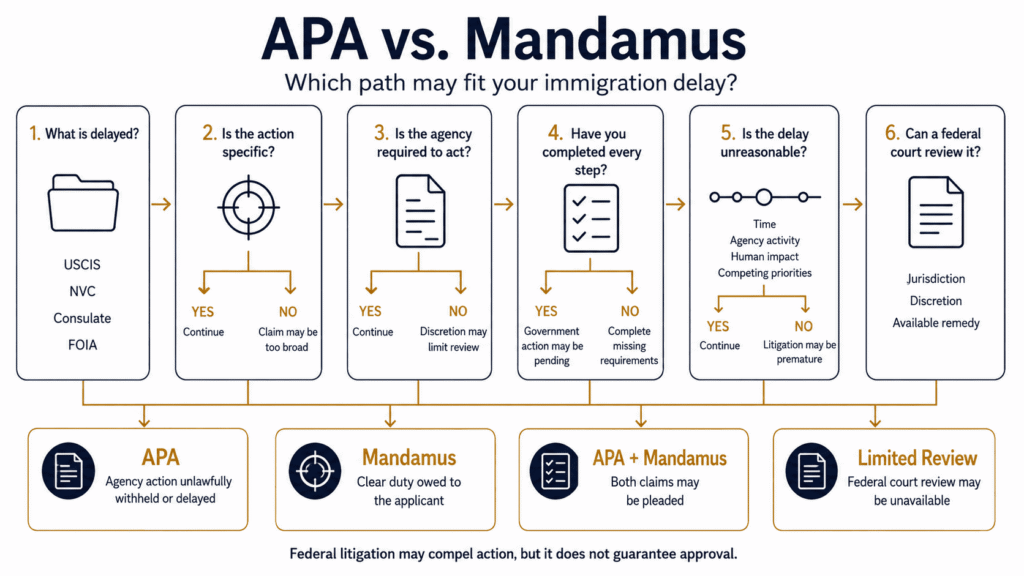
The APA vs. Mandamus Decision Tree
Use the following sequence to organize the initial analysis. The answers do not replace a court-specific legal review, but they help identify whether the case is moving toward an APA claim, a mandamus claim, both, or neither.
| Decision Point | If Yes | If No or Unclear |
|---|---|---|
| 1. Can you identify a specific unfinished action? | Continue to the source-of-duty analysis. | A broad complaint about agency management may not support relief. |
| 2. Does the law require the agency to take that action? | APA, mandamus, or both may be considered. | A discretionary action may fall outside both remedies. |
| 3. Has the applicant completed the required steps? | The next action may belong to the government. | Missing documents, fees, responses, or eligibility steps may explain the delay. |
| 4. Is the delay potentially unreasonable? | Evaluate the full record under the TRAC factors. | Recent or actively progressing cases may be premature for litigation. |
| 5. Is judicial review available? | Determine the strongest claim and defendants. | A jurisdictional restriction may require another strategy. |
| 6. Do APA and mandamus seek the same action? | Both may be pleaded, although a court may analyze them together. | The complaint must explain the distinct role of each claim. |
The reasonableness analysis commonly draws on the six factors from Telecommunications Research & Action Center v. FCC, known as the TRAC factors. Courts examine the agency’s rule of reason, any congressional timetable, the effect on human welfare, competing agency priorities, the prejudice caused by delay, and whether agency impropriety must be shown.
The factors operate as a contextual balancing framework, not a mathematical test. Review our detailed guide to the TRAC factors for unreasonable immigration delays for a factor-by-factor explanation.
Does your case pass the first steps of the decision tree?
Our federal litigation team can review the delayed action, responsible agency, source of the government’s duty, prior inquiries, and hardship evidence to evaluate an APA claim, mandamus claim, or combined strategy.
Branch One: USCIS Adjudication Delays
USCIS delays may involve Forms I-130, I-485, N-400, I-751, I-526E, asylum applications, employment authorization requests, and other petitions or applications.
Begin by identifying the precise adjudication that remains pending. Then confirm:
- The receipt date and receipt number;
- The form, category, and processing office;
- Whether biometrics or an interview has been completed;
- Whether USCIS issued an RFE, NOID, or other request;
- Whether every required response was submitted;
- The date of the last meaningful agency action.
USCIS publishes case processing-time information by form, category, and office. Those figures provide context and may show when USCIS permits an outside-normal-processing-time inquiry. They are not necessarily binding adjudication deadlines.
A case outside the published range may still require a full TRAC analysis. Conversely, a case within a broad processing estimate is not automatically immune from review when the record includes unusual circumstances, extended inactivity, or significant documented harm.
The requested relief should ordinarily focus on completing the legally required adjudicative process. A complaint should not assume that a federal judge can order USCIS to approve the underlying benefit.
Branch Two: NVC Processing and Interview Delays
An immigrant visa case may pass through USCIS, the National Visa Center, and a U.S. embassy or consulate. Identifying the agency that controls the next step is therefore essential.
The Department of State explains that NVC reviews fees, forms, and supporting documents before a case can be scheduled for an immigrant visa interview. Once the case is documentarily complete, NVC coordinates scheduling with the relevant consular post.
The Immigrant Visa Scheduling Status Tool shows the documentarily complete month and year for which NVC is scheduling most interviews at a selected post and in a selected category.
Ask:
- Has NVC created the case and issued the Welcome Letter?
- Have the fees, DS-260, Affidavit of Support, and civil documents been accepted?
- Has NVC confirmed that the case is documentarily complete?
- Is the priority date current, when visa availability applies?
- Is NVC still reviewing the file, or is the consular post controlling appointment availability?
An NVC-stage lawsuit requires more than naming the Department of State generally. The complaint should identify the delayed procedural step and explain which officials are responsible for completing it.
Branch Three: Consular Administrative Processing
Consular cases require especially careful analysis because a post-interview delay may involve a formal refusal under INA § 221(g), additional document review, security screening, or other administrative processing.
The Department of State states that when a case is refused under § 221(g), the officer should tell the applicant whether additional information is required or whether the case requires administrative processing. A refusal may later be reconsidered after the requested material or processing is completed.
Review our guide to 221(g) administrative processing delays for an explanation of how the consular stage differs from a pending USCIS adjudication.
The litigation questions include:
- Did the officer issue a § 221(g) refusal?
- Did the notice request documents or indicate administrative processing?
- Did the applicant submit every requested item?
- Is the case awaiting a specific government-controlled step?
- Has a court in the relevant jurisdiction treated the refusal as completed agency action?
- Would the requested relief require review of the visa merits rather than agency inaction?
These distinctions matter because federal courts do not apply one uniform approach to every consular-delay case. In Karimova v. Abate, for example, the D.C. Circuit affirmed dismissal where the applicant did not identify a law clearly requiring the consular officer to issue a different form of final decision after a § 221(g) refusal.
That decision does not establish that every consular-delay case fails. It shows why the complaint must carefully identify the remaining required action, the governing jurisdiction, and the distinction between compelling action and reviewing a visa refusal.
Branch Four: FOIA Request Delays
A delayed Freedom of Information Act request follows a more specific statutory framework than an ordinary immigration-benefit adjudication.
Under 5 U.S.C. § 552, agencies generally must make a determination on a properly submitted FOIA request within 20 working days, subject to statutory extensions and other procedural rules. This does not necessarily mean that every responsive record must be produced within 20 days.
For a delayed immigration A-file request, determine:
- When and where the FOIA request was submitted;
- Whether the agency acknowledged the request;
- Whether identity verification or authorization was complete;
- Whether the agency requested clarification;
- Whether an administrative appeal or constructive-exhaustion issue applies;
- Whether the request remains pending in a particular processing track.
FOIA litigation focuses on the records request itself. It does not ordinarily compel USCIS to decide a separate immigration petition or application. The request for records and the underlying immigration delay should therefore be treated as two different agency actions.
When the APA Is Especially Important
The APA is particularly important when the plaintiff challenges agency inaction and seeks review under the federal framework governing agency conduct.
In addition to § 706(1), 5 U.S.C. § 702 provides a right of judicial review to a person suffering a legal wrong or adversely affected by agency action within the meaning of a relevant statute. It also plays an important role in actions seeking nonmonetary relief against federal agencies and officials.
An APA claim may be central when:
- The case involves identifiable agency action or failure to act;
- The plaintiff can identify a legally required step;
- The action has been unlawfully withheld or unreasonably delayed;
- The requested relief is agency action rather than a specific discretionary result;
- No statute expressly precludes review;
- The challenged conduct is not committed entirely to agency discretion by law.
The APA does not automatically supply a required duty. The plaintiff must still connect the requested action to a statute, regulation, or other enforceable legal obligation.
When Mandamus Is Especially Important
Mandamus emphasizes the federal officer’s or agency’s duty to the plaintiff. Courts traditionally describe it as an extraordinary remedy, making the clarity of the duty especially important.
A mandamus theory is stronger when:
- The plaintiff has a clear right to performance of the duty;
- The defendant has a clear, nondiscretionary obligation to act;
- The plaintiff has completed all required steps;
- The delay has become unreasonable in context;
- No adequate alternative remedy provides the requested action.
Mandamus does not permit a federal court to rewrite eligibility standards or replace the agency as the immigration decision-maker. The usual objective is to obtain a lawful decision or required procedural action, whether the eventual result is approval, denial, a request for evidence, an interview, or another authorized step.
For a plain-English overview, read our guide explaining how a mandamus lawsuit works in immigration cases.
Why Immigration Complaints Often Plead Both
APA and mandamus claims are commonly pleaded together because they approach the same failure to act from related legal foundations. The APA addresses agency action unlawfully withheld or unreasonably delayed. Mandamus focuses on a clear duty owed by a federal official or agency.
Pleading both may preserve alternative theories at the complaint stage. It does not, however, eliminate the need to show:
- A specific and reviewable government action;
- A legal source requiring action;
- A connection between the duty and the plaintiff;
- An unreasonable delay or unlawful withholding;
- A form of relief the court has authority to provide.
Courts may treat the two claims as overlapping when they seek the same action. In a May 2026 memorandum disposition, the Ninth Circuit affirmed dismissal of both claims in Chen v. Mullin, explaining that the mandamus claim sought the same relief as the unsuccessful APA claim.
Similarly, the Fourth Circuit’s decision in Lovo v. Miller illustrates that both theories may fail when the plaintiff cannot identify a binding legal requirement for the particular action sought.
Pleading both claims does not create a government duty. The duty must already arise from the governing statute, regulation, or other enforceable law.
Pre-Filing Decision Checklist
Before sending your records to a mandamus lawyer, organize the case around the following questions:
- Name the unfinished action. Identify the adjudication, interview, transfer, records response, security review, or other step still pending.
- Identify the responsible agency. Distinguish USCIS, NVC, the consular post, a security-review component, or a FOIA office.
- Locate the source of the duty. Determine whether a statute, regulation, or binding rule requires the agency to act.
- Confirm applicant compliance. Collect proof that fees, forms, interviews, biometrics, document requests, and agency inquiries were completed.
- Build the delay timeline. Record every meaningful agency action, applicant submission, inquiry, and response.
- Preserve processing information. Save dated USCIS, NVC, CEAC, or FOIA status records.
- Document the consequences. Gather evidence of family separation, employment loss, financial harm, medical concerns, or other concrete prejudice.
- Review jurisdictional barriers. Consider discretion, statutory restrictions, consular-review doctrines, and circuit-specific precedent.
- Define realistic relief. Request lawful action rather than a guaranteed approval.
- Compare litigation and non-litigation options. Evaluate inquiries, escalation procedures, congressional assistance, and federal litigation based on the complete record.
A well-organized timeline and evidence file make it easier to determine whether the case fits APA relief, mandamus relief, both claims, or a different strategy.
Frequently Asked Questions
Are APA and mandamus separate lawsuits?
They are separate legal theories arising from different statutes, but they may be included as separate claims in the same federal complaint when both concern the same delayed government action.
Can an immigration complaint include both APA and mandamus claims?
Yes. Immigration-delay complaints often plead both. A court may nevertheless analyze them together when they seek the same relief and depend on the same alleged duty to act.
Can a federal judge order USCIS to approve my application?
Usually, an unreasonable-delay lawsuit seeks a decision or required procedural action rather than guaranteed approval. The agency generally retains authority to decide the merits of the underlying application.
Do USCIS processing times determine whether a delay is unreasonable?
No. Published processing times provide useful context, but courts may also consider the applicable legal duty, the entire procedural history, competing agency priorities, human-welfare effects, and prejudice caused by the delay.
Can APA or mandamus claims be used for NVC delays?
Potentially. The analysis depends on the exact pending step, whether NVC or the consular post controls it, visa availability, appointment capacity, and whether the plaintiff can identify a reviewable duty to act.
Can APA or mandamus claims challenge consular administrative processing?
Some consular delays are litigated under both theories, but jurisdiction and reviewability can be more difficult after a § 221(g) refusal. The result may depend heavily on the requested relief and controlling precedent.
Is a FOIA delay analyzed the same way as an immigration application delay?
No. FOIA contains its own statutory response framework, exhaustion rules, exemptions, and remedies. A FOIA lawsuit addresses the records request rather than the merits of a separate immigration benefit.
Does filing under both statutes guarantee that the case will move faster?
No. Filing a complaint does not guarantee timing or outcome. The government may act, defend the delay, seek dismissal, request additional time, or take another legally available position.
Which Legal Path Fits Your Immigration Delay?
The strongest starting question is not simply whether APA or mandamus sounds more powerful. It is whether the government has failed to complete a specific action that the law requires.
From there, the analysis turns to agency responsibility, applicant compliance, the length and circumstances of the delay, judicial-review restrictions, and the relief the court can provide. In some cases, an APA claim is central. In others, mandamus provides the clearer framework. Many complaints plead both, while some delays may not yet support federal litigation.
A careful evaluation should therefore begin with the case timeline and legal duty, not with a one-size-fits-all label.
Is your case delayed at USCIS, NVC, a consulate, or a FOIA office?
Send us your receipt notices, status history, agency correspondence, inquiry responses, and case timeline. Our team can evaluate which agency action remains pending and whether APA, mandamus, both claims, or another strategy may fit your circumstances.
Phone: +1 (862) 799-2200
Legal Disclaimer: This article is provided for general informational purposes only and does not constitute legal advice. Every immigration case has unique circumstances. For legal guidance specific to your situation, we recommend consulting with an experienced immigration attorney. The information reflects laws and policies as of the publication date; subsequent changes may affect its accuracy. Prior results do not guarantee a similar outcome.
Sources
- 5 U.S.C. § 706 — Scope of Review Under the Administrative Procedure Act
- 28 U.S.C. § 1361 — Action to Compel a Federal Officer or Agency to Perform a Duty
- 5 U.S.C. §§ 701–706 — Judicial Review Under the Administrative Procedure Act
- Supreme Court of the United States — Norton v. Southern Utah Wilderness Alliance, 542 U.S. 55 (2004)
- Telecommunications Research & Action Center v. FCC, 750 F.2d 70 (D.C. Cir. 1984)
- United States Court of Appeals for the Fourth Circuit — Lovo v. Miller
- United States Court of Appeals for the D.C. Circuit — Karimova v. Abate
- United States Court of Appeals for the Ninth Circuit — Chen v. Mullin
- USCIS — Case Processing Times
- Department of State — National Visa Center
- Department of State — Immigrant Visa Scheduling Status Tool
- Department of State — Administrative Processing Information
- FOIA.gov — Freedom of Information Act Statute