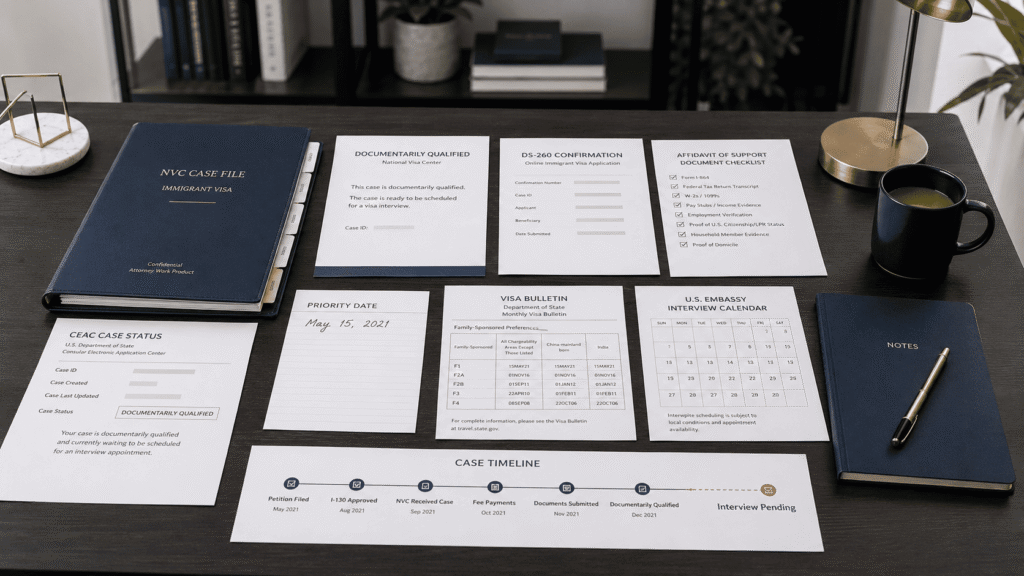
Your immigrant visa case has been marked documentarily qualified, or “DQ,” but no interview appointment has arrived. You may have completed the DS-260, submitted the Affidavit of Support and civil documents, checked CEAC repeatedly, and sent inquiries to the National Visa Center. The case appears ready, yet it remains at NVC without a scheduled interview.
An NVC interview scheduling delay does not always mean that NVC has misplaced the case or refused to act. The assigned U.S. embassy or consulate must provide appointment capacity, and applicants in numerically limited visa categories must also have an available visa number. Transfer issues, local operating conditions, staffing, vetting, and changes in the Visa Bulletin may create additional delays.
Still, some post-DQ cases remain pending far beyond the apparent queue without a case-specific explanation. The correct analysis requires more than counting months. Applicants should identify who controls the next step, whether every legal and procedural requirement has been satisfied, how the case compares with the assigned post’s scheduling data, and whether mandamus or Administrative Procedure Act litigation may be available.
In This Article NVC Interview Scheduling Delay After DQ
- What Does Documentarily Qualified Mean?
- What Happens After a Case Becomes DQ?
- Why NVC Interview Scheduling Delays Happen
- Who Controls the Interview Date?
- Is Your Case Outside the Normal Queue?
- When May Mandamus Apply After DQ?
- What Makes a Post-DQ Case Stronger or Weaker?
- Documents to Collect Before Legal Review
- Practical Steps Before Filing a Lawsuit
- Frequently Asked Questions
What Does Documentarily Qualified Mean?
A case generally becomes documentarily qualified after NVC has accepted the required fees, visa application, financial sponsorship materials, and civil documents. The Department of State’s scheduling resources often use the phrase “documentarily complete” for the same procedural milestone.
DQ status is important because it usually means that NVC has completed its primary document-review function. It does not mean that a consular officer has reviewed the applicant’s eligibility for the visa, and it does not guarantee that an interview will be scheduled immediately.
| DQ Usually Means | DQ Does Not Mean |
|---|---|
| NVC accepted the required fees and submitted documents. | The immigrant visa has been approved. |
| The case can enter the interview-scheduling process when the other requirements are met. | An appointment is immediately available at the assigned post. |
| NVC has completed its initial review of the submitted package. | The consular officer has completed admissibility, security, or merits review. |
| The DQ date may determine the case’s position in the scheduling queue. | Every case will be scheduled strictly according to one universal worldwide timeline. |
The DQ email and CEAC record should be preserved. The exact date can become important when comparing the case with the Department of State’s IV Scheduling Status Tool or evaluating whether the case has fallen behind similarly situated applicants.
What Happens After a Case Becomes DQ?
After DQ, the case generally remains at NVC until an appointment is available. The assigned embassy or consulate tells NVC which interview dates it can offer. NVC then assigns appointments based primarily on the date cases became documentarily complete.
The Department of State states that NVC usually sends the appointment notice to the applicant, petitioner, and attorney or agent approximately two to three months before the interview. That notice is normally delivered by email.
Immediate-Relative Cases
Immediate relatives of U.S. citizens are not subject to the annual numerical limits that govern family-preference and employment-based immigrant visa categories. Their scheduling delay therefore usually turns more heavily on document completion, post capacity, transfer issues, local conditions, vetting, and other operational factors.
Family- and Employment-Preference Cases
Applicants in a family-sponsored or employment-based preference category need more than DQ status. A visa number must also be available under the applicable Visa Bulletin.
The applicant’s priority date generally must be earlier than the applicable Final Action Date or the category must be listed as current. If the priority date is not current, NVC cannot schedule the interview even when every document has been accepted and the embassy has appointment capacity.
Documentarily qualified means the case has completed an important NVC stage. It does not mean that an interview date or visa number is immediately available.
Why NVC Interview Scheduling Delays Happen
Post-DQ delays are often described simply as “an NVC backlog,” but the real cause may exist at NVC, the assigned consular post, the visa-number stage, or a combination of those points.
Embassy or Consulate Capacity
The embassy or consulate controls how many immigrant visa appointment dates it provides to NVC. Staffing levels, local demand, security conditions, holidays, facility limitations, temporary service reductions, and the mix of visa categories handled by the post may affect capacity.
Country- and Post-Specific Backlogs
There is no single worldwide interview queue. One embassy may schedule cases that became DQ recently, while another post may still be working through much older cases. Comparisons with applicants assigned to a different country or visa category can therefore be misleading.
Visa Availability and Retrogression
A family- or employment-preference case may be DQ while the priority date is current and later become unavailable because of retrogression. The Department of State explains that NVC cannot schedule an interview when the priority date is no longer eligible under the Final Action Dates chart.
Transfer and Interview-Location Issues
The Department of State generally requires immigrant visa applicants to interview in the consular district designated for their place of residence or, upon request, in their country of nationality, subject to limited exceptions. A transfer request may require proof of residence, coordination between posts, or confirmation that the new post will accept the case.
A transfer may help in some circumstances, but it is not an automatic solution to a long queue. The new post may have its own backlog, the transfer may change the scheduling position, or the request may be denied because the applicant does not satisfy the current interview-location rules.
Case-Specific Holds or Unresolved Requirements
A case may appear DQ while another issue prevents scheduling. Examples can include a pending I-601A provisional waiver, an unresolved transfer request, a category change, a derivative-beneficiary issue, an expired petition concern, missing updated information, or a case that has been reopened for additional review.
The Department of State’s weekly NVC Timeframes page does not measure post-DQ interview waits. It reports case-creation, document-review, and inquiry-response activity. Applicants should not treat those dates as a promise that an interview will be scheduled within the same timeframe.
Who Controls the Interview Date?
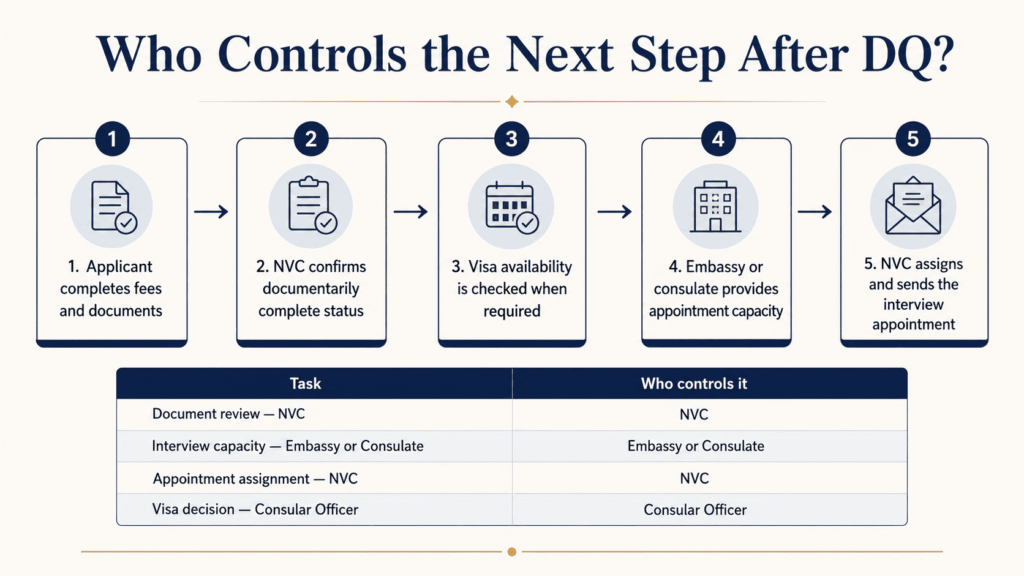
Responsibility is divided. NVC reviews and organizes the case, while the embassy or consulate supplies the appointment capacity. Visa availability may impose a separate legal limit, and the consular officer ultimately decides the visa application after the interview.
| Stage | Primary Responsibility | Practical Meaning |
|---|---|---|
| Fee and document review | NVC | NVC determines whether the required package is complete. |
| Visa-number availability | Statutory limits reflected in the Visa Bulletin | Preference-category interviews cannot be scheduled without an available visa number. |
| Interview capacity | Embassy or consulate | The post tells NVC which dates and appointment slots are available. |
| Appointment assignment | NVC | NVC fills available appointments, generally based on documentarily complete dates. |
| Post-transfer communication | Embassy or consulate, depending on the case stage | Once the file is transferred, case-specific questions may need to be directed to the post. |
| Visa adjudication | Consular officer | The officer decides whether the applicant is eligible after the interview and required review. |
This division of responsibility matters in federal litigation. A complaint should not describe every post-DQ delay as an NVC-only problem if the actual bottleneck is appointment capacity at the embassy. The APA and mandamus decision framework starts by identifying the specific unfinished government action and the officials who control it.
Has your case remained DQ without an interview?
A useful review begins with the DQ notice, visa category, priority date, assigned post, IV Scheduling Status Tool result, inquiry history, and any unresolved transfer or document issue.
How Can You Tell Whether the Case Is Outside the Normal Queue?
The Department of State’s IV Scheduling Status Tool provides a more useful starting point than anecdotes from social media or applicants assigned to different posts. The tool shows the documentarily complete month and year for which NVC is scheduling most interviews in a selected category at a selected embassy or consulate.
Compare the tool’s date with your own DQ month and year. The comparison can produce several different results:
- The post is scheduling an earlier DQ month: Your case may still be within the visible queue.
- The post is scheduling your DQ month: Continue monitoring, but preserve dated screenshots and communications.
- The post is scheduling later DQ months: Investigate whether a case-specific issue, visa-availability problem, transfer, or unexplained hold exists.
- Your category is not included in the tool: Use the case-specific Department of State instructions rather than forcing an inaccurate comparison.
The tool is updated monthly and does not guarantee an appointment. Department of State guidance states that staffing, capacity, local conditions, transfer requests, case volume, vetting, and Visa Bulletin changes may all affect scheduling.
Verify the Priority Date
Applicants in preference categories should compare the priority date with the current Final Action Date for the correct visa category and country of chargeability. Using the wrong chart, row, or country column can create the false impression that a visa is available.
Review CEAC and NVC Communications
Check whether CEAC still reflects completed documents, whether NVC issued a new message, and whether any applicant or sponsor document was reopened. A case-specific request may explain why the file did not move with other cases from the same DQ month.
Use the Correct Inquiry Channel
For cases still at NVC, the Department of State directs applicants to use the NVC Public Inquiry Form. The inquiry should identify the case number, DQ date, visa category, assigned post, priority-date status, and the specific discrepancy requiring review.
When May Mandamus Apply After DQ?
A federal mandamus lawsuit does not ask a judge to grant the immigrant visa. It generally asks the court to address government inaction and require the responsible federal officials to perform a legally required duty.
Under 28 U.S.C. § 1361, federal district courts have jurisdiction over actions seeking to compel a federal officer, employee, or agency to perform a duty owed to the plaintiff. Immigration delay complaints may also rely on 5 U.S.C. § 706(1), which permits a reviewing court to compel agency action unlawfully withheld or unreasonably delayed.
The legal analysis should identify:
- The exact government action that remains unfinished;
- The agency and officials responsible for that action;
- The legal source requiring the government to act;
- Whether the applicant completed every required step;
- Whether a visa number is legally available;
- The length and circumstances of the post-DQ delay;
- The assigned post’s current scheduling position;
- Whether another adequate remedy exists; and
- Whether the requested relief would improperly dictate a discretionary visa outcome.
Mandamus may seek required government action. It does not guarantee a visa, a favorable interview result, or an appointment on a particular date.
There Is No Automatic Waiting-Period Rule
No universal number of post-DQ months automatically creates a winning lawsuit. Courts often examine agency delay under the six-factor framework from Telecommunications Research & Action Center v. FCC, commonly called the TRAC factors.
The TRAC factors for an immigration delay consider the agency’s rule of reason, congressional timing guidance, the effect of delay on human welfare, competing agency priorities, prejudice to the applicant, and whether bad faith must be shown.
Federal decisions involving NVC interview scheduling illustrate that the DQ date, the total wait, the responsible post, family hardship, visa availability, and the exact duty alleged may all matter. They do not establish one nationwide post-DQ deadline applicable to every embassy and visa category.
Mandamus and APA Claims May Be Pleaded Together
APA and mandamus arise from different statutes but may address the same unfinished government action. Pleading both theories does not create a duty that does not already exist. The complaint must still identify a legally required action and a form of relief the court has authority to provide.
Post-DQ Delay Is Different From 221(g) Delay
A case waiting for its first interview remains at a different stage from a case already interviewed and refused under INA § 221(g). After the interview, the legal questions may involve consular administrative processing, requested documents, security screening, and judicial-review limitations. Our guide to 221(g) administrative processing delay addresses that later stage.
What Makes a Post-DQ Mandamus Case Stronger or Weaker?
Two applicants may have waited the same number of months but present very different federal litigation profiles. The strength of a case depends on the complete procedural record, not the calendar alone.
| Facts That May Support Review | Facts That May Complicate Review |
|---|---|
| The case has been DQ for a substantial period without meaningful action. | The case recently became DQ or remains within the post’s visible queue. |
| The priority date is current when visa availability is required. | The priority date is not current or recently retrogressed. |
| The post appears to be scheduling applicants with later DQ dates in the same category. | The post is still scheduling substantially earlier DQ months. |
| Every fee, form, civil document, and requested response has been completed. | A document, waiver, transfer, category issue, or applicant response remains unresolved. |
| Repeated inquiries produced only generic responses or no case-specific explanation. | The government recently provided a concrete explanation or took meaningful action. |
| The delay causes documented family, medical, financial, employment, safety, or age-out harm. | Hardship is described only generally and is not supported by records. |
An unusual delay does not guarantee jurisdiction or relief. The responsible defendants, venue, governing circuit precedent, source of the alleged duty, and requested order must all be evaluated before filing.
Documents to Collect Before Requesting Legal Review
The evidence needed before filing a mandamus lawsuit should show what the applicant completed, what government action remains pending, and how the timeline can be verified.
For a post-DQ interview delay, collect:
- USCIS petition approval notice;
- NVC Welcome Letter and case number;
- DS-260 confirmation page;
- Affidavit of Support submission records;
- Civil-document submission history;
- DQ email or documentarily complete notice;
- CEAC status screenshots with capture dates;
- Visa category and priority date;
- Relevant Visa Bulletin pages;
- Assigned embassy or consulate;
- IV Scheduling Status Tool screenshots;
- NVC Public Inquiry Form confirmations and responses;
- Embassy correspondence;
- Transfer or expedite requests and decisions;
- Evidence of residence relevant to the interview location;
- Marriage, birth, or family records relevant to continued eligibility;
- Evidence of medical, family, financial, employment, safety, or age-out harm; and
- A chronological list of every meaningful case event.
Save dated copies rather than relying only on live online pages. The Visa Bulletin, IV Scheduling Status Tool, CEAC record, post capacity, and Department of State instructions can change over time.
Practical Steps Before Filing a Lawsuit
- Confirm the DQ date. Preserve the email and verify that CEAC reflects completed document review.
- Verify visa availability. Confirm that the correct Final Action Date applies if the case is in a preference category.
- Check the assigned post. Make sure the case is assigned to the correct embassy under the current residence and nationality rules.
- Review the IV Scheduling Status Tool. Compare your DQ month with the month being scheduled for your category and post.
- Look for case-specific barriers. Check for reopened documents, transfer issues, waiver delays, category changes, or derivative-beneficiary problems.
- Submit a focused inquiry. Ask about the specific discrepancy instead of sending a general request for an estimated date.
- Preserve the response. Save the confirmation page, response email, CEAC history, and updated tool results.
- Document concrete harm. Gather records supporting family separation, health concerns, financial loss, safety issues, or age-out risks.
- Define realistic relief. A lawsuit should seek lawful government action, not guaranteed visa approval.
- Request a jurisdiction-specific assessment. Federal venue and controlling precedent can materially change the litigation analysis.
An expedite request may also be considered in a genuine life-or-death medical emergency. Department of State guidance states that preference-category applicants generally need a current priority date and available visa number before an expedite can result in interview scheduling. Expedite approval remains discretionary and depends on whether the consular post can accommodate the request.
Frequently Asked Questions
How long after DQ does NVC schedule an interview?
There is no single worldwide timeline. The assigned embassy’s capacity, the applicant’s visa category, priority-date availability, local conditions, staffing, transfer history, vetting, and case volume can all affect the wait. The IV Scheduling Status Tool provides a post- and category-specific comparison but does not guarantee an appointment date.
Does documentarily qualified mean my interview is guaranteed soon?
No. DQ means NVC accepted the required fees and documents. The interview still depends on appointment capacity and, for preference categories, visa-number availability.
Can NVC schedule the interview if my priority date is not current?
Generally, no. Applicants in family- and employment-preference categories need an available visa number under the Final Action Dates chart. Immediate relatives of U.S. citizens are not subject to the same numerical limits.
Who should I contact while the case remains at NVC?
The Department of State directs applicants to use CEAC for current case information and the NVC Public Inquiry Form for correspondence. Once the case has been transferred or an appointment has been assigned, the appropriate contact may change.
Can I transfer the case to an embassy with a shorter queue?
A transfer may be requested, but approval is not automatic. Current Department of State policy generally connects the interview location to the applicant’s residence or nationality, with limited exceptions. The applicant may need to document residence, and the requested post must be able to accept the case.
Can mandamus force NVC to schedule an interview?
Potentially, but the answer depends on the exact unfinished action, the responsible officials, visa availability, appointment capacity, applicable law, and controlling precedent. A complaint should distinguish a request for legally required action from a request for a guaranteed appointment on a particular date.
Will a federal judge approve my immigrant visa?
Ordinarily, no. A delay lawsuit generally seeks required government action. The consular officer retains responsibility for determining visa eligibility after the interview and any required review.
Does filing a lawsuit guarantee that the case will be completed within 60 days?
No. The federal government commonly has 60 days to respond after proper service, but that response period does not guarantee interview scheduling, visa issuance, or final resolution within the same period.
Post-DQ Silence Requires a Stage-Specific Analysis
A documentarily qualified case has completed an important NVC stage, but DQ status does not identify who currently controls the delay. The case may be waiting for embassy capacity, visa availability, a transfer, a case-specific review, or an unexplained government-controlled step.
The most useful starting point is to compare the DQ date with the assigned post’s current scheduling data, confirm priority-date eligibility, review CEAC and NVC communications, and identify any unresolved applicant requirement. If comparable cases have moved forward while the file remains behind without a specific explanation, a federal litigation review may be appropriate.
Before sending your records to a mandamus lawyer, organize the DQ notice, visa category, priority date, assigned post, inquiry history, scheduling-tool screenshots, transfer records, and evidence of harm caused by the delay.
Documentarily qualified but still waiting for an interview?
Contact our team for an evaluation of your DQ timeline, visa availability, assigned post, appointment queue, agency correspondence, hardship evidence, and possible APA or mandamus claims.
Phone: +1 (862) 799-2200
Legal Disclaimer: This article is provided for general informational purposes only and does not constitute legal advice. Every immigration case has unique circumstances. For legal guidance specific to your situation, we recommend consulting with an experienced immigration attorney. The information reflects laws and policies as of the publication date; subsequent changes may affect its accuracy. Prior results do not guarantee a similar outcome.
Sources
- U.S. Department of State — IV Scheduling Status Tool
- U.S. Department of State — NVC Public Inquiry Form and Interview Scheduling Information
- U.S. Department of State — National Visa Center Processing
- U.S. Department of State — Helpful Hints for Immigrant Visa Processing
- U.S. Department of State — NVC Timeframes
- U.S. Department of State — Adjudicating Immigrant Visa Applicants in Their Country of Residence
- U.S. Department of State — Visa Bulletin
- 28 U.S.C. § 1361 — Action to Compel a Federal Officer or Agency to Perform a Duty
- 5 U.S.C. § 706 — Scope of Review Under the Administrative Procedure Act
- 5 U.S.C. § 555(b) — Agency Duty to Conclude Matters Within a Reasonable Time
- Telecommunications Research & Action Center v. FCC, 750 F.2d 70 (D.C. Cir. 1984)
- Akhter v. Blinken — Post-DQ Immigrant Visa Interview Delay
- Ghaffari Ajrabadi v. Rubio — NVC and Immigrant Visa Interview Scheduling