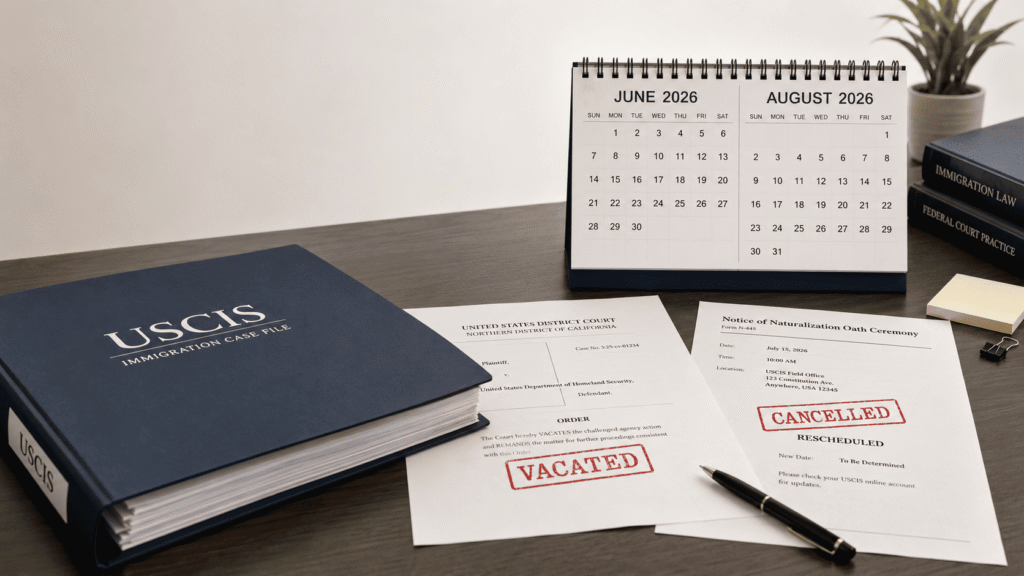
The USCIS adjudication hold commonly described as the “39-country hold” is no longer in effect as of August 7, 2026. A federal court vacated PM-602-0194 and related USCIS policies in June, and the agency publicly stated that the court’s order applies across USCIS.
For many applicants, however, the court ruling did not produce an immediate case update. Some people are still waiting for decisions, interviews, employment authorization, adjustment of status, or rescheduled naturalization ceremonies. Others continue to see only a generic message stating that their application remains under review.
That creates a new legal and practical question. If USCIS can no longer rely on the categorical hold, why is the individual case still delayed? The answer depends on the application type, procedural stage, last meaningful agency action, remaining background review, and the explanation, – if any- that USCIS has provided.
In This Article After the 39-Country Hold
- Is the 39-Country Hold Still in Effect?
- What Did PM-602-0194 Do?
- What Did the Court Decision Change?
- Why Could a Case Still Be Delayed?
- What If an Oath Ceremony Was Cancelled?
- Which Records Should You Preserve?
- What Steps Can You Take Now?
- When May Continued Delay Support Federal Action?
- Frequently Asked Questions
Is the USCIS 39-Country Adjudication Hold Still in Effect?
No, not under the policies vacated in Dorcas International Institute of Rhode Island v. USCIS. On June 5, 2026, the U.S. District Court for the District of Rhode Island vacated PM-602-0192, PM-602-0194, and Policy Alert 2025-26. The court entered final judgment on June 11.
USCIS then published an official Court Order on Hold Policies notice. The agency stated that the order was effective immediately, applied agency-wide, and required USCIS personnel to disregard the vacated memoranda as though they were not in effect.
The government appealed the ruling to the U.S. Court of Appeals for the First Circuit. An appeal, however, does not automatically restore a vacated agency policy. On July 15, 2026, the district court denied the government’s request to stay the ruling during the appeal.
As of the publication date, the filing of an appeal has not reinstated PM-602-0194. USCIS’s public position remains that the agency is complying with the court order.
Because appellate litigation can change, affected applicants should confirm the status of the case and USCIS guidance when evaluating their options. The current ruling is important, but it should not be treated as a permanent promise that no later court order could alter the legal landscape.
Timeline of the Policy and Court Challenge
| Date | Development | Practical Meaning |
|---|---|---|
| January 1, 2026 | USCIS issued PM-602-0194. | The memorandum expanded adjudicative holds involving countries identified in Presidential Proclamation 10998. |
| June 5, 2026 | The Rhode Island federal court vacated the challenged policies. | The categorical hold policies lost legal effect. |
| June 11, 2026 | The court entered final judgment. | The vacatur became immediately enforceable agency-wide. |
| June 12, 2026 | USCIS announced compliance, and the government filed an appeal. | USCIS began implementing the ruling while challenging it in the First Circuit. |
| July 15, 2026 | The district court denied a stay pending appeal. | The policies remained vacated while the appeal continued. |
What Did PM-602-0194 Do Before It Was Vacated?
The original PM-602-0194 memorandum directed USCIS to place an adjudicative hold on certain pending benefit requests submitted by or for nationals of countries identified in Presidential Proclamation 10998.
In practical terms, a case could remain pending even after the applicant had completed the steps normally required for a decision. The policy was not limited to one form type. Depending on the applicant and procedural posture, it could affect matters involving naturalization, adjustment of status, employment authorization, asylum, and other USCIS-administered benefits.
The broader policy framework also included additional screening and the re-review of certain previously approved benefit requests. This created uncertainty for applicants whose online accounts showed no clear defect, missing evidence, or case-specific reason for continued inaction.
A Categorical Hold Is Different From Individual Review
An individual case may require background checks, an interview, an RFE, supervisory review, or examination of a specific eligibility issue. PM-602-0194 operated differently because it imposed a broader nationality-linked processing framework before the individual merits of each application could produce a final adjudication.
This distinction now matters. The court removed the challenged categorical policies, but it did not eliminate USCIS’s ordinary authority to investigate an individual case, request evidence, conduct lawful security screening, or decide whether the applicant satisfies the requirements for the requested benefit.
What Did the Court Decision Change and What Did It Not Change?
The June 5 Memorandum and Order in Dorcas concluded that the challenged policies violated the Administrative Procedure Act. The court vacated the policies rather than merely directing USCIS to reconsider one individual application.
As a result, USCIS may not continue withholding decisions solely because PM-602-0194 instructed officers to apply the now-vacated adjudicative hold. The agency’s own compliance announcement states that the affected policies must be disregarded agency-wide.
The court ruling did not, however:
- Approve every application previously affected by the hold;
- Find that every remaining delay is automatically unlawful;
- Prevent lawful, case-specific security or background review;
- Eliminate the applicant’s burden to establish eligibility;
- Guarantee a new interview, oath ceremony, or decision by a particular date; or
- Invalidate the presidential proclamations governing entry into the United States.
The court removed the categorical adjudication policy. It did not convert pending cases into automatic approvals.
An applicant can therefore benefit from the vacatur while still receiving an RFE, interview notice, notice of intent to deny, approval, denial, or another lawful case-specific action when processing resumes.
Why Could a Case Still Be Delayed After the Hold Was Vacated?
The absence of an immediate decision does not necessarily mean USCIS is secretly continuing PM-602-0194. A file that was held for months may not return to active adjudication the day the policy is vacated. USCIS may need to redistribute files, update internal controls, reopen workflows, or complete work that did not occur during the hold.
Other possible explanations include:
- Operational backlog: A large number of affected files may be returning to active processing at the same time.
- Background or security checks: The categorical policy may be gone while a lawful individual check remains incomplete.
- Missing or transferred files: The A-file or electronic record may be moving between a service center, field office, records facility, or other component.
- Supervisory review: An officer may have completed initial review but still require approval from a supervisor.
- Eligibility questions: USCIS may be reviewing travel, residence, employment, criminal, admissibility, or prior-application history.
- Pending RFE response review: The applicant may have responded, but the submitted evidence has not yet been evaluated.
- Scheduling limitations: The case may require an interview or oath ceremony that has not yet been placed on the local office calendar.
The important question is whether the agency can identify a current, case-specific reason for the delay. A generic statement that the application remains under review may confirm that the case is open, but it may not explain what action remains unfinished or why no meaningful progress has occurred since the court ruling.
Look at the Last Meaningful Action
Total case age matters, but the lawyer evaluating the delay should also identify the most recent substantive event. An interview, RFE, case transfer, cancelled ceremony, or detailed agency response may affect the analysis differently from an automated online update.
The court decision also changes the timeline’s context. If an application was inactive because of PM-602-0194 and remains inactive after the policy was vacated, the case record should distinguish:
- The period before the hold;
- The period during which the hold affected adjudication; and
- The period of continued silence after USCIS was directed to disregard the policy.
What If Your Naturalization Oath Ceremony Was Cancelled?
A cancelled naturalization ceremony creates a particularly difficult form of uncertainty. The applicant may have passed the interview and received approval but still cannot exercise the rights of U.S. citizenship.
USCIS states that an applicant does not become a U.S. citizen until taking the Oath of Allegiance at a naturalization ceremony. An approved Form N-400 and a scheduled ceremony are significant steps, but they do not substitute for completion of the oath.
If the ceremony was cancelled during the adjudication hold, preserve the original Form N-445, cancellation email or letter, online account history, and any notice showing that the N-400 had already been approved. These records may help distinguish an oath-scheduling problem from a case that was returned to active eligibility review.
Questions to Ask About the Cancelled Ceremony
- Did USCIS state that the cancellation was connected to a policy hold?
- Was the Form N-400 already approved?
- Did USCIS withdraw or reopen the approval?
- Has a new Form N-445 been issued?
- Has the field office provided a case-specific explanation?
- Did USCIS request updated information about travel, arrests, residence, or marital history?
A cancelled oath ceremony does not always fit the same legal framework as an N-400 that remains undecided after an interview. Where the statutory naturalization examination occurred more than 120 days earlier without a determination, 8 U.S.C. § 1447(b) may provide a separate federal court procedure. The correct route depends on the exact stage and wording of the notices.
What Should You Preserve If Your Case Is Still Frozen?
A continuing-delay evaluation depends heavily on the written record. Applicants should save the documents showing what USCIS knew, what USCIS communicated, and what changed—or failed to change—after the court order.
| Record | Why It Matters |
|---|---|
| Receipt and approval notices | They establish the application, filing date, procedural stage, and any prior approval. |
| Interview and oath notices | They show completed steps and appointments USCIS scheduled. |
| Cancellation or postponement notices | They may connect the delay to a particular policy or office action. |
| Online account screenshots | They preserve status language that may later change or disappear. |
| Service requests and responses | They show whether USCIS provided a meaningful case-specific explanation. |
| Congressional or Ombudsman correspondence | It may document repeated attempts to resolve the continued delay. |
| Hardship evidence | Employment, travel, family, medical, or financial records can show the consequences of continued inaction. |
A one-page timeline should identify the filing date, biometrics, interviews, RFEs, responses, approvals, cancelled appointments, service requests, and all events occurring after June 11, 2026. Our mandamus evidence guide explains how notices, screenshots, inquiry records, and hardship documents can help build a reliable delay record.
Is your USCIS case still frozen after PM-602-0194 was vacated?
A useful legal review examines the application type, procedural stage, cancellation notices, last meaningful USCIS action, post-vacatur inquiry history, underlying eligibility record, and harm caused by the continuing delay.
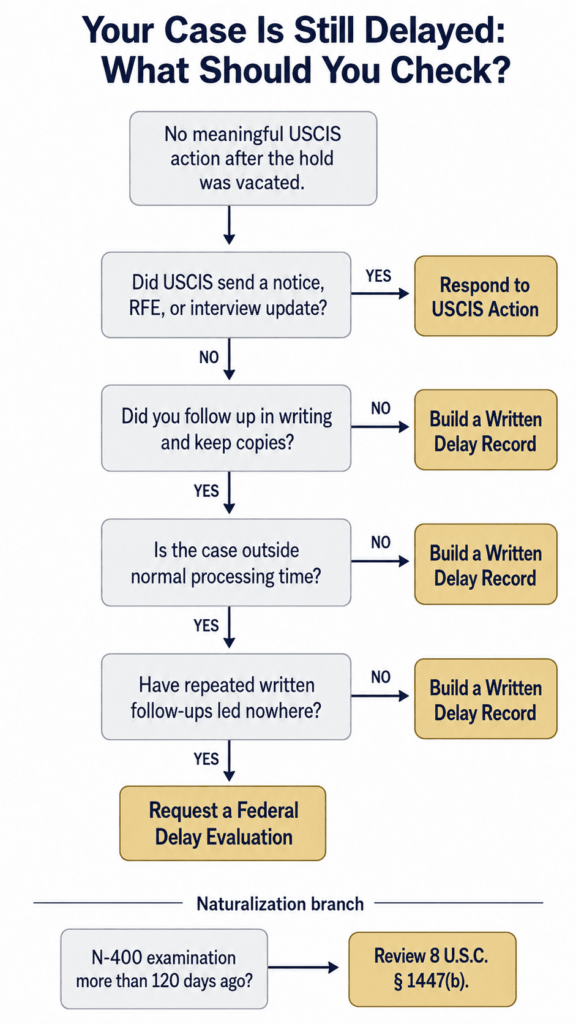
Practical Steps to Take Before Considering Federal Court
Not every post-vacatur delay should move directly into litigation. The first objective is to determine whether the case is still affected by an outdated internal restriction or whether USCIS has identified a different case-specific issue.
1. Confirm the Last Official Case Action
Review the online account, mailed notices, emails, interview record, and any cancellation communication. Do not rely only on the current one-line status message. Save screenshots and download notices before the account changes.
2. Submit a Focused Inquiry
A focused inquiry is usually more useful than repeatedly asking why a case is taking so long. Identify the vacated policy, explain the case’s procedural stage, provide the date of the last meaningful action, and ask whether another case-specific issue is preventing adjudication.
Applicants can review the official USCIS processing-time tool and determine whether the case is eligible for an inquiry. The posted inquiry date is relevant, but it is not the only fact in a legal unreasonable-delay analysis.
3. Ask for Written Confirmation
When possible, preserve the response in writing. A telephone statement may help explain what happened, but a written USCIS, congressional, or Ombudsman response is usually easier to evaluate and present accurately.
4. Document Continuing Harm
Record the concrete consequences of the delay. Examples may include expired or uncertain employment authorization, loss of a job opportunity, inability to travel, family separation, delayed petitioning for relatives, financial loss, or inability to participate fully in civic life after a cancelled oath ceremony.
5. Review the Underlying Immigration Case
A lawsuit intended to accelerate processing can bring the underlying application back under immediate scrutiny. Before filing, the applicant and lawyer should examine criminal history, travel, continuous residence, tax filings, marital history, prior applications, status violations, unauthorized employment, misrepresentation concerns, and any unresolved evidence issue relevant to the benefit.
When the broad policy disappears but the individual file remains inactive, the legal question shifts: Is USCIS now withholding a required case-specific action for an unreasonable period?
When May a Continuing Delay Support Federal Action?
A writ of mandamus is a federal lawsuit seeking to compel a federal officer or agency to perform a duty owed to the plaintiff. Under 28 U.S.C. § 1361, federal district courts have jurisdiction over actions in the nature of mandamus. The Administrative Procedure Act separately allows courts to compel agency action unlawfully withheld or unreasonably delayed under 5 U.S.C. § 706(1).
A continuing post-vacatur delay may deserve closer review when:
- The applicant completed every required step;
- The case received no meaningful action before or after the vacatur;
- USCIS continues giving only generic responses;
- A cancelled appointment or ceremony has not been rescheduled;
- The agency cannot identify a current case-specific reason for the delay;
- The delay materially harms the applicant or family; and
- The requested relief is a legally required action rather than guaranteed approval.
The court’s decision in Dorcas does not automatically establish that every individual delay is unreasonable. A separate lawsuit would require analysis of the application, timeline, defendants, venue, requested relief, agency explanation, and controlling precedent.
The Separate Role of 8 U.S.C. § 1447(b)
Naturalization cases require special attention. When USCIS fails to make a determination within 120 days after the naturalization examination, 8 U.S.C. § 1447(b) may permit the applicant to ask the federal district court for a hearing.
This article does not address the filing requirements or jurisdictional consequences of that procedure in detail. Our dedicated guide explains the 1447(b) process for an N-400 delayed after the examination.
What a Delay Lawsuit Can and Cannot Seek
| Possible Litigation Objective | What It Does Not Guarantee |
|---|---|
| Require USCIS to resume and complete a legally required action | Approval of the application |
| Challenge unreasonable continued inaction | A decision by a specific date in every case |
| Seek adjudication, scheduling, or another unfinished duty | Protection from an RFE, NOID, denial, or lawful additional review |
Applicants with citizenship delays may also review our broader guide to an N-400 delay and federal lawsuit. Cases that have not yet reached the interview stage may present different legal issues from applications delayed after examination or approval.
Frequently Asked Questions
Is the USCIS 39-country adjudication hold still active?
No. The U.S. District Court for the District of Rhode Island vacated PM-602-0192, PM-602-0194, and PA 2025-26. USCIS stated that the order applies agency-wide. The government appealed, but the district court denied its request for a stay pending appeal.
Does the court ruling require USCIS to approve my case?
No. The ruling removed the challenged categorical policies. USCIS may still examine individual eligibility, request evidence, conduct lawful screening, approve the application, or issue an adverse decision supported by the record and applicable law.
Can USCIS still conduct background checks?
Yes. Vacating PM-602-0194 did not eliminate USCIS’s lawful authority to conduct case-specific identity, background, fraud, public-safety, or national-security review. The question is whether USCIS is performing a legitimate individual review or continuing an unlawful categorical freeze.
What happens if my oath ceremony was cancelled?
You generally do not become a U.S. citizen until taking the Oath of Allegiance. Preserve the approval and cancellation records, request information about rescheduling, and determine whether the application remains approved or has been returned for further review.
Should USCIS automatically reschedule every cancelled ceremony?
The vacatur removed the challenged policy, but it did not create one universal rescheduling timetable. The field office may need to place the applicant on a new ceremony calendar or resolve a case-specific issue first. Extended silence without explanation may justify further inquiry and legal review.
How long should I wait after the vacatur before speaking with a lawyer?
There is no single waiting period that applies to every form and procedural stage. A consultation may be appropriate when USCIS has taken no meaningful post-vacatur action, a cancelled ceremony remains unscheduled, the case is beyond applicable inquiry dates, or continued delay is causing serious harm.
Can a mandamus lawsuit force USCIS to approve the application?
Generally, a mandamus or APA unreasonable-delay claim seeks required agency action, not a predetermined approval. Accelerated adjudication may result in approval, an interview, an RFE, a NOID, additional review, or denial.
The Hold Was Vacated, but the Individual Delay May Require Its Own Response
The June 2026 court ruling removed PM-602-0194 and the related categorical hold policies. That was a significant change for applicants whose files had been frozen based on the challenged framework.
Yet vacatur does not guarantee that every affected case will immediately return to the front of the adjudication line. The next step is to identify what has happened since the ruling, whether USCIS has provided a current case-specific explanation, and whether continued inaction is becoming legally unreasonable.
Applicants should preserve every notice, cancellation record, inquiry response, online screenshot, and item of hardship evidence. Where the record shows prolonged inactivity after the policy was removed, a case-specific federal litigation review may help determine whether mandamus, an APA claim, 8 U.S.C. § 1447(b), or another strategy is appropriate.
Was your oath ceremony cancelled, or is your USCIS case still delayed after the 39-country hold was vacated?
Contact our team for an evaluation of your case timeline, USCIS notices, cancellation records, inquiry history, underlying immigration application, post-vacatur inactivity, and available federal court options.
Phone: +1 (862) 799-2200
Legal Disclaimer: This article is provided for general informational purposes only and does not constitute legal advice. Every immigration case has unique circumstances. For legal guidance specific to your situation, we recommend consulting with an experienced immigration attorney. The information reflects laws, policies, and publicly available court developments as of August 7, 2026; the pending appeal or subsequent agency action may affect its accuracy. Prior results do not guarantee a similar outcome.
Sources
- USCIS — Court Order on Hold Policies
- USCIS Policy Memorandum PM-602-0194 — Pending Applications From Additional High-Risk Countries
- Dorcas International Institute of Rhode Island v. USCIS — Memorandum and Order, June 5, 2026
- Dorcas International Institute of Rhode Island v. USCIS — Order Denying Stay Pending Appeal
- USCIS — Citizenship: What to Expect
- 8 U.S.C. § 1447 — Naturalization Determinations After Examination
- 28 U.S.C. § 1361 — Action to Compel a Federal Officer or Agency to Perform a Duty
- 5 U.S.C. § 706(1) — Agency Action Unlawfully Withheld or Unreasonably Delayed