
Your H-1B petition is approved and the visa interview is over, but you left the consulate holding a 221(g) notice instead of a stamped passport. Your job, your lease and your family’s plans in the United States now depend on a review that has no published end date.
H-1B 221(g) administrative processing is not a denial, and it does not cancel your USCIS approval. Since December 15, 2025, every H-1B and H-4 visa applicant has also gone through an online presence review, which added a new layer to a stage that was already hard to predict.
Here is what the pause usually means, what you and your employer can do while it runs, and what two 2026 court decisions say about when a lawsuit fits.
In This Article
- What Does a 221(g) Mean for an H-1B Visa?
- Why H-1B and H-4 Cases Enter Administrative Processing in 2026
- How Long Does H-1B 221(g) Administrative Processing Take?
- What You and Your Employer Can Do While You Wait
- H-4 Spouses and Children in the Same Case
- When an H-1B 221(g) Delay Supports a Lawsuit
- Frequently Asked Questions
- An H-1B 221(g) Runs on Two Calendars
What Does a 221(g) Mean for an H-1B Visa?
A 221(g) refusal means the consular officer has not issued your visa yet. The State Department explains that a completed application can only be issued or refused, and that a refused case may still be approved after administrative processing or after you send requested information.
For an H-1B worker, two details matter. Your I-797 approval stays in place unless USCIS itself revokes it, because a consulate cannot cancel a petition. And the visa tracker may show “Refused” for the entire review. Our guide to what CEAC “Refused” means after an interview explains that display, and our overview of the 221(g) blue, white or pink slip covers what each color usually signals.
Why H-1B and H-4 Cases Enter Administrative Processing in 2026
An H-1B file can pause after the interview for several reasons. Knowing which one applies tells you who can move the case.
The Online Presence Review That Began December 15, 2025
Since December 15, 2025, consular officers conduct an online presence review for every H-1B applicant and H-4 dependent. Applicants are instructed to set the privacy settings on all of their social media profiles to public. The State Department extended the same review to more visa categories on March 30, 2026.
Because the review now applies to everyone in the category, a 221(g) during it does not by itself mean the officer found something negative. It means the review is not finished. Keep the profiles you listed on your DS-160 public until the case is decided.
When the Petition, the DS-160 and Your Profiles Do Not Match
Officers compare what the petition says about your job with your DS-160, your résumé and your public profiles. A different job title, a worksite or end client that changed after approval, or employment dates that do not line up can each lead to a document request. Consulting arrangements often draw follow-up questions about the end client and where the work is actually performed.
An approved petition is strong evidence, but the officer can still ask for proof that the job described in it still exists.
Technical Roles and Security Advisory Opinions
Engineers, researchers and other technical workers may also be held for a security review handled outside the consulate. That process has its own timing problems, covered in our guide to TAL security advisory opinion delays.
How Long Does H-1B 221(g) Administrative Processing Take?
No official clock applies to H-1B 221(g) administrative processing. The State Department says the length of administrative processing varies with the circumstances of each case, and its published nonimmigrant wait times do not include it. For general ranges and the point at which a wait starts to look unusual, see our guide to administrative processing delay.
For an H-1B file, the more useful question is which kind of review you are in, because each one is cleared by a different actor.
What Adds Time to an H-1B File
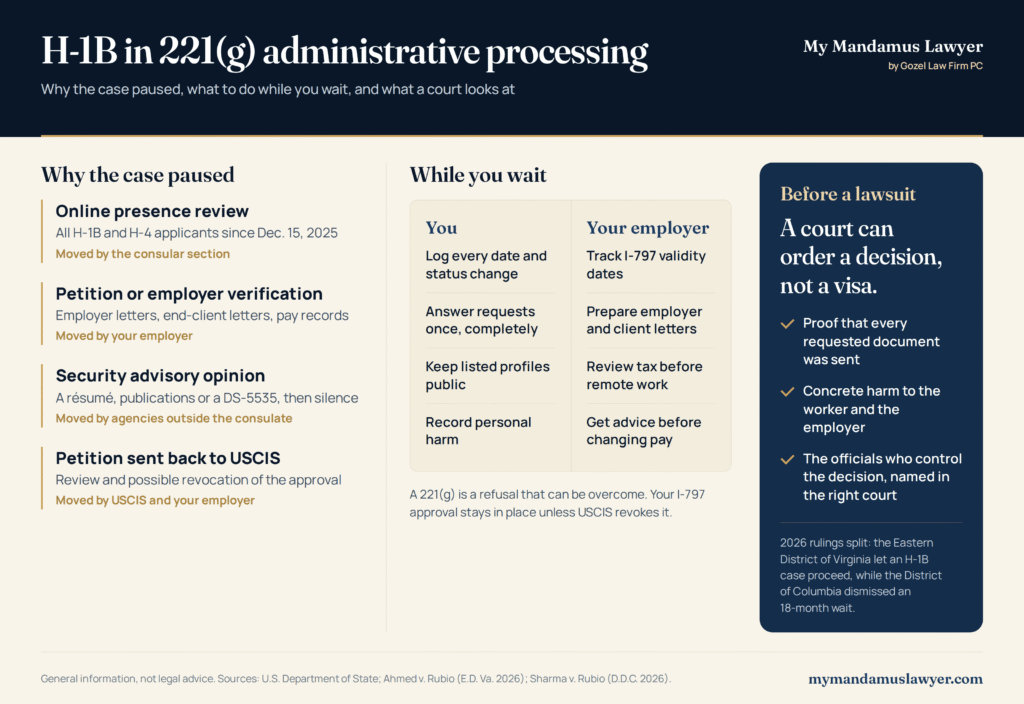
| Reason for the pause | What it usually looks like | Who can move it |
|---|---|---|
| Online presence review | No document request, a “Refused” status and no further contact. | The consular section. You keep listed profiles public and answer any follow-up quickly. |
| Petition or employer verification | A request for an employer letter, end-client letter, pay records or the full petition. | Your employer, by sending complete documents in one submission. |
| Security advisory opinion | A request for a résumé, publications or a DS-5535, then silence. | Agencies outside the consulate. You can document the wait, not speed it. |
| Petition sent back to USCIS | A letter saying the petition was returned for review and possible revocation. | USCIS and your employer, through the response to any notice. |
If the Consulate Sends the Petition Back to USCIS
Some H-1B files leave the consulate entirely. If the officer believes the petition should not have been approved, the file goes back to USCIS, usually through the State Department’s Kentucky Consular Center, and visa processing stops until USCIS acts.
Under 8 C.F.R. §214.2(h)(11), USCIS can reaffirm the petition or move to revoke it on notice, which gives your employer a chance to respond. There is no posted processing time for this stage. Our guide to a petition returned to USCIS explains the review for immigrant petitions; the timing problem is the same for an H-1B.
What You and Your Employer Can Do While You Wait
H-1B 221(g) administrative processing is shared work. You control the consular file. Your employer controls the job, the payroll and most of the evidence.
| The employee | The employer |
|---|---|
| Log the interview date, the date each document was sent and every status change. | Track the I-797 validity dates and any project or contract end date tied to the role. |
| Answer document requests once and completely, following the post’s instructions. | Prepare employer and end-client letters before the consulate asks for them. |
| Keep the profiles listed on your DS-160 public. | Confirm that the job title, worksite and salary in every letter match the petition. |
| Ask before working remotely from abroad. | Approve remote work only after tax and employment-law review. |
| Keep records of personal harm: lost pay, missed deadlines, family separation. | Keep records of business harm: delayed projects, coverage costs, lost contracts. |
| Tell the consular section about a unique hardship, as the State Department invites. | Talk to counsel about timing for an inquiry or a lawsuit once the wait grows long. |
If you are still in the United States and the problem is a pending extension rather than a visa, the options are different; see our guide to H-1B petition delay at USCIS.
Working Remotely From Abroad
U.S. immigration rules focus on work performed inside the United States, so remote work from abroad is mostly a tax and employment question. Bloomberg Law reported in January 2026 that employers with H-1B workers stranded in India can face permanent establishment tax risk if those workers keep working there. Your employer should get tax advice before approving it. Do not assume remote work protects the job.
Pay and Leave Under the H-1B Wage Rules
The Labor Department rule at 20 C.F.R. §655.731(c)(7) requires an employer to keep paying the required wage when the worker is in nonproductive status because of the employer’s decision, including the lack of a permit or license. It does not require pay when the worker is away for reasons unrelated to the job, at the worker’s own request.
The rule does not mention a consular delay, so the answer depends on the facts. Get employment-law advice before cutting pay, placing anyone on unpaid leave or ending the job.
Is your H-1B stuck after the interview?
Workers and employers can both request a review. We look at the 221(g) notice, the dates and the documents already sent, and explain whether federal litigation could fit.
H-4 Spouses and Children in the Same Case
The December 2025 announcement covers H-4 dependents as well, so each family member’s online presence is reviewed. Each H-4 applicant files a separate application and can receive a separate 221(g).
An H-4 visa depends on the principal’s H-1B classification, so a delay in the principal’s case usually holds the family’s cases too. Two points help families plan. A spouse’s or child’s own online history is reviewed on its own terms. And an H-4 work permit is a separate USCIS matter that does not move the visa forward.
When an H-1B 221(g) Delay Supports a Lawsuit
A federal lawsuit cannot make the consulate issue a visa. It can ask a court to order a final decision when the wait has become unreasonable. Two 2026 H-1B decisions show how much depends on the court and the record.
What Courts Weighed in 2026 H-1B Cases
In Ahmed v. Rubio, an H-1B researcher had waited more than a year after sending every document the embassy requested. On August 3, 2026, the Eastern District of Virginia denied the government’s motion to dismiss. The court read 22 C.F.R. §41.121(c) to require review of a 221(g) refusal and a final decision, and held that consular nonreviewability did not bar a request to finish processing. That ruling let the case go forward; it did not decide the visa. The judge also noted that other decisions in the same district had reached the opposite result.
In Sharma v. Rubio, decided July 10, 2026 in the District of Columbia, a worker had waited about 18 months in India. The court dismissed the case. It found the senior officials he sued were not shown to be responsible for the delay. Weighing the TRAC factors for unreasonable delay, it held that ordering faster action would move him ahead of other applicants, even though his separation from his family weighed in his favor.
The length of the wait is only one part of the record. In Sharma, 18 months was not enough on its own. In Ahmed, the court focused on what the consulate still had to do after the applicant sent everything it asked for.
Who Brings the Case and Where
The worker can sue in his or her own name, as both plaintiffs above did. An employer that filed the petition may have its own business harm to show. Venue for suits against federal officials depends partly on where a plaintiff resides, so who joins the case can change which court is available. Our guide on where to file a mandamus lawsuit explains venue.
What the Record Should Show
Before filing, gather what these courts examined: the interview date, proof that every requested document was sent, the I-797 validity window, and concrete harm to the worker and the employer. Naming the officials who actually control the decision matters too. Our page on 221(g) consular delay lawsuits explains how these cases are evaluated.
Frequently Asked Questions
Is a 221(g) for H-1B a denial?
Not a final one. It is a refusal that can be overcome after review or after you send requested information. The State Department gives you one year from the refusal to provide requested information before you must reapply and pay a new fee.
Can I work remotely while my H-1B is in administrative processing?
Only if your employer approves it after tax and employment-law review. It is mainly an employer question, and the wage and tax issues above apply.
Does my H-4 spouse wait for the same review?
Yes. H-4 dependents are also subject to the online presence review, and their cases usually follow the principal’s.
Will a new appointment speed it up?
Usually not, and it costs a new fee. The State Department describes reapplying as what happens when requested information is not sent within one year, not as a way to speed review. If you face a unique hardship, the Department asks applicants to tell the consular section where they applied.
When can my employer or I sue?
There is no fixed date. Courts look at how long the case has been pending, what the consulate still has to do and the harm you can document, and they reached different results in 2026 H-1B cases. A case review can show where your facts fall.
An H-1B 221(g) Runs on Two Calendars
Every case in H-1B 221(g) administrative processing runs on two calendars. The consulate’s has no deadline. The job’s does. You cannot shorten the first, but you can protect the second: track the dates, send complete documents once, keep your employer informed and build a record. If the wait outlasts what the job can absorb, that record is what a lawyer and a court will look at first.
Get a Case-Specific Review
Tell us the consulate, your interview date and what was requested. For an initial review, have your I-797 approval notice and 221(g) notice ready.
Phone: +1 (862) 799-2200
Legal Disclaimer: This article is provided for general informational purposes only and does not constitute legal advice. Every immigration case has unique circumstances. For legal guidance specific to your situation, we recommend consulting with an experienced immigration attorney. The information in this article reflects laws and policies as of the publication date; subsequent changes may affect its accuracy.
Sources
- Announcement of Expanded Screening and Vetting for H-1B and Dependent H-4 Visa Applicants, U.S. Department of State, December 2025, effective December 15, 2025.
- Announcement of Expanded Screening and Vetting for Visa Applicants, U.S. Department of State, March 25, 2026.
- Administrative Processing Information, U.S. Department of State, accessed October 21, 2026.
- 22 C.F.R. §41.121, Refusal of Individual Visas, Cornell Legal Information Institute.
- 8 C.F.R. §214.2(h)(11), Revocation of Approval of Petition, Cornell Legal Information Institute.
- 20 C.F.R. §655.731(c)(7), Wage Obligations During Nonproductive Status, Cornell Legal Information Institute.
- Ahmed v. Rubio, No. 1:25-cv-02116-MSN-WBP, Memorandum Opinion and Order, ECF No. 14, Eastern District of Virginia, August 3, 2026.
- H-1B Visa Dad Stuck Abroad Told 18 Month Delay Is Reasonable, Newsweek, July 13, 2026; reporting on Sharma v. Rubio, No. 25-cv-3368, District of Columbia, opinion of July 10, 2026.
- H-1B Workers Stranded in India Create Tax Dilemma for Employers, Bloomberg Law, January 27, 2026.