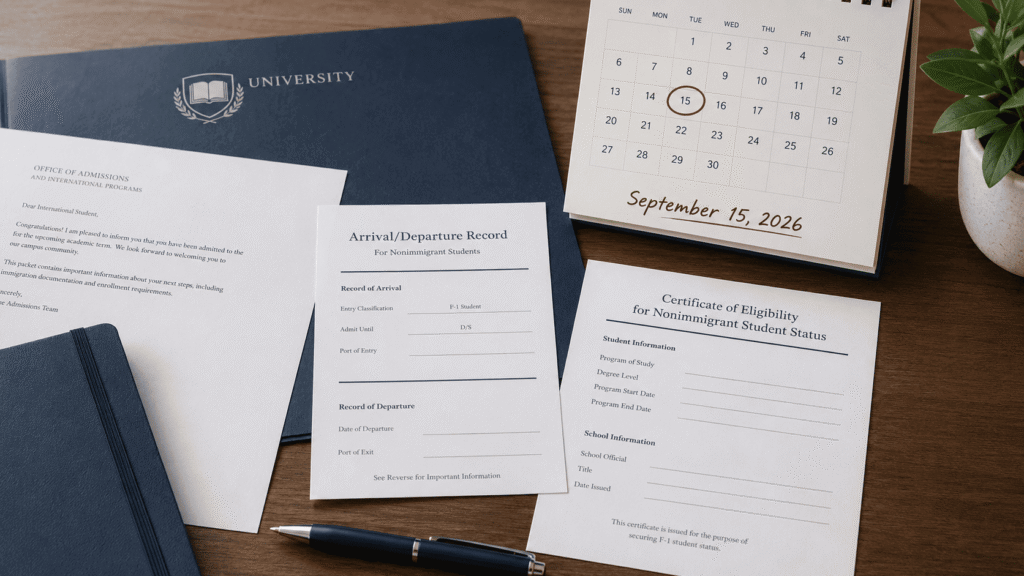
September 15, 2026 could fundamentally change how F-1 students and J-1 exchange visitors maintain lawful status in the United States. Instead of being admitted for “duration of status,” many F and J nonimmigrants will receive a specific date by which their authorized stay ends.
The new duration of status rule for 2026 does more than put a date on Form I-94. It can require students and exchange visitors who need additional time to file an extension of stay with USCIS, often using Form I-539. That moves more status-extension decisions into a federal adjudication system where processing time can matter directly to study, training, employment, and future immigration plans.
Not everyone must file an extension on September 15. The final rule contains transition protections for many people already in the United States in F or J status. The practical questions are when you were admitted, what your I-94 says, how long your program lasts, whether you travel after the effective date, and whether USCIS must approve additional time.
In This Article F-1/J-1 Duration of Status Change
- What the 2026 Duration of Status Rule Actually Changes
- Before vs. After September 15: Who Is Affected?
- Who Will Need an Extension of Stay From USCIS?
- Why the Rule Creates a New I-539 Delay Risk
- What Happens While an Extension Is Pending?
- Why Your Form I-94 Becomes More Important
- When an I-539 Delay Becomes a Legal Problem
- What a Delay Lawsuit Can and Cannot Do
- What F-1 and J-1 Holders Should Check Now
- Frequently Asked Questions
What the 2026 Duration of Status Rule Actually Changes
On July 17, 2026, the Department of Homeland Security published a final rule in the Federal Register replacing duration of status for F, J, and I nonimmigrants with a fixed period of admission. The rule is scheduled to take effect on September 15, 2026.
There is an important qualification. DHS classified the regulation as a major rule subject to congressional review. The Federal Register states that if the effective date changes through that process, DHS will publish another notice establishing a different effective date or terminating the rule. Applicants should therefore verify the rule’s status again before making a filing, travel, or program decision based on September 15.
Duration of Status vs. a Fixed Admission Period
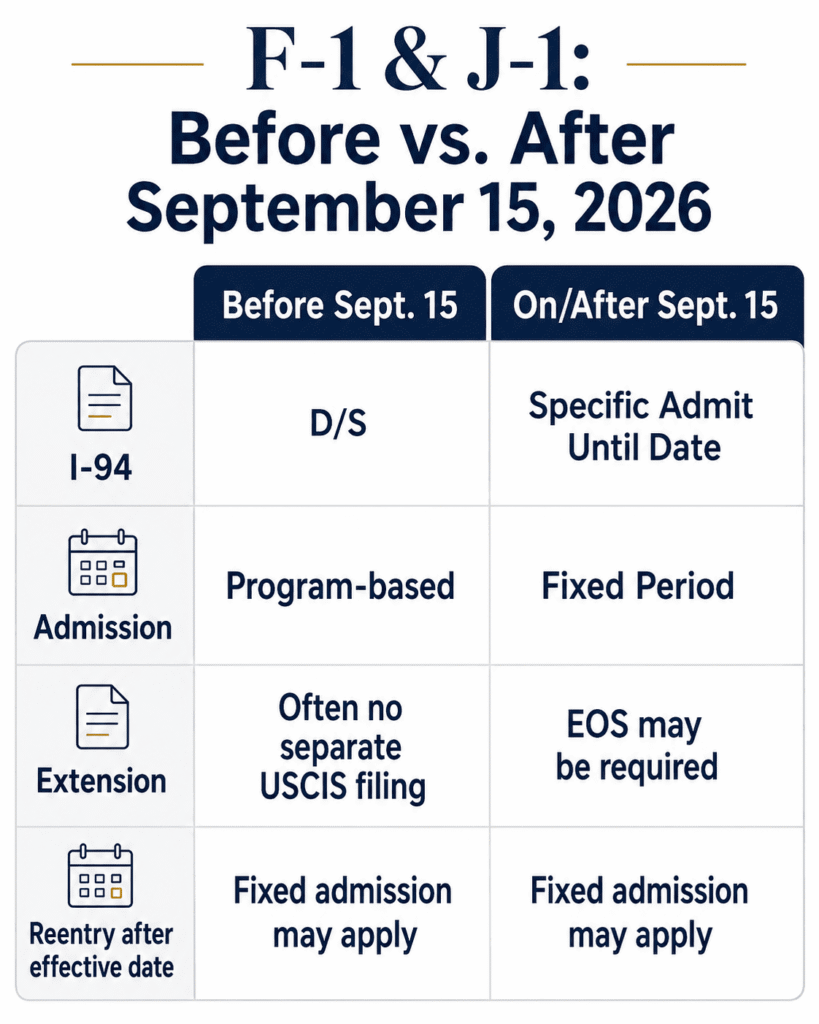
Under the traditional F-1 system, many students receive “D/S” on Form I-94 rather than a calendar expiration date. D/S generally allows the person to remain while properly pursuing the authorized course of study or practical training and otherwise maintaining status.
Under the new system, incoming F students will instead receive a specific Admit Until Date on Form I-94. DHS guidance explains that the admission period will generally correspond to the program listed on Form I-20, subject to a maximum period of four years and other applicable limits. J-1 admissions will likewise become date-certain rather than D/S admissions.
The four-year limit does not mean every degree or exchange program must be completed within four years. A student in a longer doctoral program, for example, may continue pursuing the program if eligible, but additional authorized stay may require an extension application.
The Language-Training Limit
The rule also imposes a separate restriction for F-1 students in language-training programs. Their period of study is generally limited to an aggregate of 24 months, including breaks and annual vacation periods, subject to the regulatory framework.
The central change is not simply that Form I-94 gets an expiration date. It is that staying beyond that authorized period can now require an affirmative USCIS extension decision.
Before vs. After September 15: Who Is Affected and When?
Current F-1 and J-1 holders are not all required to file Form I-539 when the rule takes effect. DHS created transition provisions for many people who are already in the United States, properly maintaining F or J status, and were admitted for D/S.
| Situation | Status Treatment | Potential USCIS Filing Issue |
|---|---|---|
| F-1 or J-1 already in the U.S. in valid D/S status on Sept. 15 | Transition protection generally applies | No automatic I-539 filing merely because Sept. 15 arrives |
| New F-1 admission on or after Sept. 15 | Specific Admit Until Date | EOS may be needed if additional time is required |
| New J-1 admission on or after Sept. 15 | Specific Admit Until Date | EOS may be needed if the exchange program requires more time |
| Current D/S holder leaves and reenters after Sept. 15 | May be readmitted under the new fixed-period system | The new I-94 date can affect later extension planning |
| Program continues beyond the authorized admission period | Additional authorization is needed | A timely EOS application may be required |
| F-1 seeks post-completion OPT or STEM OPT | Depends on transition timing and admission period | I-539 may be required in addition to I-765, subject to transition exceptions |
For people already in valid F or J D/S status on September 15, DHS generally allows continued status until the applicable program end date or EAD expiration date, subject to the transition ceiling. The final rule sets that outer limit at four years from the effective date, plus the applicable departure period. For the transition population, that produces an outside date of November 14, 2030 for F nonimmigrants and October 15, 2030 for J nonimmigrants.
The transition rules are especially important because they prevent a false conclusion that every international student must suddenly file with USCIS in September. A current student whose existing program finishes within the protected transition period may never need an I-539 solely because D/S was eliminated.
Travel Can Change the Analysis
International travel after the effective date deserves special attention. The final rule provides that an F or J nonimmigrant who leaves the United States after September 15 and later seeks admission may be admitted with a new fixed period of admission, even if the person previously benefited from the D/S transition rules.
That means a student should not assume that a pre-September D/S admission will remain the controlling admission indefinitely. After reentry, the new Form I-94 and its Admit Until Date may become the key record for determining when an extension is required.
Who Will Need an Extension of Stay From USCIS?
The new system makes an extension of stay, or EOS, relevant when the person’s authorized admission period is not long enough to complete the activity for which F or J status is needed.
DHS’s Study in the States guidance explains that F students may need an EOS when they require additional time to complete a course of study, begin another program, or participate in post-completion OPT or STEM OPT beyond their existing authorized period.
Longer Academic Programs
A doctoral or other long-term academic program may extend beyond the student’s fixed admission date. In that situation, an updated Form I-20 alone may not be enough. If the student needs to remain past the Admit Until Date, a timely extension request to USCIS may be required.
OPT and STEM OPT
The relationship between EOS and employment authorization is more complicated. In some situations, an F-1 student seeking post-completion OPT or STEM OPT may need to file both Form I-539 and Form I-765. However, the final rule includes a transition exception for certain F-1 students who timely file for post-completion OPT or STEM OPT on or before March 18, 2027.
Students should not assume that an I-765 employment authorization filing automatically solves every extension-of-stay issue. The admission date, program end date, transition rules, and timing of the OPT application must be considered together.
J-1 Program Extensions
For J-1 exchange visitors, a sponsor’s updated Form DS-2019 remains important, but under the fixed-admission system an updated program document does not always eliminate the need for USCIS action. A J-1 who requires authorized stay beyond the existing admission period may need an EOS application based on the extended program.
Why the New Rule Creates a New I-539 Delay Risk
It is too early to say that the September rule has already created a new F-1 or J-1 I-539 backlog. The fixed-admission system has not yet taken effect. But the final rule itself recognizes that USCIS is expected to receive more extension applications after implementation.
The structural reason is straightforward. Under D/S, many program extensions could be managed through the student or exchange program framework without a separate USCIS adjudication of the person’s authorized stay. Under the fixed-period system, more people who need additional time must ask USCIS for permission to remain.
That changes the consequences of processing time. When the government’s decision becomes part of maintaining the immigration timeline, a delayed extension can affect academic planning, research, training, employment, travel, and the ability to move into the next stage of a program.
This is why the better description today is new I-539 delay exposure, not a proven new backlog. Actual processing patterns should be evaluated after USCIS begins receiving extension filings under the new rules.
What Happens While an Extension Is Pending?
A timely filed extension does not automatically mean an F-1 student must stop studying the moment the original admission period expires. The final rule provides important protections for certain applicants while USCIS is deciding the EOS request.
F-1 Students Can Continue Studying in Certain Pending Cases
The final rule states that an F-1 student who timely files an EOS before the authorized period expires is considered to be in a period of authorized stay while the application is pending and may continue pursuing a full course of study while USCIS adjudicates the request.
Employment is more category-specific. A pending EOS does not create a universal right to begin new employment. For example, DHS explains that someone seeking post-completion OPT who needs both EOS and employment authorization may have to wait until the relevant approvals are issued before beginning new employment.
J-1 Activities and Employment While USCIS Decides
The J-1 rules contain their own protections. A J-1 whose authorized admission period expires after a timely EOS filing may generally continue authorized program activities and qualifying employment for up to 240 days while the application remains pending.
There is also a special transition provision for certain J-1 EOS applications filed on or before March 18, 2027. Depending on the circumstances, qualifying J-1 participants may continue permitted program activities while the EOS remains pending up to the program end date reflected on the Form DS-2019 submitted with the application.
J-2 employment should not be treated the same way. J-2 dependents generally rely on a separately issued EAD for employment, and the final rule states that the J-1 principal’s 240-day incident-to-status employment protection does not automatically extend an expired J-2 EAD.
Why Your Form I-94 Becomes More Important After September 15
Under a fixed-admission system, the immigration documents in a person’s file do different jobs. Understanding those differences is essential.
- Form I-94: shows the period for which CBP or DHS authorized admission.
- Form I-20: identifies the F-1 academic program and relevant program dates.
- Form DS-2019: identifies the J-1 exchange program and program dates.
- Form I-797 receipt notice: documents that USCIS received an extension application.
- EAD, when applicable: controls the period of specific employment authorization.
A visa stamp is different from all of these. The expiration date printed on an F-1 or J-1 visa is not necessarily the date authorized stay inside the United States ends. After implementation, Form I-94 becomes especially important because it will generally contain an actual Admit Until Date rather than D/S.
When an I-539 Delay Becomes More Than an Inconvenience
There is no universal rule that an I-539 becomes legally unreasonable after a fixed number of months. A federal unreasonable-delay analysis is fact-specific.
USCIS processing times can provide useful context, but they do not by themselves decide whether a lawsuit is appropriate. Our 2026 USCIS processing times guide explains why published processing ranges are a starting point rather than a complete legal test.
A delay may deserve closer review when the application has remained pending for an unusually long period, USCIS provides no meaningful case-specific explanation, repeated inquiries produce no movement, and the delay causes identifiable consequences to the applicant.
The federal courts often evaluate unreasonable delay through considerations commonly associated with the TRAC factors. Those factors examine the agency’s timing, competing priorities, congressional guidance where relevant, and the human or practical interests harmed by waiting.
For an F-1 or J-1 applicant, the relevant harm could include disruption to a degree program, inability to begin authorized employment, interruption of research or training, loss of a funded academic position, or uncertainty about whether the person can lawfully continue the next stage of an approved program.
What a Delay Lawsuit Can and Cannot Do for a Pending I-539
If an EOS application eventually becomes unreasonably delayed, federal litigation may be one option to evaluate. Claims involving delayed agency action are often brought under the Administrative Procedure Act, mandamus principles, or both, depending on the specific legal duty and procedural posture.
Our guide to an APA § 706(1) lawsuit for USCIS delay explains the important distinction between asking a federal court to address agency inaction and asking the court to dictate the substantive immigration outcome.
A delay lawsuit may seek to require USCIS to take action on a case it has left pending for an unreasonable period. It does not create F-1 or J-1 eligibility, excuse an underlying status violation, or require USCIS to approve an extension that does not satisfy the law.
That distinction will be especially important with the new D/S system. Filing federal litigation simply because a program deadline is approaching is not automatically appropriate. The length of the delay, the filing record, the applicant’s current status, USCIS activity, available administrative options, and the consequences of forcing a decision should all be reviewed first.
What F-1 and J-1 Holders Should Check Now
Students and exchange visitors do not need to wait until September to understand how the new framework could affect them. The most useful preparation is to identify the dates and documents that will control the individual case.
- Check your current Form I-94. Determine whether it shows D/S or a specific Admit Until Date.
- Check your Form I-20 or DS-2019. Confirm the current program end date and whether the document may need to be extended.
- Determine whether the transition rule applies. Current D/S holders may have significant protection without an immediate I-539 filing.
- Review any planned international travel. Reentry after the effective date may result in a new fixed admission period.
- Look ahead to OPT, STEM OPT, academic training, or a new program. These transitions can affect whether an EOS is required.
- Preserve every USCIS filing record. Keep receipt notices, delivery records, case-status screenshots, RFEs, and responses if an extension is filed.
- Re-check the rule before relying on September 15. Congressional review could affect implementation, and DHS has stated it will publish a Federal Register notice if the effective date changes.
USCIS’s current Form I-539 page should also be checked before filing. Form instructions, required evidence, filing procedures, fees, and implementation guidance can change.
Frequently Asked Questions
Does every current F-1 student need to file Form I-539 on September 15, 2026?
No. F-1 students already in the United States, properly maintaining status, and admitted for D/S may qualify for the final rule’s transition protections. They are not required to file Form I-539 merely because September 15 arrives.
What happens to an F-1 student who is currently admitted for D/S?
A qualifying current student may generally remain through the applicable program end date or qualifying EAD period, subject to the transition ceiling. If additional time is later needed beyond the protected period, an extension of stay may be required.
Will traveling outside the United States after September 15 change my I-94?
Potentially. F and J nonimmigrants departing after the effective date may be admitted under the new fixed-period framework when they return. The I-94 issued at reentry should be reviewed carefully because it may establish a new Admit Until Date.
Does an extended Form DS-2019 automatically extend J-1 authorized stay?
Not necessarily under the new framework. If the J-1’s existing admission period does not cover the extended program, a USCIS extension of stay may be required even though the sponsor has extended the Form DS-2019.
Can I remain in the United States while my extension of stay is pending?
A timely filed EOS can provide a period of authorized stay while USCIS adjudicates the application, but study, training, and employment rules differ by category and activity. F-1 students and J-1 exchange visitors should separately verify what they may continue doing while the application remains pending.
Can a mandamus lawsuit force USCIS to approve my Form I-539?
No. A mandamus or APA unreasonable-delay case may seek action on an application that has remained pending too long, but it does not guarantee approval or control the substantive immigration decision. USCIS remains responsible for deciding whether the applicant satisfies the requirements for the extension.
Fixed Admission Makes Timing Part of the Immigration Strategy
The end of duration of status changes the role of time in F-1 and J-1 cases. Under the new structure, more students and exchange visitors will have to coordinate Form I-94 deadlines, program documents, travel, employment authorization, and USCIS extension filings rather than relying on D/S alone.
For current D/S holders, the transition provisions mean there is usually no reason to assume that an immediate Form I-539 is required on September 15. For new admissions and people who later need additional time, however, USCIS extension processing can become a much more important part of maintaining a valid immigration timeline.
If an extension is eventually filed and remains pending for an unusually long time, the question becomes different: not simply whether USCIS is slow, but whether the particular delay has become legally unreasonable under the facts of the case.
Is your extension still pending as an important F-1 or J-1 deadline approaches?
Our team can review your USCIS filing date, Form I-94, I-20 or DS-2019 timeline, extension history, agency responses, practical harm caused by the delay, and whether federal delay litigation should be considered.
Phone: +1 (862) 799-2200
Legal Disclaimer: This article is provided for general informational purposes only and does not constitute legal advice. Every immigration case has unique circumstances. For legal guidance specific to your situation, we recommend consulting with an experienced immigration attorney. The information in this article reflects laws and policies as of August 12, 2026; congressional review, subsequent DHS or USCIS guidance, litigation, form changes, or other policy developments may affect its accuracy. Prior results do not guarantee a similar outcome.
Sources
- Department of Homeland Security — Establishing a Fixed Time Period of Admission and an Extension of Stay Procedure, Final Rule, July 17, 2026
- DHS Study in the States — Final Rule Quick Facts, updated July 20, 2026
- DHS Study in the States — Final Rule Frequently Asked Questions
- USCIS — Form I-539, Application to Extend/Change Nonimmigrant Status