If your family is still abroad years after you filed Form I-730, the I-730 delay has an address: USCIS, the National Visa Center, or a U.S. embassy. Finding out which one holds the file is the first step toward moving it.
Asylum or refugee status was supposed to end the separation. Form I-730 lets a principal asylee or refugee ask for a spouse and unmarried children under 21 to join them, and the law lets those family members share the status you were granted. Yet an I-730 delay of two, three or four years is not unusual, and once the petition leaves USCIS, no published timeline covers the wait.
Below is how the I-730 moves, how to tell where yours is stuck, what changed for asylee and refugee families in 2026, and when an I-730 delay becomes a case for federal court.
In This Article
- How the I-730 Process Works: USCIS, NVC, and the Embassy
- How to Tell Where Your I-730 Is Stuck
- Missed the Two-Year I-730 Deadline?
- I-730 Approved but No Interview: Who Is Responsible?
- Asylee vs. Refugee Families in 2026: Why the Cases No Longer Move Alike
- When Does an I-730 Delay Justify a Lawsuit, and Who Is Sued?
- Frequently Asked Questions
How the I-730 Process Works: USCIS, NVC, and the Embassy
A petition for a relative abroad passes through three offices. Any of them can cause an I-730 delay, and they do not all answer to the same agency.
Stage 1: USCIS Decides the Petition
USCIS reviews the petition and the proof of the family relationship. That relationship must have existed on the date you were granted asylum or admitted as a refugee, and it must still exist when USCIS receives the petition, when it decides it and when your relative is admitted, according to the State Department’s Foreign Affairs Manual. If your relative is already in the United States, USCIS generally keeps the case and interviews them here.
Stage 2: NVC Forwards the Approved File
For a relative abroad, USCIS sends the approved petition through the National Visa Center to an embassy, a consulate or, in some locations, a USCIS international office. NVC creates a record, ships the paper file to the post that covers your relative’s home and sends you a Notice of Case Transfer. Its role here is narrower than in a family-based immigrant visa case, which our guide to NVC interview scheduling delays covers.
Stage 3: Interview and Boarding Foil Abroad
The post should contact your relative once the file arrives, explain the document and medical exam requirements and schedule an interview. The officer verifies identity, confirms the relationship and checks for bars. If your relative is approved, they receive a boarding foil, which is a travel document rather than a visa, and a sealed travel packet.
Asylee family members pay for their own medical exam and arrange their own flights. Refugee family members must travel on flights arranged by the International Organization for Migration, the Foreign Affairs Manual says.
How to Tell Where Your I-730 Is Stuck
The notices in your folder say more about an I-730 delay than the online case status does. Match the last document you received to the table below.
| Last Document You Have | Where the File Likely Is | Where to Ask |
|---|---|---|
| Receipt notice, no decision | USCIS | USCIS Contact Center |
| Approval notice, no transfer notice | In transit to or at NVC | NVC Public Inquiry Form |
| NVC Notice of Case Transfer | Embassy, consulate or USCIS international office | The post named in the notice |
| Interview done, no boarding foil | The consular post | The post, asking whether the file was returned |
| Notice that the case went back to USCIS | USCIS, reviewing a consular return | USCIS Contact Center |
Signs Your Case Is Still at USCIS
If you hold only a receipt notice, the petition has not left USCIS. Since June 2024, the USCIS Contact Center can answer I-730 questions once it verifies your identity, so keep the receipt notice in hand when you call. Make sure USCIS also has your relative’s current address. An I-730 can sit pending until USCIS learns that a beneficiary has moved.
Signs Your Case Has Moved Abroad
A Notice of Case Transfer means the file is at a post, and you or your relative may ask that post about it directly. If you filed for several relatives, tell the post. Petitions filed together are sometimes forwarded separately, and officers are directed to interview family members together when they live in the same country. Answer every scheduling letter: a relative who misses two interviews and stays silent for six months can have the case sent back to USCIS.
Missed the Two-Year I-730 Deadline?
You must file within two years of your asylum grant or refugee admission. USCIS can extend that time for humanitarian reasons, so a late petition should explain why it is late and include proof.
If the window has closed and no extension applies, the I-730 route is usually gone, but your family is not out of options. Once you become a permanent resident, you may petition for a spouse or unmarried child with Form I-130. The same path applies to relationships that began after your grant, such as a marriage, which never qualify for an I-730. An I-130 has its own waits, covered in our I-130 delay guide.
I-730 Approved but No Interview: Who Is Responsible?
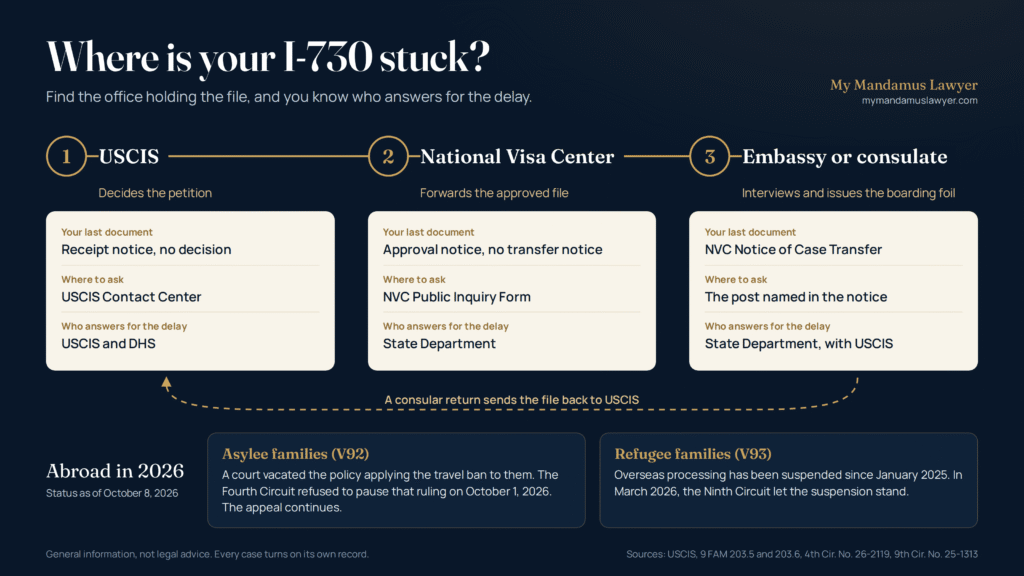
For a relative abroad, an approval notice starts the hardest stretch to read. Consular officers do not decide the I-730 again. The Foreign Affairs Manual says they perform services on behalf of USCIS, which keeps primary responsibility for the petition. A silent embassy is a State Department delay, but USCIS stays part of the picture.
If the officer finds a problem with the relationship evidence or a bar, the post sends the file back to USCIS through NVC with a memo. USCIS may then reopen the case and issue a Notice of Intent to Deny, or reaffirm the approval and send the file abroad again. That loop can add months to an I-730 delay, and our guide to a petition returned to USCIS explains how it works.
No published timeline covers this stage. USCIS says it has no processing time information for petitions pending with the State Department, so a dated log of every inquiry becomes your measure of the I-730 delay.
Asylee vs. Refugee Families in 2026: Why the Cases No Longer Move Alike
For years, whether you held asylum or refugee status made little difference to how your family’s case moved abroad. In 2026, it makes a large one.
Follow-to-Join Asylees (V92)
The travel ban proclamations of June and December 2025 exempt people granted asylum and say they do not limit the ability to seek asylum. The State Department applied them anyway to deny boarding foils to asylees’ spouses and children. On July 29, 2026, a federal court in Virginia vacated that policy in A.A. v. State. On October 1, 2026, the Fourth Circuit refused to pause that ruling while the government appeals, noting that it requires individual decisions, not approvals.
For now, the vacatur is not limited to the families who sued, though one judge on the panel would have limited it. If your relative’s case stopped because of the travel ban, ask the post that handled it to resume processing. The appeal is still pending, so this can change.
Follow-to-Join Refugees (V93)
Refugee family members are processed through the U.S. Refugee Admissions Program. After the January 2025 executive order suspending that program, the State Department stopped V93 travel eligibility interviews at its posts. In March 2026, the Ninth Circuit held in Pacito v. Trump that the President likely had authority to suspend refugee admissions. It left in place only the part of the lower court’s order protecting services for refugees already here.
What Changed at the USCIS Stage
In June 2026, a federal court in Rhode Island vacated the USCIS hold policies that had paused many benefit requests from nationals of the listed countries, and USCIS acknowledged the order. In August, the First Circuit paused only the re-review policy, leaving the holds vacated. Our page on the USCIS 39-country hold tracks that fight.
Not sure which office is holding your family’s file?
Our team can review your receipt and approval notices, any NVC transfer notice and the embassy’s messages, and tell you whether the delay is ready for federal court.
When Does an I-730 Delay Justify a Lawsuit, and Who Is Sued?
A mandamus lawsuit, usually paired with an Administrative Procedure Act claim, asks a federal court to order an agency to act on a case it has left waiting. Courts weigh an I-730 delay under the six TRAC factors, explained in our guide to TRAC factors and unreasonable delay. In an I-730 case, the factor about human welfare carries real weight: spouses apart for years, children growing up abroad, families sometimes living in danger.
Pending at USCIS
When the petition has not been decided, the defendants are USCIS and DHS officials. An I-730 delay at this stage makes the strongest case when the wait is well past posted processing times, every inquiry is documented and no request for evidence is outstanding.
In one of our client results, a Ukrainian client’s I-730 had been pending for more than three years despite four inquiries. We filed in the Southern District of Florida on April 17, 2026, and the petition was approved on May 28, 2026. Past results do not guarantee future outcomes.
Approved and Waiting Abroad
Once the file is at a post, State Department officials become defendants, often alongside USCIS and DHS, as in A.A. v. State. The government usually invokes consular nonreviewability, but the Fourth Circuit found that a forward-looking challenge to a policy appears reviewable. For asylee families, that keeps the consular stage open to challenge. For refugee families, a suit to restart V93 travel processing faces the Pacito ruling, at least in the Ninth Circuit. Where you file matters, as our guide on where to file a mandamus lawsuit explains.
A lawsuit asks for a decision, not an approval. It cannot repair thin relationship evidence, and an I-730 denial cannot be appealed, though a motion to reopen or reconsider remains possible. Review the relationship evidence before you push for a fast answer.
Frequently Asked Questions
Does USCIS publish a processing time for I-730 petitions?
For a petition still at USCIS, compare your receipt date with the processing times USCIS posts online. For the State Department stage, it publishes none. A posted time is a benchmark, not a legal deadline.
Can my family travel if they are from a travel-ban country?
It depends on your status. For asylee families, the court order vacating the travel-ban policy remains in effect during the appeal. For refugee families, the Ninth Circuit’s ruling leaves the suspension of refugee processing in place. Check with counsel before your relative makes travel plans.
What happens if my child turns 21 while the I-730 is pending?
A child who was under 21 when you filed your asylum or refugee application generally stays a child for I-730 purposes, as long as they remain unmarried. A child who marries before traveling loses eligibility unless the marriage ends before travel.
Can I still file an I-730 after I become a U.S. citizen?
No. A naturalized citizen cannot file a new I-730, but one already pending when you naturalize continues to be processed. Citizens petition for relatives with Form I-130 instead.
Will filing a lawsuit put my family’s I-730 at risk?
A lawsuit does not change the standards the petition must meet. It changes the timing, so a decision may come sooner on the record as it stands.
Locate the File, Then Decide How to Move It
An I-730 delay is rarely one problem. It is a file sitting with a specific office, under rules that differ for asylee and refugee families. Once you know which office holds it, you can tell whether an inquiry, a correction or a lawsuit comes next.
Gather four things now: the receipt and approval notices, any NVC transfer notice, every message from the embassy, and a dated log of your inquiries.
Your family’s wait is not your fault.
A mandamus lawsuit can be a legal remedy against an unreasonable I-730 delay, whether the file sits at USCIS or at an embassy. Contact our team to review your notices and whether a federal filing makes sense now.
Phone: +1 (862) 799-2200
Legal Disclaimer: This article is provided for general informational purposes only and does not constitute legal advice. Every immigration case has unique circumstances. For legal guidance specific to your situation, we recommend consulting with an experienced immigration attorney. The information in this article reflects laws and policies as of the publication date; subsequent changes may affect its accuracy.
Sources
- I-730, Refugee/Asylee Relative Petition, U.S. Citizenship and Immigration Services, last updated October 5, 2026.
- USCIS Policy Manual, Volume 4, Part C, Chapter 5: Adjudication, U.S. Citizenship and Immigration Services, accessed October 8, 2026.
- 9 FAM 203.5, Casework and Processing for V92 Follow-to-Join Asylees, U.S. Department of State, May 31, 2024.
- 9 FAM 203.6, Casework and Processing for V93 Following-to-Join Refugees, U.S. Department of State, February 4, 2025.
- Policy Alert PA-2024-17: Customer Service Options for Refugee/Asylee Relative Petition (Form I-730), U.S. Citizenship and Immigration Services, June 25, 2024.
- Update on I-730 Following-to-Join Refugee Processing at the Department of State, U.S. Department of State, February 7, 2025.
- A.A. v. U.S. Department of State, No. 26-2119, Order Denying Stay Pending Appeal, U.S. Court of Appeals for the Fourth Circuit, October 1, 2026.
- Pacito v. Trump, No. 25-1313, Opinion, U.S. Court of Appeals for the Ninth Circuit, March 5, 2026.
- Update on USCIS’ Strengthened Screening and Vetting, U.S. Citizenship and Immigration Services, last updated June 12, 2026.
- Dorcas International Institute of Rhode Island v. USCIS, No. 26-1703, U.S. Court of Appeals for the First Circuit, August 14, 2026.