
An immigration FOIA delay can create more than an administrative inconvenience. When USCIS does not produce your records, you may be unable to understand your immigration history, prepare for litigation, respond to an agency notice, or determine why your underlying immigration case remains pending.
The Freedom of Information Act gives you a legal method to request records maintained by federal agencies. However, a FOIA request does not compel USCIS to approve or deny an immigration application, and it does not automatically resolve an A-File request delay.
In some cases, the correct remedy is a FOIA lawsuit seeking delayed records. In others, the larger problem is an unreasonably delayed immigration application that may support an Administrative Procedure Act claim, a writ of mandamus, or both.
FOIA helps you uncover the record. A mandamus or APA lawsuit may address the government’s failure to act on the immigration case itself.
In This Article
- What Is an Immigration FOIA Request?
- Why USCIS A-File Requests Get Stuck
- How to File a FOIA Request Correctly
- When a FOIA Delay Requires Legal Action
- FOIA Lawsuit, Mandamus, or APA Claim
- How an A-File Can Strengthen a Mandamus Case
- Four Immigration Delay Scenarios
- What to Do Right Now
- How We Handle Immigration Delay Cases
- Frequently Asked Questions
| Issue | What It Means |
|---|---|
| FOIA response period | An agency generally must make a determination within 20 working days, subject to statutory qualifications and extensions. |
| A-File | The government’s central immigration record concerning a particular individual. |
| FOIA lawsuit | A federal action seeking a lawful search and disclosure of nonexempt agency records. |
| Constructive exhaustion | A doctrine that may allow a requester to sue after an agency misses FOIA’s statutory response period. |
| Mandamus lawsuit | A federal action seeking to compel a clear, legally required government duty. |
| APA claim | A claim challenging agency action that has been unlawfully withheld or unreasonably delayed. |
What Is an Immigration FOIA Request and Why Does It Matter?
The Freedom of Information Act, commonly called FOIA, allows individuals to request existing federal agency records. In immigration matters, those records may be maintained by USCIS, ICE, CBP, the Department of State, or another federal immigration component.
FOIA is primarily a records-access law. It is not the same as a USCIS service request, an immigration expedite request, a congressional inquiry, or a demand that an officer decide a pending immigration benefit. If the larger problem is that the immigration application itself remains unresolved, our guide to mandamus lawsuits for immigration delays explains how federal litigation may be used to seek agency action.
FOIA vs. a Case Status Inquiry
A case status inquiry asks USCIS for information about a pending petition or application. The agency may respond that the case remains under review, that background checks are pending, or that the matter is within the agency’s published processing timeframe, without providing the underlying agency record.
A FOIA request asks the agency to search for and disclose existing records. Those records may include notices, historical applications, correspondence, entry records, interview-related materials, or other documents that are not visible through the public case status system or the applicant’s online USCIS account.
| Tool | Primary Purpose | What It Usually Cannot Do |
|---|---|---|
| Case status inquiry | Request an update on a pending case. | Provide the complete internal immigration record. |
| FOIA request | Request existing agency records. | Require approval or adjudication of an application. |
| Expedite request | Ask USCIS to prioritize an immigration benefit request. | Guarantee faster processing or approval. |
| Federal lawsuit | Seek judicial relief for a legally actionable delay. | Guarantee a favorable immigration decision. |
What Is an A-File?
An Alien File, usually called an A-File, is the government’s central immigration record concerning an individual. The exact content depends on the person’s entries, applications, immigration court history, enforcement encounters, and prior agency interactions.
An A-File may contain applications and petitions, notices issued by USCIS, entry or inspection records, immigration court documents, prior statements, correspondence, and other records connected to the person’s immigration history.
- Copies of prior immigration applications and petitions;
- USCIS receipt, approval, denial, RFE, or NOID notices;
- Entry, inspection, parole, or border records;
- Removal proceeding and immigration court documents;
- Interview-related documents, subject to applicable exemptions;
- Prior asylum, adjustment, naturalization, or visa records;
- Correspondence between the applicant and immigration agencies;
- Documents transferred between USCIS, ICE, CBP, or other components.
These records may be especially important when preparing a waiver, removal defense, federal lawsuit, naturalization case, adjustment application, or response to an agency notice. They may also reveal inconsistent historical information that should be addressed before submitting a new immigration filing.
A-File: Why USCIS FOIA Requests Get Stuck
An A-File request may require USCIS to identify the correct record, locate electronic or archived materials, obtain documents from another office, review responsive pages, and apply FOIA exemptions. A broad request involving years of immigration history may therefore require a more complicated search and review process.
A delay does not always mean that USCIS lost the file. However, prolonged silence, repeated template responses, unexplained closures, or demands for information already supplied can indicate that the request requires closer legal review or a more formal escalation strategy.
The 20-Working-Day Statutory Framework
Under 5 U.S.C. § 552, a federal agency generally must determine whether it will comply with a proper FOIA request and notify the requester within 20 working days, subject to statutory qualifications and permissible extensions.
The 20-day provision does not necessarily require the agency to produce every responsive page by the twenty-first working day. It generally requires the agency to make and communicate a legally sufficient determination on the request, rather than leaving the requester in an indefinite administrative queue.
When the agency fails to comply with the applicable statutory period, the requester may be considered to have constructively exhausted administrative remedies. Depending on what the agency did before litigation began, this may permit the requester to seek relief in federal district court.
Nightingale v. USCIS and Systemic A-File Delays
The systemic importance of immigration records was addressed in Nightingale v. USCIS, litigation concerning delays in USCIS and ICE responses to certain A-File requests. The case illustrates that delayed access to immigration records can affect removal, asylum, detention, and benefit proceedings.
The litigation also demonstrates why an A-File request should not always be treated as a routine customer-service matter. When a person needs government records to defend against removal or prepare an immigration filing, delayed disclosure can create meaningful procedural harm and limit the person’s ability to make informed legal decisions.
What an “Insufficient Information” Notice May Mean
USCIS may legitimately need additional information when it cannot identify the subject of a request or verify the requester’s identity. An incorrect A-Number, incomplete legal name, missing authorization, or illegible identification document can prevent the agency from conducting a reliable records search or confirming the requester’s right to access the file.
- An incorrect or incomplete A-Number;
- A name that does not match agency records;
- Failure to include prior names or alternative spellings;
- Missing identity certification or identification;
- An unsigned third-party authorization;
- A request covering several family members in one submission;
- A request that does not reasonably describe the records sought.
However, a requester should not assume that every closure is proper. If the request included a correct A-Number, complete biographic details, proof of identity, and a clear description of the records, counsel may evaluate whether to correct or resubmit the request, file an administrative appeal, or consider a FOIA delay lawsuit.
How to File a FOIA Request That Is Less Likely to Be Rejected
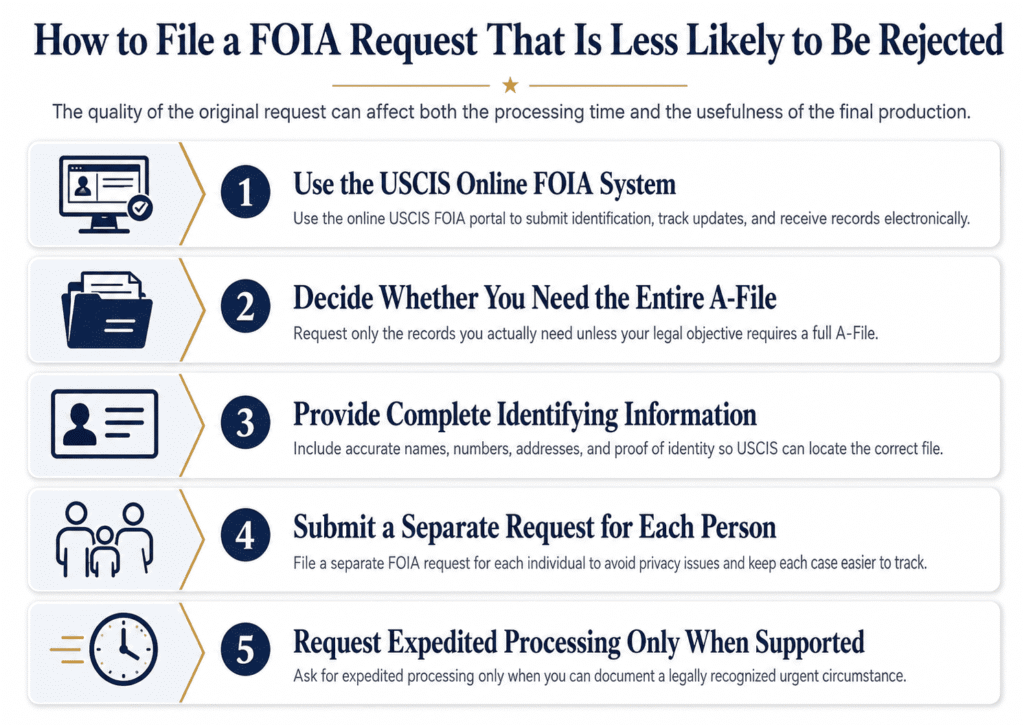
The quality of the original request can affect both the processing time and the usefulness of the final production. A request should identify the correct agency, accurately describe the records, and include enough information to permit a reasonable agency search while avoiding unnecessary scope and review burdens.
Use the USCIS Online FOIA System
USCIS directs requesters to use its online FOIA request system. The online process allows requesters to submit identification, describe the records sought, monitor correspondence, and receive electronic record productions.
Form G-639 remains a useful reference for understanding the information USCIS expects in a records request. Nevertheless, requesters should follow the agency’s current filing instructions and use the required submission method.
Decide Whether You Need the Entire A-File
A request for “everything” may appear safer, but a full A-File request can require a broader search and a more extensive exemption review. When the requester needs only a prior application, entry record, interview notice, or decision, a targeted records request may produce a faster and more manageable disclosure.
A complete A-File may still be appropriate when the person has a complicated immigration history, does not possess prior filings, has been placed in removal proceedings, or needs to reconstruct multiple agency interactions. The scope should be based on the requester’s specific legal objective.
Provide Complete Identifying Information
Fields that appear optional may still help USCIS locate the correct record. A prior surname, alternative spelling, earlier address, or old receipt number may connect the request to a file that cannot be found using only the person’s current legal name and present mailing address.
- Full current legal name;
- All prior names and alternative spellings;
- Date and country of birth;
- Correct A-Number;
- USCIS online account number, when available;
- Relevant receipt numbers;
- Current and prior addresses;
- Clear proof of identity;
- Signed authorization for a third-party request.
Every number should be reviewed before submission. A single transposed digit may cause USCIS to search for the wrong individual or conclude that it cannot identify the requested immigration record, resulting in an avoidable A-File processing delay.
Submit a Separate Request for Each Person
USCIS instructs requesters to submit a separate request for each individual. A spouse, parent, and child may be connected through the same immigration case, but each person can have a separate government record and distinct identity-verification requirements.
Combining several family members into one request can make the scope unclear and create privacy concerns. Separate requests generally make it easier to track each FOIA control number, agency response, and document production.
Request Expedited Processing Only When Supported
FOIA regulations permit expedited processing in limited circumstances. A requester should explain the legally recognized urgency and attach supporting documents rather than relying on a general statement that the records are personally important or that the requester has already waited a long time.
- A scheduled immigration court hearing;
- An approaching filing or litigation deadline;
- A detention or removal-related emergency;
- A documented threat to life or physical safety;
- Another circumstance recognized by the applicable agency regulations.
An expedited FOIA request is different from a request to expedite an immigration application. The two requests involve different agency duties, different legal standards, and different supporting evidence.
When to Escalate: Signs Your FOIA Delay Requires Legal Action
Not every delayed FOIA request should result in an immediate lawsuit. The first step is to determine whether the request was proper, whether the agency issued a legally sufficient response, and whether an administrative appeal remains necessary before pursuing federal judicial review.
However, waiting without a strategy may no longer be reasonable when the agency repeatedly fails to produce records or the delay threatens another legal proceeding. The following circumstances may justify a formal escalation analysis or consultation with counsel experienced in federal writ of mandamus litigation.
- No meaningful determination after the statutory response period;
- Repeated template updates with no production date;
- Closure for allegedly missing information that was supplied;
- Multiple requests producing the same unresolved result;
- An approaching RFE, NOID, court, appeal, or filing deadline;
- A partial production with unexplained missing records;
- Extensive redactions without a sufficient exemption explanation;
- An underlying immigration case that is also substantially delayed.
The Twenty-First-Working-Day Question
When an agency fails to issue a timely determination, the requester may have constructively exhausted the administrative process. This can mean that the requester is not required to wait for an administrative appeal that could not be filed because the agency never issued a timely initial determination or meaningful appealable response.
Constructive exhaustion is not automatic proof that the requester will win. Counsel should confirm the request date, receipt date, scope, identity documentation, agency correspondence, claimed extension, and any later action that may affect the requester’s exhaustion status or the court’s jurisdictional analysis.
How a Missing A-File Can Harm the Immigration Case
An A-File delay becomes particularly important when the records are needed to prepare for removal proceedings, identify an old immigration order, evaluate past statements, respond to an RFE, or understand why an adjustment application remains pending. The harm depends on both the missing records and the separate immigration deadline.
- Preparing for an asylum or removal hearing;
- Determining whether a prior removal order exists;
- Responding accurately to an RFE or NOID;
- Evaluating inconsistencies between past and current filings;
- Preparing a waiver, motion, or federal complaint;
- Reviewing an old entry, inspection, or enforcement record;
- Investigating an unexplained post-interview delay.
A pending FOIA request ordinarily does not pause an RFE deadline, immigration court schedule, motion deadline, or statutory filing period. Applicants should therefore continue protecting their underlying immigration case while pursuing access to the delayed agency records.
Is Your FOIA Request Delayed While Your Immigration Case Remains Stuck?
A delayed A-File request and a delayed immigration application involve two different government duties. Our team can evaluate whether your situation may require a FOIA lawsuit, an APA claim, mandamus litigation, or a coordinated legal strategy.
FOIA Lawsuit, Mandamus, or APA Claim: Which Legal Tool Fits?
A common mistake is to describe every federal delay action as a mandamus lawsuit. The appropriate cause of action depends on whether the plaintiff seeks agency records, action on an immigration application, or relief concerning both separate delays. Our detailed immigration mandamus vs. APA lawsuit guide explains why both legal theories are often considered in federal delay cases.
| Legal Tool | Primary Objective | Possible Court-Ordered Relief |
|---|---|---|
| FOIA lawsuit | Obtain responsive, nonexempt agency records. | A lawful search, justified redactions, and production of improperly withheld records. |
| APA claim | Challenge agency action unlawfully withheld or unreasonably delayed. | Completion of a legally required agency action. |
| Mandamus claim | Compel a clear, nondiscretionary duty owed to the plaintiff. | Performance of the required duty, not a predetermined favorable result. |
| Combined strategy | Address delayed records and a separate immigration adjudication. | Relief tailored to each government duty and legal claim. |
FOIA Lawsuit Under 5 U.S.C. § 552
FOIA expressly authorizes federal district courts to review an agency’s withholding of records. A complaint may challenge the agency’s failure to issue a timely determination, failure to conduct an adequate search, improper use of exemptions, or failure to produce reasonably segregable information from otherwise exempt agency material.
The objective of a FOIA lawsuit is access to records. The court ordinarily does not use the FOIA claim to approve an I-485, decide an I-140, schedule a visa interview, or adjudicate another immigration benefit request that involves a separate agency obligation.
Why Standalone Mandamus Is Usually Not the Main FOIA Remedy
The Mandamus Act, 28 U.S.C. § 1361, gives district courts jurisdiction over actions seeking to compel a federal officer or agency to perform a duty owed to the plaintiff. Mandamus is generally considered an extraordinary legal remedy.
Because FOIA creates its own cause of action and judicial remedy, a court may question whether standalone mandamus is necessary to address the same records dispute. A delayed records request is therefore generally litigated under FOIA’s specific enforcement provision, rather than relying only on the Mandamus Act.
Where Mandamus May Apply
Mandamus becomes more relevant when the true problem is a separate failure to act on an immigration petition or application. For example, USCIS may produce the requested A-File while continuing to leave an I-485, N-400, I-130, I-140, or asylum application in an unresolved adjudicatory queue for a potentially unreasonable period.
An APA and mandamus complaint may ask the federal court to require USCIS or another agency to take legally required action. It usually does not ask the judge to approve the application, but to require the government to issue a lawful agency decision or complete another nondiscretionary procedural step.
Applicants who are new to federal delay litigation can begin with our guide explaining what a mandamus lawsuit means in an immigration case. Our page explaining how a mandamus lawsuit works also outlines the evaluation, filing, service, government-response, and case-resolution stages.
When the central claim is that USCIS has unlawfully withheld or unreasonably delayed a required action, our guide to APA § 706(1) lawsuits for USCIS delays explains the discrete-agency-action requirement and why the requested relief is normally agency action rather than guaranteed approval.
Because federal delay litigation involves venue, jurisdiction, service, statutory claims, and litigation strategy, many applicants choose to consult an experienced mandamus lawyer before filing a complaint or communicating a litigation threat to the agency.
The Strategic Case for FOIA and Mandamus Together
FOIA and mandamus may serve complementary purposes. FOIA can help identify what exists in the government record, while a mandamus or APA claim can target the agency’s failure to complete a required action on the underlying immigration matter.
- Identify the missing information. Determine which records are needed and which agency is likely to possess them.
- Request the appropriate records. Submit a precise FOIA request with complete identifying information.
- Evaluate the production. Review what the record reveals about agency action, inactivity, or historical issues.
- Separate the legal duties. Distinguish the duty to disclose records from the duty to adjudicate an immigration case.
- Select the correct claim. Use FOIA, the APA, mandamus, or a coordinated combination based on the facts.
In some cases, it makes sense to obtain the A-File before filing an immigration delay lawsuit. In others, waiting for FOIA may create additional harm, and counsel may proceed using existing evidence while separately addressing the records-access problem and the adjudication delay.
The legal claim should match the delayed government duty. A records delay and an adjudication delay may be related, but they are not legally identical.
The Mandamus Advantage: When FOIA Reveals a Bigger Delay Problem
A useful A-File is more than a collection of old forms. It can help counsel reconstruct what the agency has done, identify gaps in the procedural history, and determine whether the record supports an unreasonable-delay argument or reveals a different substantive immigration concern.
What the A-File May Reveal
- A transfer between field offices or service centers;
- A completed interview followed by a long period of inactivity;
- A prior request or notice that was not fully resolved;
- Incorrect biographic information or mismatched identifiers;
- A prior removal, asylum, visa, or adjustment record;
- A missing filing or document that the applicant believed was submitted;
- Which agency or office may currently possess the relevant record;
- A discrepancy between public case status and documented agency activity.
Not every internal document will be disclosed. FOIA permits agencies to withhold information protected by applicable exemptions, including certain privileged, law-enforcement, privacy, national-security, and deliberative materials. A production may therefore contain redacted pages or omit exempt records.
Using FOIA Findings in a Mandamus Complaint
A federal complaint should contain more than the allegation that a case has taken too long. The pleading should accurately explain the application history, agency communications, steps taken by the applicant, consequences of delay, and the nature of the government duty at issue in the specific immigration proceeding.
- Receipt and approval notices;
- Interview and biometrics notices;
- Case-status screenshots;
- Service requests and agency responses;
- Congressional inquiry correspondence;
- Ombudsman submissions;
- Consular emails and 221(g) notices;
- FOIA correspondence and productions;
- Evidence of financial, professional, medical, or family hardship.
The A-File may help create a reliable chronology and reduce the risk of making an allegation that conflicts with a prior filing. It may also identify which office has authority over the case and whether the delay appears connected to a file-transfer issue, unresolved review, or another agency-specific bottleneck.
The documents required before filing will vary by case, but applicants can review our resource on mandamus eligibility, process, costs, and risks when organizing the initial case history.
Attorney’s Fees in FOIA Litigation
FOIA permits a court to assess reasonable attorney’s fees and litigation costs when the plaintiff has substantially prevailed and the legal requirements for a fee award are satisfied. A requester may substantially prevail through certain enforceable judicial relief or when the lawsuit causes a qualifying voluntary agency change.
Attorney’s fees are not automatically recovered simply because records are produced after filing. Eligibility and entitlement depend on the procedural history, the reason for disclosure, the parties’ conduct, and the court’s application of the relevant statutory factors to the individual FOIA case.
Four Realistic Immigration Delay Scenarios
The following scenarios are hypothetical and do not predict the result of any particular case. They illustrate how FOIA, APA, and mandamus may play different roles depending on the records being sought and the underlying immigration delay.
Scenario 1: I-485 Stuck After the Adjustment Interview
Nadia completed a marriage-based I-485 interview nearly two years ago. USCIS repeatedly states that the matter remains under review, but provides no meaningful explanation for the post-interview delay or the lack of a final adjustment decision.
A targeted or complete A-File request may provide applications, notices, nonexempt interview-related material, and other records. The production may help counsel determine whether the file reflects an unresolved discrepancy, missing document, supervisory review, or an extended period of documented agency inactivity.
If the I-485 delay is legally unreasonable, an APA and mandamus lawsuit may seek to compel USCIS to issue a decision. Applicants facing this problem can review our guide to the available options for an I-485 delay mandamus lawsuit.
When the pending adjustment application is employment-based, additional issues may include an approved I-140, priority-date availability, and the stage of the adjustment process. These cases are discussed in our guide to an employment-based I-485 delay after I-140 approval.
Scenario 2: DACA Renewal Pending Near Work Permit Expiration
Carlos timely filed a DACA renewal and employment authorization request, but the application remains pending as his current EAD approaches expiration. His immediate concern is maintaining work authorization and avoiding the financial consequences of an employment interruption.
FOIA may help recover prior DACA filings or documents missing from his personal records. However, a new FOIA request may not be fast enough to address an immediate EAD problem, so the applicant should separately evaluate an expedite request, service inquiry, congressional assistance, and any available federal litigation options.
A mandamus lawsuit may be considered when the adjudication delay becomes unreasonable, but the discretionary aspects of DACA and the particular procedural history require careful analysis. The applicant should not postpone an urgent adjudication strategy merely because an A-File request remains pending.
Applicants can review the broader immigration mandamus lawsuit FAQ for common questions about eligible case types, litigation risks, government responses, and possible outcomes.
Scenario 3: EB-2 NIW Petition Delayed Without Explanation
A researcher filed an EB-2 NIW Form I-140, but USCIS has not issued an RFE, decision, or meaningful update. The prolonged delay affects future employment planning, adjustment eligibility, and the researcher’s ability to make long-term professional decisions.
FOIA may help reconstruct earlier filings or immigration history, although a pending adjudicatory file may contain exempt or deliberative information. The applicant should not assume that FOIA will disclose the officer’s complete reasoning or the agency’s internal decision-making process.
If the delay is unreasonable under the individual circumstances, a federal complaint may seek action on the I-140. Relevant facts can include the length of delay, USCIS activity, agency explanations, competing priorities, and the concrete harm caused by continued inaction.
The broader legal framework is discussed in our guide to APA lawsuits for delayed USCIS action. Applicants with investor petitions may also find the analysis in our EB-5 I-526E delay lawsuit guide useful for understanding how petition-specific facts affect unreasonable-delay litigation.
Scenario 4: Consular Administrative Processing After 221(g)
Amir attended an immigrant visa interview and received a 221(g) refusal requesting additional information. He submitted the requested material, but the consular case has remained in administrative processing for more than a year without a substantive case update.
A Department of State FOIA request may seek nonexempt visa-related records, while a separate USCIS request may be appropriate for the approved petition or earlier immigration history. Consular confidentiality provisions and FOIA exemptions may substantially limit the records ultimately released.
Mandamus and APA litigation may seek action on prolonged consular processing depending on jurisdiction, procedural history, and the legal duty asserted. These cases require careful treatment of consular nonreviewability and the distinction between demanding a visa approval and requesting completion of delayed administrative processing.
Applicants whose visas remain in administrative processing can review our focused guide to a mandamus lawsuit for a 221(g) administrative processing delay.
| Scenario | Possible FOIA Purpose | Possible Litigation Focus |
|---|---|---|
| I-485 post-interview delay | Review filings, notices, and available interview-related records. | Compel a decision on the adjustment application. |
| DACA renewal delay | Recover prior filings or missing historical documents. | Address delayed adjudication where legally appropriate. |
| EB-2 NIW delay | Clarify prior immigration history and available records. | Seek action on a delayed I-140 petition. |
| Consular processing delay | Request available DOS or USCIS records. | Seek completion of prolonged administrative processing. |
What to Do Right Now: A Step-by-Step Action Plan

A successful strategy begins by separating the records problem from the adjudication problem. Before filing another inquiry or lawsuit, determine exactly what information is missing, which agency possesses it, and which government action remains incomplete.
- Define your immediate objective. Determine whether you need records, a decision on an immigration case, or both.
- Identify the correct agency. USCIS, ICE, CBP, and the Department of State maintain different categories of records.
- Preserve all immigration documents. Save filings, notices, emails, status screenshots, inquiry responses, and interview records.
- Submit a precise FOIA request. Include accurate identifiers and request specific documents when the entire A-File is unnecessary.
- Track the statutory timeline. Record the submission date, acknowledgment, control number, extensions, and agency correspondence.
- Protect separate deadlines. Continue responding to RFEs, court notices, motions, and appeal deadlines while FOIA remains pending.
- Document the effects of delay. Preserve evidence of employment loss, family separation, financial harm, medical concerns, or litigation deadlines.
- Evaluate the correct cause of action. Determine whether the facts support FOIA litigation, an APA claim, mandamus, or a coordinated approach.
Applicants should avoid repeatedly submitting duplicate requests without understanding why the first request stalled. Duplicate filings can complicate tracking and do not necessarily correct an incomplete identity certification, unclear scope, or agency-specific filing error.
Before federal litigation, counsel should review the full chronology, identify potential weaknesses, evaluate venue, and consider whether the government’s review of the underlying application may reveal a separate eligibility concern or create another case-specific litigation risk.
Applicants who are considering litigation can review the typical mandamus lawsuit timeline and the firm’s mandamus lawsuit success stories to better understand the process. Prior results do not guarantee a similar outcome.
How My Mandamus Lawyer Handles Immigration FOIA Delay Cases
A strong delay strategy begins by identifying the precise duty the government has failed to perform. My Mandamus Lawyer evaluates whether the dispute concerns delayed access to records, an unreasonably delayed immigration adjudication, or a combination of both problems.
- Whether the FOIA request was properly submitted;
- Whether the agency’s statutory response period has expired;
- Whether USCIS issued a legally sufficient determination;
- Whether an administrative appeal is available or required;
- Whether the search and production appear complete;
- Whether redactions or withholdings may be challenged;
- Whether the underlying immigration matter is independently delayed;
- Whether FOIA, APA, mandamus, or combined claims fit the case;
- Which federal district may provide proper jurisdiction and venue;
- What risks may arise when the agency reviews the underlying application.
Our federal litigation practice handles USCIS applications, adjustment cases, naturalization matters, asylum applications, employment-based petitions, family petitions, and consular delays. Each case requires an individual analysis of the agency duty, the length and cause of delay, and the available evidence.
Applicants whose cases involve different immigration categories can review our guides to I-130 delay mandamus lawsuits, mandamus lawsuits for asylum delays, and I-485 delay litigation.
You can also review our immigration mandamus blog and USCIS delay guides or read answers to common questions in the mandamus lawsuit FAQ.
Has USCIS Failed to Produce Your A-File or Decide Your Immigration Case?
My Mandamus Lawyer can review the history of your FOIA request, the length of the underlying immigration delay, and the agency responses you have received. We will determine whether your case may support federal FOIA litigation, an APA or mandamus claim, or another appropriate escalation strategy.
Frequently Asked Questions
How long does an immigration FOIA request take?
FOIA generally requires an agency determination within 20 working days, subject to statutory qualifications and extensions. The actual production of records may take longer depending on the request’s scope, the location of the records, consultations with other agencies, and the need to review potentially exempt information.
Can I file a FOIA lawsuit without an attorney?
An individual may represent themselves in federal court, but a FOIA case can involve exhaustion, service, jurisdiction, search adequacy, exemption claims, and procedural deadlines. An attorney can also determine whether the real issue is the records delay, the underlying immigration delay, or both separate disputes.
What should I do if USCIS closes my request for insufficient information?
Review whether you provided the correct A-Number, full name history, date of birth, identity document, signature, and any required authorization. Depending on the notice, the appropriate response may be to correct the request, seek reconsideration, file an administrative appeal, or evaluate federal FOIA litigation.
Does filing FOIA slow down my immigration case?
A FOIA request does not ordinarily pause an immigration application. However, the requested file may need to be located, transferred, copied, or reviewed, and there is no categorical rule that a FOIA request will either accelerate or delay the underlying adjudication.
Can I sue USCIS for delaying my A-File?
Potentially. FOIA authorizes federal district court review when agency records have been improperly withheld. The viability of a lawsuit depends on the request’s validity, the agency’s response, administrative exhaustion, subsequent production, and the specific relief requested.
What is the difference between FOIA and the Privacy Act?
FOIA provides access to federal agency records subject to statutory exemptions. The Privacy Act provides additional rights concerning certain records maintained about individuals in federal systems, although the scope of those rights and the persons covered differ from FOIA’s disclosure framework.
How does mandamus fit into a FOIA delay case?
FOIA is generally the main statutory remedy for obtaining delayed records. Mandamus and APA claims become more important when the underlying immigration petition or application is also subject to a separate unreasonable delay. The different legal theories are explained in our mandamus vs. APA lawsuit comparison.
Can attorney’s fees be recovered in a FOIA lawsuit?
FOIA permits qualifying plaintiffs who substantially prevail to seek reasonable attorney’s fees and litigation costs. Recovery is not guaranteed and depends on the court’s application of the statutory fee standards to the individual litigation record.
What if my records are heavily redacted?
Review the exemption codes and the agency’s explanation for each category of withheld information. A requester may challenge unsupported redactions, an inadequate search, or the agency’s failure to release reasonably segregable portions of responsive records.
Can FOIA reveal why my background check is pending?
FOIA may provide context, but national-security, law-enforcement, privacy, and deliberative exemptions can prevent disclosure of sensitive information. The production may show that a case remains under review without revealing every reason for the pending background check.
Can I use FOIA to prepare an RFE response?
Yes, when the responsive records can be obtained in time and are relevant to the requested evidence. However, submitting FOIA does not extend the RFE deadline, so the applicant must continue preparing the strongest possible timely response.
Does agency understaffing excuse an unlimited FOIA delay?
Staffing and workload may be part of the government’s factual explanation, but they do not eliminate FOIA’s statutory requirements. Whether a particular delay supports federal relief depends on the request, agency actions, procedural history, and the legal remedy pursued.
Legal Disclaimer: This article is provided for general informational purposes only and does not constitute legal advice. Every immigration case has unique circumstances. For legal guidance specific to your situation, consult with an experienced immigration attorney. The information in this article reflects laws and policies as of the publication date; subsequent changes may affect its accuracy. Prior results do not guarantee a similar outcome.