
The one-year mark after your 221(g) refusal is approaching, or it has already passed, and no one has told you what that means. The question is whether your file is closed, whether the approved petition behind it survives, and whether any of it can be reversed.
The one-year rule is not a single deadline, and it does not run in every case. A file in administrative processing is treated differently from a file waiting on a document you were asked to send, and even when the year does expire, termination runs through two notices a year apart.
A 221g one year deadline passed is a status to verify, not a conclusion to accept. This guide covers which clock applies to you, when it stops running, what the termination notices do, how a terminated registration is reinstated, and when a termination becomes a federal court question.
If you are still inside the deadline, the practical question is how to respond rather than what happens if you do not. Our separate guide covers how to answer a 221(g) blue slip document request.
In This Article After the One-Year Mark
Which One Year Deadline Actually Applies to Your Case?
Two separate one-year periods appear in the immigrant visa regulations, and applicants routinely confuse them. Both sit in 22 CFR 42.83 and both end in termination of your registration for an immigrant visa. One runs when a visa becomes available and you do not apply for it. The other runs from the refusal itself, and ends your registration if you have not presented a consular officer with evidence purporting to overcome the basis for that refusal within the year.
| Clock | What starts it | What stops it |
|---|---|---|
| Visa availability INA 203(g), 22 CFR 42.83(a) |
A notice that an immigrant visa is available to you | Applying, or a substantive step such as rescheduling a missed appointment |
| 221(g) evidence 22 CFR 42.83(b) |
The date of the 221(g) refusal at your interview | Evidence reasonably purporting to overcome the basis for the refusal |
Nonimmigrant Visa Applicants Follow a Different Rule
There is no immigrant visa registration to terminate in a nonimmigrant case, so 22 CFR 42.83 does not reach you if you interviewed for a B, F, H, L, O, or similar visa. The Foreign Affairs Manual states the obligation directly instead: a 221(g) refusal requires the applicant either to wait for the results of additional administrative processing or to comply with a request for documentation or information within one year of the visa interview. The Department of State’s public guidance is that an applicant asked for additional information generally has one year from the refusal date to provide it before having to reapply and pay a new fee.
The One-Year Clock Does Not Run While You Are in Administrative Processing
This is the most common source of unnecessary panic in a long consular case, and the Foreign Affairs Manual answers it plainly. 9 FAM 504.13 provides that applications refused under INA 221(g) for administrative processing are not subject to the INA 203(g) provisions during the period the application is undergoing that processing.
The distinction tracks who holds the next move. When the consulate asked you for a document, the year is a deadline for your action. When it told you the case requires further review and asked for nothing, there is nothing for you to present, and the termination machinery is not applied while that review continues. If your notice requested nothing, our guide to what happens after a 221(g) white slip describes that stage.
That does not make the wait acceptable. It means the delay belongs to the government rather than to you, which is a different problem with a different remedy.
If You Cannot Obtain the Requested Document in Time
Applications refused for reasons other than administrative processing are subject to termination, but the FAM carves out applicants who cannot comply through no fault of their own. An applicant who makes a credible assertion that the documentation or information is not available within one year of the refusal would not be subject to the INA 203(g) provisions.
Credible is the operative word. Write to the post before the year runs and identify what you are seeking, which authority holds it, when you requested it, and why it has not arrived.
Applicants the Rule Does Not Reach at All
The same FAM section lists categories outside the termination provisions:
- Classifications for which visa numbers are unavailable
- Applicants awaiting USCIS processing of an I-601A provisional waiver
- Applicants following to join a principal applicant
- Applicants refused under a ground of ineligibility in INA 212(a) rather than 221(g)
- Applicants who elected adjustment of status, including those who filed Form I-485 within one year of visa availability
- Cases that have not had one full year of visa availability
The last point protects anyone caught by retrogression: where a priority date moves backward, the case cannot be treated as inactive until a full year of visa availability has passed. Separately, an applicant who is the beneficiary of more than one approved petition loses only the petition connected to the untimely application.
Every Submission Restarts the One-Year Clock
The period following a 221(g) refusal is not fixed. The FAM states that it is extended each time an applicant presents evidence reasonably purporting to overcome the INA 221(g) ineligibility.
That changes how the deadline behaves in a long case. A file that has gone back and forth for three years, with one document request answered in month four and another in month nineteen, is not a file that expired at month twelve. Each qualifying submission opened a new period.
Two consequences follow. Your record of submission dates establishes where the deadline actually sits, not only what a future delay claim would look like. And the extension depends on what you sent being responsive to the refusal, so a status inquiry or a request for an update is not evidence purporting to overcome anything.
What Actually Happens After the Year Passes
Termination is not a single event on the anniversary of the refusal. The Department of State runs it through two letters, separated by a year.
The first is the Notice of Termination of Registration, known internally as the Termination 1 letter. It tells the applicant that the registration and any petition approved on their behalf have been canceled, and that the application may be reinstated if, within one year, the applicant establishes that the failure to pursue it was due to circumstances beyond their control. The regulation requires both the notice and the statement of that right.
The Final Notice of Cancellation follows when that second year passes without a basis for reinstatement. At that point the registration record, the petition, and copies of supporting documents are destroyed, original civil documents are returned, and an unused labor certification goes back to the approving USCIS office.
The petition does not survive on its own. Under 8 CFR 205.1(a)(1), approval of a petition is automatically revoked when the Secretary of State terminates the beneficiary’s registration under INA 203(g).
The Priority Date Is the Consequence Most Applicants Do Not See Coming
If the same petitioner later files a new petition for the same beneficiary and the original was revoked under INA 203(g), the original priority date is not valid for the new filing. In a family preference or employment-based case, that is the difference between a place in line earned years ago and a place at the back of it. The fee is rarely the expensive part of a missed deadline. Our guide to a current I-130 priority date with no action explains how that queue position works.
Nonimmigrant Applicants: A New Application, and Sometimes a New Fee
There is no registration and no petition revocation on the nonimmigrant side. If the year passes without a response, the result is a new DS-160 and a new appointment. The fee carries a nuance worth knowing: the FAM instructs posts that they may not charge an additional machine-readable visa fee to an applicant refused under 221(g) who reapplies within one year of that refusal. The fee-free window and the evidence window close on the same date.
Received a termination notice, or watching the year run out?
Our team can review your refusal date, what the 221(g) notice requested, every submission you made and when, any termination letter and the address it was sent to, and whether the clock had already restarted.
How a Terminated Registration Is Reinstated
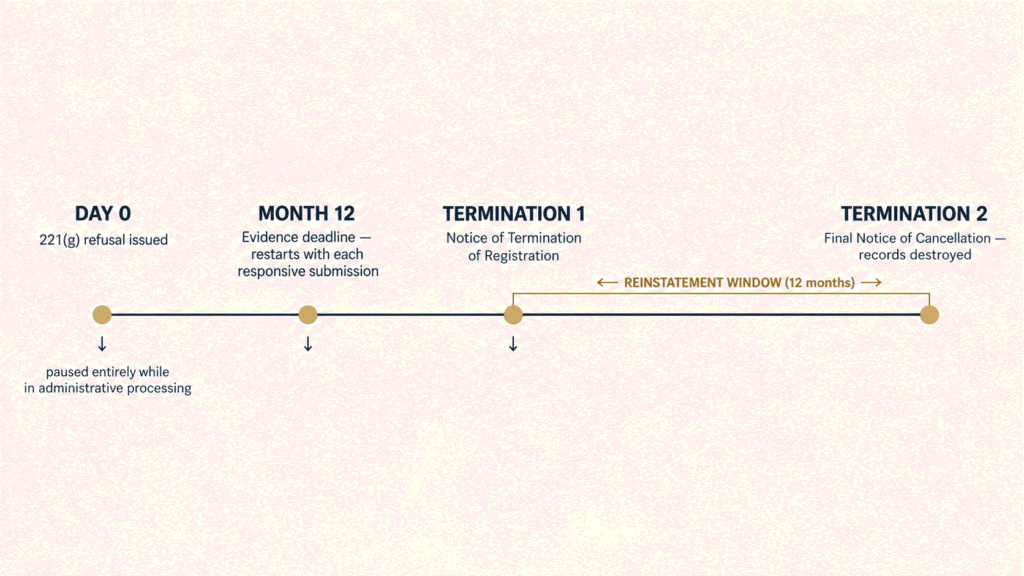
The second year after the Termination 1 letter is a real window rather than a formality. Under 22 CFR 42.83(d), where the consular officer is satisfied that the failure to present evidence purporting to overcome the 221(g) ineligibility was due to circumstances beyond the applicant’s control, the officer reinstates the registration. A petition automatically revoked as a result of that termination is then treated as reinstated with it.
Whether you have established that is a factual determination made by the post. The FAM describes circumstances beyond the applicant’s control as factors arising outside the applicant’s normal circumstances, and offers medical emergency and natural disaster as examples. Convenience, or a wish not to travel to the interview within the year, does not qualify. Neither does failing to receive a notice because you did not report a change of address.
Reinstatement the Post Is Required to Grant
Some grounds are not discretionary. The FAM instructs posts to reinstate a case where there had not been one full year of visa availability when the Termination 1 letter was sent, where the post did not meet the notification requirements, or where the case was prematurely terminated through a system or other error.
Those three categories matter because they are checkable. The date the notice was sent, the address it went to, the parties copied on it, and the Visa Bulletin position of your priority date during the relevant period are all facts you can reconstruct. If reinstatement is granted and the case was documentarily complete, the post renews clearances more than six months old and requests a visa number once the priority date is current.
When a Termination Becomes a Federal Court Question
A termination carried out according to the rules is difficult to attack. A termination that was not is a different matter, and these cases tend to turn on notice.
In Singh v. Clinton, the State Department conceded that it had not sent notice to the beneficiary’s Indian village address as listed on the I-130 petition, directing packets instead to an attorney’s 1991 address. The government argued that the absence of restrictive language in the statute and regulations left it free to give notice through any channel reasonably calculated to reach the beneficiary. The Ninth Circuit rejected that, noting that an agency has no discretion to make a decision contrary to law, and reversed.
Singh concerned the visa availability branch rather than a 221(g) refusal, so it is not a direct holding on the deadline discussed here. But the government abandoned its consular nonreviewability argument on appeal, and the court restated the established line: jurisdiction exists where a suit challenges the consul’s authority to take or fail to take an action, as distinct from a decision made within the consul’s discretion.
Where the Problem Is Delay Rather Than Termination
5 U.S.C. § 706(1) authorizes a court to compel agency action unlawfully withheld or unreasonably delayed, and 28 U.S.C. § 1361 gives district courts jurisdiction over an action to compel a federal officer to perform a duty owed to the plaintiff. Courts assessing whether a wait has become unreasonable commonly work through the TRAC factors, and our venue guide explains why such a case does not automatically belong in Washington, D.C.
A lawsuit in either posture asks for action, not an outcome. A court may require the government to adjudicate, or to apply its own termination and reinstatement rules correctly. It does not order a visa to be issued.
Frequently Asked Questions
Is my case automatically closed one year after a 221(g) refusal?
No. For an immigrant visa applicant the post must send a Notice of Termination of Registration and inform you of the right to reinstatement, and a second year runs before the final cancellation notice.
Does the deadline apply while I am in administrative processing?
The FAM provides that applications refused under 221(g) for administrative processing are not subject to the INA 203(g) provisions during that processing. If your notice requested nothing from you, this is the situation it describes.
Does sending part of what was requested extend the deadline?
The one-year period is extended each time the applicant presents evidence reasonably purporting to overcome the 221(g) ineligibility. A partial but responsive submission is not the same as a status inquiry, which extends nothing.
Will my priority date survive if my registration is terminated?
Not for a new petition filed by the same petitioner. Where the original petition was revoked under INA 203(g), the original priority date is not valid for the replacement filing.
I received a Notice of Termination of Registration. Is it too late?
Not necessarily. You have one year from that notice to establish that the failure was due to circumstances beyond your control, and certain grounds, including a defective notice or a premature termination, call for reinstatement regardless.
Do I pay the visa fee again if I reapply?
Posts may not charge an additional machine-readable visa fee to an applicant refused under 221(g) who reapplies within one year of that refusal. After the year, a new application and a new fee apply.
A Missed Deadline Is a Status to Verify, Not a Verdict
The one-year rule is stated as though it were a wall. In practice it does not run during administrative processing, restarts with each responsive submission, and ends in a notice that carries its own second year.
Three dates settle most cases: when the refusal issued, when you last submitted something responsive to it, and when any termination notice was sent and to what address. Establish those three and you will know whether a deadline was actually missed, whether the clock had already restarted, and whether the notice that ended your registration was valid.
Your case delay is not your fault.
A mandamus lawsuit is a legal remedy against unreasonable Department of State and consular delays. Contact our team for a review of your refusal date, the instructions on your 221(g) notice, your submission history, any termination or reinstatement correspondence, and whether federal litigation is realistic in your case.
Phone: +1 (862) 799-2200
Legal Disclaimer: This article is provided for general informational purposes only and does not constitute legal advice. Whether a one-year period has run, whether it was extended or suspended, and whether a termination or reinstatement decision can be challenged depend on the visa category, the instructions issued by the consular post, the procedural history, jurisdiction, and the facts of the individual case. For legal guidance specific to your situation, we recommend consulting with an attorney experienced in federal immigration litigation. The information in this article reflects Department of State guidance, federal regulations, and authorities reviewed as of September 14, 2026; subsequent changes may affect its accuracy. Prior results do not guarantee a similar outcome.
Sources
- 22 CFR 42.83, Termination of Registration, Electronic Code of Federal Regulations, accessed September 14, 2026.
- 9 FAM 504.13, Termination of Immigrant Visa Registration, U.S. Department of State, Foreign Affairs Manual, CT:VISA-2015, June 21, 2024.
- 9 FAM 403.10, NIV Refusals, U.S. Department of State, Foreign Affairs Manual, accessed September 14, 2026.
- 9 FAM 403.4, NIV Fees, U.S. Department of State, Foreign Affairs Manual, accessed September 14, 2026.
- 8 CFR 205.1, Automatic Revocation, Electronic Code of Federal Regulations, accessed September 14, 2026.
- Administrative Processing Information, Bureau of Consular Affairs, U.S. Department of State, accessed September 14, 2026.
- Singh v. Clinton, 618 F.3d 1085, U.S. Court of Appeals for the Ninth Circuit, August 20, 2010.
- 5 U.S.C. § 706, Scope of Review, Legal Information Institute, Cornell Law School, accessed September 14, 2026.
- 28 U.S.C. § 1361, Action to Compel an Officer of the United States to Perform a Duty, Legal Information Institute, Cornell Law School, accessed September 14, 2026.