
You heard that the 75 country visa pause was struck down. Your refusal notice is still in a folder, CEAC still says “Refused,” and the consulate has not told you what comes next. A 75 country visa pause refusal requires a closer look at why your application was refused and what remains unfinished.
The court in CLINIC v. Rubio set aside the policy and refusals based solely on it. That distinction matters: another refusal ground, an outstanding document request, or a separate restriction can put your case on a different path.
Here is how to check whether the ruling reaches your refusal, follow up with the consulate, preserve the record, and assess a reconsideration process that has stopped moving.
In This Article
- What Changed After the 75 Country Visa Pause Was Vacated?
- Was Your Visa Refused Solely Because of the Pause?
- What Should Happen During Reconsideration?
- No Update From the Consulate? How to Follow Up
- How Do You Assess a Reconsideration Delay?
- When Should You Discuss Federal Court Options With a Lawyer?
- Frequently Asked Questions
What Changed After the 75 Country Visa Pause Was Vacated?
On August 21, 2026, the U.S. District Court for the Southern District of New York vacated the nationality-based immigrant visa policy challenged in CLINIC v. Rubio, No. 26-CV-00858. The court also set aside immigrant visa refusals based solely on that policy and remanded those applications for further proceedings.
The Department of State’s public notice, updated August 28, states that the January 2026 pause is no longer in effect as of August 21. The affected process concerns immigrant visas issued through consulates abroad, rather than USCIS adjustment-of-status applications.
What the Ruling Did Not Decide
The judgment did not issue anyone a visa, eliminate another lawful refusal ground, or resolve every separate entry restriction. Your nationality being on the 75 country list does not establish that the pause was the only reason for your refusal.
| Date | Verified development |
|---|---|
| January 21, 2026 | The pause took effect, as described in the DOS notice. |
| August 21, 2026 | The court vacated the policy and sole-policy refusals. |
| September 8, 2026 | The government reported more than 43,000 affected applications and no fixed completion date for all reconsiderations. |
| September 25, 2026 | The district court denied the government’s stay request. |
Litigation status note | Sources reviewed October 16, 2026: The government appealed. The district court’s September 25 stay denial is a verified ruling, not confirmation that no later appellate order exists. Check the operative district court and Second Circuit orders before relying on the status or scope of relief.
Was Your Visa Refused Solely Because of the Pause?
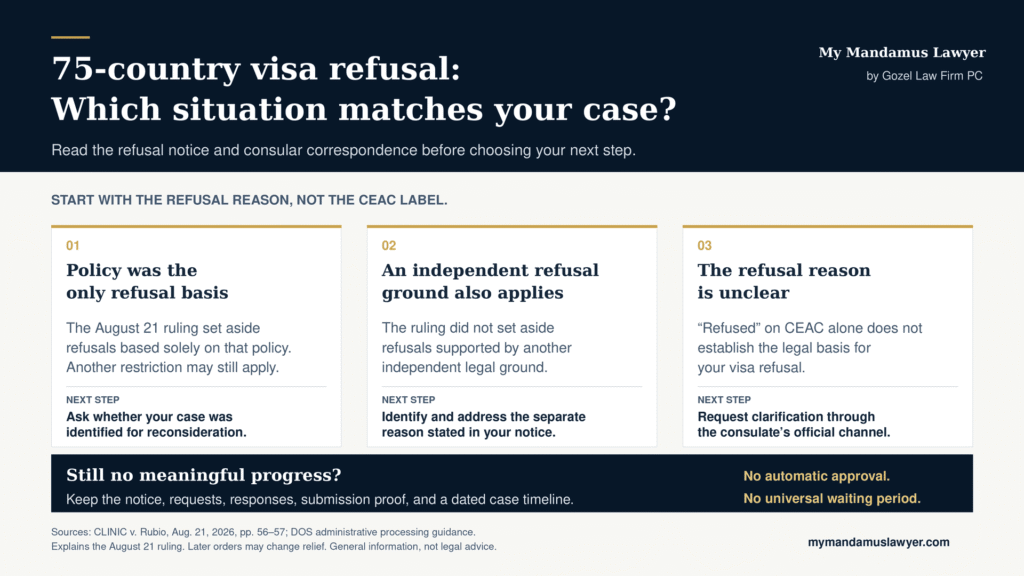
Start with the written refusal, then read the consulate’s emails and any document requests alongside it. The August 21 decision expressly distinguishes refusals based solely on the policy from refusals supported by an independent legal ground, even if the policy was also mentioned.
Your Notice Identifies Only the 75 Country Policy
This is the situation most directly addressed by the vacatur and remand. Preserve the wording connecting your refusal to the policy, including an email explaining why issuance stopped after the interview. Ask whether the consulate has identified your application for reconsideration under the judgment.
For example, a notice citing the pause, followed by an email saying issuance stopped for that reason alone, gives you a more specific record than nationality and an unchanged status screen. If you previously received an approval communication before a policy-related refusal, preserve both. The sequence may help counsel understand whether the post had already completed an individual eligibility assessment.
Your Notice Lists Another Refusal Ground
A separate inadmissibility finding or outstanding requirement needs its own assessment. The judgment does not erase it. A request for a police certificate, an individual security review, and a substantive finding of ineligibility also raise different questions; read the notice rather than treating every reference to section 221(g) as interchangeable.
| What your record shows | What to clarify | Useful next step |
|---|---|---|
| Only the 75-country policy is identified. | Whether your case was identified for reconsideration. | Request case-specific instructions. |
| The policy and another ground are identified. | Which independent reason remains operative. | Review that reason before choosing a response. |
| CEAC says “Refused,” with no clear explanation. | The actual legal basis and outstanding requirements. | Seek clarification through the post’s official channel. |
Scope distinction: CLINIC v. Rubio, August 21 Opinion and Order, pp. 56–57. The next-step suggestions are practical record-building guidance.
CEAC Says “Refused,” but the Reason Is Unclear
The status label alone does not establish that your refusal was policy-based. Our guide to CEAC status “Refused” explains the display; here, the question is which ground produced it and what the consulate says must happen next.
What Should Happen During Reconsideration?
In its September 8 status report, the government described identifying affected applications, reviewing individual files, and notifying applicants when more information was needed. Some cases required manual review to confirm that the pause was the sole refusal basis.
Updated Documents or Another Interview
The report said officers could request updated medical examinations, police certificates, other documents, or an additional interview where needed. Written instructions would identify the requested information and submission method. That does not mean every applicant must immediately obtain new documents or book another medical exam. Check the instructions actually issued in your case.
Keep an inventory of documents that may need updating, but distinguish preparation from submission. If the post requests a replacement certificate, record exactly what was requested, obtain it in the required form, and retain delivery proof. If a request is unclear or impossible to meet, seek clarification promptly rather than silently leaving it unanswered.
A Prior Public Charge Finding
The September 25 opinion emphasized prior eligibility findings and explained that the judgment did not require the government’s chosen wholesale re-evaluation. Do not read a remand as an order to repeat every earlier assessment. If the post requests financial evidence, respond to that request and have counsel examine any concern about its legal basis.
A New Refusal Changes the Next Question
If the consulate issues a new refusal, preserve it before continuing to describe the case as simple silence. A decision on another ground may require a different response from an effort to obtain action on an untouched remand. The next question becomes what was decided, under which provision, and whether any further processing remains open.
Not sure which refusal your case actually has?
Our team can review your refusal notice, consular correspondence, and the steps taken since the ruling to help identify what remains unresolved.
No Update From the Consulate? How to Follow Up
A focused inquiry should establish the file’s position, rather than repeat “When will my visa be approved?” Use the inquiry procedure published by the embassy or consulate handling your case. Confirm that your contact information is current, check for missed messages, and review outstanding requests before writing.
Ask Whether Your Case Was Identified for Reconsideration
Include the case number, interview and refusal dates, and a short explanation of the policy connection. If the basis is unclear, ask for clarification instead of asserting that the judgment necessarily covers you. Do not send unrelated sensitive documents merely to make the message longer.
Sample inquiry for adaptation to your own record:
Subject: Case [case number] | Reconsideration following CLINIC v. Rubio
I interviewed on [date], and my application was refused on [date]. The notice or later correspondence identified [quote or accurately describe the stated reason]. Please confirm whether my application has been identified for reconsideration following the judgment in CLINIC v. Rubio, No. 26-CV-00858, and whether any independent refusal ground or applicant-side requirement remains outstanding.
Please provide instructions if updated documents or another interview are required. I submitted [requested items] on [date] through [submission channel]. Thank you for confirming the next step.
Keep the Request, Response, and Submission Record
Save the notice, complete email threads, submission confirmations, and dated screenshots. A useful chronology distinguishes an unanswered inquiry from a new document request and a completed response. If the consulate identifies a hardship procedure, provide concrete supporting information through that channel; DOS advises applicants with unique hardship to inform the consular section.
Use a simple four-column log: date, action, supporting record, and next step. “Documents sent” should point to the submission confirmation; “case still pending” should point to the actual response. Keep the original messages as well as the summary, so a lawyer can read the wording and distinguish your interpretation from what the post said.
How Do You Assess a Reconsideration Delay?
The government’s September report did not promise a single completion date. That historical statement does not answer whether your individual wait is reasonable or whether later orders impose additional requirements. A legal assessment should examine the full record and the current procedural position.
Track the Full History and Post-Ruling Activity
Record the interview, original refusal, applicant responses, and meaningful actions after the judgment. Keep both the overall case age and the post-ruling period visible. Neither automatically proves unreasonable delay, and neither should disappear from the chronology simply because the other seems more favorable.
Separate Applicant Tasks From Government Inaction
An unanswered request for a medical exam differs from months of silence after proof of a complete response. A new passport request also differs from an automated date change. Identify the last substantive action and who controls the next one; our 221(g) administrative processing delay guide addresses ordinary post-interview delays separately.
Document the Continuing Harm
Preserve evidence of family separation, disrupted medical care, lost employment opportunities, or other concrete consequences. Counsel can assess these facts under the applicable law, including the TRAC factors for unreasonable delay. Another applicant’s faster result may prompt questions, but does not establish that the cases share the same requirements or legal position.
When Should You Discuss Federal Court Options With a Lawyer?
Consider a case-specific review when you cannot obtain a meaningful explanation of the outstanding step, you have completed the requests made of you, and continued inactivity is causing documented harm. There is no universal month at which every remanded application becomes a viable mandamus case.
Identify the Specific Action Still Required
APA §706(1) addresses unlawfully withheld or unreasonably delayed agency action. In Norton v. Southern Utah Wilderness Alliance, the Supreme Court required a discrete action that the agency is legally required to take. A lawyer must therefore identify more than a frustrating wait: what precise duty remains unfinished?
Consider How the Existing Litigation Affects Your Case
Review the operative judgment, any implementation orders, appellate restrictions, and the scope of relief affecting your application. Existing litigation may influence whether separate proceedings are appropriate. The court’s treatment of a general policy challenge does not automatically decide jurisdiction over your individual refusal or delay claim.
Ask counsel to explain which problem a proposed case would address: failure to implement existing relief, delay in a legally required action, or disagreement with a new merits decision. Those are different claims. A letter referring to the original judgment does not, by itself, resolve who may seek further relief or which court has authority to grant it.
Understand What a Delay Lawsuit Can Seek
28 U.S.C. §1361 provides jurisdiction over certain actions to compel a federal duty. Whether APA or mandamus claims fit depends on the duty, available remedies, and controlling precedent. Seeking required action does not guarantee approval; further processing can produce another request or an adverse decision.
Frequently Asked Questions
Do I need to file a new visa application or pay another fee?
Do not assume that the ruling requires either. First establish whether your existing refusal was set aside and what the consulate instructs you to do. The CLINIC applicant guide advises affected applicants not to assume a new application is necessary unless instructed.
Do I have to be a named plaintiff to benefit from the ruling?
The August 21 judgment set aside the policy and refusals based solely on it; it was not framed as relief limited to the named applicants. However, whether that relief currently reaches your case requires checking the refusal basis and any later orders that change its operation or scope.
What if my refusal also listed another legal ground?
The court expressly excluded refusals supported by another legal ground from its vacatur of sole-policy refusals. Obtain the written basis and review the separate issue before deciding how to respond. The presence of the 75-country language on your notice does not erase an independent ground.
Does an unchanged CEAC status mean reconsideration has not started?
No. A public status label alone does not establish what internal work has occurred or which legal reason remains outstanding. Read it with the refusal notice, later instructions, and consular correspondence. A focused inquiry can ask whether your application was identified for reconsideration and whether action is required from you.
Is there a fixed waiting period before I can sue?
There is no universal waiting period for this group of cases. Counsel must examine the current orders, the required government action, the case timeline, applicant compliance, jurisdiction, and harm. A request for a deadline in litigation should not be presented as an existing deadline unless the court actually adopted it.
Find the Refusal Reason, Then Address the Unfinished Step
A 75-country visa pause refusal can leave you waiting even after a major ruling. The useful next move is to establish what the ruling changes for your application, what the consulate has done since, and whether it is waiting for anything from you. Start by putting the refusal notice and the latest consular message side by side.
Still waiting after a policy-based visa refusal?
Contact My Mandamus Lawyer to review your refusal notice, case timeline, completed requests, and consular correspondence, and discuss whether further follow-up or federal litigation may fit your circumstances.
Phone: +1 (862) 799-2200
Legal Disclaimer: This article provides general information, not legal advice. It discusses the August 21 judgment, the September 8 government report, and the September 25 district court stay decision, with sources reviewed October 16, 2026. It does not certify the absence of later orders. Subsequent district court or appellate action may change the status, scope, or implementation of relief. Your options depend on your refusal grounds, case history, applicable orders, and jurisdiction. Prior results do not guarantee a similar outcome.
Sources
- CLINIC v. Rubio, No. 26-CV-00858, Opinion and Order, ECF No. 83, U.S. District Court for the Southern District of New York, August 21, 2026.
- Immigrant Visa Processing Updates for Nationalities at High Risk of U.S. Public Benefits Reliance, U.S. Department of State, updated August 28, 2026.
- CLINIC v. Rubio, Defendants’ Status Report, ECF No. 96, September 8, 2026; government representations concerning implementation.
- CLINIC v. Rubio, Opinion and Order Denying Stay Pending Appeal, ECF No. 109, U.S. District Court for the Southern District of New York, September 25, 2026.
- CLINIC v. Rubio: The 75-Country Visa Pause Was Vacated. What Happens Now?, CLINIC guide hosted by the National Immigration Law Center, September 30, 2026.
- Administrative Processing Information, U.S. Department of State, accessed October 16, 2026.
- 5 U.S.C. §706, Scope of Review, U.S. Code, accessed October 16, 2026.
- 28 U.S.C. §1361, Action to Compel a Federal Duty, U.S. Code, accessed October 16, 2026.
- Norton v. Southern Utah Wilderness Alliance, 542 U.S. 55, Supreme Court of the United States, June 14, 2004.