
Your employer filed the extension months ago. The receipt notice is in a folder, the I-94 date has passed, and the only thing moving is a count of days toward 240.
That is what an I-129 delay looks like from the inside. Form I-129 is the petition an employer files to keep a worker in H-1B, L-1, O-1, TN or several other classifications, and while it sits undecided, so does the worker’s job. The wait is getting longer: an American Immigration Council analysis of USCIS data found pending I-129 cases rose from about 63,000 to 120,000 in a year, while filings barely changed and approval rates held near 90 percent.
This guide explains what the petition controls, where it stalls, how the 240-day rule and premium processing work, and when an H-1B petition delay mandamus lawsuit belongs in the plan.
In This Article
- What Form I-129 Is and Why the Box Your Employer Checked Matters
- Where I-129 Petitions Get Stuck
- The H-1B 240-Day Rule: When Your Work Authorization Actually Ends
- H-1B Premium Processing: The Clock Ran Out and There Is Still No Decision
- Status Gap Risk and What You Can Do While the Case Is Pending
- If Your Employer Won’t Sue: Portability, Grace Periods and Other Options
- Frequently Asked Questions
What Form I-129 Is and Why the Box Your Employer Checked Matters
Much of what happens during an I-129 delay is decided on page two of the form, before anyone at USCIS opens the file.
Classifications Filed on Form I-129
According to USCIS, employers use the form for H-1B, H-2A, H-2B, H-3, L-1, O-1, O-2, P, Q-1 and R-1 workers, and also to extend or change status into E-1, E-2, E-3, H-1B1 and TN. The employer is the petitioner and the worker is the beneficiary, which matters later: the petitioner answers requests for evidence and decides whether to pay for faster processing.
Basis for Classification: Extension, Change of Employer, Change of Status, Amendment
Part 2 of the current edition asks the employer to choose one of six bases, from continuation of previously approved employment to change of employer or an amended petition, and a requested action, such as extending the worker’s stay. Together, those answers decide which protection applies while the case waits.
| Your situation | Basis usually selected | What protects you while it is pending |
|---|---|---|
| Same job, same employer, more time | Continuation without change, with an extension of stay | The 240-day rule, for the same employer only |
| H-1B worker moving to a new employer | Change of employer | H-1B portability: work can generally begin once the petition is filed |
| F-1 student selected in the H-1B cap | New employment, with a change of status | Cap-gap, for eligible students, until April 1 of the fiscal year |
| Job terms change, such as a new worksite | Change in previously approved employment or amended petition | Depends on timing and the current approval; get advice before the change takes effect |
Receipt Notice vs. Approval Notice
The receipt notice, Form I-797C, proves when USCIS received the petition, which shows whether the filing was timely. An approval that grants an extension or change of status arrives with a new I-94. Until then, the employer keeps the receipt notice with the worker’s Form I-9, as the USCIS employer handbook explains.
Keep the receipt notice and your latest I-94 record close. Nearly every deadline in this guide runs from one of them.
Where I-129 Petitions Get Stuck
Three patterns come up often in 2026. A fourth, the hold for nationals of 39 countries, was vacated by a federal court in June 2026; our guide to cases still delayed after the 39-country hold covers what has happened since.
After an RFE Response
A request for evidence stops whatever clock the employer was counting on. In a premium case, a new window starts when USCIS receives the response. In a regular case there is none, and a file can sit for months. Keep proof of delivery: the response date becomes the new anchor for the delay.
New Scrutiny of Employers With Layoffs
On September 18, 2026, the President signed Executive Order 14431, directing DHS, the Labor Department and the State Department to consider whether an H-1B sponsor laid off similarly situated U.S. workers in the past year or plans to. The order does not say a layoff disqualifies an employer, but petitions from companies with recent reductions in force may draw more questions and take longer.
Cap-Subject Change of Status Pending After October 1
Some students selected in the FY 2027 cap may not have a decision by October 1, 2026. Under the H-1B modernization rule, eligible F-1 students keep their status and OPT work authorization until April 1 of the fiscal year while the petition is pending. For FY 2027, that date is April 1, 2027.
That is the deadline to plan around, not October 1.
The H-1B 240-Day Rule: When Your Work Authorization Actually Ends
The 240-day rule is the most important date in a pending extension, and it is narrower than many workers assume.
What “Timely Filed” Means
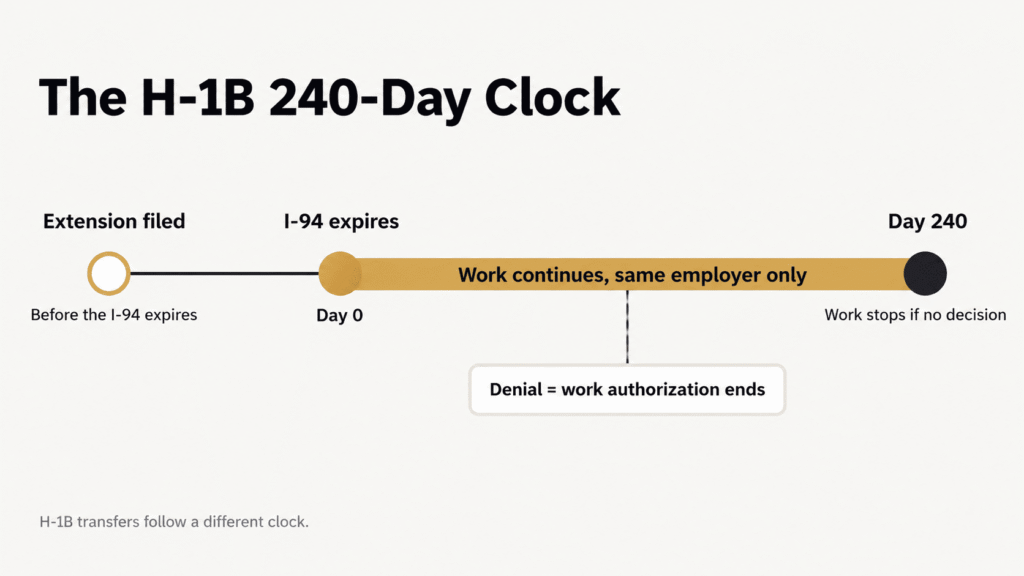
Under 8 CFR 274a.12(b)(20), a worker in H-1B, L-1, O-1, TN, E or several other classifications may keep working for the same employer for up to 240 days after the I-94 expires, if the extension was filed on time. “On time” means USCIS received the petition before that I-94 date.
What Changes on Day 240
The protection ends on day 240 or on notice of a denial, whichever comes first. On day 240, the worker must stop working even if the petition is still pending and nothing is wrong with it. Whether they may remain in the United States after that is a separate question that turns on the filing, so get advice on both before the date arrives.
Why Transfers Run on a Different Clock
An H-1B worker moving to a new employer relies on portability instead. Under the rules DHS finalized in 2016, a worker lawfully admitted in H-1B status who has not worked without authorization may start with the new employer once a non-frivolous petition is filed before the current stay expires, and continue until USCIS decides it.
Count forward from your I-94 date now. If day 240 comes before the posted processing time, the delay is already a status problem.
Is your H-1B extension getting close to day 240?
Our team can review your receipt notice, your I-94 and 240-day dates, and whether a federal filing makes sense before your work authorization runs out.
H-1B Premium Processing: The Clock Ran Out and There Is Still No Decision
Premium processing is usually the first tool employers reach for. For most I-129 classifications, the regulation sets the fee at $2,965 and requires USCIS to act within 15 business days. Three details matter more than the price.
First, only the petitioner can request it, on Form I-907. A worker cannot upgrade their own case.
Second, “act” does not mean “decide.” A request for evidence meets the deadline, and a new window opens only when the response arrives.
Third, if USCIS misses the window, it refunds the fee and keeps processing, with no further deadline. A refund does not add a single day to the 240-day clock. An upgrade works best well before the final weeks, while an RFE can still be answered. The broader mechanics are covered in our guide to premium processing in an I-140 delay.
Status Gap Risk and What You Can Do While the Case Is Pending
A status gap opens when the basis for staying or working runs out before USCIS decides. With an I-129 pending, it usually happens in one of three ways: day 240 arrives, the job ends, or USCIS denies the petition after the I-94 has expired. Each is easier to handle before it happens.
The Proposed End of the 60-Day Grace Period
Today, when employment ends, H-1B, L-1, O-1, E and TN workers and their dependents can generally be treated as maintaining status for up to 60 days, which gives them time to find a new employer or file for another status. On September 11, 2026, DHS proposed removing it entirely. Under the proposal, a worker would be expected to leave once the qualifying employment ends unless another basis allows them to stay. Forbes has reported on laid-off workers who relied on that window to find a new sponsor.
The proposal is not in effect, and comments are open through November 10, 2026. If it is finalized as written, a worker whose extension is already pending would have far less room to move the case to a new employer after a layoff.
Steps to Take Before Day 240
- Put three dates on one calendar: the I-94 expiration, day 240 and, for a cap-subject student, April 1.
- Submit an inquiry once the case qualifies. Form I-129 uses a different trigger than most forms, which our guide to service requests, the Ombudsman and congressional inquiries explains.
- Ask the employer to decide on premium processing early, while there is still time to answer an RFE.
- Keep a record of every inquiry and every consequence: a payroll stop date, a lost project, a spouse’s expiring work permit.
When a Mandamus Lawsuit Fits
A mandamus or APA lawsuit asks a federal court to order USCIS to decide the petition, not to approve it. It fits best when the case is well past the posted time, inquiries have produced nothing, and the harm has a date attached, such as day 240.
Because the government generally has 60 days to respond once a complaint is served, an H-1B petition delay mandamus lawsuit filed in the final weeks before day 240 may come too late to protect the job. Venue matters too; see our guide on where a mandamus lawsuit can be filed.
If Your Employer Won’t Sue: Portability, Grace Periods and Other Options
The employer filed the petition, so the employer is usually the natural plaintiff. Courts differ on whether a worker can sue alone, and our I-140 guide walks through that split. When the employer will not act, the worker’s practical options often matter more.
Moving to a New Employer Through H-1B Portability
A new employer can file a change-of-employer petition, and under portability the worker can start once it is filed. With an unwilling employer, that is often the fastest way out of a stalled extension. The filing has to come before the current authorized stay ends, which is why the grace period matters so much. If the current extension is itself pending, the new petition depends on it.
L-1, O-1 and TN workers generally have no equivalent rule, so a new employer’s petition usually has to be approved first.
What Happens to H-4 Family Members
H-4 family members usually extend on Form I-539, and their status depends on the principal’s case. Premium processing is not available for an H-4 extension. An H-4 spouse with a work permit faces a separate clock: for renewals filed on or after October 30, 2025, DHS no longer extends the old card automatically while the renewal is pending, so the spouse may have to stop working when the card expires.
Frequently Asked Questions
Can I keep working while my H-1B extension is pending?
Yes, for the same employer, if USCIS received the extension before your I-94 expired. The authorization lasts up to 240 days past that date or until a denial, whichever comes first.
Can I travel while my I-129 is pending?
Leaving can cause USCIS to treat a pending change of status as abandoned, and coming back generally requires a valid visa. Plan any trip with counsel.
Can USCIS deny my I-129 after a lawsuit is filed?
Yes. A court can order a decision, and a decision can be a denial. Options such as an appeal or motion on Form I-290B are covered in our guide to what happens when USCIS denies a case after you sue.
How long does a mandamus case over an I-129 usually take?
It depends on the court and the case. The government generally has 60 days to respond to the complaint, and our mandamus lawsuit timeline explains what usually happens in that window.
My petition is approved but my visa is stuck at the consulate. Does this apply?
No. Once the petition is approved, a delay at the consulate is a State Department matter with its own rules. See our guide to security advisory opinion and TAL delays.
An I-129 Delay Is a Calendar Problem
An I-129 delay rarely turns on the strength of the petition. It turns on dates: the I-94 expiration, day 240 and, for students, April 1. The worker feels the delay first, but the employer holds most of the tools.
Ask three questions now: which basis did the employer check, on what date does your protection end, and is the case already past the posted processing time? The answers decide whether the next step is an inquiry, a premium upgrade, a new employer or a lawsuit. If a lawsuit is on the table, our guide to what happens in a mandamus consultation lists the documents worth bringing.
Your case delay is not your fault.
A mandamus or APA lawsuit can be a legal remedy against unreasonable USCIS delay, and with an I-129 the timing matters as much as the facts. Contact our team for a review of your receipt notice, the dates your work authorization depends on, and whether a federal filing is realistic before they pass.
Phone: +1 (862) 799-2200
Legal Disclaimer: This article is provided for general informational purposes only and does not constitute legal advice. Every immigration case has unique circumstances. For legal guidance specific to your situation, we recommend consulting with an experienced immigration attorney. The information in this article reflects laws and policies as of the publication date; subsequent changes may affect its accuracy.
Sources
- USCIS Backlog Grows Even as Agency Gets Fewer Filings, American Immigration Council, September 11, 2026.
- I-129, Petition for a Nonimmigrant Worker, U.S. Citizenship and Immigration Services, form edition dated January 17, 2025, accessed September 29, 2026.
- Handbook for Employers M-274, 7.7 Extensions of Stay for Other Nonimmigrant Categories, U.S. Citizenship and Immigration Services, accessed September 29, 2026.
- 8 CFR 274a.12, Classes of Aliens Authorized to Accept Employment, Electronic Code of Federal Regulations, current as of July 16, 2026.
- 8 CFR 106.4, Premium Processing Service, Electronic Code of Federal Regulations, accessed September 29, 2026.
- Executive Order 14431, Enhancing Program Integrity and Interagency Coordination in the Administration of the H-1B Nonimmigrant Visa Program, The White House, September 18, 2026.
- Modernizing H-1B Requirements, Providing Flexibility in the F-1 Program, and Program Improvements Affecting Other Nonimmigrant Workers, Federal Register, December 18, 2024.
- Retention of EB-1, EB-2, and EB-3 Immigrant Workers and Program Improvements Affecting High-Skilled Nonimmigrant Workers, Federal Register, November 18, 2016.
- Eliminating the Discretionary 60-Day Grace Period, Federal Register, September 11, 2026.
- DHS Proposes Immigration Rule To End 60-Day H-1B Grace Period, Forbes, September 11, 2026.
- Removal of the Automatic Extension of Employment Authorization Documents, Federal Register, October 30, 2025.