
The EB-5 fee increase became final on September 30, 2026, and takes effect on November 30. Any EB-5 petition or application postmarked on or after that date must carry the new fees.
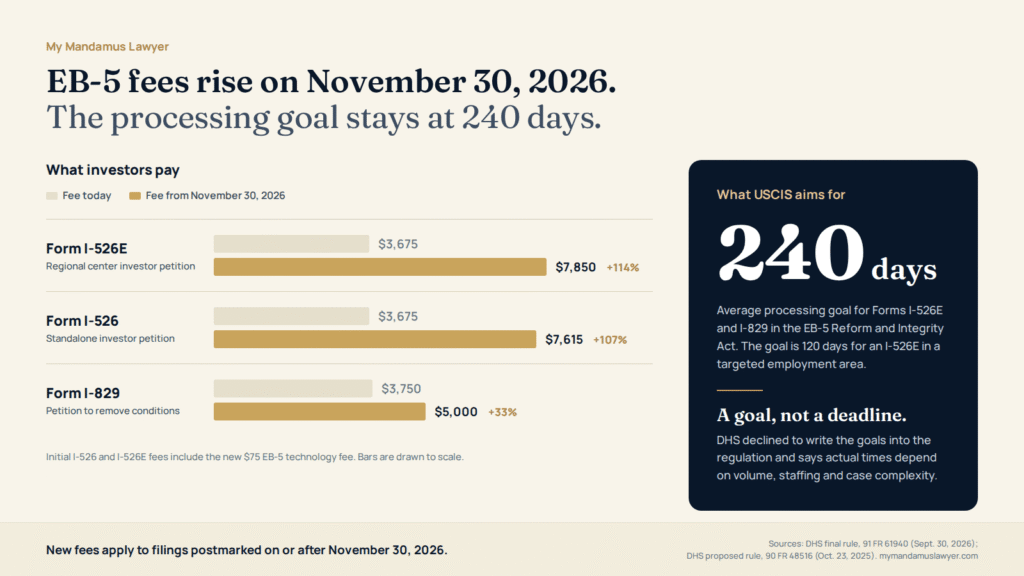
Under the final rule, Form I-526E rises from $3,675 to $7,850 and Form I-829 from $3,750 to $5,000. DHS says the schedule is meant to cover program costs and pursue the processing goals in the EB-5 Reform and Integrity Act of 2022. For a waiting investor, that raises one question: if you pay more, will you wait less?
This guide covers the new fees, who pays them and when, what the rule says about processing times, and what it means if your case is already delayed.
In This Article
What Changed: The New EB-5 Fee Schedule
The final rule replaces today’s fees with a schedule built on the fee study the 2022 law required.
Investor Petitions: I-526, I-526E and I-829
The table compares today’s fees with those for filings postmarked on or after November 30, 2026, as summarized from the rule by EB-5 Updates.
| Form | Fee today | Fee from November 30, 2026 | Change |
|---|---|---|---|
| I-526, standalone investor (initial) | $3,675 | $7,615 | +107% |
| I-526E, regional center investor (initial) | $3,675 | $7,850 | +114% |
| I-526E amendment | $3,675 | $7,775 | +112% |
| I-829, removal of conditions | $3,750 | $5,000 | +33% |
| EB-5 Integrity Fund fee, paid with an I-526E | $1,000 | $1,100 | +10% |
| I-527, amendment to a legacy I-526 | No fee (new form) | $10,330 | New |
Initial I-526 and I-526E fees include a new $75 technology fee.
Regional Center Forms and the New Form I-527
For project sponsors, Form I-956F rises from $17,795 to $42,675, and annual regional center Integrity Fund fees rise 10 percent. The new Form I-527 is for pre-2022 investors who need to amend a petition after their regional center is terminated or their new commercial enterprise is debarred. DHS says it keeps the original priority date.
Why Today’s Fees Are the 2016 Fees
In April 2024, USCIS raised EB-5 fees to $11,160 for Form I-526E and $9,525 for Form I-829. On November 12, 2025, a federal court in Colorado stayed those increases in Moody v. Noem, finding that the 2022 law barred DHS from changing EB-5 fees through its general fee rule. USCIS then returned to its pre-April 2024 fees.
When you budget, compare against today’s fees, not the 2024 figures still circulating online.
Who Pays the New Fees and When
The trigger is the postmark: the rule covers any EB-5 filing postmarked on or after November 30, 2026.
Cases Already Pending
A petition already pending was filed under the fee in effect at the time, and the rule does not reach back. It also does not help investors who paid the 2024 fees: DHS said Moody did not require reimbursement and declined to issue refunds.
If Your I-829 Filing Window Overlaps November 30
Form I-829 must be filed within the 90-day period before the second anniversary of your conditional residence, under 8 CFR Part 216, so it generally cannot be filed early to avoid the new fee. If your window opens before November 30, a complete petition mailed in that gap is charged $3,750. A second anniversary of February 15, 2027, for example, opens the window around November 17, 2026.
Under an August 2026 USCIS policy change, a request filed without all required initial evidence may be denied without a request for evidence. Saving $1,250 is not worth an incomplete I-829.
Family Members Who File Their Own I-829
Spouses and children are usually included on the investor’s I-829. When they are not, each must file separately, and DHS declined to let them combine those petitions. Their deadline is tied to the investor’s window, so the same postmark question applies.
Mark two dates now: the first day of your I-829 window and November 30, 2026.
Will Higher Fees Mean Faster Decisions?
Not automatically. The EB-5 fee increase is tied to goals, and DHS has said goals are not deadlines.
The Processing Goals the Fees Are Built On
Section 106 of the 2022 law ties EB-5 fees to the cost of meeting average processing goals. DHS’s proposed rule lists them as 240 days for Forms I-526E and I-829, 120 days for an I-526E in a targeted employment area, and 180 days for regional center and project applications. It also says the law sets no hard deadline and no consequence, such as a refund, for missing them. In the final rule, DHS declined to write the goals into the regulation, noting that actual times depend on volume, staffing and case complexity.
What the Latest USCIS Data Shows
DHS has called EB-5 backlogs excessive and reported that the I-829 backlog fell from 9,989 at the end of fiscal year 2023 to 7,249 by June 2024. Recent figures are less encouraging: an analysis of USCIS data for April through June 2026 found that I-829 volumes did not meaningfully improve, though the denial rate stayed under 10 percent.
Higher fees can fund capacity. They do not put a date on your case.
Has your EB-5 petition been pending far longer than 240 days?
Our team can review your receipt notice, how far your case has run past the statutory goal, and whether a federal filing makes sense.
If Your EB-5 Case Is Already Delayed
A mandamus or APA lawsuit asks a federal court to order USCIS to decide a petition, not to approve it. Courts test the delay against the six TRAC factors, the second of which asks whether Congress set a timetable. In Mukkavilli v. Jaddou, an I-526 case, the D.C. Circuit counted the absence of a statutory deadline in the government’s favor. Our guide to TRAC factors and unreasonable delay explains the rest of the test.
The fee rule does not make the 240-day goals binding, but DHS now says its fees are set to help meet those goals. That could make a general lack-of-resources explanation harder to defend in a long-pending case, though courts weigh it differently, which is one reason where you file a mandamus lawsuit matters.
Form I-829 also has its own statutory language: 8 U.S.C. § 1186b calls for a determination within 90 days of the filing or interview, whichever is later. For I-526E issues, see our EB-5 I-526E delay lawsuit guide or how we handle EB-5 investor visa delays. The cost of suing is separate from these USCIS fees, as our mandamus lawsuit cost guide explains.
What to Do Before November 30
- Planning an I-526E: budget $7,850 unless a complete petition will be postmarked before November 30.
- Holding a conditional green card: find the second anniversary on your card and count back 90 days.
- Filing a separate I-829 for a spouse or child: confirm its postmark date too.
- Already pending: compare the receipt date with the 240-day goal and submit an inquiry once eligible, as our guide to service requests, the Ombudsman and congressional inquiries explains.
- Pre-2022 investor with a terminated regional center: ask counsel whether Form I-527 applies.
Frequently Asked Questions
Will USCIS refund the higher 2024 EB-5 fees?
No. DHS said the court’s decision did not require reimbursement, and the final rule declines to issue refunds.
Can EB-5 filing fees be waived?
Generally no. DHS treats EB-5 fees as ineligible for waivers or exemptions.
Does the rule change the minimum investment?
No. It changes filing fees only. According to Business Standard, the thresholds stay at $800,000 for targeted employment area and infrastructure projects and $1,050,000 elsewhere.
Will paying more speed up a case that is already pending?
No. The new schedule applies to new filings, and nothing in the rule reorders pending cases.
Will EB-5 fees change again?
Possibly. USCIS reviews its fees every two years, and a separate DHS proposal from July 2, 2026 to implement the rest of the 2022 law is still in development.
Higher Fees, Same Clock
The EB-5 fee increase changes what you pay, not how long you wait. New fees apply to filings postmarked on or after November 30, 2026, the 240-day figures remain goals, and pending petitions are unaffected.
Check three things now: the postmark date of your next filing, the first day of any I-829 window, and how far your pending case has run past 240 days. If a lawsuit is on the table, our guide to what happens in a mandamus consultation lists the documents worth bringing.
Your case delay is not your fault.
A mandamus or APA lawsuit can be a legal remedy against unreasonable USCIS delay, whatever fee you paid. Contact our team to review your receipt notice, how long your petition has been pending, and whether a federal filing makes sense.
Phone: +1 (862) 799-2200
Legal Disclaimer: This article is provided for general informational purposes only and does not constitute legal advice. Every immigration case has unique circumstances. For legal guidance specific to your situation, we recommend consulting with an experienced immigration attorney. The information in this article reflects laws and policies as of the publication date; subsequent changes may affect its accuracy.
Sources
- U.S. Citizenship and Immigration Services Employment-Based Immigrant Visa, Fifth Preference (EB-5) Fee Rule (final rule), Federal Register, September 30, 2026.
- U.S. Citizenship and Immigration Services Employment-Based Immigrant Visa, Fifth Preference (EB-5) Fee Rule (proposed rule), Federal Register, October 23, 2025.
- 8 CFR Part 216, Conditional Basis of Lawful Permanent Residence Status, Electronic Code of Federal Regulations, accessed October 1, 2026.
- 8 U.S.C. § 1186b, Conditional Permanent Resident Status for Certain Alien Entrepreneurs, Spouses, and Children, Cornell Legal Information Institute, accessed October 1, 2026.
- Mukkavilli v. Jaddou, No. 23-5138, U.S. Court of Appeals for the District of Columbia Circuit, March 22, 2024.
- USCIS to Reduce Frivolous Immigration Benefits Requests by Reinforcing Evidence Standards, U.S. Citizenship and Immigration Services, August 8, 2026.
- Immigration and Citizenship Data, U.S. Citizenship and Immigration Services, accessed October 1, 2026.
- EB-5 Filing Fee Change Nov. 30, EB-5 Updates, September 29, 2026.
- Sluggish Volumes and Rising Denial Rates Continue in FY2026 Q3 Processing Data, EB-5 Updates, September 9, 2026.
- US EB-5 Fees Jump 114%: What the New Rules Mean for Indian Investors, Business Standard, September 30, 2026.