
If your I-829 has been pending for years, a federal lawsuit can push USCIS to decide it. Before you file one, make sure you want that decision now.
A properly filed I-829 keeps your conditional residence in place, and the receipt notice extends an expired green card for 48 months. When that cushion starts to run out, an I-829 delay mandamus lawsuit can put a stalled case back in front of an officer. That officer will decide on the record as it stands: the jobs the project created, your regional center’s standing and the evidence in your petition. If your conditional green card came through marriage, the form is I-751, which our I-751 delay guide covers.
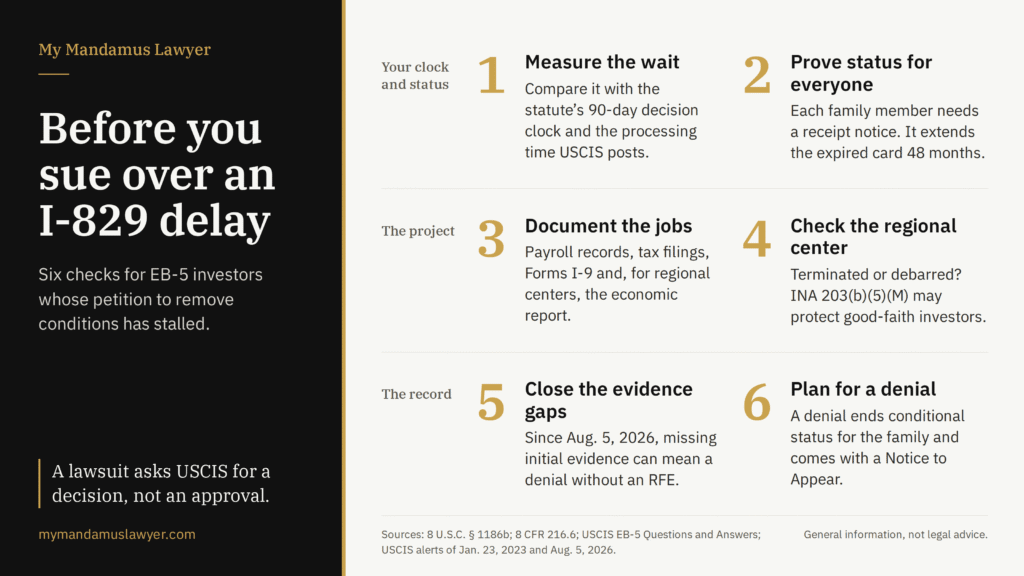
Below are six checks to make before you sue, and how to tell when a lawsuit makes sense.
In This Article
Your Clock and Your Status While the I-829 Is Pending
The first two checks are about time: how long you have really waited, and whether your family can prove status while you wait.
1. Is Your Case Past a Meaningful Benchmark?
Before an I-829 delay mandamus lawsuit, measure the wait against three yardsticks. The first is the statute. Under 8 U.S.C. § 1186b, USCIS is to decide an I-829 within 90 days of the filing or the interview, whichever is later, and 8 CFR 216.6 repeats that clock. The second is the processing time USCIS posts for Form I-829 at the Immigrant Investor Program Office, together with the date after which it accepts a case inquiry.
The third is the agency’s actual pace. From April through June 2026, USCIS received 1,944 I-829 petitions, completed 845 and saw pending inventory rise to 8,244, according to an analysis of USCIS data. The median completed case took 12.8 months. A median describes decided cases, not the ones still waiting. If your I-829 has been pending three or four years, it is not moving with the queue.
DHS has also tied its new EB-5 fees to a 240-day goal for the I-829, though a goal is not a deadline, as our EB-5 fee guide explains. Keep a dated record of every inquiry; our guide to service requests, the Ombudsman and congressional inquiries covers the options.
2. Does Every Family Member Have Proof of Status?
A properly filed I-829 extends conditional resident status automatically until USCIS decides it. Since January 2023, the I-829 receipt notice extension has covered 48 months beyond the date on the card, and the two documents together show that you may work and travel.
Check each person separately. Your spouse and children may be included in your petition, and a child who turned 21 or married during conditional residence may be included or file alone. Confirm that everyone has a receipt notice and note when each 48-month window ends. USCIS continues to provide proof of status until the petition is decided, so request it early when a window is about to close.
The Project Behind Your EB-5 Petition
Checks three and four look past your own paperwork to the business your capital went into, because an EB-5 conditions removal delay often traces back to the project.
3. Were the Jobs Created, and Can You Show It?
USCIS removes conditions only if you invested the required capital, kept it invested as the rules require, and created, or can be expected to create within a reasonable time, 10 full-time jobs. The regulation names the proof it expects: payroll records, tax documents and Forms I-9. Regional center investors usually also rely on an economic report for indirect jobs.
Which rules apply depends on when your I-526 or I-526E was filed. Investors who filed before March 15, 2022 must have sustained the investment through the two-year conditional period. For later investors, capital must remain invested for at least two years, and those still creating jobs may receive a discretionary one-year extension, USCIS explains. For these post-2022 cases, the statute also requires a site visit before conditions are removed. Ask the regional center now for its latest job-creation report.
4. Is Your Regional Center Still in Good Standing?
USCIS publishes lists of approved and terminated regional centers, so look yours up. If it has been terminated, or if your new commercial enterprise or job-creating entity has been debarred, the 2022 law offers some protection. Under INA 203(b)(5)(M), a good-faith investor may still be able to show eligibility at the I-829 stage.
The details cut both ways. Pre-2022 investors may stay eligible if the project was completed with enough jobs and their capital was sustained, and USCIS generally does not treat a termination for administrative reasons, such as an unpaid Integrity Fund fee, as a material change. But a project failure on its own does not trigger these protections, and an investor who knowingly took part in the misconduct cannot use them. If you have received a termination or debarment notice, settle that question before you ask a court for a decision.
The Record USCIS Will Decide On
The last two checks assume the lawsuit works and an officer opens your file. What happens next depends on what is in it.
5. Would Your File Hold Up Without an RFE?
On August 5, 2026, USCIS told officers they may deny a request without first issuing a Request for Evidence or a Notice of Intent to Deny when required initial evidence is missing or the filing does not establish eligibility. The policy applies to cases already pending. If an RFE does come and you answer only part of it, USCIS may decide on what you sent.
An I-829 filed years ago can look thin by today’s standards. Review it with counsel for gaps in the investment, sustainment and job evidence, and confirm USCIS has a current address for everyone on the petition. A missed biometrics appointment can lead to a denial for abandonment. Our guide to the evidence needed before filing a mandamus lawsuit covers what the court filing itself requires.
6. Are You Prepared If the Answer Is a Denial?
An I-829 denial cannot be appealed within USCIS. The agency issues a written decision and a Notice to Appear, and the status of the investor, spouse and children ends on the date of the decision. You can contest the denial only in removal proceedings, where USCIS must show by a preponderance of the evidence that the petition was properly denied.
So plan for the bad outcome before an I-829 delay mandamus lawsuit pushes for a fast one. Know where each family member will be when a decision is likely, because a denial issued while someone is abroad can complicate their return. Line up counsel who handles immigration court, and ask whether another green card path could serve as a fallback.
Not sure how your file scores on these six checks?
Before you file an I-829 delay mandamus lawsuit, our team can review your receipt notices, the project’s job-creation record and your regional center’s standing.
When the Checks Point Toward an I-829 Delay Mandamus Lawsuit
If your file clears all six checks, the length of the wait becomes the main question, and that is where an I-829 delay mandamus lawsuit fits. The suit, usually paired with an Administrative Procedure Act claim, asks a federal court to order USCIS to decide. Courts weigh the delay under the six TRAC factors, explained in our guide to TRAC factors and unreasonable delay.
Why the 90-Day Clock Matters in Court
The second TRAC factor asks whether Congress set a timetable or otherwise signaled how fast it expected the agency to act. For many immigration forms, it did not. For the I-829 it did: § 1186b sets the 90-day decision clock and a 90-day window for the interview. The statute does not say what happens when DHS misses either, and no single factor decides a case. What the clock gives a judge in an I-829 delay mandamus case is a congressional benchmark, and against it a four-year wait looks very different.
Courts have also rejected the argument that the pace of EB-5 decisions is beyond review. In July 2026, a federal court in Northern California joined other district courts in holding that USCIS has a mandatory duty to decide EB-5 investor petitions within a reasonable time. Results still vary by court, which is why where you file a mandamus lawsuit matters.
What a Lawsuit Can and Cannot Do
An I-829 delay mandamus lawsuit can put a deadline on a case that has none in practice, and many cases resolve when USCIS acts before the court rules. In one of our client results, a Washington investor’s I-829 had been pending for more than three years, and conditions were removed within eight weeks of filing. Past results do not guarantee future outcomes.
A lawsuit cannot approve your petition, fix a job shortfall or stop a Notice to Appear if the answer is a denial. It asks for a decision, not an approval.
Frequently Asked Questions
Can I sue if my I-829 is still within USCIS processing times?
Possibly. The posted time is USCIS’s own measure, not a legal threshold, and courts weigh all TRAC factors, including the statute’s 90-day clock. A shorter wait is harder to win, so review your timeline first.
Will suing USCIS hurt my I-829?
An I-829 delay mandamus lawsuit does not change the standards your petition must meet. It changes the timing: a decision may come sooner, on the record as it stands.
Can I apply for citizenship while my I-829 is pending?
You can file once you are otherwise eligible, but under the USCIS Policy Manual, conditional residents generally cannot naturalize until their conditions are removed. The option to decide a pending petition during the naturalization interview applies to the marriage-based I-751, not the I-829.
Can I travel while my I-829 is pending?
Yes. Once the petition is properly filed, you may travel and return with your expired card and the receipt notice during the 48-month extension. For absences of a year or more, file Form I-131 for a reentry permit first, and weigh check six before a long trip.
How long does an I-829 delay mandamus case take?
Federal rules generally give the government 60 days after service to respond. Timing still varies by court and by file.
Does a lawsuit guarantee my conditions will be removed?
No. The court can order USCIS to decide, not how to decide. Approval still depends on your investment, the jobs and the rest of the record.
Check the Record, Then Push the Clock
The six checks come down to one question: if USCIS decided your I-829 tomorrow, would the record support approval? If it would, a multi-year wait is a problem a federal court can address. If it would not, fix the record first.
Gather four things now: a receipt notice for each family member, the latest job-creation report, any notice about your regional center, and a dated log of your inquiries.
Your case delay is not your fault.
A mandamus lawsuit can be a legal remedy against an unreasonable I-829 delay. Contact our team to review your receipt notices, the project’s job-creation record, and whether a federal filing makes sense now.
Phone: +1 (862) 799-2200
Legal Disclaimer: This article is provided for general informational purposes only and does not constitute legal advice. Every immigration case has unique circumstances. For legal guidance specific to your situation, we recommend consulting with an experienced immigration attorney. The information in this article reflects laws and policies as of the publication date; subsequent changes may affect its accuracy.
Sources
- 8 U.S.C. § 1186b, Conditional Permanent Resident Status for Certain Alien Entrepreneurs, Spouses, and Children, Cornell Legal Information Institute, accessed October 6, 2026.
- 8 CFR Part 216, Conditional Basis of Lawful Permanent Residence Status, Electronic Code of Federal Regulations, accessed October 6, 2026.
- USCIS Extends Green Card Validity for Conditional Permanent Residents with a Pending Form I-751 or Form I-829, U.S. Citizenship and Immigration Services, January 23, 2023.
- Policy Alert: Documentation of Conditional Permanent Resident Status for Immigrant Investors with a Pending Form I-829, U.S. Citizenship and Immigration Services, May 2, 2018.
- EB-5 Questions and Answers, U.S. Citizenship and Immigration Services, accessed October 6, 2026.
- USCIS to Reduce Frivolous Immigration Benefits Requests by Reinforcing Evidence Standards, U.S. Citizenship and Immigration Services, August 5, 2026.
- USCIS Policy Manual, Volume 12, Part D, Chapter 2: Lawful Permanent Resident Admission for Naturalization, U.S. Citizenship and Immigration Services, accessed October 6, 2026.
- FY2026 Q3 EB-5 Data Analysis: Pending I-526E Petitions Exceed 11,000 as Rural Filings Continue to Dominate the EB-5 Market, EB5AN, September 22, 2026.
- Dinh v. Edlow, No. 26-cv-02697-TSH, Order Denying Motion to Dismiss, U.S. District Court for the Northern District of California, July 10, 2026.
- Federal Rules of Civil Procedure, Rule 12, Cornell Legal Information Institute, accessed October 6, 2026.