The interview is over. Instead of a visa, you have a 221(g) notice or an email asking for fifteen years of your life: every trip abroad, every address, every job. The form is DS-5535, and how carefully you complete it affects whether the consulate can read your answers once or has to come back with questions.
Form DS-5535, Supplemental Questions for Visa Applicants, is a State Department questionnaire that a consular officer can require after a visa interview. It asks for up to 15 years of travel, address and employment history, prior passports and certain relatives, and it adds to your DS-160 or DS-260 instead of replacing it.
This guide takes the DS-5535 form section by section, shows how to handle dates you cannot remember, lists five common mistakes and tells you what to keep after you send it.
In This Article
- What Form DS-5535 Asks For and How It Reaches You
- Before You Start: Records to Gather
- How to Fill Out DS-5535, Section by Section
- DS-5535 Travel History: Handling Gaps and Estimates
- Five Common DS-5535 Mistakes and How to Avoid Them
- After You Submit: What to Keep and What to Expect
- Frequently Asked Questions
- Answer Once, Completely, and Keep the Copy
What Form DS-5535 Asks For and How It Reaches You
Form DS-5535 carries OMB control number 1405-0226. Consular officers may require it when the application alone is not enough to decide eligibility (22 C.F.R. §41.103 and §42.63). The State Department’s April 2024 Federal Register notice estimates about 50,000 respondents a year, at roughly 55 minutes each.
The version described in the Department’s 2023 notice covers five areas:
- Travel during the last 15 years.
- Siblings, children, former spouses and domestic partners not already listed in your visa application.
- Addresses during the last 15 years, if different from your current address.
- Prior passport numbers.
- Occupations and employers during the last 15 years, with a brief description.
The request usually arrives with your 221(g) slip or by email soon after the interview. You may be asked to answer by email, on paper, orally or through an electronic Microsoft version of the form, and some posts print a link or QR code on the refusal letter.
The rule that saves the most time. Apart from your name, date of birth and visa classification, the form asks only for information that is not already in your current DS-160 or DS-260. You are filling gaps in an existing record, not writing a second one.
What the request means for your case, and how long the review can run, is covered in our guide to DS-5535 administrative processing delay.
Before You Start: Records to Gather
Most DS-5535 problems are not wrong answers but answers that disagree with the first application or your own documents. Gather these first.
| Record | Where to find it | Section it supports |
|---|---|---|
| A full copy of your DS-160 or DS-260 | Your saved printout or PDF, or the person who prepared it. | Every section, so you add only what is new. |
| Current and expired passports | Your files, or the issuing authority for a lost one. | Passports and travel. |
| Travel proof | E-tickets, boarding passes, e-visas and booking emails. | Travel history. |
| Housing records | Leases, utility bills, residence registration. | Address history. |
| Work records | Your CV, employer letters, tax or social insurance records. | Employment history. |
| Civil records | Birth, marriage and divorce records. | Relatives. |
Keep the DS-160 or DS-260 copy open while you work. If a new date differs from the old one, confirm which is right before you continue.
How to Fill Out DS-5535, Section by Section
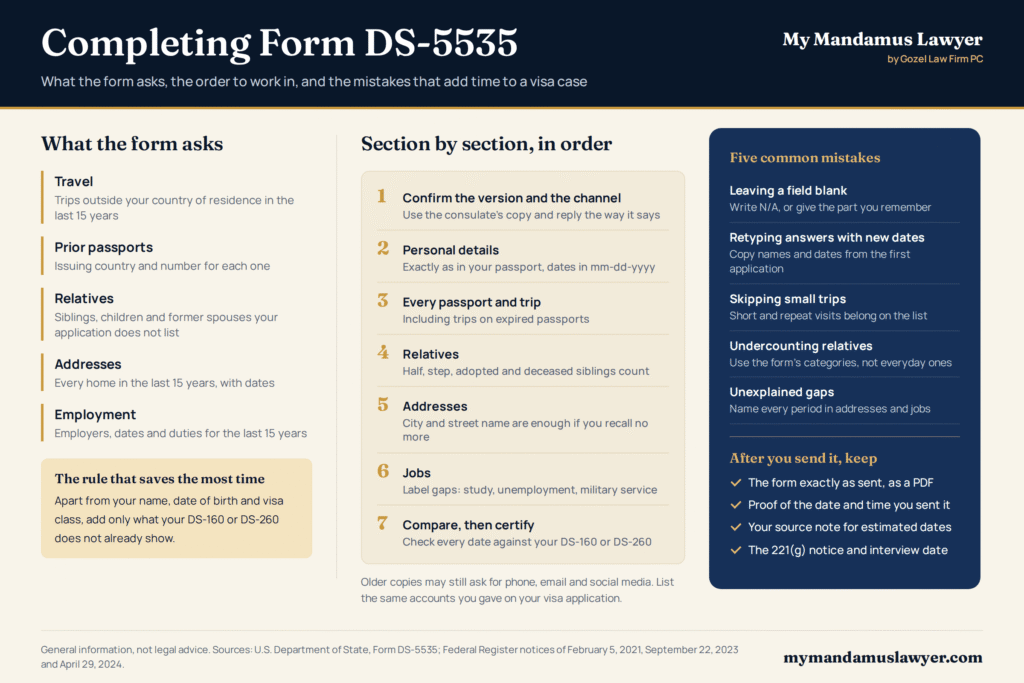
Work through the form in order. Each step ends with the slip seen most often at that stage.
- Confirm the version and the channel. Use the copy or link the consulate sent you, not one found online, and reply by the method your notice names. If your copy still has phone, email or social media fields, list the same accounts you gave on your visa application. Common slip: sending the form to a general embassy inbox instead of the address in the notice.
- Personal information. Enter your names, date of birth and visa classification exactly as in your passport and application, using the mm-dd-yyyy format. Common slip: switching to day-month-year partway through.
- Passports and travel. List every passport you have held other than the one in your application, with the issuing country and number. Then list trips outside your country of residence in the last 15 years, with places, dates, length of stay and, if asked, source of funds. Common slip: forgetting trips taken on an expired passport.
- Relatives. Siblings include full, half, step and adopted, living or deceased. Children include minor and adult, natural, step and adopted. Spouses include current and former spouses and civil or domestic partners. List only those your application does not already show. Common slip: leaving out a half-sibling or a sibling who has died.
- Address history. Give every address from the last 15 years that is not already in your application, with dates of residence. If you cannot recall a street number, the form accepts the city, state or province and street name. Common slip: dropping the months between two leases.
- Employment history. For each job in the last 15 years, give the employer, dates, address, phone number, job title and a short description of duties. Include self-employment, and label gaps for what they were: study, unemployment or military service. Common slip: a job title that does not match your CV or employer letter.
- Review, certify and submit. Compare the form with your DS-160 or DS-260 once more, then certify it. You certify under penalty of perjury, and a willfully false or misleading statement can lead to a visa refusal. Common slip: sending before checking dates across sections.
DS-5535 Travel History: Handling Gaps and Estimates
Almost nobody can recall fifteen years of trips, and the form does not expect it. Its instructions ask for answers to the best of your knowledge. In a 2021 Federal Register notice, the State Department said that missing information does not necessarily lead to a denial when the officer finds a credible explanation for why a question cannot be answered.
Rebuild the list from records rather than memory:
- Entry and exit stamps in current and expired passports.
- Airline account histories and booking emails.
- E-visa and travel authorization approvals.
- An official entry and exit record from your own government, where one is available.
When an exact date is lost, give the month and year and mark it approximate, for example “approx. 06-2014.” Keep a one-page note of where each date came from, so any later answer comes from the same source.
The form asks about travel outside your country of residence. Under the 2023 notice, an officer can also ask about travel inside your own country in specific situations, such as time in an area controlled by a terrorist organization. Answer that only if asked.
Five Common DS-5535 Mistakes and How to Avoid Them
These five come up again and again because each one breaks an instruction printed on the form itself.
| Mistake | Why it causes trouble | How to avoid it |
|---|---|---|
| 1. Leaving a field blank | The officer cannot tell “none” from “skipped.” | Write N/A where a question does not apply, and give a partial answer when you remember only part. |
| 2. Retyping application answers with new dates or spellings | Two versions of one fact create a question someone has to resolve. | Add only what is new, and copy names and dates exactly from the first application. |
| 3. Skipping trips that seem too small | Gaps show up against passport stamps and travel records. | Include short visits, repeat visits to the same country and trips taken on old passports. |
| 4. Undercounting relatives | The form’s definitions are broader than everyday use. | Follow its categories: half, step, adopted and deceased siblings, adult children, former spouses. |
| 5. Unexplained gaps in addresses or jobs | A missing year reads as missing information. | Label every period, including study, unemployment, caregiving and military service. |
None of these is fatal on its own: the form says an unanswered question will not necessarily prevent a visa. It also warns that missing information may delay or prevent processing, which is the delay you are trying to avoid.
After You Submit: What to Keep and What to Expect
Before you close the email or online form, build a submission record. It takes ten minutes and is the file you will need if the case stalls:
- The form exactly as sent, saved as a PDF.
- The sent email, or a screenshot of the online confirmation, showing the date and time.
- A note of which version of the form you answered.
- Your one-page source note for estimated dates.
- The 221(g) notice and your interview date.
After that, the timing belongs to the consulate. The State Department says the length of administrative processing depends on each case, and that an officer can reconsider a 221(g) refusal once processing ends or new information arrives. During that time your CEAC status will usually show Refused. The State Department adopted that display in 2020, and the status can change once the open issues are resolved.
Requests for information generally carry a one-year window; our guide to the 221(g) one-year deadline explains which clock applies to your file. If your work is in a technical field, the case may also be in a security advisory opinion review.
Sent DS-5535 and heard nothing since?
Tell us when you were interviewed, when you submitted DS-5535 and what CEAC shows today. We will look at the timeline and tell you whether a federal delay case is realistic at this stage.
Frequently Asked Questions
How many years of travel history does DS-5535 ask for?
Fifteen years of trips outside your country of residence. The same 15-year window applies to addresses and employment.
What if I cannot remember exact dates?
Give the month and year, mark it approximate and note the record you used. A credible explanation can be enough when a question truly cannot be answered.
Does DS-5535 still ask for social media accounts?
The current version does not. In its 2021 revision, the State Department removed the social media, phone and email fields and moved them to the main visa application. If your consulate sends an older copy that still has them, list the same accounts you gave on your DS-160 or DS-260.
How do I submit DS-5535?
Use the method your notice names: a reply email, an online form or paper. If the notice is unclear, ask the post through its visa inquiry channel instead of guessing.
Does completing DS-5535 mean my visa will be approved?
No. It gives the officer what is needed to finish the review, and the decision after administrative processing can go either way.
Answer Once, and Keep the Copy
DS-5535 rewards preparation more than speed. Work from your DS-160 or DS-260, add only what is new, label every gap and estimate, and save exactly what you sent. That gives the consulate one clean record to review, and it gives you a dated file if the review runs longer than it should.
Still Waiting After DS-5535?
Your case delay isn’t your fault. A mandamus lawsuit is a legal remedy against unreasonable government delays, including consular cases that stay in administrative processing long after every request has been answered. Contact us for a free case evaluation. Keep the 221(g) notice, a copy of the DS-5535 you sent and a CEAC screenshot at hand for the first review.
Phone: +1 (862) 799-2200
Legal Disclaimer: This article is provided for general informational purposes only and does not constitute legal advice. Every immigration case has unique circumstances. For legal guidance specific to your situation, we recommend consulting with an experienced immigration attorney. The information in this article reflects laws and policies as of the publication date; subsequent changes may affect its accuracy.
Sources
- Form DS-5535, Supplemental Questions for Visa Applicants (text published with the 2020 revision notice), U.S. Department of State, via AILA Doc. No. 20102133, posted October 26, 2020.
- 30-Day Notice of Proposed Information Collection: Supplemental Questions for Visa Applicants (Public Notice 12368), Federal Register, April 29, 2024.
- 60-Day Notice of Proposed Information Collection: Supplemental Questions for Visa Applicants (Public Notice 12166), Federal Register, September 22, 2023.
- 30 Day Notice of Proposed Information Collection: Supplemental Questions for Visa Applicants (Public Notice 11335), 86 FR 8475, Federal Register, February 5, 2021.
- Administrative Processing Information, U.S. Department of State, accessed October 26, 2026.
- Visas: CEAC Case Status Change, U.S. Department of State, March 5, 2020.
- 22 C.F.R. §41.103 and §42.63, Cornell Legal Information Institute.