
The embassy’s email says your immigrant visa interview is canceled and a new date will follow. Weeks later, no date has come. You are not alone: the 2026 immigrant visa interview pause, which began in late August, has postponed interviews at U.S. embassies and consulates around the world while consular officers train on new public charge screening.
This guide is for applicants and U.S. petitioners whose interview had a date and then lost it during the pause. If your case became documentarily qualified but never received an interview date, read NVC interview scheduling delays after DQ instead. If a consular officer refused your visa under the 75-country policy, see what to do after a 75-country pause refusal.
Below: what the pause is, how to check whether your post has resumed, what your notice means, which documents can expire while you wait, and when the delay may support a federal lawsuit.
In This Article
- What Is the 2026 Immigrant Visa Interview Pause?
- Has Your Embassy Resumed Interviews?
- Canceled, Rescheduled or Back in the Queue?
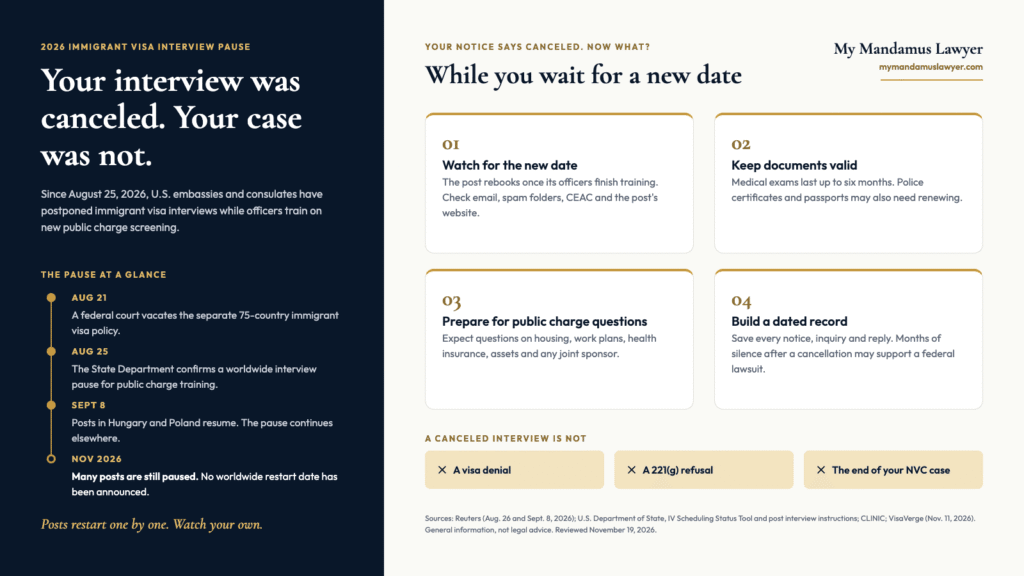
- What to Do While You Wait for a New Date
- Preparing for the New Public Charge Questions
- Documents That May Expire Before Your New Date
- When Does a Canceled Interview Become an Unreasonable Delay?
- Frequently Asked Questions
What Is the 2026 Immigrant Visa Interview Pause?
On August 25, 2026, a State Department spokesperson confirmed that appointments for visa services were being adjusted so consular officers could complete a global training initiative (Reuters). The training centers on the public charge ground of inadmissibility, the rule that lets an officer refuse an immigrant visa to someone likely to depend on public benefits (8 U.S.C. § 1182(a)(4)). Applicants with interviews on the calendar began receiving emails that their appointments were canceled and would be rescheduled later.
Three points define the pause:
- It covers immigrant visas. Visitor, student and temporary work visas were not part of it.
- It is not tied to nationality. It began four days after a federal court vacated the separate 75-country policy, which the State Department confirmed was no longer in effect as of August 21, 2026.
- It has no published end date. The department has issued no formal notice, regulation or timetable for the pause.
A Canceled Interview Is Not a Refusal
An interview that never took place produces no visa decision. You were not refused under section 221(g), and the cancellation does not by itself change your approved petition or your documentarily qualified status. The case waits with NVC and the post until a new date is set.
Has Your Embassy Resumed Interviews?
Posts do not restart together. Each embassy or consulate resumes once its officers complete the training. On September 8, Reuters reported that posts in Hungary and Poland had resumed immigrant visa processing while the pause continued elsewhere. As of early November, interviews remained paused at many posts and no broad restart date had been announced (VisaVerge).
To check your own post:
- Your inbox and CEAC account. Rebooking notices usually arrive by email. Check spam folders and every address you gave NVC.
- The post’s website and official social media. Posts often announce scheduling changes there.
- The IV Scheduling Status Tool. It shows which documentarily complete month NVC is scheduling at each post. It updates monthly, so it can lag behind a restart.
- The NVC Public Inquiry Form. The post tells NVC which dates it is holding, and NVC fills them first in, first out. If your post schedules its own interviews, contact the post directly.
Some cases are also moved to a regional processing post. If yours was, see how interviews rescheduled to another post work.
Canceled, Rescheduled or Back in the Queue?
Notices use different words, and the words decide your next step.
| What your notice or account shows | What it usually means | Your next step |
|---|---|---|
| Appointment canceled, new date to follow | A pause-related cancellation. The post will rebook after training | Watch for the new date and keep documents current |
| Interview rescheduled to a new date | The post has a slot for you again | Confirm the date and check your medical exam and police certificates |
| No interview date after a cancellation | The case is waiting to be rebooked | Ask the post or NVC whether it is in line, and keep the reply |
| Interview held, then a 221(g) refusal | A decision on a pending issue, not a cancellation | 221(g) administrative processing |
| Refusal citing the 75-country policy | A refusal the court set aside for reconsideration | 75-country refusal steps |
A cancellation stops the clock you can see. It does not end the case. What happens next depends on your post and on the record you build.
Was your immigrant visa interview canceled in the pause?
Our team can review your cancellation notice, your NVC case number and DQ date, and your CEAC history, and tell you whether to wait, escalate or file in federal court.
What to Do While You Wait for a New Date
During the pause, the post sets the new date. Asking for a specific day rarely helps before your post resumes, but these steps do:
- Keep your contact details current in CEAC and with NVC. A rebooking email you never see delays the case again.
- Hold off on travel and job changes. Do not buy non-refundable tickets or give notice at work until the post confirms a date.
- Use the right channel. NVC answers through the Public Inquiry Form, and replies come from TSGSystem@tsg.state.gov. Send a follow-up only after the posted response time passes.
- Request an expedite only with proof. According to CLINIC, the request goes to NVC when no interview is scheduled and to the post when you want an earlier date. A documented medical emergency is the clearest ground, and the post decides.
A short, factual inquiry works best:
NVC case number: [number]. Applicant: [full name, date of birth]. Our immigrant visa interview at [post] on [original date] was canceled on [notice date], with a new date to follow. We remain documentarily qualified and ready to attend. Please confirm whether the case is in line for rescheduling and whether you need anything from us.
Keep a copy of every message and reply. Those dates become your evidence if the wait turns unreasonable.
Preparing for the New Public Charge Questions
When your interview comes back, expect closer questions about money. CLINIC reports that the State Department is screening for public charge through written questionnaires, and that a September 10 cable (26 STATE 88862) told officers to complete the new training and applicants to fill out a special public charge worksheet the department has not published.
Some posts have shared an Immigrant Visa Interview Preparation Addendum with sample questions. Its topics include housing, employment plans, health insurance, household members, income, assets and debts, past public benefits and, in family cases, joint sponsors. The questions are examples, not a list of required documents.
To prepare:
- Reread the sponsor’s Form I-864 Affidavit of Support and confirm the figures still hold.
- Have a plan for health insurance on arrival, and proof of any job offer.
- Gather records of savings, property and other assets.
The new DHS public charge rule governs green card applications filed with USCIS, not consular decisions. If you are adjusting status inside the United States, read our guide to the September 2026 public charge rule for I-485 applicants.
Documents That May Expire Before Your New Date
A long pause can push your interview past the life of documents you gathered for the original date. Your post’s instructions control, but these rules are common:
| Document | Common rule | What to do |
|---|---|---|
| Medical exam | Valid for up to six months, and the visa cannot outlast it | Ask the panel physician whether you need a new exam before the new date |
| Police certificate | A newer one is needed if you are over 16, got it more than a year ago and still live in that country | Request a new certificate early, since some countries take weeks |
| Passport | Valid for at least six months after your planned U.S. entry | Renew now if it will run short |
| Sponsor’s tax evidence | Form I-864 asks for the most recent tax year’s return | Bring the newest return if a filing season passes |
The rules above come from State Department post instructions. If a child in the case is close to 21, act now: the State Department says NVC may be able to expedite when a visa is available before the child’s birthday.
When Does a Canceled Interview Become an Unreasonable Delay?
A federal court cannot order the State Department to issue a visa. In some cases it can order the agency to act on a case it has unreasonably delayed. These suits pair the Mandamus Act, 28 U.S.C. § 1361, with the Administrative Procedure Act, which requires agencies to conclude matters within a reasonable time (5 U.S.C. § 555(b)) and lets courts compel action unreasonably delayed (5 U.S.C. § 706(1)). Our NVC delay lawsuit guide covers the consular side in detail.
How the Pause Has Reached Court
In CLINIC v. Rubio, the case that struck down the 75-country policy, the plaintiffs told the court that immigrant visa interview appointments had been canceled globally through September. On September 24, 2026, Judge Jeannette Vargas found that this raised some doubt about compliance and ordered the parties to show cause why an injunction setting a date to finish the remanded applications should not issue (order). That case concerns refusals under the 75-country policy. It does not set a deadline for every canceled interview.
What a Court Will Weigh
Courts apply the six factors from Telecommunications Research & Action Center v. FCC, explained in our guide to the TRAC factors. No number of months qualifies automatically. In a cancellation case:
- What helps: the agency already treated your case as ready by giving it a date; months have passed since the cancellation; family separation or lost work is documented; your inquiries are on record.
- What hurts: a short wait since the cancellation; a post that has announced its restart; anything still owed on your side; and the concern that an order would only move you ahead of others waiting at the same post.
Two threshold questions come first. Consular nonreviewability limits court review of visa refusals, though a claim that no decision has been made raises a different question. And where you file can change the analysis.
Frequently Asked Questions
Is the immigrant visa interview pause over?
Not everywhere. Posts in Hungary and Poland resumed in September, but many others had not as of early November 2026. Watch your post’s notices and the IV Scheduling Status Tool.
Does a canceled interview mean my visa was denied?
No. A cancellation is not a decision. A refusal follows an interview and comes with a written notice.
Do I have to pay the visa fee again?
The immigrant visa fee is charged per applicant before the interview, and the State Department has not announced a new fee for rebooked interviews. Confirm with your post or NVC before paying anything twice.
Can I ask for an earlier interview date?
You can request an expedite from the post, but it needs proof of urgent need, such as a documented medical emergency, and the post decides.
Will my medical exam expire if the interview moves?
It may. Medical exams are generally valid for up to six months, so ask the panel physician before your new date.
Can I sue if the embassy keeps postponing my interview?
Possibly, once the wait since the cancellation is unreasonable under the TRAC factors and nothing is owed on your side. A court can order the agency to act, not to approve.
A Canceled Date Is Not a Closed Case
The 2026 pause stopped interviews, not cases. Your petition, your NVC file and your documentarily qualified status survive a cancellation. What you lose is time, and sometimes the life of your medical exam or police certificate.
Watch your post’s notices, keep documents current, prepare for the public charge questions and keep a dated record of every contact. When months pass after the cancellation and nothing is owed on your side, a federal court is the place that can require the government to act.
Your case delay is not your fault.
A mandamus lawsuit can be a legal remedy against an unreasonable delay in scheduling your immigrant visa interview. Contact our team to review your cancellation notice, your NVC case number and DQ date, your CEAC history, and whether your district is a good place to file. More on how our mandamus process works.
Phone: +1 (862) 799-2200
WhatsApp: WhatsApp
Legal Disclaimer: This article is provided for general informational purposes only and does not constitute legal advice. Every immigration case has unique circumstances. For legal guidance specific to your situation, we recommend consulting with an experienced immigration attorney. The information in this article reflects laws and policies as of the publication date; subsequent changes may affect its accuracy. Federal statutes, State Department guidance and court filings were reviewed as of November 19, 2026. Prior results do not guarantee a similar outcome.
Sources
- Trump administration issues pause on visa appointments for applicants worldwide, Reuters, August 26, 2026.
- US resumes immigrant visa processing for Hungary, Poland as pause remains elsewhere, Reuters, September 8, 2026.
- Immigrant Visa Interviews Remain Paused at Many U.S. Posts as Some Issue New Guidance, VisaVerge, November 11, 2026.
- New State Department Public Charge Questions: How to Prepare Immigrant Visa Applicants, Catholic Legal Immigration Network (CLINIC), accessed November 19, 2026.
- Catholic Legal Immigration Network, Inc. v. Rubio, No. 26-cv-00858 (S.D.N.Y.), Order to Show Cause, ECF No. 108, September 24, 2026.
- Immigrant Visa Processing Updates for Nationalities at High Risk of Public Benefits Usage, U.S. Department of State, updated August 28, 2026.
- IV Scheduling Status Tool, U.S. Department of State, accessed November 19, 2026.
- Immigrant Visa Interview Instructions, U.S. Embassy Dushanbe, U.S. Department of State, accessed November 19, 2026.
- When and How To Expedite a Case, Catholic Legal Immigration Network (CLINIC), accessed November 19, 2026.
- Telecommunications Research & Action Center v. FCC, 750 F.2d 70, U.S. Court of Appeals for the D.C. Circuit, 1984.