
Your N-400 was approved. You are not a citizen yet. If your N-400 is approved but no oath ceremony has been scheduled, you are in the last and least explained stage of naturalization, and in 2026 more people are waiting in it.
Citizenship begins on the day you take the Oath of Allegiance, 8 C.F.R. § 337.9 says, not on the day of approval. Until then you remain a permanent resident. The wait has also grown: USCIS approved about 22,000 naturalization applications a month in 2026, down from about 70,000 in 2024 and 2025, while ceremonies were canceled across the country, NPR reported in October.
This guide explains how long the wait usually lasts, why ceremonies stall or get canceled, what to do while you wait, and when the delay may support a federal lawsuit.
In This Article
How Long After N-400 Approval Is the Oath Ceremony?
No national deadline sets the oath date after approval. Timing depends on your local USCIS office and, in some areas, on a court that holds ceremonies for its district.
The law still gives you two reference points. A court that claims exclusive authority over oaths in your area holds that authority for 45 days after USCIS certifies you as eligible, and USCIS must send the court your information within 10 days of approval, under 8 U.S.C. § 1421(b). Federal law also directs that USCIS ceremonies be public and held frequently and at regular intervals, under 8 U.S.C. § 1448(d).
Approval Is Not Citizenship Yet
Until the oath, you keep your green card and every obligation that comes with it. Do not vote, register to vote or call yourself a U.S. citizen before the ceremony.
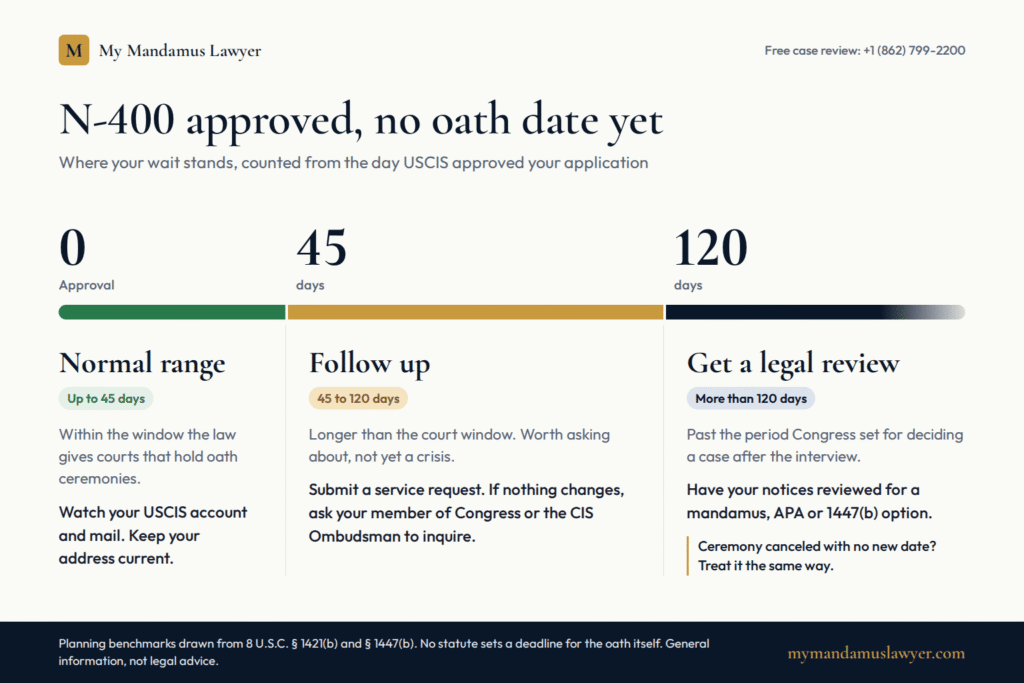
The short version. An approval notice is not a certificate of naturalization. Measure your wait against two benchmarks: 45 days, the window courts get to hold your ceremony, and 120 days, the time Congress gave USCIS to decide a case after the interview.
Normal, Follow Up, or Evaluate a Lawsuit: A Three-Stage Guide
The table turns those benchmarks into a plan. We borrow the 120-day mark from 8 U.S.C. § 1447(b), which measures it from the interview; no statute sets a deadline for the oath itself.
| Time since approval | What it usually means | What to do |
|---|---|---|
| Up to 45 days | Normal scheduling range. Courts that hold ceremonies get this window. | Watch your online account and mail. Keep your address current. |
| 45 to 120 days | Longer than the court window. Worth asking about, not yet a crisis. | Submit a service request. If nothing changes, ask your member of Congress or the CIS Ombudsman to inquire. |
| More than 120 days, or canceled with no new date | Past the period Congress set for deciding a case after the interview. A delay with no case-specific reason deserves a legal review. | Have your notices reviewed for a mandamus, APA or 1447(b) option. |
Why the Oath Ceremony Gets Delayed or Canceled
Most oath ceremony delays, and most cancellations, come from three places: the ceremony calendar, a second look at your file, and the wider slowdown at USCIS in 2026.
Ceremony Calendars and Who Holds Your Ceremony
The oath is given at an administrative ceremony run by USCIS or at a judicial ceremony run by a federal or qualifying state court. If a court in your area has claimed exclusive authority, USCIS cannot give you the oath during the 45-day window, so your date depends on the court’s calendar. If USCIS does not certify you in time for a court’s ceremony, the court may waive its authority, and USCIS must then notify you.
An empty calendar is a scheduling problem, not a finding against you, but a missed slot can push you to the next one.
Extra Review After Approval
USCIS can take a second look between approval and oath. Its Policy Manual says officers must not schedule the oath if they receive or identify disqualifying derogatory information. In that case the agency files a motion to reopen and gives you 15 days to respond, under 8 C.F.R. § 335.5. The Form N-445 questionnaire you complete before check-in covers changes since your interview, and an officer reviews it at the ceremony.
The 2026 Slowdown and Policy Holds
USCIS told NPR it is screening applications more closely, and naturalization processing times doubled from six to 13 months. Two USCIS memos also held many cases from 39 countries in 2026. After a federal court order on August 24, 2026, USCIS said it is ordered to adjudicate those applications in the normal course. If your ceremony was canceled during that hold, our guide to the USCIS 39-country hold covers that situation.
What to Do While You Wait
Most of what helps here is within your control. Work through it in order.
Check Your Account and Address First
Read the exact status wording and every notice in your USCIS online account. The ceremony notice, Form N-445, goes to the address on file, so update your address right away if you moved. A move can also change who holds your ceremony, because courts give the oath to people living in their district.
Service Request, Congressional Inquiry, Ombudsman
Past the 45-day mark with no notice, call the USCIS Contact Center at 1-800-375-5283 and ask for a service request on your approved N-400. Write down the date and the request number. If nothing changes in a few weeks, a congressional caseworker or the CIS Ombudsman can ask on your behalf. Our guide to service requests, Ombudsman help and congressional inquiries explains the order.
When You Can Ask for an Expedited Oath
Federal law allows an expedited ceremony for sufficient cause. Section 1448(c) lists examples: serious illness of the applicant or an immediate family member, a disability that prevents attending a scheduled ceremony, advanced age, and urgent circumstances related to travel or employment. Make the request in writing, attach proof such as a doctor’s or employer’s letter, and mention it in your service request.
If Your Ceremony Was Canceled
If your naturalization oath ceremony was canceled, the notice usually tells you more than the online status. Read it for three things.
- Who canceled: if you returned your N-445 with a letter asking for a new date, USCIS reschedules you and sends a new notice.
- Whether the approval still stands: a motion to reopen means USCIS is revisiting the decision, and the 15-day response period applies.
- Whether a new date is listed or promised.
Keep the original N-445, the cancellation notice and dated screenshots of your online status. If no new notice and no reopening letter arrive within about 45 days, move to the follow-up steps above.
One rule is about your own attendance, not USCIS’s. Under 8 C.F.R. § 337.10, missing more than one ceremony without good cause creates a presumption that you abandoned your application. A cancellation by USCIS is not a missed ceremony, but answer every new notice promptly.
When the Delay May Support a Federal Lawsuit
Whether a lawsuit fits, and which kind, depends on the exact wording of your status and notices. No outcome is certain, and the right path differs from case to case.
If Your Status Still Says “Recommended for Approval”
Some notices say an officer recommended approval while the case goes through further review. If no final decision has been made and more than 120 days have passed since your interview, § 1447(b) lets you ask the federal district court where you live to decide the case or send it back to USCIS with instructions. Our 1447(b) lawsuit guide explains the process.
If Your N-400 Shows as Approved
Here the decision is made and the remaining step is the oath. A mandamus or APA lawsuit can ask a court to order USCIS to complete action it has unreasonably delayed. Courts weigh how long you have waited, what USCIS has said and how the delay affects you; the statute’s call for frequent, regular ceremonies is part of that picture. Our N-400 delay lawsuit guide covers how these cases are built.
If USCIS Reopened Your Approval
A motion to reopen returns the case to a decision. Respond within the 15 days with evidence that answers the concern. If USCIS then denies the application, you can request a hearing with USCIS and, after that, ask a federal court to review the denial under § 1421(c).
A lawsuit can ask a court to make USCIS act; it cannot make an ineligible case eligible, and it fits a long, documented delay better than an approaching deadline. Some applicants caught in this year’s slowdown have already turned to federal courts, The Washington Post reported.
N-400 approved and still no oath date?
Send us your approval notice, any cancellation notice and your latest online status. We will tell you whether your wait is still in the normal range, ready for follow-up, or ready for a closer legal look.
Frequently Asked Questions
Can I travel before my oath ceremony?
You can travel as a permanent resident, but keep trips short and be back for any ceremony date. The N-445 asks what changed since your interview, including trips, so answer it accurately.
Can I vote or apply for a U.S. passport before the oath?
No. Both depend on citizenship, which starts on the day of the oath. You receive your certificate of naturalization at the ceremony, and voter registration may be offered at administrative ceremonies.
What happens if I miss my oath ceremony?
If you know in advance, return the N-445 with a letter asking for a new date; otherwise contact your local office right away. Missing more than one ceremony without good cause can lead USCIS to presume you abandoned the application.
What if I moved after my interview?
Update your address with USCIS right away. Your ceremony may move to a different office or court, which can add time.
Can I sue USCIS to schedule my oath?
Possibly. If your N-400 is approved and the oath has been delayed without a case-specific reason, a mandamus or APA lawsuit may be an option. If the case was only recommended for approval, § 1447(b) may apply instead.
An Approved N-400 Should Reach the Oath
An approved N-400 means the hardest questions are behind you. If your N-400 is approved but no oath ceremony has come, measure the wait: watch the first 45 days, follow up after that, and look at legal options once the delay passes about 120 days or a canceled ceremony goes unrescheduled. Until the oath, keep your address current and answer notices quickly.
Approved but Still Waiting for Your Oath?
Your case delay isn’t your fault. A mandamus lawsuit is a legal remedy against unreasonable USCIS delays, including an oath ceremony that never gets scheduled. Contact us for a free case evaluation with your approval notice and latest case status at hand.
Phone: +1 (862) 799-2200
Legal Disclaimer: This article is provided for general informational purposes only and does not constitute legal advice. Every immigration case has unique circumstances. For legal guidance specific to your situation, we recommend consulting with an experienced immigration attorney. The information in this article reflects laws and policies as of the publication date; subsequent changes may affect its accuracy.
Sources
- 8 U.S.C. § 1421, Naturalization authority, Legal Information Institute, Cornell Law School.
- 8 U.S.C. § 1447, Hearings on denials of applications for naturalization, Legal Information Institute, Cornell Law School.
- 8 U.S.C. § 1448, Oath of renunciation and allegiance, Legal Information Institute, Cornell Law School.
- 8 C.F.R. Part 337, Oath of Allegiance (§ 337.9 Effective date of naturalization; § 337.10 Failure to appear), Legal Information Institute, Cornell Law School.
- 8 C.F.R. § 335.5, Receipt of derogatory information after grant, Legal Information Institute, Cornell Law School.
- USCIS Policy Manual, Volume 12, Part B, Chapter 5: Motion to Reopen, U.S. Citizenship and Immigration Services.
- Naturalization Ceremonies, U.S. Citizenship and Immigration Services.
- Recent Court Order on Hold Policies, U.S. Citizenship and Immigration Services, August 28, 2026.
- Naturalization in the U.S. is on the decline, NPR, October 13, 2026.
- Would-be voters in limbo as approvals of U.S. citizenship plunge by 72 percent, The Washington Post, October 23, 2026.