
USCIS says your case is on hold. That one word can mean a visa number is unavailable, a background check is open, an investigation is running, or simply that your file is not near the top of anyone’s stack.
Those are not the same situation, and the difference decides whether a federal delay claim has anything to work with.
The word appears constantly in agency emails and service request responses, and almost nowhere in the rules governing a pending file. A USCIS case on hold describes what the agency is doing, not a legal category that suspends what the agency owes you.
This guide covers the one question that separates a hold with a lawful basis from one without, and how to tell which kind applies to your file.
In This Article When a Case Is On Hold
“Hold” Is Not a Legal Term
There is one place in the regulations where holding a case has a formal basis, and it is narrow. Under 8 CFR § 103.2(b)(18), USCIS may authorize withholding adjudication, but only where two conditions hold together. An investigation must be underway involving eligibility or the exercise of discretion, and disclosure to the applicant must be something that would prejudice that investigation.
The provision also builds in a clock. If the investigation has not concluded within one year of its inception, USCIS reviews whether to hold adjudication in abeyance for six months or until the investigation ends, whichever comes first. If six months pass and it remains open, the matter is reviewed again, and at recurring intervals after that.
Notice what that assumes: not a file sitting untouched for years, but a documented decision someone inside the agency keeps making on a schedule.
Most cases described this way were never withheld under the provision at all. The word is doing descriptive work rather than legal work, and that is where analysis begins.
The Only Question That Matters
Strip away the terminology and one question remains: has anything actually suspended the obligation to reach a decision? That obligation is not optional. 5 U.S.C. § 555(b) requires each agency to conclude a matter presented to it within a reasonable time. Two provisions give a court the means to enforce it. 5 U.S.C. § 706(1) allows a court to compel agency action unlawfully withheld or unreasonably delayed, and 28 U.S.C. § 1361 gives district courts jurisdiction over actions compelling a federal officer to perform a duty owed to the plaintiff.
None contains an exception for files the agency has labelled. A court does not ask whether USCIS used the word “hold.” It asks whether the agency’s timing follows a rule of reason, the first of six factors courts weigh when measuring an immigration delay against the TRAC framework.
That splits the problem in two. Either the law prevents the agency from granting the benefit right now, so waiting is not a failure to act, or a case on hold is still a case the agency is obliged to decide and the label changes nothing.
Holds That Give the Agency a Reason to Wait
Three situations fall into the first category. In each, ordering a favorable outcome would ask the agency to do something the law does not permit.
No Immigrant Visa Number Is Available
Adjustment of status carries a statutory condition. Under 8 U.S.C. § 1255(a)(3), status may be adjusted only where an immigrant visa is immediately available at filing. When a priority date is not current under the Visa Bulletin, no court order changes that arithmetic.
The underlying petition is a separate matter. A Form I-130 or I-140 can be adjudicated whether or not a number is available, because approval establishes a priority date rather than granting residence. Retrogression does not excuse a petition left undecided for years, and our guide on an I-130 priority date that is current with no action covers where that line falls.
A Statutory or Regulatory Bar on the Relief
Some benefits depend on something outside the file. An annual cap may have been reached, a required prior approval may not have issued, or the statute may build in a waiting-list stage before final adjudication.
Where a condition precedent is unsatisfied, the agency is not withholding a decision it is free to make. The realistic target is the step available now, not the one the statute defers.
The File Is Waiting on You
This one is uncomfortable but worth checking first. An unanswered Request for Evidence, unscheduled biometrics, or a notice sent to an old address all leave the last move on the applicant’s side.
Where the most recent action was an agency request, the record reads very differently than where the agency has gone silent on a complete file.
Holds That Leave the Duty Intact
The second category is where most cases actually sit. Something real is happening, but none of it removes the obligation under section 555(b).
Internal Triage and Workload Prioritization
Agencies allocate limited resources and courts accept that they must. Competing priorities are a recognized consideration, and a well-prepared claim does not pretend otherwise.
What triage is not is a legal impediment. It is the agency’s own choice about sequencing, so the ability to act was never lost. Resource constraints cannot justify indefinite inaction permanently, and a file held for years by queue position alone has no external barrier to point to.
An Open-Ended Background or Security Check
USCIS retains full authority to conduct identity, fraud, public safety, and national security review. That authority is not in question and should not be argued against.
Duration and explanation are. An active review with a case-specific account of what remains is a different fact pattern from a check described as pending for years with no detail. On the naturalization side, see our guide to an N-400 name check delay covers that stage, and for applicants abroad the equivalent appears in our guide to DS-5535 administrative processing.
The regulatory point above applies here. If a hold genuinely rests on an investigation, section 103.2(b)(18) requires review at fixed intervals. A hold with a real basis leaves a paper trail.
A Policy Hold With No Remaining Legal Effect
A policy memorandum is an internal instruction to officers. It is not a statute, and it creates no barrier to deciding a case otherwise ready.
Where a categorical hold policy has been withdrawn or vacated, the agency cannot keep relying on it, a situation covered in our post on cases still delayed after the 39-country adjudication hold was vacated.
Told your case is on hold with no end date?
Our team can review the wording USCIS used, whether a legal condition genuinely prevents a decision, how long the file has been inactive, and whether a federal filing is realistic.
Which One Do You Have?
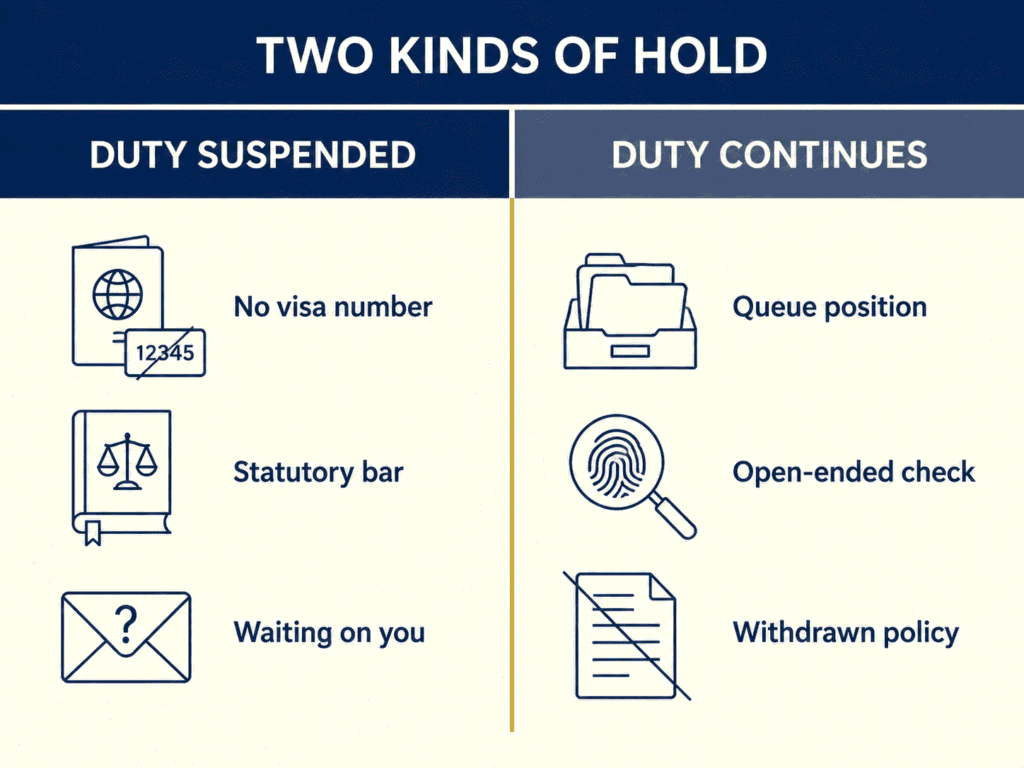
Working out which kind of case on hold you have comes down to one question. Can the agency name a specific outstanding step and a case-specific reason it has not been completed? A named step with a named obstacle points to a real basis. A statement that the file is under review, in background checks, or outside normal processing times is a status description rather than a legal position.
| What You Were Told | What It May Actually Mean | Does the Duty to Decide Continue? |
|---|---|---|
| Held pending visa availability | Priority date not current at the adjustment stage | Suspended by statute. The underlying petition is a separate duty |
| Held pending background checks | Security or identity review, possibly already complete | Yes. Lawful review does not authorize open-ended silence |
| Held pending an investigation | Possibly withheld under 8 CFR § 103.2(b)(18) | Yes, with review required at set intervals |
| Held pending a policy review | An internal instruction, not a statutory bar | Yes, more clearly so if the policy was withdrawn |
| Held, with no further detail given | Position in an internal queue | Yes. Nothing has legally suspended it |
Getting a more specific answer is its own exercise, covered in our guide to what a service request, the Ombudsman, and a congressional inquiry can each achieve.
What a mandamus lawyer examines here is narrower than the volume of correspondence suggests. What matters is the last substantive agency action, the exact wording describing the hold, and whether any legal condition stands between the file and a decision.
Frequently Asked Questions
Does USCIS have to explain a case on hold?
No general rule requires a case-specific explanation on request, and where adjudication is withheld for an investigation the regulation contemplates limited disclosure. Silence is not unlawful in itself, but it leaves the agency without a stated basis to rely on later.
Is a background check a valid defense to a delay lawsuit?
It is a relevant fact rather than an automatic answer. Courts recognize the authority to complete security screening, then examine whether the review is genuinely active and how long it has run without an account of what remains.
My priority date is not current. Can I still file a delay case?
The adjustment grant cannot be compelled while no visa number is available, because the statute conditions it on immediate availability. A separate pending step, such as an undecided petition, may still be an unfulfilled duty.
How long can USCIS withhold adjudication because of an investigation?
The regulation sets review points rather than a hard outer limit. If an investigation has not concluded within one year, USCIS reviews whether to hold the case in abeyance for six months or until it completes, then revisits that at recurring intervals.
Can a court order USCIS to lift a hold?
A delay claim asks a court to compel action unlawfully withheld or unreasonably delayed. The practical request is completion of the adjudication, not removal of a label, and the decision that follows can still be a denial.
Will asking about a case on hold hurt my application?
An inquiry does not change the eligibility standards an officer applies. It does create a dated record of what the agency said and when, often the only proof of how long the file has been described the same way.
A Hold Is a Description, Not a Defense
USCIS uses one word for several very different situations. In a few, a statute or a numerical limit genuinely prevents the agency from granting what you asked for, and no court can order around that. In the rest, something is being described rather than required. An internal queue, a review with no stated remaining step, or a withdrawn policy are accounts of agency behavior, not legal barriers.
A case on hold is not automatically a case the law says can wait. Ask what step remains outstanding and why, then measure the answer against what the law requires. If a decision is forced and goes against you, our guide on what happens when USCIS denies a case after a lawsuit sets out the deadlines that follow.
Is there a legal reason your case has not been decided?
Contact our team for a review of the hold language USCIS used, the last substantive action on your file, whether a statutory condition applies to your category, and the federal options available if none does.
Phone: +1 (862) 799-2200
Legal Disclaimer: This article is provided for general informational purposes only and does not constitute legal advice. Whether a particular hold rests on a statutory condition, a regulatory basis, or internal agency sequencing depends on the form type, the category, and the procedural posture of each case. For legal guidance specific to your situation, we recommend consulting with an attorney experienced in federal immigration litigation. The information in this article reflects federal statutes, regulations, and agency guidance reviewed as of August 31, 2026; subsequent changes may affect its accuracy. Prior results do not guarantee a similar outcome.
Sources
- 8 CFR § 103.2, Submission and Adjudication of Benefit Requests, Electronic Code of Federal Regulations, accessed August 31, 2026.
- 5 U.S.C. § 555, Ancillary Matters, Legal Information Institute, Cornell Law School, accessed August 31, 2026.
- 5 U.S.C. § 706, Scope of Review, Legal Information Institute, Cornell Law School, accessed August 31, 2026.
- 28 U.S.C. § 1361, Action to Compel an Officer of the United States to Perform a Duty, Legal Information Institute, Cornell Law School, accessed August 31, 2026.
- 8 U.S.C. § 1255, Adjustment of Status of Nonimmigrant to That of Person Admitted for Permanent Residence, Legal Information Institute, Cornell Law School, accessed August 31, 2026.
- Telecommunications Research & Action Center v. FCC, 750 F.2d 70, U.S. Court of Appeals for the District of Columbia Circuit, October 24, 1984.
- Visa Bulletin, Bureau of Consular Affairs, U.S. Department of State, accessed August 31, 2026.
- Court Order on Hold Policies, U.S. Citizenship and Immigration Services, accessed August 31, 2026.
- Check Case Processing Times, U.S. Citizenship and Immigration Services, accessed August 31, 2026.
- Mandamus and APA Delay Cases: Avoiding Dismissal and Proving the Case, American Immigration Council and National Immigration Litigation Alliance, practice advisory, 2021.