
Your I-140 has been pending well past the time USCIS posts for its category. No request for evidence, no denial, no approval. Meanwhile an H-1B clock, a planned job change or a family’s move is waiting on one decision.
An I-140 delay mandamus lawsuit asks a federal court to order USCIS to make that decision. It cannot order an approval. What sets the I-140 apart from most green card delays is the nature of the decision itself: for most classifications, once USCIS verifies the facts and finds the beneficiary eligible, the statute says the petition shall be approved.
Form I-140 is filed either by a sponsoring employer or, in EB-1A and national interest waiver cases, by the applicant as a self-petitioner. Both routes can stall, and both raise the same three questions: is the wait actually unreasonable, does premium processing change anything, and who should bring the case. This guide takes them in order, along with the harms a pending I-140 causes and why the usual pre-suit options are narrower here.
In This Article When the Petition Itself Is Stuck
How Long an I-140 Should Take, and How Long It Is Taking
There is no single number that makes an I-140 late. USCIS posts processing times by form, classification and service center on its case processing times tool, and for Form I-140 the rows differ widely. An extraordinary ability petition, a national interest waiver and a PERM-based skilled worker petition sit in three different queues.
Reading the Processing-Times Tool by Category
Select Form I-140, then your classification, then the service center on your receipt notice. The figure reflects how long most recently completed cases in that row took. It is not a deadline. The page also lists a receipt date before which USCIS accepts a case inquiry, which is the gate to a service request.
Why the Classification on Your Receipt Notice Matters
Your Form I-797C receipt notice identifies the classification USCIS is adjudicating. Compare against that row, not a one-year rule of thumb. A petition modestly outside the posted time for a slow classification may be ordinary, while the same wait in a faster classification may already be significant.
The first question in any delay assessment is whether you are measuring against the right line.
Once the petition is approved, the wait moves to a different stage, covered in our guide to an I-485 still pending after I-140 approval.
Premium Processing: Paid, Refunded, or Never Filed
Premium processing is the fact that sets I-140 delays apart from most USCIS delays. Every I-140 classification is eligible, and a petition already pending can be upgraded at any time by filing Form I-907. Since March 1, 2026 the premium processing fee for Form I-140 is $2,965.
What Premium Processing Actually Guarantees
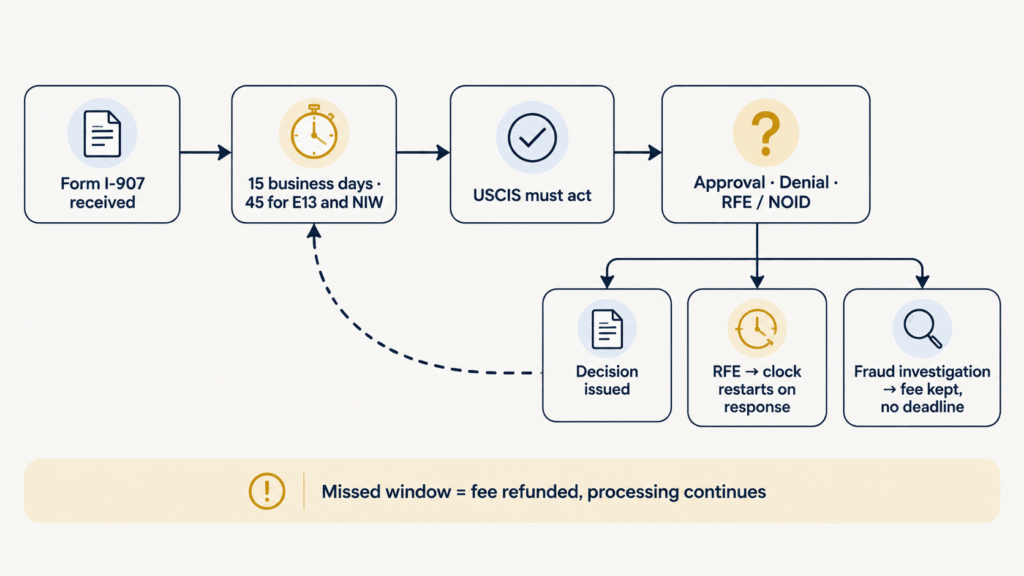
Premium processing buys a deadline for action, not for a decision. Under 8 CFR 106.4, USCIS must issue an approval, a denial, a request for evidence or a notice of intent to deny within 15 business days for most classifications, and within 45 business days for multinational executives and managers and for national interest waivers.
For those two classifications, the clock starts only when everything USCIS needs to adjudicate the petition has been received. A request for evidence stops the clock, and a new one begins when your response arrives. USCIS’s own premium processing page still describes the windows in calendar days, but the regulation, amended in 2024, counts business days.
When the Premium Clock Ran and No Decision Came
Two situations leave a premium case without an answer. If USCIS misses the window, it refunds the fee and keeps processing, with no further deadline in the regulation. If it opens an investigation for fraud or misrepresentation, it may keep the fee, take no action within the window, and not notify the petitioner.
A petition can therefore be both premium-processed and indefinitely undecided.
The “You Could Have Paid” Argument
In a delay lawsuit, the government may argue that a petitioner who chose not to pay for premium processing had a faster path available. How much weight that carries is not settled, and it turns on facts.
It is weakest where the person suing could not have used premium processing at all. USCIS does not allow the beneficiary of an employer-filed petition to request it; only the petitioner or a self-petitioner can. It is also weak where premium processing was used and produced the refund or investigation described above. It carries more force where a self-petitioner could simply have upgraded, which is why that question should be answered before a complaint is drafted.
What Makes an I-140 Delay Unreasonable
Whether a wait has become unreasonable is assessed through the TRAC factors, the framework federal courts commonly apply to agency delay. Three features specific to the I-140 shape how that analysis runs.
A Decision USCIS Is Required to Make
For most classifications, the statute directs that once USCIS verifies the facts and finds the beneficiary eligible, it shall approve the petition. The Fifth Circuit called visa petition decisions ordinarily non-discretionary for this reason in Flores v. Garland, and courts are far more cautious about compelling discretionary action.
An I-140 also does not wait on a visa number. An approved petition places the beneficiary in line; it does not grant residence. It can be decided whether or not the Visa Bulletin is current, as our guide to what USCIS means when it says a case is on hold explains.
The NIW Exception and Why Venue Matters
National interest waiver petitions are the exception. The statute says USCIS “may” grant the waiver, and both the Fifth Circuit in Flores and the Eleventh Circuit in Brasil v. Secretary, DHS held that a denial of the waiver is shielded from judicial review. The Fifth Circuit has separately applied the same jurisdictional provision to the pace of adjustment decisions in Cheejati v. Blinken.
We have not located an appellate decision extending that reasoning to the pace of an NIW petition, but the government can make the argument, so where a case is filed matters. Our guide on where a mandamus lawsuit can be filed covers the venue options.
In practice, many NIW delay cases end when USCIS simply decides the petition. In one of our cases, a research scientist’s NIW petition pending 22 months past normal processing times was approved seven weeks after the lawsuit was filed. Results depend on the facts and the court.
Harm That Is Specific to a Pending I-140
The harm showing rests on documents, and a pending I-140 produces a distinctive set:
- H-1B time beyond six years. Under 8 CFR 214.2(h)(13)(iii), workers past the limit can extend one year at a time once a labor certification or petition has been pending 365 days, but three-year extensions when per-country limits block a visa require an approved I-140.
- No protection against employer changes. A petition withdrawn by the employer, or whose employer closes, 180 days or more after approval generally remains approved under 8 CFR 205.1. An undecided petition has no such protection. Some H-1B families also wait on I-140 approval for a spouse’s work authorization.
- A beneficiary abroad. Nothing moves to the National Visa Center until the petition is approved.
One recent source of delay has changed. In June 2026 a federal court vacated USCIS policies that had held pending benefit requests from nationals of certain countries, and on August 14, 2026 the First Circuit allowed only a separate re-review of approved benefits to resume during the appeal. A petition still held on that basis has lost its policy footing, though it may be delayed for other reasons.
Is your I-140 past the posted time for its classification, with no premium option that fits your situation?
Our team can review your classification and receipt dates, whether premium processing was available to you or already used, who is best placed to be the plaintiff, the harm the delay is causing, and whether a federal filing is realistic in your jurisdiction.
Why the Pre-Suit Options Are Narrower for an I-140
For many USCIS forms, a delay case begins with a documented expedite request. For the I-140 that route is largely closed. USCIS generally does not accept discretionary expedite requests for classifications eligible for premium processing, with an exception for petitioners the IRS designates as not-for-profit entities.
What remains is a service request once the case is outside the posted time, an inquiry to the CIS Ombudsman, and a congressional inquiry. How each works, and what each can realistically achieve, is covered in our guide to service requests, the Ombudsman and congressional inquiries.
Keep every attempt and every reply. The evidence behind a mandamus lawsuit is largely a record of what was tried and what the agency said in response.
Who Should File the I-140 Delay Mandamus Lawsuit
Before the agency, the petitioner is the party with standing in an I-140 proceeding. In federal court the picture is broader, but it depends on who filed the petition.
Self-Petitioners: EB-1A and NIW
Where you filed the petition yourself, you are both petitioner and beneficiary, and you are the natural plaintiff. The premium processing question applies most directly here, because you are the person who could have requested it.
Employer-Filed Petitions: Filing Together
Where an employer filed the petition, the employer is the clearest plaintiff, and the beneficiary often joins. USCIS regulations exclude the beneficiary from the definition of an affected party before the agency. In Rossville Convenience & Gas v. Garland, a federal district court held that this does not decide who may sue, and it followed the Second, Sixth and Eleventh Circuits in allowing a beneficiary to challenge a petition decision in his own right. The same opinion notes that several other courts, including others in the District of Columbia, have reached the opposite conclusion.
When the Employer Will Not Act
Employers stop cooperating for ordinary reasons: a reorganization, a change of counsel, a manager who has moved on. The beneficiary standing cases involved denials and revocations rather than delay, so a beneficiary bringing an I-140 delay mandamus lawsuit alone should confirm how courts in the relevant circuit treat that claim.
Where the beneficiary has already changed jobs under the AC21 portability provision, the argument is stronger. The Rossville court relied on that provision in finding that the statute protects beneficiaries as well as employers, and noted that USCIS itself has acknowledged porting beneficiaries fall within the protected zone of interests.
Frequently Asked Questions
How long is too long for an I-140?
There is no fixed number. Compare the time since receipt with the posted time for your classification and service center. A wait far outside that figure, with documented harm, is the usual starting point for a legal assessment.
Can I sue if I never paid for premium processing?
Possibly. Not paying is not a bar to filing, but the government may raise it. The argument is strongest against a self-petitioner who could have upgraded, and weak against an employee who could not file Form I-907 in the first place.
Can the employee sue if the employer filed the I-140?
Several federal appeals courts have allowed beneficiaries to sue over employer-filed petitions, mainly in denial and revocation cases. Filing jointly with the employer avoids the question where that is possible.
Will suing USCIS get my I-140 approved?
No. The relief is an order to decide. A lawsuit will not fix real evidentiary problems, and the decision may be a denial. Our guide on what happens if USCIS denies a case after a lawsuit covers that scenario.
Can USCIS decide my I-140 if my priority date is not current?
Yes. Approving the petition does not require an available visa number. The Visa Bulletin controls the later stage of the case, not the petition itself.
An I-140 Is a Decision, Not a Place in Line
The petition is the one part of an employment-based case that, in most classifications, the statute says USCIS shall approve once eligibility is shown. Premium processing complicates that picture but does not end it, and who could have used it matters as much as whether anyone did.
Ask three questions: is the wait outside the posted time for your classification, was premium processing realistically available to the person who would sue, and is the harm documented. Employers and workers weighing their options across the wider process can start with our page on employment-based green card delays.
Your case delay is not your fault.
A mandamus or APA lawsuit is a legal remedy against unreasonable USCIS delay. Contact our team for a review of your classification and receipt dates, the published processing time that applies to your petition, whether premium processing was available or already used, who should be the plaintiff, and whether federal litigation is realistic in your jurisdiction.
Phone: +1 (862) 799-2200
Legal Disclaimer: This article is provided for general informational purposes only and does not constitute legal advice. Whether a particular I-140 delay is actionable, whether premium processing was available to the person who would bring the case, who has standing to sue, and what relief is available depend on the classification, the filing history, the controlling law of the jurisdiction, and the facts of the individual case. For legal guidance specific to your situation, we recommend consulting with an attorney experienced in federal immigration litigation. The information in this article reflects federal regulations, agency guidance and judicial authorities reviewed as of September 23, 2026; subsequent changes may affect its accuracy. Prior results do not guarantee a similar outcome.
Sources
- How Do I Request Premium Processing?, U.S. Citizenship and Immigration Services, updated March 23, 2026.
- 8 CFR 106.4, Premium Processing Service, Electronic Code of Federal Regulations, accessed September 23, 2026.
- Adjustment to Premium Processing Fees, final rule, Department of Homeland Security, January 12, 2026.
- Flores v. Garland, No. 22-20419, U.S. Court of Appeals for the Fifth Circuit, June 23, 2023.
- Brasil v. Secretary, Department of Homeland Security, No. 21-11984, U.S. Court of Appeals for the Eleventh Circuit, March 18, 2022.
- Recent Trends in Immigration Delay Cases, National Immigration Litigation Alliance, May 17, 2024.
- Rossville Convenience & Gas, Inc. v. Garland, No. 20-2218 (JDB), U.S. District Court for the District of Columbia, December 10, 2021.
- 8 CFR 205.1, Automatic Revocation, Electronic Code of Federal Regulations, accessed September 23, 2026.
- 8 CFR 214.2, Special Requirements for Admission, Extension, and Maintenance of Status, Legal Information Institute, accessed September 23, 2026.
- Court Order on Hold Policies, U.S. Citizenship and Immigration Services, June 12, 2026.
- Dorcas International Institute of Rhode Island v. USCIS, No. 26-1703, Order of Court, U.S. Court of Appeals for the First Circuit, August 14, 2026.