The refusal notice cites a section of law and very little else. The question most families ask next is whether a federal judge can look at it. Usually the answer is no, and the reason has a name: consular nonreviewability.
Consular nonreviewability is the rule that federal courts generally will not review a consular officer’s decision to issue or refuse a visa. It does not close every door. Courts can still hear claims that the government has not finished a required step, challenges to the policies behind consular decisions and a narrow set of constitutional claims brought by U.S. citizens.
This guide explains what the doctrine blocks, why the section on your notice matters, how Muñoz and a 2026 Ninth Circuit ruling shape the U.S. citizen exception, and four questions to answer before you sue.
In This Article
- What Is Consular Nonreviewability?
- Which Refusal Did You Receive? Why It Decides the Court Question
- What Courts Can Still Review: Delay, Process and Policy
- The U.S. Citizen Exception: Mandel, Din, Muñoz and Gonzalez
- Before You Consider a Lawsuit: Four Questions About Your Refusal Notice
- Frequently Asked Questions
- Start With the Section Number on Your Notice
What Is Consular Nonreviewability?
The doctrine comes from court decisions, not a statute. It rests on the view that admitting foreign nationals belongs to Congress and the executive branch, so judges do not second-guess an officer’s visa decision, even when the applicant says the officer misread the facts or a regulation. A federal court in Washington, D.C. said exactly that in Sorbi v. Rubio on August 24, 2026.
Two limits matter. The doctrine covers consular officers abroad, not USCIS; a denied I-130, I-485 or N-400 follows different rules, which our guide to a USCIS denial after a mandamus lawsuit explains. And the doctrine covers decisions that have been made, not the absence of one.
The short version. A court will rarely ask whether the consulate decided your case correctly. It may ask whether it decided at all, whether its rule was lawful and, for a U.S. citizen, whether its reason was legitimate on its face.
Which Refusal Did You Receive? Why It Decides the Court Question
Every refusal cites a section of the Immigration and Nationality Act (INA), and that section decides what a court can be asked. CEAC shows “Refused” for all of them; our guide to the CEAC status Refused explains why. The written notice tells you which one you have.
| Section cited | What it means | Can the consulate revisit it? | What a court may be asked to do |
|---|---|---|---|
| INA 221(g) | The officer could not yet find you eligible. Documents or administrative processing are outstanding. | Yes, once documents arrive or processing ends. | In many courts, order the consulate to finish a required step. Courts disagree on whether a 221(g) refusal is already a final decision. |
| INA 212(a) | The officer found a ground of inadmissibility, such as public charge under 212(a)(4) or misrepresentation under 212(a)(6)(C)(i). | Only with new evidence that overcomes the ground, or a waiver where the law allows one. | Very little. The finding itself is shielded; a U.S. citizen may ask whether a facially legitimate reason was given. |
| INA 212(f) | Entry is suspended for a class of people by presidential proclamation, such as Proclamation 10998. | Only through a listed exception or a national interest waiver. | A challenge to the proclamation itself may be heard. A challenge to how it was applied to you usually is not. |
The State Department’s visa denials page adds that, apart from 221(g) refusals, reapplying means a new application and a new fee, and that waivers are authorized by the Department of Homeland Security.
A 221(g) case still in processing is where a delay case is realistic; our guide to the 221(g) blue, white or pink slip covers what each notice asks of you. Once the file moves to 212(a) or 212(f), the question changes from when to why, and why is what the doctrine protects.
What Courts Can Still Review: Delay, Process and Policy
Three kinds of claims survive in at least some courts. None asks the judge to decide the visa.
When the consulate has not finished
The Mandamus Act, 28 U.S.C. §1361, and the Administrative Procedure Act, 5 U.S.C. §706(1), let a court order an agency to take a required action it has unreasonably delayed. Many courts hold that the doctrine does not reach a case still in administrative processing, because no final decision exists. Others, including the D.C. Circuit in Karimova v. Abate (2024), treat the 221(g) refusal itself as the decision. That split is covered in our 221(g) administrative processing delay guide and our APA or mandamus decision tree.
When the problem is a policy
Courts also hear forward-looking challenges to the rules that govern consular decisions. The D.C. Circuit said so in Pietersen v. U.S. Department of State in May 2025. On August 21, 2026, the Southern District of New York relied on that reasoning in CLINIC v. Rubio to vacate the 75-country immigrant visa pause, because the plaintiffs attacked the policy rather than any officer’s judgment.
On October 19, 2026, a temporary Second Circuit order left the vacatur of the policy in place but paused the part that reopened individual refusals, which is where the line runs. If your notice cited that pause, see our guide to a refusal under the 75-country visa pause.
When a delay case turns into a refusal
In Sorbi, a U.S. citizen sued after her husband’s IR-1 application sat in administrative processing for fourteen months following an interview at the U.S. Embassy in Ankara. In May 2026, while the suit was pending, the embassy refused the visa under INA 212(f) and Proclamation 10998. The court held that the refusal mooted the delay claim and rejected her new arguments, because she questioned how the proclamation applied to her husband, not whether it was valid.
That is what stays out of reach: asking a judge to find that the officer weighed the evidence wrongly or applied a valid rule to the wrong person.
The U.S. Citizen Exception: Mandel, Din, Muñoz and Gonzalez
The only constitutional route into a consular refusal runs through a U.S. citizen’s rights, not the applicant’s. Four decisions set its limits.
| Year | Case | What the court held | What it means for you |
|---|---|---|---|
| 1972 | Kleindienst v. Mandel | U.S. professors’ First Amendment interest in hearing a Belgian economist allowed limited review; the government wins with a facially legitimate and bona fide reason. | The origin of the only constitutional route. |
| 2015 | Kerry v. Din | No majority. The controlling concurrence found citing the statutory ground enough, absent an affirmative showing of bad faith. | Naming the statute usually satisfies the test. |
| 2024 | Department of State v. Muñoz, 602 U.S. 899 | By 6 to 3, a U.S. citizen has no fundamental liberty interest in a noncitizen spouse’s admission. | A spouse cannot use due process to demand a fuller explanation. |
| 2026 | Gonzalez v. U.S. Department of State, 9th Cir., April 30 | Muñoz did not overrule Mandel; a spouse’s First Amendment claim allowed limited review, and a brief explanation still passed. | The door is open in theory and rarely in result. |
The test asks whether the government pointed to a valid legal ground, not whether the officer was right. In Sorbi, the court repeated that naming the statutory provision can satisfy it. To get past it, a plaintiff must make an affirmative showing of bad faith; in the Ninth Circuit, that means the officer did not believe the basis for the decision or relied on information known to be false. An honest mistake is not enough.
Gonzalez shows how narrow the opening is. A U.S. citizen argued that her husband’s refusal, tied to tattoos the officer linked to a criminal organization, burdened her First Amendment right to hear him speak in person. The majority allowed limited review and upheld the government’s short explanation; a concurring judge called the claim an attempt to get around Muñoz. For a spouse, the practical work usually lies elsewhere, and our guide to spouse visa administrative processing covers it.
Before You Consider a Lawsuit: Four Questions About Your Refusal Notice
Can you sue after a visa refusal? Answer these in order, with the refusal notice in front of you.
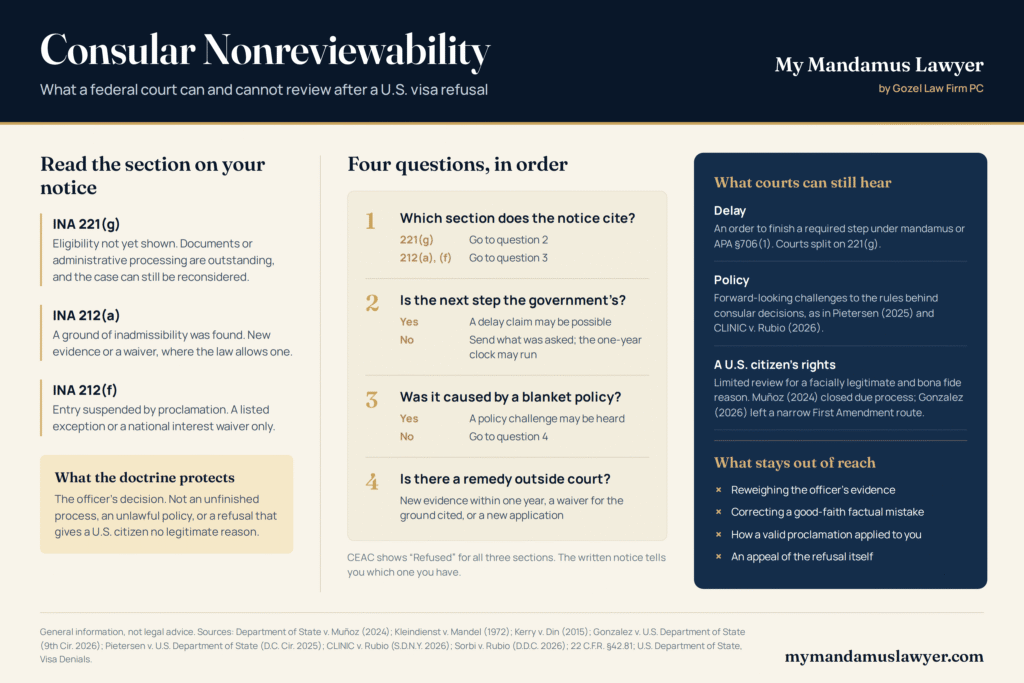
- Which section does the notice cite? If it cites 221(g), go to question 2. If it cites 212(a) or 212(f), go to question 3.
- Is the next step the government’s? If you have answered every request and the file still sits in administrative processing, a delay claim may be possible. If you still owe documents, send them first; the 221(g) one-year deadline may be running.
- Was the refusal caused by a blanket policy rather than a judgment about you? If yes, a policy challenge or existing litigation may matter more than your own file. If no, go to question 4.
- Is there a remedy outside court? Under 22 C.F.R. §42.81(e), an immigrant visa refusal must be reconsidered if you present evidence tending to overcome the ground within one year. A waiver may exist for the ground cited, and a new application is possible. A U.S. citizen petitioner keeps the limited review above, which in practice requires evidence of bad faith.
If your answers stop at question 2, the case is about time. If they stop at question 4, it is about evidence.
Not sure which refusal you have?
Send us the refusal notice, your interview date and what CEAC shows today. We will tell you whether your case is a delay question a court can hear or a decision it cannot.
Frequently Asked Questions
Can I appeal a U.S. visa refusal?
There is no formal appeal of a consular refusal. You can present new evidence to the consulate, apply for a waiver where the ground allows one, or file a new application.
Does consular nonreviewability apply to a 221(g) refusal?
It depends on the court while the case is in administrative processing. Once the consulate issues a final refusal, the doctrine applies.
Can a U.S. citizen spouse sue over a visa refusal?
Not on due process grounds after Muñoz. A First Amendment theory survived in Gonzalez, but review stops at whether a legitimate reason was given.
What is the facially legitimate and bona fide reason test?
The standard used when a U.S. citizen’s constitutional rights are involved. Citing a valid legal ground passes it unless the citizen proves bad faith.
Can I sue for delay after a refusal?
Often yes under 221(g), if the government still has a step to finish. A final refusal under 212(a) or 212(f) usually ends the delay claim.
Start With the Section Number on Your Notice
Consular nonreviewability protects the officer’s decision. It does not protect an unfinished process, an unlawful policy or, within narrow limits, a refusal that gives a U.S. citizen no legitimate reason at all. Read the section number on your notice, decide whether the next step belongs to you or the government, and keep every date. That record shows which door, if any, is still open.
Received a Refusal Notice?
Not every refusal can go to court, but a stalled one often can. A mandamus lawsuit is a legal remedy against unreasonable government delay, including consular cases that stay in administrative processing after every request has been answered. Contact us for a free case evaluation. Keep the refusal notice, your interview date and a CEAC screenshot at hand for the first review.
Phone: +1 (862) 799-2200
Legal Disclaimer: This article is provided for general informational purposes only and does not constitute legal advice. Every immigration case has unique circumstances. For legal guidance specific to your situation, we recommend consulting with an experienced immigration attorney. The information in this article reflects laws and policies as of the publication date; subsequent changes may affect its accuracy.
Sources
- Department of State v. Muñoz, 602 U.S. 899, No. 23-334, Supreme Court of the United States, June 21, 2024.
- Kleindienst v. Mandel, 408 U.S. 753, Supreme Court of the United States, June 29, 1972, via Justia.
- Kerry v. Din, 576 U.S. 86, Supreme Court of the United States, June 15, 2015, via Justia.
- Gonzalez v. U.S. Department of State, No. 23-4205, U.S. Court of Appeals for the Ninth Circuit, April 30, 2026.
- Pietersen v. U.S. Department of State, No. 24-5092, 138 F.4th 552, U.S. Court of Appeals for the D.C. Circuit, May 2025.
- Sorbi v. Rubio, No. 25-cv-02353 (RC), Memorandum Opinion, U.S. District Court for the District of Columbia, August 24, 2026.
- CLINIC v. Rubio, No. 26-cv-00858 (S.D.N.Y.), case page and Opinion and Order of August 21, 2026, Center for Constitutional Rights.
- 75-Country Visa Ban: State Keeps Reviewing Refusals, Fights Deadlines, Immigration Analytics, October 24, 2026.
- Visa Denials, U.S. Department of State, accessed October 28, 2026.
- 22 C.F.R. §42.81, Procedure in Refusing Immigrant Visas, Electronic Code of Federal Regulations, accessed October 28, 2026.