
The trip is eight weeks away and the advance parole card has not arrived. An advance parole delay this close to travel leaves fewer options than most families expect, and one firm rule: an I-131 receipt notice is not a travel document.
Advance parole lets someone with a pending green card application travel and return without abandoning the case. In 2026 the wait grew, denials rose, and the Board of Immigration Appeals changed what a trip can cost anyone with a past overstay.
This guide covers wait times, what leaving does to your I-485, expedite and emergency options, an eight-week countdown, and when an I-131 delay can go to federal court.
In This Article
- How Long Does Advance Parole Take Right Now?
- Leaving the U.S. Without Advance Parole: What Happens to Your I-485
- Expedite Request: Criteria and How to Ask
- Emergency Advance Parole at a Field Office
- A Holiday Travel Timeline: 8 Weeks Out to Departure
- When an I-131 Delay Can Go to Federal Court
- Frequently Asked Questions
- An Advance Parole Delay Is a Planning Problem First
How Long Does Advance Parole Take Right Now?
The posted I-131 processing time is longer than most applicants planned for. In October 2026, the USCIS processing-times tool showed 80 percent of advance parole applications at Service Center Operations completed within 26.5 months. That figure also sets when you can submit a case inquiry.
The median tells a different story. USCIS historical figures compiled by the Niskanen Center put the median at roughly six months in fiscal year 2026. Many cases move in half a year; a meaningful share wait far longer, and your receipt notice will not say which group you are in.
Denials changed too. The American Immigration Council found the advance parole denial rate rose from 29.9 percent to 46.7 percent between the first quarters of fiscal years 2025 and 2026. Our guide to USCIS processing times explains how posted times work.
The short version. About half of advance parole cases are decided within six months, but the posted outer limit is now over two years. Plan the trip around the card in your hand, not the receipt date.
Leaving the U.S. Without Advance Parole: What Happens to Your I-485
If you travel with a pending I-485 and no advance parole, 8 C.F.R. § 245.2(a)(4)(ii) treats the departure as abandoning the application, unless a narrow exception applies. The Form I-131 instructions apply the same rule to the travel request itself.
| Your situation | If you leave | Rule |
|---|---|---|
| Pending I-485, no advance parole, no H, L, K or V status | The I-485 is treated as abandoned, and so is a pending I-131. | 8 C.F.R. § 245.2(a)(4)(ii)(A); I-131 instructions |
| In H-1B or L-1 status (or H-4 or L-2 through the principal), returning to the same employer with a valid visa | The I-485 is not abandoned. K-3, K-4 and V holders have a similar exception. | 8 C.F.R. § 245.2(a)(4)(ii)(C) and (D) |
| Advance parole in hand, no more than 180 days of past unlawful presence | The I-485 is preserved. CBP still decides parole at the port of entry. | 8 C.F.R. § 245.2(a)(4)(ii)(B) |
| Advance parole in hand, more than 180 days of past unlawful presence | Since August 13, 2026, the trip can trigger the 3-year or 10-year bar. | Matter of Delcarmen-Lara; USCIS alert |
| Pending asylum application, trip to the country you fear | Presumed abandonment of asylum, withholding and CAT claims, absent compelling reasons. | Matter of M-R-I- (BIA Oct. 7, 2026) |
| Removal order or open immigration court case | Leaving can carry consequences beyond abandonment. | Individual review before any travel |
The August 2026 Change for Anyone With a Past Overstay
For 14 years, Matter of Arrabally and Yerrabelly held that a trip on advance parole was not a “departure” for the unlawful presence bars. On August 13, 2026, the Board overruled it in Matter of Delcarmen-Lara, 29 I&N Dec. 830, and USCIS added an alert to its Form I-131 page. Anyone with more than 180 days of past unlawful presence who leaves, even with the document, may now be inadmissible on return.
It reaches applicants who overstayed and are adjusting through a U.S. citizen relative, and some DACA recipients. The Board applied the rule going forward, so have any trip on or after August 13, 2026 reviewed before you book.
One cost usually does not apply. The H.R. 1 parole fee rose to $1,050 on October 16, 2026, but its statutory exceptions cover a lawful adjustment applicant returning from temporary travel. Carry your I-485 receipt with the parole document.
Expedite Request: Criteria and How to Ask
An advance parole expedite request asks USCIS to take a pending I-131 out of order. The USCIS Policy Manual lists five grounds: severe financial loss, an emergency or urgent humanitarian reason, a nonprofit request serving U.S. cultural or social interests, government interests, and clear USCIS error. The decision is discretionary.
What USCIS Says About Travel
USCIS may expedite a travel document for a pressing or critical need to leave, planned or not. Unplanned events include a funeral or a family member’s grave illness; planned ones include work, academic or personal commitments such as a wedding or graduation.
For planned events, USCIS asks whether you filed the I-131 in time; its own example is an applicant who filed five months earlier and faces an event 45 days away. A general holiday visit rarely fits. A parent’s surgery date or a sibling’s wedding invitation does.
Evidence That Supports the Request
- Illness: medical records or a doctor’s letter with the diagnosis and timing.
- Death in the family: a death certificate, obituary or funeral notice.
- Wedding or other personal event: the invitation or reservations, plus proof of your relationship and why you need to attend.
- Work travel: an employer letter explaining the trip and the cost of missing it.
How to Make the Request
Call the USCIS Contact Center at 1-800-375-5283 with your I-131 receipt number, ask for an expedite, and note the date and any service request number. If nothing moves, the CIS Ombudsman can help with emergencies. Our guide to service requests, Ombudsman help and congressional inquiries explains the order.
Emergency Advance Parole at a Field Office
Emergency advance parole is for travel that cannot wait for even an expedited case. Field offices take no walk-ins: call the Contact Center for an appointment, then file and pay in person. USCIS asks you to bring:
- A new, signed Form I-131 with any fee, even if another I-131 is pending.
- Proof of eligibility, such as your I-485 receipt notice.
- Evidence of the pressing or critical need to travel.
- Two passport-style photos and certified translations of foreign-language documents.
The officer decides whether it qualifies, and a documented request can still be refused. Emergency parole does not change the August 2026 rule either: past unlawful presence carries the same risk on return.
A Holiday Travel Timeline: 8 Weeks Out to Departure
If your I-131 is pending, this is what you can still control, counting back from departure.
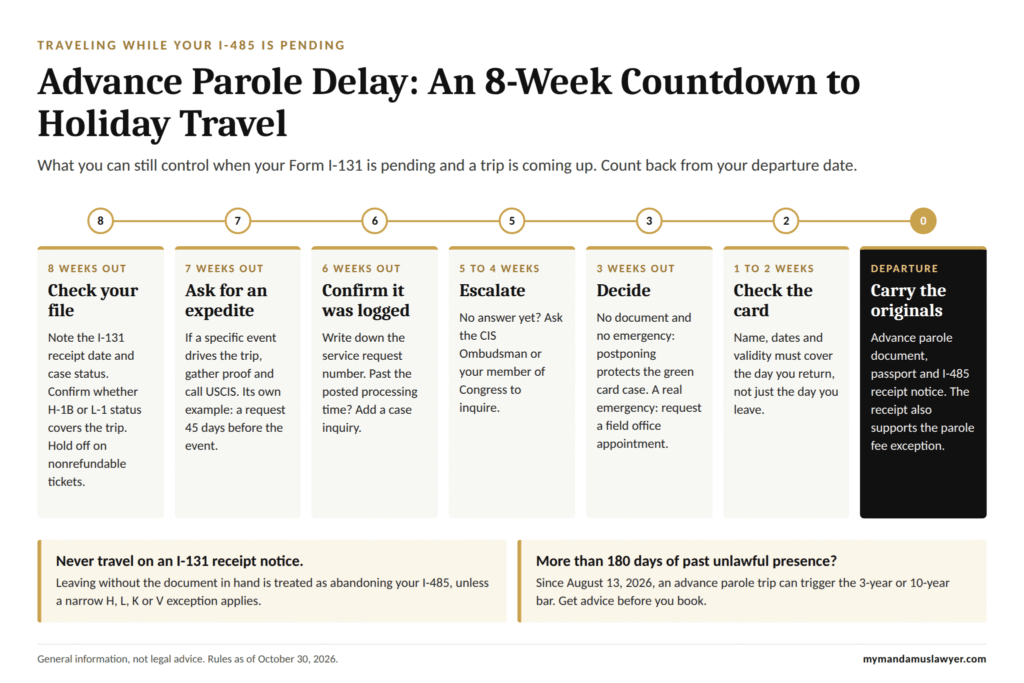
| When | What to do |
|---|---|
| 8 weeks out | Check the I-131 receipt date and status. Confirm whether H-1B or L-1 status covers the trip. Review past unlawful presence with a lawyer. Hold off on nonrefundable tickets. |
| 7 weeks out | If a specific event drives the trip, gather evidence and request an expedite. USCIS’s own example is 45 days before the event. |
| 6 weeks out | Confirm the request was recorded. Past the posted processing time? Add a case inquiry. |
| 5 to 4 weeks out | Still no answer? Ask the CIS Ombudsman or your member of Congress to inquire. |
| 3 weeks out | Decide. No document and no emergency: postponing protects the green card case. A real emergency: request a field office appointment. |
| 1 to 2 weeks out | If the card arrives, check the name, dates and validity against your return date. |
| Departure day | Carry the original advance parole document, passport and I-485 receipt. Never travel on an I-131 receipt. |
When an I-131 Delay Can Go to Federal Court
Parole itself is discretionary; the duty to decide is not. Because federal law requires agencies to act within a reasonable time, an advance parole delay can be challenged in a mandamus or APA lawsuit, which asks for a decision, not an approval.
Courts weigh the TRAC factors; in travel cases, the effect on health and welfare and the interests harmed often matter most, so a missed funeral, a parent’s surgery or a job that requires travel is useful evidence.
The I-131 Is Its Own Application
The I-131 has its own receipt and its own agency duty. For employment-based applicants whose I-485 waits on a visa number, that matters: the travel document needs none, as our guide to C09 EAD renewal delays explains. When the I-485 itself is the bottleneck, the stronger case may be an I-485 delay lawsuit.
Why a Lawsuit Rarely Saves a December Trip
The government generally has 60 days after service to answer, so a suit filed three weeks before departure rarely produces a decision in time. Litigation fits a different file: an I-131 well past the posted time, inquiries already made, and a need that keeps returning, such as recurring work travel or an ill parent. If your work permit is stuck too, see our guide to the EAD and advance parole lawsuit.
Weigh the outcome as well: with close to half of recent decisions ending in denial, review eligibility and unlawful presence history before you ask a court to force one.
Travel date coming up and your I-131 still pending?
Send us both receipt notices, your travel date and the reason for the trip. We will tell you whether an expedite, an emergency appointment or a lawsuit fits.
Frequently Asked Questions
How long does advance parole take in 2026?
About half are decided within roughly six months, but the posted processing time reached 26.5 months in October 2026. Check the USCIS tool for your office before planning travel.
Can I travel while my I-131 is pending?
Not safely, unless you maintain H, L, K or V status and meet the regulation’s conditions. Leaving on a receipt notice is treated as abandoning both the I-485 and the pending I-131.
Can I expedite advance parole for a family emergency?
Yes. A death or grave illness in the family is an unplanned event USCIS considers. Call the Contact Center with your receipt number and the records ready; for travel within days, request an emergency appointment.
Does leaving without advance parole cancel my green card application?
For most applicants, yes. USCIS treats the departure as abandonment, which ends the application. H-1B, L-1, K and V holders who meet the regulation’s conditions are the main exceptions.
Can I sue USCIS for an advance parole delay?
Yes, if the advance parole delay is unreasonable. A mandamus or APA lawsuit asks a federal court to order a decision, not an approval, and with 60 days for the government to respond, it fits long delays better than imminent trips.
An Advance Parole Delay Is a Planning Problem First
An advance parole delay is rarely solved in the last week. Check your history before you book, request an expedite while USCIS can still act, and keep emergency parole for real emergencies. If the I-131 is well past the posted time and the reason for travel keeps returning, a court can be asked to compel a decision. Either way, do not leave on a receipt notice.
Planning a Trip With an I-131 Still Pending?
Your case delay isn’t your fault. A mandamus lawsuit is a legal remedy against unreasonable USCIS delays, including an advance parole delay well past the posted time. Contact us for a free case evaluation before you book, with both receipt notices and your travel date at hand.
Phone: +1 (862) 799-2200
Legal Disclaimer: This article is provided for general informational purposes only and does not constitute legal advice. Every immigration case has unique circumstances. For legal guidance specific to your situation, we recommend consulting with an experienced immigration attorney. The information in this article reflects laws and policies as of the publication date; subsequent changes may affect its accuracy.
Sources
- Matter of Delcarmen-Lara, 29 I&N Dec. 830 (BIA 2026), Board of Immigration Appeals, August 13, 2026.
- Matter of M-R-I-, 30 I&N Dec. 137 (BIA 2026), Board of Immigration Appeals, October 7, 2026.
- 8 C.F.R. § 245.2, Application (effect of departure), Electronic Code of Federal Regulations.
- I-131, Application for Travel Documents, Parole Documents, and Arrival/Departure Records, form page, instructions and August 2026 alert, U.S. Citizenship and Immigration Services.
- Check Case Processing Times: Form I-131, Advance Parole, Service Center Operations, U.S. Citizenship and Immigration Services, October 2026.
- USCIS Policy Manual, Volume 1, Part A, Chapter 5: Expedite Requests, U.S. Citizenship and Immigration Services, updated March 21, 2024.
- Emergency Travel, U.S. Citizenship and Immigration Services.
- Immigration Parole Fee Required by HR-1 Reconciliation Bill, 90 FR 48317, Department of Homeland Security, October 16, 2025; FY 2027 amount in Federal Register Doc. 2026-20185, October 1, 2026.
- USCIS Filing Trends: New Data Shows Immigration Processing Falling Further Behind, American Immigration Council, August 5, 2026.
- Legal Immigration in Numbers: June 2026 Status Update, Niskanen Center, August 2026.