
You filed your adjustment of status application the month the Dates for Filing chart opened, and you filed it for one reason: the work permit came with it. Years later the green card has not moved, and the card keeping you employed now expires every eighteen months with nothing underneath it.
The (c)(9) employment authorization document is not a side benefit of a pending Form I-485. For anyone who filed years before a visa number could exist, it is the entire practical return on filing early. Everything else about the case is waiting on a number the Department of State has not allocated.
A C09 EAD renewal delay is therefore not an administrative annoyance. It is the failure of the only part of the case that was supposed to work. This guide covers why the green card is locked while the work permit is not, the two protections that disappeared in 2025, what the renewal cycle now looks like across a long backlog, and the line federal courts currently draw between the delay they will not examine and the delay they will.
If the cutoff date itself moved backward after you filed, that is a related but separate problem, covered in our guide to what happens when a priority date retrogresses.
In This Article When the Work Permit Is the Case
Why Filing Early Made the Work Permit the Whole Point
Each month USCIS designates which of the two Visa Bulletin charts adjustment applicants may use. When it designates the Dates for Filing chart, applicants who are still years away from a visa number can get their file in the door.
Getting in the door is not the same as getting an answer. The USCIS Policy Manual requires a visa to be available both when the application is filed and again when USCIS approves it. Filing under the earlier chart satisfies the first requirement and does nothing at all for the second. In an oversubscribed category the second requirement may not be satisfied for a decade.
So the application sits. What does not sit, or is not supposed to, are the two interim applications filed alongside it: Form I-765 for employment authorization under category (c)(9), and Form I-131 for advance parole. Neither requires an available visa number. For an applicant with a 2019 priority date in a backlogged category, those two documents are the case, and everything else is a receipt notice.
The mechanics of the two charts are covered separately in our guide to a current priority date with no action, and the employment-based version of the same standstill in our guide to an I-485 still pending after I-140 approval.
Two Safety Nets Existed. Both Are Gone.
For most of the last decade, an applicant in this position had two structural protections against USCIS processing slowly. Neither exists now, and the second one disappeared within the last year.
The 90-Day Adjudication Rule, Removed in 2017
The original version of 8 CFR 274a.13 required USCIS to adjudicate a Form I-765 within 90 days of filing and to issue an interim card if it missed that deadline. The 2016 retention rule, effective January 17, 2017, eliminated both provisions. In their place it created the automatic extension described below.
There is now no regulatory deadline by which USCIS must decide a (c)(9) application. That matters directly to litigation, because it removes the simplest possible argument and forces the analysis onto how long the agency itself says the work should take.
The Automatic Extension, Ended October 30, 2025
The replacement protection was the automatic extension: file a timely renewal in an eligible category and your existing card kept working while USCIS processed the new one, for up to 540 days.
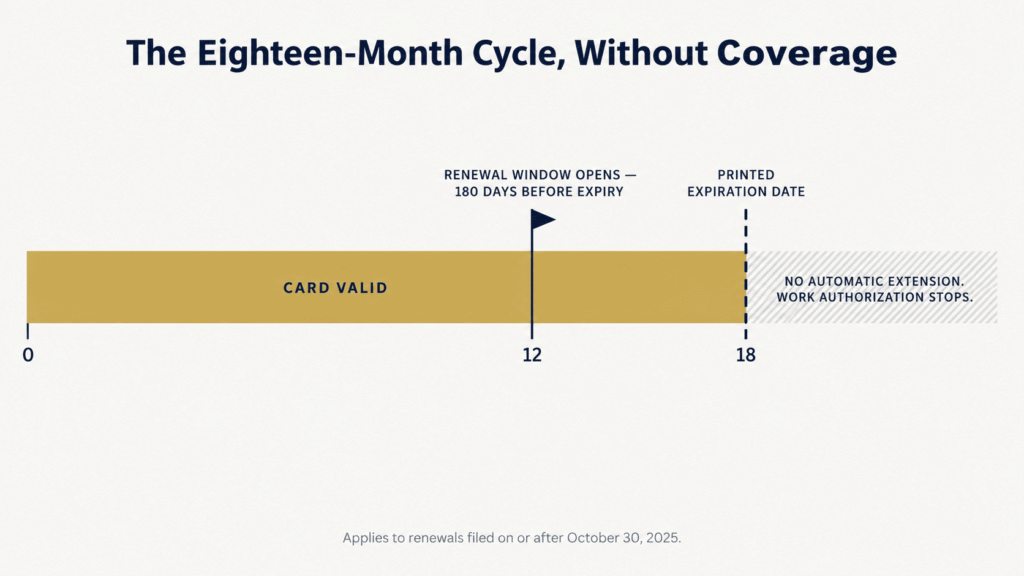
A DHS interim final rule effective October 30, 2025 ended that practice for renewal applications filed on or after that date. Category (c)(9) is among those affected. Applicants who received extension notices before October 30, 2025 may still rely on them for the remainder of that period, but every renewal filed since then carries no coverage at all. When the printed date passes, work authorization stops, regardless of whether USCIS has looked at the file.
Why C09 Cards Now Expire in Eighteen Months
Five weeks later, a USCIS policy update effective December 5, 2025 cut the maximum validity period for initial and renewal cards in several categories, including (c)(9), from five years to eighteen months.
Either change alone would be manageable. Together they invert the arrangement that made early filing sensible: longer cards existed precisely because I-485 applications sit for years.
What the Renewal Cycle Looks Like on a Long Wait
USCIS generally accepts a renewal application up to 180 days before the current card expires. On an eighteen-month card, that means roughly twelve months of settled work followed by six months of watching a receipt number.
An applicant facing another nine years in line will file six or seven more renewals, each an independent adjudication with its own chance of running past the printed date. The question is not whether a gap will happen but how many chances there are for one.
What a (c)(9) holder can and cannot rely on now:
- The printed expiration date is the hard stop for renewals filed on or after October 30, 2025. A pending receipt notice is not work authorization.
- The 180-day filing window is the only lever the applicant controls. Filing at the earliest permitted date is the difference between a comfortable margin and none.
- An expired card ends employment, not the case. The underlying I-485 stays pending and the priority date is unaffected.
- The employer has no discretion. Once the document expires without a valid replacement, reverification obligations take over.
Is your work permit renewal sitting past its processing time while your green card waits on a visa number?
Our team can review your category and receipt dates, how long the renewal has been pending against the published time, whether an open request on the I-485 is holding it, the employment consequences already in motion, and whether a federal filing is realistic.
The I-485 Delay Is Barred. The I-765 Delay Is Not.
Applicants in this position often ask whether a federal court can order USCIS to decide the green card application. On that question the law has moved sharply against them, and it is better to know which part of the case is litigable before anyone drafts a complaint.
Why the Green Card Application Is Behind a Closed Door
Five federal appellate circuits have now held that courts lack jurisdiction over challenges to the pace at which USCIS handles a held adjustment application. The Eleventh Circuit reached that result in Kanapuram v. Director, USCIS in March 2025, and the Fourth Circuit followed in Kale v. Alfonso-Royals that June, joining the Third, Fifth and Eighth. The reasoning in each case turns on the same feature: adjustment of status is statutorily discretionary, and that discretion has been read to cover the timing of the process, not only its outcome.
USCIS has since leaned further into that framing. Policy Memorandum PM-602-0199, issued May 21, 2026, instructs officers to treat adjustment as discretionary relief granted as a matter of administrative grace rather than as a routine benefit. The memorandum is about how applications are decided, not how fast, but it reinforces the same statutory lever the circuits relied on. The full analysis appears in our guide to retrogression and what courts will review.
Why the Work Permit Application Is Not
None of that reasoning reaches Form I-765 or Form I-131. Those are not discretionary grants of permanent residence. Eligibility for a (c)(9) card follows from the fact that an adjustment application was properly filed and remains pending; once that condition holds, the decision is a ministerial one the agency owes.
The practical consequence is the point most applicants miss. Your final action date does not have to be current for a renewal delay to be actionable. The unavailability of a visa number explains why the green card has not issued. It explains nothing about why a work permit renewal has been sitting for ten months.
The One Thing That Can Tie Them Together
There is a genuine exception, and an honest case assessment has to check it first. USCIS will not approve the (c)(9) application until the underlying I-485 has cleared an initial review confirming it was properly filed. An unanswered request for evidence on the adjustment application, an unresolved signature or fee problem, or a filing USCIS considers defective can therefore freeze the renewal for a reason that has nothing to do with agency inaction.
That is a fact question, and it is usually answerable from the notices already in the file. Where the adjustment application is clean and simply held for a visa number, the renewal has no such excuse behind it.
When a Renewal Delay Becomes Ripe
With the 90-day rule gone, no number makes a case automatically ready. What replaces it is a comparison against the agency’s own published expectations, plus evidence of what the delay is costing. Three things carry the analysis.
The published processing time. USCIS reports times on its case processing times tool by form category and office, based on how long most adjudicated cases took over the preceding six months. A renewal sitting well past the figure for its own category and office is the starting point, not the conclusion.
The filing date relative to the window. A renewal filed at the earliest permitted date and still undecided at expiration presents very differently from one filed three weeks out. Diligence on the applicant’s side is part of the record.
Concrete, documented harm. Lost employment, a withdrawn offer, a suspended professional license. Whether a wait has become unreasonable is assessed through the TRAC factors, and that showing usually rests on documents rather than description.
What to Have in Hand Before You Call a Lawyer
- Receipt notices for the I-485, the I-765 and, if filed, the I-131, with dates.
- The front and back of the expiring or expired card, showing the category code.
- Every notice USCIS has issued on the adjustment application, including any request for evidence and your response.
- A record of the service requests, congressional inquiries or ombudsman contacts already attempted, and the replies.
- Written evidence of the employment consequence, such as a reverification notice or suspension letter.
Advance Parole Sits on the Same Shelf
Form I-131 follows the same logic and deserves its own timeline check. It is a separate application with a separate receipt and a separate agency obligation, and it does not depend on an available visa number either.
The stakes differ. Leaving the United States on a pending adjustment application without advance parole in hand can result in the application being treated as abandoned, which turns a travel problem into the loss of the case. The litigation considerations specific to both interim benefits are addressed in our guide to EAD and advance parole delays.
Frequently Asked Questions
Can I keep working while my C09 renewal is pending?
Not if you filed the renewal on or after October 30, 2025. The automatic extension was eliminated for those filings, so work authorization ends on the date printed on the card. Applicants who received an extension notice before that date may still rely on it for the period stated.
My priority date is not current. Can I still sue over the work permit?
Yes. Visa number availability governs whether the adjustment application can be approved. It is not a condition of adjudicating the interim applications, and the delay analysis for those is separate.
Will suing over the EAD speed up my green card?
No, and it should not be presented that way. The relief sought is a decision on the delayed interim application. The adjustment application remains subject to visa availability and, in five circuits, to case law holding its pace unreviewable.
Why is my renewal stuck when the I-485 has been quiet for years?
Check for an open item on the adjustment application first. USCIS will not approve a (c)(9) application until the underlying filing clears an initial review, so an unanswered request for evidence can hold the renewal without any separate decision being made about it.
Should I try an expedite request instead?
Attempting the administrative route first is usually worth the time and strengthens the record either way. Expedite criteria are narrow and the decision is discretionary, so it is a step in the sequence rather than a substitute.
What should my employer do when the card expires?
Reverification obligations attach to the document, not to the pending case. Telling an employer that a green card application is pending does not preserve authorization, which is why the timing of the renewal filing matters more now than it did before October 2025.
The Green Card Is Frozen. The Work Permit Should Not Be.
Filing under the earlier chart bought exactly one thing, and two rule changes in late 2025 made that one thing fragile. The adjustment application will wait as long as the line takes, and there is currently little a court in most of the country will do about that.
The interim applications are different, and treating them as part of the same frozen block is the mistake that costs people their jobs. Ask three questions: is the renewal past the published time for its category and office, is the underlying application clean or is something open on it, and is the employment consequence documented. Those answers separate a wait that has to be absorbed from one that has a remedy.
Your case delay is not your fault.
A mandamus or APA lawsuit is a legal remedy against unreasonable USCIS delay. Contact our team for a review of your receipt dates and category, the published processing time that applies to your filing, whether anything open on the adjustment application is holding the renewal, the employment harm already underway, and whether federal litigation is realistic in your jurisdiction.
Phone: +1 (862) 799-2200
Legal Disclaimer: This article is provided for general informational purposes only and does not constitute legal advice. Whether a particular renewal delay is actionable, which automatic extension rules apply to a given filing date, whether anything on the underlying adjustment application is holding the interim adjudication, and what relief is available depend on the eligibility category, the filing history, the controlling law of the jurisdiction, and the facts of the individual case. For legal guidance specific to your situation, we recommend consulting with an attorney experienced in federal immigration litigation. The information in this article reflects federal regulations, agency guidance and judicial authorities reviewed as of September 21, 2026; subsequent changes may affect its accuracy. Prior results do not guarantee a similar outcome.
Sources
- USCIS Policy Manual, Volume 7, Part A, Chapter 6, Adjudicative Review, U.S. Citizenship and Immigration Services, accessed September 21, 2026.
- Adjustment of Status Filing Charts from the Visa Bulletin, U.S. Citizenship and Immigration Services, accessed September 21, 2026.
- Retention of EB-1, EB-2, and EB-3 Immigrant Workers and Program Improvements Affecting High-Skilled Nonimmigrant Workers, final rule, 81 FR 82398, Department of Homeland Security, November 18, 2016.
- Removal of the Automatic Extension of Employment Authorization Documents, interim final rule, Department of Homeland Security, October 30, 2025.
- Policy Alert, Employment Authorization Document Validity Periods, U.S. Citizenship and Immigration Services, December 4, 2025.
- 8 CFR 274a.13, Application for Employment Authorization, Electronic Code of Federal Regulations, accessed September 21, 2026.
- Kanapuram v. Director, U.S. Citizenship and Immigration Services, No. 23-12826, U.S. Court of Appeals for the Eleventh Circuit, March 20, 2025.
- Kale v. Alfonso-Royals, No. 23-1799, U.S. Court of Appeals for the Fourth Circuit, June 3, 2025.
- Policy Memorandum PM-602-0199, Adjustment of Status is a Matter of Discretion and Administrative Grace, U.S. Citizenship and Immigration Services, May 21, 2026.
- Check Case Processing Times, Form I-765, U.S. Citizenship and Immigration Services, accessed September 21, 2026.