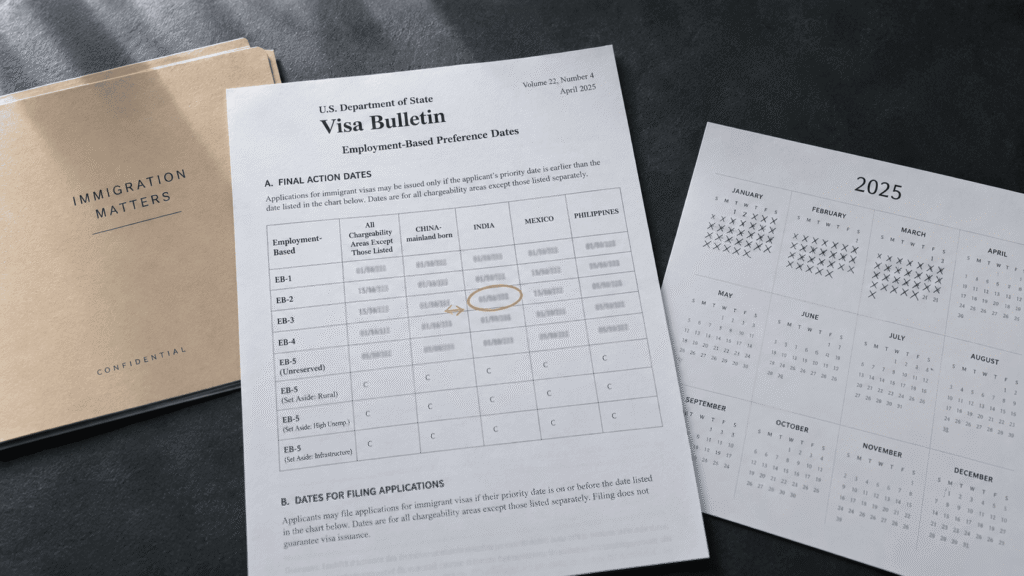
Your priority date was current. Then the next Visa Bulletin pulled the cutoff backward, and everything stopped. The question is whether the application you already filed still counts, and whether any part of the wait is yours to act on.
Retrogression is neither a denial nor an administrative error. It is what happens when the Department of State has published dates that draw more demand than the annual limits can absorb, and has to pull the line back to stay inside them. The September 2026 bulletin, the final one of fiscal year 2026, showed both halves of that cycle at once: family-sponsored final action dates advancing by years, while EB-2 India and EB-5 Unreserved India remained unavailable for the rest of the year.
A retrogressed date freezes an outcome, not a file. This guide covers why cutoff dates move backward, what happens to an application already on file, what keeps running while you wait, how a child’s age is affected, and where the line now sits between a delay a federal court will examine and one it will not.
If your date is current and nothing is moving, that is a different problem. Our separate guide covers a current I-130 priority date with no action.
In This Article When Your Date Moves Backward
Why Cutoff Dates Move Backward
Congress caps how many immigrant visas may be issued each year and limits how many of them any one country may take. Demand in the oversubscribed categories runs far past those ceilings, so the Department of State publishes a cutoff date each month instead of a queue number. USCIS describes the priority date as the applicant’s place in that line, and the bulletin as the instrument that says which part of the line the government can reach.
The Date Is an Estimate, and Estimates Are Corrected
A cutoff date is set on a forecast of how many people behind it will actually come forward. When fewer come forward than expected, the Department advances the date to avoid wasting numbers before the fiscal year closes. When more come forward than expected, or when a per-country limit is reached sooner than projected, the date has to be pulled back.
The Department says so in the bulletin itself rather than leaving it to inference. Its June 2026 edition explained that dates had been advanced across several categories to make use of numbers available in fiscal year 2026, and warned that as additional demand materialized, retrogression might become necessary in the months ahead to keep issuances within the annual limits. It also flagged India EB-1 and EB-2 specifically, where number use had already forced final action dates backward.
Aggressive forward movement is therefore not a signal that a category is clearing. It is often the setup for a correction, and a family-sponsored applicant who saw a date jump by two years in one month is reading a number that has not yet been tested by demand.
When a Category Goes Unavailable Instead
Sometimes the correction is not a date but a letter. A category marked “U” is unauthorized, meaning no numbers may be issued in it at all for the remainder of the fiscal year. EB-2 India carried that marking from July 2026 through the end of fiscal year 2026, with the annual allocation resetting on October 1.
A reset replenishes the supply. It does not erase the queue, and the date a category returns at can sit well behind where it stood before it closed.
What Happens to an Application You Already Filed
An adjustment of status application that was properly filed when a visa was available remains properly filed. USCIS does not return it, reject it, or treat it as abandoned because the chart moved afterward.
What changes is the ending. Under 8 CFR 245.2(a)(5)(ii), an adjustment application filed by a preference applicant may not be approved until an immigrant visa number has been allocated by the Department of State. No number, no approval. The file sits in what USCIS administers as an adjudication hold until the applicable final action date reaches the priority date again.
Your Filing Date and Priority Date Do Not Reset
Two dates survive retrogression untouched. The priority date, which is your position in the line, stays exactly where it was. The receipt date of the adjustment application stays where it was as well, which is what keeps derivative family members attached to the filing and keeps the application eligible for the benefits that depend on it being pending.
Nothing about the wait pushes you further back. The line stopped moving toward you; you did not move away from it.
Why a File Can Be Finished and Still Not Approved
USCIS can complete most of the work on a held case. Background and security checks can be run, an interview can be conducted, a request for evidence can be issued and answered. What the agency cannot do is take the final step, because that step consumes a visa number that does not exist for your category and country this month.
This is why a case can look complete on paper and still produce nothing. For employment-based applicants, the same pattern appears in our guide to an employment-based I-485 still pending after I-140 approval, where the distinction between a file that is not ready and a file that is ready but unfundable does most of the analytical work.
What Keeps Running While the Case Is Held
The held application is the most visible part of the case and the part you control least. Several other parts are neither held nor discretionary in the same way, and they are where a retrogressed applicant actually has something to do.
Work Authorization and Travel Documents Are Separate Applications
Employment authorization and advance parole tied to a pending adjustment application are filed on their own forms, carry their own receipts, and are adjudicated on their own timelines. A visa number is not required for either one. When a case is going to sit for years, keeping these current is not administrative housekeeping; it is what preserves the ability to work and to travel during the wait.
They are also a separate agency obligation. A renewal that sits unadjudicated past its normal processing time is a delay in its own right, addressed in our guide to delays in EAD and advance parole adjudication. Retrogression explains why the green card has not issued. It does not explain why a work permit renewal has been pending for ten months.
Job Changes, Travel, and Keeping the File Reachable
Three practical points matter more during a long hold than they do in a fast case.
A pending adjustment application that has been on file for 180 days or more, with an approved immigrant worker petition behind it, generally allows a change to a new job in the same or a similar occupational classification without starting over. Retrogression makes this relevant precisely because the wait now spans careers rather than months.
Travel outside the United States on a pending application ordinarily requires advance parole issued before departure, and leaving without it risks the application being treated as abandoned. And every notice the government sends goes to the address it has on record, so an unreported move can turn a routine request for evidence into a denial you never saw coming.
Not sure whether retrogression is the real reason your case has not moved?
Our team can review your priority date and category, the chart that applied when you filed, how long the case has been held, whether any separate application is sitting past its own processing time, and whether a federal filing is realistic.
Children Turning 21 During a Retrogression
For a family with a child approaching twenty-one, retrogression raises a sharper question than anyone else’s: does the child lose the case by waiting?
The Child Status Protection Act answers it with a calculation rather than a birthday. A child’s age for immigration purposes is measured at the moment a visa became available to the family, reduced by the time the underlying petition spent pending, and the applicant must then seek to acquire permanent residence within one year of that availability.
The part that matters here is what happens when availability disappears afterward. The USCIS Policy Manual addresses retrogression directly and works through an example in which a visa becomes available in one month and the chart retrogresses two months later. The age is calculated using the earlier date, when the visa was available. A date that locked does not unlock because the chart moved.
One change is worth confirming against your own filing date. On August 8, 2025, USCIS announced that availability for this calculation is determined by the Final Action Dates chart, applying to requests filed on or after August 15, 2025, while applications already pending before that date continue under the earlier policy. Which policy governs your child depends on when the application was filed, and the two can produce different results.
What Is Still Reviewable, and What Courts Say Is Not
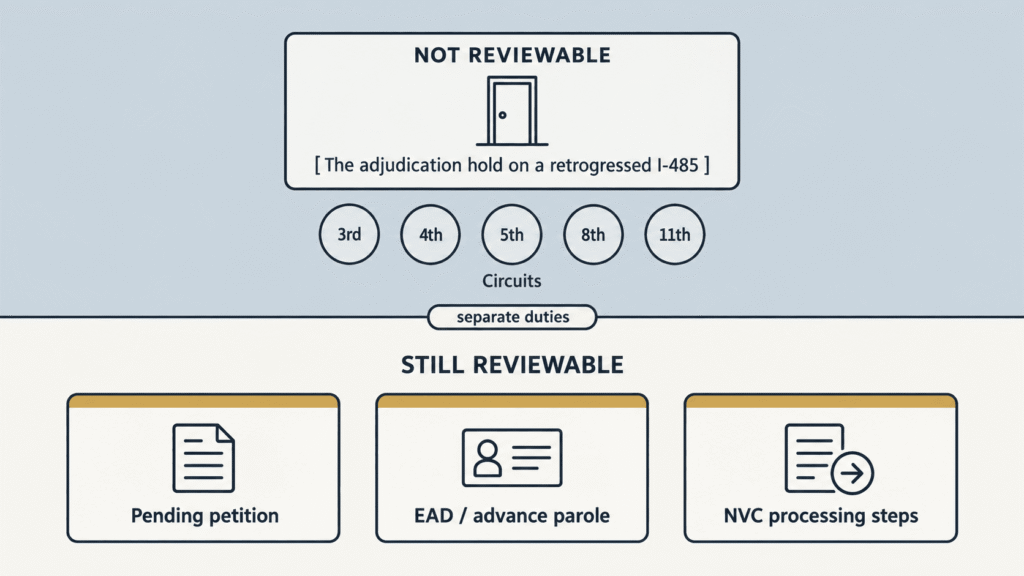
Applicants who have waited years for a held case reasonably ask whether a federal court can order USCIS to decide it. On the hold itself, the answer has hardened considerably, and it is better to know that before filing than after.
Five Circuits Have Declined to Review the Hold
In Kanapuram v. Director, USCIS, two Indian nationals in EB-2 had filed adjustment applications while within the cutoff, then watched the final action date move back more than two years while those applications were pending. After nineteen months they sued, asking the court to declare the retrogression policy unlawful and to compel adjudication within thirty days. The Eleventh Circuit affirmed dismissal in March 2025, holding that the statute governing adjustment confers discretion broad enough to cover not only the decision but the pace at which the process is conducted, and that challenges to that pace are barred from judicial review.
The Fourth Circuit reached the same conclusion three months later in Kale v. Alfonso-Royals, describing the question as one already confronted by its sister circuits and joining the Third, Fifth, Eighth and Eleventh in finding that federal courts lack jurisdiction over challenges to the adjudication hold policy. That is five circuits, none in the other direction.
A lawsuit aimed at the hold itself is now facing settled authority in a large part of the country. That is a reason to identify what the case is actually about before drafting anything.
The Steps That Remain Separate Duties
The hold covers the grant of adjustment. It does not convert every stage of the case into an unreviewable one. An immigrant petition that remains undecided is its own pending matter, since approving it establishes a place in line rather than granting residence. A work permit or travel document application carries its own obligation to decide. So do the document review and interview scheduling stages handled by the National Visa Center and the consulate in a case processed abroad.
Whether a particular wait in one of those stages has become unreasonable is a separate analysis, one courts commonly run through the TRAC factors. And retrogression is only one of several things USCIS may mean when it reports that a case is on hold, a distinction drawn out in our guide to what USCIS means when it says your case is on hold.
Mistakes That Make the Wait Worse
Most of the damage done during a retrogression is self-inflicted and avoidable.
- Withdrawing and refiling later. The pending application is what holds the filing date and the derivatives attached to it. Withdrawing surrenders both.
- Letting the underlying nonimmigrant status lapse on the assumption that a pending application is itself a status.
- Traveling without advance parole in hand, which can be treated as abandonment of the application.
- Letting a work permit or travel document expire because the green card felt like the only thing worth tracking.
- Moving without updating the address on record, then missing a request for evidence.
- Filing suit over the hold itself without checking the controlling law in the circuit where the case would be brought.
Frequently Asked Questions
Does retrogression cancel my pending application?
No. An application properly filed when a visa was available stays on file. It cannot be approved until a number is allocated again, but it is not rejected, returned or abandoned because the chart moved.
Does my priority date change when the chart retrogresses?
No. Your priority date is fixed by the underlying petition and does not move. What moved is the cutoff the government can currently reach.
Should I refile when my date becomes current again?
Generally no, if an application is already pending. Refiling surrenders the original filing date and the benefits that depend on it. Confirm your filing is still properly pending before considering anything else.
Can I keep working and traveling while the case is held?
Work authorization and advance parole are separate applications with their own timelines and do not require an available visa number. Keeping them current is what preserves the ability to work and travel during a long wait.
Will my child age out because the date went backward?
Not necessarily. The age calculation uses the date the visa became available, and USCIS applies that earlier date even where the chart retrogresses afterward. Which version of the policy governs depends on when the application was filed.
Can I sue USCIS over the retrogression hold?
Five federal appellate circuits have held that courts lack jurisdiction over challenges to the hold itself. A separate step in the same case, such as an undecided petition or an unadjudicated work permit, may still be a reviewable duty.
Retrogression Stops the Approval, Not the Case
A date moving backward is the visible part of a numerical system doing what it was built to do. The application you filed keeps its date, its derivatives and its position. What it loses is the ending, until the chart returns.
Three questions separate a wait you have to absorb from one you can act on: is the category genuinely unavailable this month, is every separate application in the case current and adjudicated, and is the delay in any one of those steps now running past what the agency can explain. Answer those three and you will know whether the hold is the reason your case has not moved, or only the reason that is easiest to give.
Your case delay is not your fault.
A mandamus lawsuit is a legal remedy against unreasonable USCIS, NVC and consular delays. Contact our team for a review of your category and priority date history, how long the application has been held, the status of every related filing in the case, the responses the agency has given, and whether federal litigation is realistic in your jurisdiction.
Phone: +1 (862) 799-2200
Legal Disclaimer: This article is provided for general informational purposes only and does not constitute legal advice. Whether a visa is available in a given month, how a retrogression affects a particular filing, which age calculation policy applies, and whether any delay in a case is reviewable depend on the category, the country of chargeability, the procedural history, the controlling law of the jurisdiction, and the facts of the individual case. For legal guidance specific to your situation, we recommend consulting with an attorney experienced in federal immigration litigation. The information in this article reflects Department of State bulletins, federal regulations, agency guidance and judicial authorities reviewed as of September 16, 2026; subsequent changes may affect its accuracy. Prior results do not guarantee a similar outcome.
Sources
- Visa Bulletin for September 2026, Bureau of Consular Affairs, U.S. Department of State, August 2026.
- Visa Bulletin for June 2026, Bureau of Consular Affairs, U.S. Department of State, May 2026.
- Visa Availability and Priority Dates, U.S. Citizenship and Immigration Services, accessed September 16, 2026.
- 8 CFR 245.2, Application, Electronic Code of Federal Regulations, accessed September 16, 2026.
- USCIS Policy Manual, Volume 7, Part A, Chapter 3, Filing Instructions, U.S. Citizenship and Immigration Services, updated July 10, 2026.
- USCIS Policy Manual, Volume 7, Part A, Chapter 7, Child Status Protection Act, U.S. Citizenship and Immigration Services, updated August 8, 2025.
- USCIS Updates Policy on CSPA Age Calculation, U.S. Citizenship and Immigration Services, August 8, 2025.
- Kanapuram v. Director, U.S. Citizenship and Immigration Services, No. 23-12826, U.S. Court of Appeals for the Eleventh Circuit, March 20, 2025.
- Kale v. Alfonso-Royals, No. 23-1799, U.S. Court of Appeals for the Fourth Circuit, June 3, 2025.