
The interview seemed to go well. Then the officer kept the file open, handed your spouse a 221(g) notice instead of a visa, and the case went quiet. You are in the United States, your husband or wife is abroad, and the reunion you planned around no longer has a date.
Spouse visa administrative processing is not a final denial, and the approved I-130 survives it. It is a review that happens after the interview, and in 2026 more IR-1 and CR-1 cases are landing in it: consular officers were retrained on public charge in August, a new Form I-864 became mandatory, and a travel ban now reaches the spouses of U.S. citizens from some countries.
Here is what usually holds a spouse case, how long the wait tends to run, what you can do from the U.S. side, and when a federal lawsuit fits.
In This Article
- What Spouse Visa Administrative Processing Means
- Why IR-1 and CR-1 Cases Are Held After the Interview
- What Changed for Spouse Visas in 2026
- How Long Does IR-1 Administrative Processing Take?
- What the U.S. Spouse Can Do From Here
- If the Consulate Returns the I-130 to USCIS
- When a Spouse Visa Delay Supports a Lawsuit
- Frequently Asked Questions
- Build the Record While the Consulate Decides
What Spouse Visa Administrative Processing Means
Administrative processing means the consular officer has refused the immigrant visa under section 221(g) for now, because the case needs more review before a final decision. Under State Department guidance, every completed application ends in issuance or refusal, and a case refused for more review can still be approved once administrative processing ends or the applicant supplies what was asked.
Three details help you read the pause correctly. The approved I-130 remains valid; only USCIS can revoke it. The visa tracker will usually show “Refused” for the whole review; our guide to CEAC “Refused” after an interview explains why. And the category matters. IR-1 and CR-1 are immediate relative visas for spouses of U.S. citizens, with no wait for a visa number. A CR-1 is issued when the marriage is less than two years old at admission and leads to conditional residence. A green card holder’s spouse files in the F2A category instead, so a delay there can also be a visa number problem, covered in our guide to an I-130 priority date that is current but not moving.
Not interviewed yet? That is a scheduling problem; see our guide to NVC interview scheduling delay. Adjusting status inside the United States? See marriage green card delay.
Why IR-1 and CR-1 Cases Are Held After the Interview
A spouse case can stop after the interview for reasons a work visa rarely meets. The reason matters because it decides who holds the next move.
| Reason for the hold | What it usually looks like | Who can move it |
|---|---|---|
| Relationship evidence | Questions about the marriage or a prior marriage, then a request for photos, travel records or civil documents. | You and your spouse, by sending one complete and consistent record. |
| Affidavit of Support | A request for tax transcripts, proof of current income, a joint sponsor or the current I-864 edition. | The U.S. sponsor and any joint sponsor. |
| Public charge review | Questions on finances, health or job prospects; in some cases, a notice to apply for a public charge bond. | The sponsor’s evidence, and USCIS if a bond is required. |
| Security or background check | A request for travel history or a DS-5535, then silence. | Agencies outside the consulate. Your part is a dated record of the wait. |
| I-130 sent back to USCIS | A notice that the I-130 went back to USCIS for another look. | USCIS, and you through the response to any notice. |
Marriage Evidence and Relationship Questions
USCIS found the marriage genuine when it approved the I-130, but the consular officer reviews the record again. Answers that differ between the spouses, a prior marriage without a final divorce record, or gaps between the I-130 and the DS-260 often lead to a request for more evidence.
Send that evidence once and keep it consistent with what you filed before. Our guide on how to respond to a 221(g) document request covers format and delivery.
The Affidavit of Support Under the New I-864
Most spouse cases need a Form I-864 from the U.S. petitioner. Since October 1, 2026, USCIS accepts only the 08/24/26 edition, and signing it authorizes the government to request the sponsor’s consumer credit information. A credit freeze can block that request. If the file at the consulate holds an older edition or outdated tax records, expect a request for a replacement. Our sister firm’s Form I-864 guide covers the full income rules.
Security Checks and Prior Immigration History
Some files leave the consulate for a security review run by other agencies; our guide to security advisory opinion delays explains how that review is timed. A prior overstay, a removal order or an earlier visa refusal can also send the case to waiver or legal review.
One point is often misread. The State Department’s formal online presence review lists nonimmigrant classes, including K-1 and K-3, not IR-1 or CR-1 immigrant visas. Officers still review whatever the file contains, but a held spouse case is not part of that program by default.
What Changed for Spouse Visas in 2026
Three 2026 developments changed what happens after a spouse interview, and each points to a different next step.
Public Charge Retraining and the Interview Pause
In late August 2026, the State Department rescheduled immigrant visa interviews worldwide while consular officers trained on public charge screening, and a September 10 cable told posts to resume. For a spouse who has already interviewed, the practical effect is a closer reading of the financial side of the file. Under INA section 212(a)(4), the officer decides whether the applicant is likely to become a public charge, and the sponsor’s I-864 is the main evidence against that finding.
Public Charge Bonds for Immigrant Visas
Since August 2026, a State Department procedure lets consular officers require certain immigrant visa applicants refused on public charge grounds to apply for a bond with USCIS. You cannot request a bond yourself; the officer must notify you. If the bond is approved, the officer may issue the visa when every other requirement is met.
A bond notice is a refusal under section 212(a)(4), not ordinary administrative processing. The answer to it is evidence and the bond process, not waiting.
Refusals That Are Not Administrative Processing
Two other refusals can look like administrative processing on CEAC. The 75-country immigrant visa pause is no longer in effect as of August 21, 2026, and refusals based only on that pause are being revisited; our guide to a refusal under the 75-country pause covers the follow-up. Separately, Proclamation 10998, in force since January 1, 2026, removed the exception that had protected IR-1 and CR-1 applicants from the listed countries. A refusal under that proclamation turns on its exceptions, not on how long the case has waited. The reach is wide: a Cato Institute analysis estimates that the country bans reached half of all spouses and minor children of U.S. citizens, based on 2024 data.
How Long Does IR-1 Administrative Processing Take?
IR-1 administrative processing has no published time limit. The State Department says its length depends on each case. Our guide to 221(g) administrative processing sets out general ranges and the point where a wait turns unusual. In spouse visa administrative processing, the more useful question is what is still open in the file.
What Adds Time to a Spouse Case
- A second document request because the first answer was incomplete.
- A joint sponsor whose own documents are missing or out of date.
- A security review that leaves the consulate.
- A return of the I-130 to USCIS.
- A transfer to another post under the regional consular hubs.
Signs the Wait Is No Longer Routine
The State Department asks applicants, except in emergencies such as a serious illness or death in the immediate family, to wait at least 180 days from the interview or the last document submission, whichever is later, before asking about administrative processing.
Past that mark, four signals deserve attention: no new request in months, the same generic reply to each inquiry, proof that everything requested was delivered, and harm that is growing rather than stable, such as a pregnancy or a child born abroad.
Spouse visa stuck after the interview?
Send us the interview date, the 221(g) notice and the current CEAC status. We review the record and tell you plainly whether a federal case makes sense yet.
What the U.S. Spouse Can Do From Here
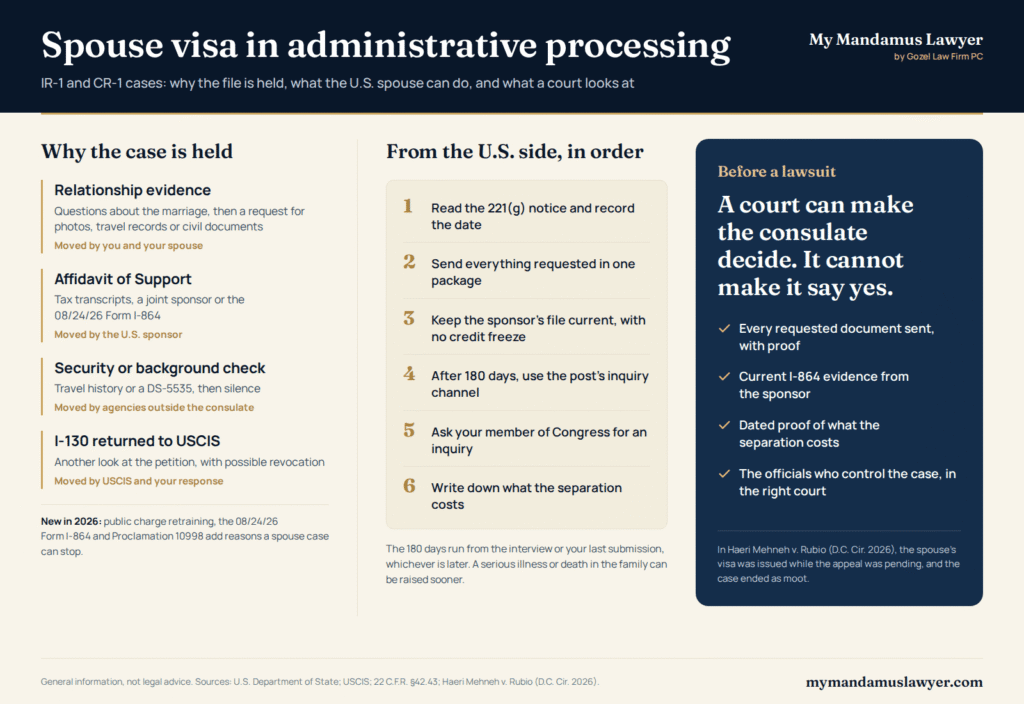
You are not the applicant at the consulate, but as the petitioner, and usually the sponsor, you have a real role. Take these steps in order:
- Read the 221(g) notice and record the date. If it asks for documents, you have one year from the refusal to provide them under 22 C.F.R. §42.81(e).
- Send everything requested in one complete package, by the method the post names.
- Keep the sponsor file current: the latest tax transcript, recent pay records, an employment letter, and no credit freeze.
- After 180 days, use the post’s immigrant visa inquiry channel. Raise an emergency sooner.
- Ask your member of Congress to open a congressional inquiry.
- Record what the separation costs, then get a case review.
Contacting the Consulate as the Petitioner
Many posts accept inquiries from the petitioner; check the post’s website. Give the case number and interview date, and keep a copy of every message. For a unique hardship, the State Department asks applicants to tell the consular section; say what changed and attach proof. One clear inquiry works better than repeated messages.
Congressional Inquiries, and Why the CIS Ombudsman Rarely Fits Here
A congressional caseworker can ask the State Department about the case. The answer often only confirms administrative processing, but it still belongs in your record.
The CIS Ombudsman helps with USCIS problems. The Department of Homeland Security directs questions about visas, the NVC and consular processing to the State Department. The Ombudsman becomes relevant only if the file returns to USCIS.
Documenting What the Separation Costs
Courts and officers respond to specifics. A couple paying two rents, a spouse managing a pregnancy across time zones, a child who knows one parent mostly from video calls: each is concrete harm once it is written down with dates and receipts.
Keep that evidence in one file. It speaks to two of the TRAC factors courts use to judge delay: human health and welfare, and the interests the delay harms.
If the Consulate Returns the I-130 to USCIS
Some spouse files leave the consulate entirely. Under 22 C.F.R. §42.43, a consular officer must suspend action and return the petition when the officer knows or has reason to believe it was approved through fraud or misrepresentation, or that the beneficiary is not entitled to the approved status. In spouse cases the concern is usually whether the marriage is genuine or whether a prior marriage legally ended.
USCIS can then keep the approval or start revocation under INA section 205, normally with a notice you can answer. USCIS publishes no processing time for this review; see our guide to a petition returned to USCIS for how it runs and when the delay becomes actionable.
When a Spouse Visa Delay Supports a Lawsuit
A federal lawsuit cannot end spouse visa administrative processing with an approval. It can ask a judge to order the State Department to finish the case once the wait has become unreasonable.
What Courts Weighed in 2026
In Haeri Mehneh v. Rubio, a U.S. citizen had petitioned for her husband. After his interview, the case was placed in administrative processing, and he sent the additional information requested. Sixteen months after the interview, the couple sued, and the district court dismissed the case under the TRAC factors.
While the appeal was pending, the State Department finished processing and issued the visa. On January 16, 2026, the D.C. Circuit dismissed the appeal as moot. The husband had entered the United States and applied for his green card.
The lawsuit and the visa are separate outcomes. In Mehneh, the couple lost in the district court and still received the visa while the appeal was pending. The length of the wait rarely carries a delay claim on its own; the work left on the consulate’s side and the harm you can prove usually matter more.
What Muñoz Does and Does Not Decide
In Department of State v. Muñoz, decided June 21, 2024, the Supreme Court held that a U.S. citizen does not have a fundamental liberty interest in a noncitizen spouse’s admission. The citizen therefore has no constitutional right to a fuller explanation of a refusal. That case involved a final refusal. A delay claim asks for a decision, not a reason, and courts still differ on how consular nonreviewability affects it; our 221(g) delay guide covers that split.
Who Sues, Whom, and Where
The U.S. spouse usually joins the case as a plaintiff, which can open venue where the petitioner lives as well as in Washington, D.C.; venue options are covered in our guide on where to file a mandamus lawsuit. The defendants should be the officials with real authority over the case, and our page on consular delay lawsuits explains how we evaluate these cases.
Frequently Asked Questions
How long is administrative processing for an IR-1 visa?
There is no set period. Outside emergencies, the State Department asks applicants to wait at least 180 days from the interview or last submission before asking about status.
Does administrative processing mean my spouse visa will be denied?
No. It is a temporary refusal that can be reversed when the review ends or once you provide what was asked. The outcome depends on what the review finds.
Can I contact the embassy as the U.S. petitioner?
Usually yes, through the post’s immigrant visa inquiry channel. Wait for the 180-day mark unless you have an emergency.
What happens if the I-130 is sent back to USCIS?
Visa processing stops. USCIS may reaffirm the petition or issue a notice of intent to revoke that you can answer.
Does the 2026 public charge review apply to spouses of U.S. citizens?
Yes. The public charge ground applies to most family immigrant visa applicants, including spouses, and the sponsor’s I-864 is the main evidence. A public charge bond comes into play only if the officer requires one.
Can I sue the State Department for a spouse visa delay?
In some cases. Judges weigh the length of the wait, the work still pending at the consulate and the harm you can show. A lawsuit can lead to a decision; it cannot guarantee approval.
Build the Record While the Consulate Decides
Spouse visa administrative processing has no fixed end date. You cannot set the consulate’s pace, but you control most of what it reads next. Answer requests once and completely, keep the sponsor’s evidence current, ask through the right channel after 180 days and write down what the separation costs. If the wait outlasts that record, a lawyer will start with the same documents a court would.
Get a Spouse Visa Case Review
Your case delay is not your fault. Share the consulate, the interview date and what was requested. Keep the I-130 approval notice, the 221(g) notice and a CEAC screenshot at hand for the first review.
Phone: +1 (862) 799-2200
Legal Disclaimer: This article is provided for general informational purposes only and does not constitute legal advice. Every immigration case has unique circumstances. For legal guidance specific to your situation, we recommend consulting with an experienced immigration attorney. The information in this article reflects laws and policies as of the publication date; subsequent changes may affect its accuracy.
Sources
- Administrative Processing Information, U.S. Department of State, accessed October 23, 2026.
- Visa Appointment Wait Times (administrative processing inquiry notice), U.S. Department of State, accessed October 23, 2026.
- Immigrant Visa Processing Updates for Nationalities at High Risk of U.S. Public Benefits Reliance, U.S. Department of State, August 28, 2026.
- Public Charge Bonds for Immigrant Visa Applicants, U.S. Department of State, August 5, 2026.
- Announcement of Expanded Screening and Vetting for Visa Applicants, U.S. Department of State, March 25, 2026.
- State Department Pauses Immigrant Visa Appointments Worldwide, Boundless, August 26, 2026.
- State Department Resumes Immigrant Visa Interviews and Processing, University of Michigan International Center, updated September 23, 2026.
- Form I-864, Affidavit of Support Under Section 213A of the INA, U.S. Citizenship and Immigration Services, accessed October 23, 2026.
- Proclamation 10998, Restricting and Limiting the Entry of Foreign Nationals To Protect the Security of the United States, Office of the Federal Register, December 16, 2025.
- 22 C.F.R. §42.43 and §42.81; 8 U.S.C. §1155 and §1186a, Cornell Legal Information Institute.
- Haeri Mehneh v. Rubio, No. 25-5001, U.S. Court of Appeals for the D.C. Circuit, January 16, 2026.
- Department of State v. Muñoz, No. 23-334, Supreme Court of the United States, June 21, 2024.
- Immigration Resources to Help You Navigate the Citizenship and Immigration Services Process, CIS Ombudsman, U.S. Department of Homeland Security.
- President Trump Cut Legal Immigrant Entries 2.7 Times More Than Illegal Entries, Cato Institute, October 8, 2026.