
Your USCIS case status says “Response To USCIS’ Request For Evidence Was Received,” the date beside it keeps getting older, and nothing else has changed. That message confirms delivery. It does not start a decision deadline, and it does not mean an officer has your file open.
This guide covers the stage after you answer a request for evidence (RFE) on any USCIS form, up to the point where a federal mandamus lawsuit makes sense. If USCIS never sent an RFE and your case went quiet after an interview, read why USCIS still has not decided after the interview instead.
Below: the post-response clock by form, the August 2026 rule on partial responses, a checklist before you escalate, and how federal courts judge a delay after an RFE.
In This Article
- How Long After “Request for Evidence Was Received” Does USCIS Decide?
- What the Status Message Means, and What It Doesn’t
- The Post-Response Clock by Form
- Why a Decision Can Stall After the Response
- What to Check Before You Escalate
- Case Inquiry, Ombudsman or Congressional Inquiry After an RFE
- When Does Post-RFE Delay Become Unreasonable?
- Before You Sue: Is Your Post-RFE File Ready?
- Frequently Asked Questions
How Long After “Request for Evidence Was Received” Does USCIS Decide?
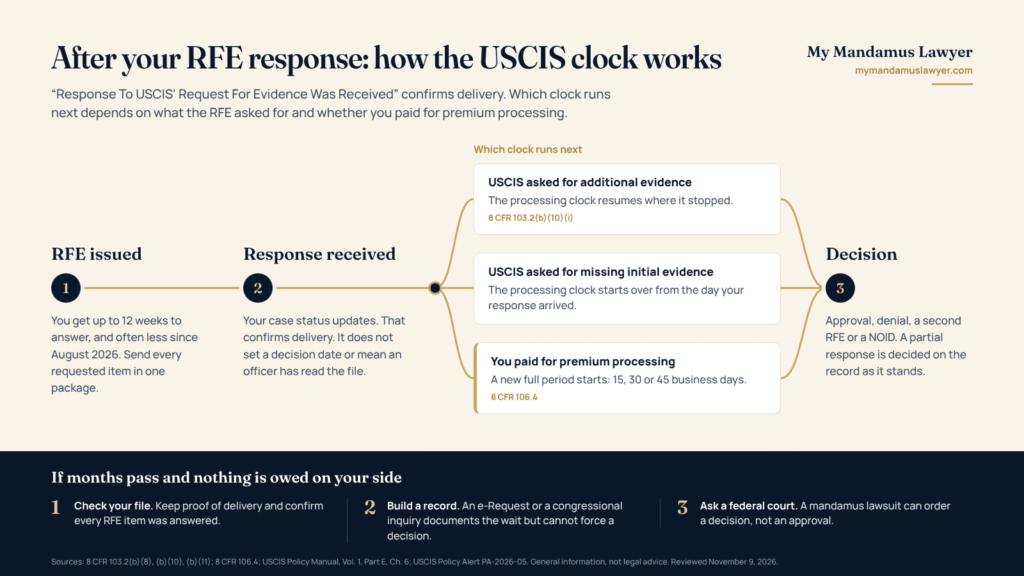
USCIS publishes no separate deadline for deciding a case after an RFE response. If you paid for premium processing, USCIS must act within a new, full premium period that begins the day it receives your response (8 CFR 106.4). Without premium processing, the processing clock pauses when USCIS asks for evidence and picks up where it stopped once your response arrives.
There is one exception. Under 8 CFR 103.2(b)(10)(i), if the RFE asked for missing initial evidence, meaning documents the form instructions required at filing, the processing period starts over from the day USCIS receives them. If it asked for additional evidence, the period was only suspended.
Posted USCIS processing times will not give you an exact answer either. They show how long USCIS took to complete 80 percent of recent cases, so by design one case in five takes longer, and they count from your original receipt date, not from your response. A decision can come within weeks or sit for many months. The rest of this guide explains that spread.
What the Status Message Means, and What It Doesn’t
The full message usually says that USCIS received your response to its Request for Evidence on a given date, that it “has begun working on your case again,” and that it will send a decision or tell you if it needs something more. Older versions name the office, such as the National Benefits Center.
“Begun Working on Your Case Again” Is Not an Officer Assignment
The update confirms that your response was logged into the file. It does not tell you whether an officer has read it, and it does not move you ahead of other cases. Your file goes back to its queue.
Two Meanings of “RFE Response Time”
People use the phrase for two different clocks. The first is how long you have to answer. Under 8 CFR 103.2(b)(8)(iv), an RFE can give you up to 12 weeks, plus three days when it is mailed, and no extensions are allowed. Since August 2026, employers have reported deadlines as short as 30 days, and naturalization RFEs generally allow 30 days, so always read the date on your notice. The second clock is how long USCIS takes to decide after you answer. That is the subject of this guide.
The Post-Response Clock by Form
The pause-or-restart rule applies to every form, but premium processing, separate statutes and the office holding your file change what happens next. Premium processing is available for most Form I-129 and Form I-140 filings, but not for Form I-485, Form I-130 or Form N-400.
| Form | Clock after your response | What else shapes the wait | Read next |
|---|---|---|---|
| I-129 (H-1B and other workers) | Premium: a new full period, 15 business days for most classifications. Regular: the paused clock resumes | The worker’s status may lapse while the petition waits | H-1B petition delays |
| I-140 | Premium: a new full period, 15 business days for most categories and 45 for EB-1C and NIW. Regular: the paused clock resumes | The classification on the receipt notice and that category’s queue | I-140 delays |
| I-485 | Regular only. Resumes, or starts over if the RFE asked for missing initial evidence | Visa availability, interview scheduling, linked I-765 and I-131 filings | I-485 delays |
| I-130 | Regular only. The paused clock resumes | Service center queue and, for spouses, a closer look at the marriage | I-130 delays |
| N-400 | Regular only. RFEs usually allow 30 days to respond | After the interview, 8 U.S.C. § 1447(b) opens a separate route to federal court 120 days after the examination | N-400 delays |
The clock rule tells you when USCIS’s own timeframe resumes or restarts. It does not give you a deadline you can enforce. Only a court order does that.
Has your status said “Request for Evidence Was Received” for months?
Our team can review your RFE notice, your response and proof of delivery, and your original receipt date, and tell you whether to wait, escalate or file in federal court.
Why a Decision Can Stall After the Response
Most post-RFE delays have little to do with the quality of the response. USCIS is deciding fewer cases than it receives: the American Immigration Council counted 12.1 million pending cases in the second quarter of fiscal year 2026, a record in its dataset. Inside that backlog, three things hold individual files.
Transfers, Security Re-Checks and Supervisory Review
Files move between the National Benefits Center, service centers and field offices, and each move can reset a case’s place in the internal queue. Background and security checks must be complete before an officer decides, and some must be repeated when a case sits too long. A case may also go to a supervisor or a fraud unit. None of these steps produces a status update. When USCIS calls the result a “hold,” see what a case on hold means legally.
A Second RFE or a NOID
The USCIS Policy Manual tells officers to put everything they need into a single RFE, but allows a follow-up RFE or a Notice of Intent to Deny (NOID) when a response raises new eligibility questions. A NOID is the stronger signal: it explains why USCIS intends to deny and gives at most 30 days to answer. If you are on a second or third RFE with no decision, read about repeated RFEs with no real movement.
After August 5, 2026: What a Partial Response Now Means
Under 8 CFR 103.2(b)(11), all requested materials must be sent together, and sending only some of them counts as a request for a decision on the record. USCIS Policy Alert PA-2026-05, issued August 5, 2026, restated that rule: USCIS does not wait for a second mailing or issue a new RFE just because a response was partial. The alert also widened officers’ discretion to deny without any RFE or NOID, including in cases already pending. AAUP v. Mullin (D. Mass.), filed October 5, 2026, challenges the alert, but it stays in effect while the case proceeds. If you realize something was missing from your response, get advice before mailing anything else.
What to Check Before You Escalate
Before you send an inquiry or call a lawyer, confirm that nothing is waiting on your side. A judge will ask the same questions.
- Proof of delivery. Keep the courier tracking record or the online upload confirmation, and check that its date matches the status update.
- Every item answered. Put the RFE next to your response and tick off each request. A gap is now treated as a request for a decision on what you sent.
- Your address. If you moved, update it with USCIS. A second RFE or an interview notice sent to an old address can cost you the case.
- Your online account. Notices for online filings often appear there before the paper copy arrives.
- Linked filings. A pending I-485 often carries an I-765 and an I-131, and family members have their own receipts. Check each one.
- Your status in the meantime. If you are here on a temporary status, confirm your I-94 and work authorization dates. The wait does not pause them.
Case Inquiry, Ombudsman or Congressional Inquiry After an RFE
The USCIS e-Request tool decides whether you may file an “outside normal processing time” inquiry by comparing your original receipt date with the posted inquiry date. It does not account for the RFE, so the tool may accept your inquiry while the reply points to your response as the reason the case is still within its timeframe.
According to CLINIC, replies usually arrive within 30 to 60 days, cannot compel a decision, and are most useful as a paper trail. CLINIC also notes that reduced staffing at the CIS Ombudsman has pushed practitioners toward congressional inquiries. Our guide compares service requests, the Ombudsman and congressional inquiries step by step.
When Does Post-RFE Delay Become Unreasonable?
A federal court can order USCIS to decide a case it has unreasonably delayed. It cannot order an approval. These suits usually combine the Mandamus Act, 28 U.S.C. § 1361, with the Administrative Procedure Act, which requires agencies to conclude matters within a reasonable time (5 U.S.C. § 555(b)) and lets courts compel action unreasonably delayed (5 U.S.C. § 706(1)).
Which Date the Delay Is Measured From
In a post-RFE case, expect the government to measure the delay from the day it received your response, because the regulation paused or restarted its own clock. Build your record on both numbers: the total time since filing, which shows the human cost, and the time since USCIS received a complete response, which shows that the remaining wait belongs to the agency. Our H-1B petition delay guide makes the same point: the response date becomes the new anchor.
How Federal Courts Weigh the Wait
Courts apply the six factors from Telecommunications Research & Action Center v. FCC (D.C. Cir. 1984): whether the agency follows a rule of reason, whether Congress set a timetable, whether human health and welfare are at stake, how an order would affect others in line, how much the delay hurts you, and the fact that the court need not find bad faith. No number of months qualifies automatically.
On March 30, 2026, the Supreme Court declined to hear Chen v. Mullin (No. 25-957), a petition asking whether courts should keep using this framework, so it remains the test. More on the TRAC factors and APA § 706(1) claims against USCIS.
What Weakens a Post-RFE Delay Claim
- Anything still owed on your side: an unanswered item, a missed biometrics appointment, an old address.
- A recent response, one USCIS received only weeks ago.
- A fresh agency step, such as a new RFE or an interview notice, which shows the file is moving.
- Venue. In Texas, Louisiana and Mississippi, the Fifth Circuit reads § 706(1) narrowly, so where you file is the first question.
Before You Sue: Is Your Post-RFE File Ready?
What a Lawsuit Can and Cannot Produce
Once the government is served, it has 60 days to answer under Federal Rule of Civil Procedure 12(a)(2), and USCIS often acts in that window. An approval or a denial ends the delay claim; whether a new RFE does depends on the facts. Across all case types, our published estimate is that most mandamus cases resolve within 30 to 60 days of filing, and no timing is guaranteed. See what happens if USCIS denies after you sue and how mandamus results are measured.
Why a Complete RFE Response Matters More After August 2026
A lawsuit makes USCIS decide on the record it has. Because a partial response counts as a request for a decision on that record, and officers now have wider room to deny without another request, your RFE response is what a forced decision will rest on. Before filing, have a lawyer read the RFE and your response side by side. Our evidence checklist for a mandamus lawsuit covers the delay side of the file.
Frequently Asked Questions
How do I know USCIS received my RFE response?
The status update is one confirmation, but keep your own: the courier’s delivery record or, for online filings, the submission confirmation in your account. If tracking shows delivery but the status never changes, keep that proof and ask the USCIS Contact Center to confirm receipt.
Does “begun working on your case again” mean an officer has my file?
Not necessarily. It confirms that your response was logged; an officer may not open the file for weeks or months.
Will USCIS send a second RFE?
It can, when your response raises new eligibility questions. Officers are told to request everything in one RFE, and a partial response does not earn a second chance: USCIS treats it as a request to decide on the record.
Does a long wait after an RFE response mean denial?
No. A long wait usually reflects queues, transfers and background checks, not a decision already made. If USCIS plans to deny based on information you have not seen, it generally must tell you first and let you respond.
Can I file a mandamus lawsuit after responding to an RFE?
Yes, once the wait since USCIS received a complete response is unreasonable under the TRAC factors and nothing is owed on your side. The court can order a decision, not an approval, so review your response before you file.
The Response Date Is Your New Starting Line
“Response To USCIS’ Request For Evidence Was Received” is a receipt, not a promise. From that date, premium cases get a fresh deadline and regular cases resume a clock you cannot see.
Keep proof of delivery, confirm that every item was answered, use inquiries to build a record, and measure your wait from the response date. When months pass and nothing is owed on your side, a federal court is the only place that can set a deadline.
Your case delay is not your fault.
A mandamus lawsuit can be a legal remedy against an unreasonable USCIS delay after an RFE. Contact our team to review your RFE notice and response, your proof of delivery, your original receipt date, and whether your district is a good place to file. More on how our mandamus process works.
Phone: +1 (862) 799-2200
WhatsApp: WhatsApp
Legal Disclaimer: This article is provided for general informational purposes only and does not constitute legal advice. Every immigration case has unique circumstances. For legal guidance specific to your situation, we recommend consulting with an experienced immigration attorney. The information in this article reflects laws and policies as of the publication date; subsequent changes may affect its accuracy. Federal regulations, agency guidance and judicial authorities were reviewed as of November 9, 2026. Prior results do not guarantee a similar outcome.
Sources
- 8 CFR 103.2, Submission and Adjudication of Benefit Requests, Electronic Code of Federal Regulations, accessed November 9, 2026.
- USCIS Policy Manual, Volume 1, Part E, Chapter 6, Evidence, U.S. Citizenship and Immigration Services, updated August 2026, accessed November 9, 2026.
- 8 CFR 106.4, Premium Processing Service, Electronic Code of Federal Regulations, accessed November 9, 2026.
- PA-2026-05: Evidence, Requests for Evidence, and Notices of Intent to Deny, U.S. Citizenship and Immigration Services Policy Alert (AILA Doc. No. 26080601), August 5, 2026.
- USCIS Shortens RFE Response Periods, SHRM, August 27, 2026.
- American Association of University Professors v. Mullin, No. 1:26-cv-14527 (D. Mass.), complaint, filed October 5, 2026.
- Telecommunications Research & Action Center v. FCC, 750 F.2d 70, U.S. Court of Appeals for the D.C. Circuit, 1984.
- Order List, Chen v. Mullin, No. 25-957, certiorari denied, Supreme Court of the United States, March 30, 2026.
- When Cases Stall: A Practitioner’s Guide to “Outside Normal Processing Time”, Catholic Legal Immigration Network (CLINIC), accessed November 9, 2026.
- USCIS Backlog Grows Even as Agency Gets Fewer Filings, American Immigration Council, September 11, 2026.