
Your H-4 EAD renewal is still pending, the date on your card is close or already behind you, and the receipt notice in your folder no longer lets you work. An H-4 EAD mandamus lawsuit asks a federal court to make USCIS decide that application.
Since October 30, 2025, a pending renewal no longer extends an H-4 EAD, and on October 14, 2026, DHS made that permanent. A lawsuit is now the one tool that puts a deadline on the decision. Filing alone buys speed and control; joining a group lowers cost but ties your case to others.
Below: the two kinds of H-4 EAD lawsuits in the news, how a delay case produces a decision, a ten-point group vs individual comparison, and the questions to ask before you sign.
In This Article
- What Changed in October 2026, and What Did Not
- The H-4 EAD in Brief
- Two Different Lawsuits: Challenging the Rule vs Forcing a Decision
- How a Mandamus Lawsuit Gets an H-4 EAD Decided
- Group vs Individual H-4 EAD Lawsuit: Side by Side
- The Middle Path: One Complaint for the Whole Family
- Which Path Fits Your Situation
- How to Hire a Lawyer for an H-4 EAD Mandamus Lawsuit
- What It Costs
- Frequently Asked Questions
What Changed in October 2026, and What Did Not
DHS published the final rule, Removal of Automatic Extensions for Certain Employment Authorization Documents, on October 14, 2026 (91 FR 65306, RIN 1615-AD05), effective the same day. It adopts the October 30, 2025 interim final rule (90 FR 48799) without changing the regulatory text. DHS received 653 public comments and changed nothing.
| As of November 2026 | Renewal received before Oct. 30, 2025 | Renewal received on or after Oct. 30, 2025 |
|---|---|---|
| Can you keep working after the card expires? | Yes, if you filed before the card expired and remain in H-4 status | No. Work authorization ends on the date printed on the card |
| What you show for Form I-9 | Expired EAD, I-797C receipt showing timely filing, and an unexpired H-4 I-94 | A new, approved EAD |
| Outer limit | 540 days after the card expires or your I-94 end date, whichever comes first | No extension at all |
DHS estimates that over an 18-month window beginning in May 2027, roughly 20,000 to 33,000 EADs will lapse while renewals wait. For H-4 spouses the exposure repeats with every renewal.
That is also what did not change. In DHS’s own words, the rule only removes “an intermediate automatic extension” of the EAD period. The H-4 EAD program, the (c)(26) category and your right to apply for a new card are intact. A separate DHS regulatory agenda item, RIN 1615-AD14, would remove H-4 spouses from EAD eligibility, but as of November 2026 no proposed rule has been published. Our sister firm tracks whether the H-4 EAD is going away.
Grandfathered Filers Still Have a Ceiling: Your I-94
If USCIS received your renewal before October 30, 2025, you may still be working on an automatic extension, but for H-4 spouses it was never a flat 540 days. It requires an unexpired I-94 showing H-4 status and stops on the I-94 end date. If your I-94 expired while your Form I-539 sits pending, the extension can end early or not apply at all. Check your own I-94, not only your spouse’s approval notice.
The H-4 EAD in Brief
The H-4 EAD is an employment authorization document in category (c)(26) for certain H-4 spouses of H-1B workers. You qualify if your H-1B spouse has an approved Form I-140 or has been granted H-1B time beyond six years under AC21, the American Competitiveness in the Twenty-first Century Act.
DHS created the category by rule in 2015. The D.C. Circuit upheld it on August 2, 2024 in Save Jobs USA v. DHS, and the Supreme Court declined review on October 14, 2025 (No. 24-923).
Three practical facts shape any delay case:
- No premium processing. It is not available for a (c)(26) Form I-765.
- The 180-day window is yours to use. You can file a renewal up to 180 days before the card expires, and DHS itself warns that the later you file, the more likely a lapse.
- Renewals repeat. Because the EB-2 and EB-3 lines for people born in India run for years, many H4 EAD holders file renewal after renewal, each a new chance of running late.
Why H-4 EAD Renewals Stall
Most stalled renewals trace to one of four causes:
- Your status decision comes first. If your H-4 extension on Form I-539 is pending, USCIS generally needs a valid status decision before it approves the EAD.
- Your spouse’s H-1B is on a different track. When the H-1B extension is filed or decided separately, your dependent filings can wait in their own queue.
- Vetting must now finish first. The final rule ties every renewal to completed background and security checks, including resolution of any flagged information.
- Something is open on your side. An unanswered request for evidence or a rejected filing stops progress until it is fixed.
For wait times and filing strategy, see current H-4 EAD processing times. If your card is a (c)(9) EAD based on a pending green card application, see our guide to C09 EAD renewal delays.
Two Different Lawsuits: Challenging the Rule vs Forcing a Decision
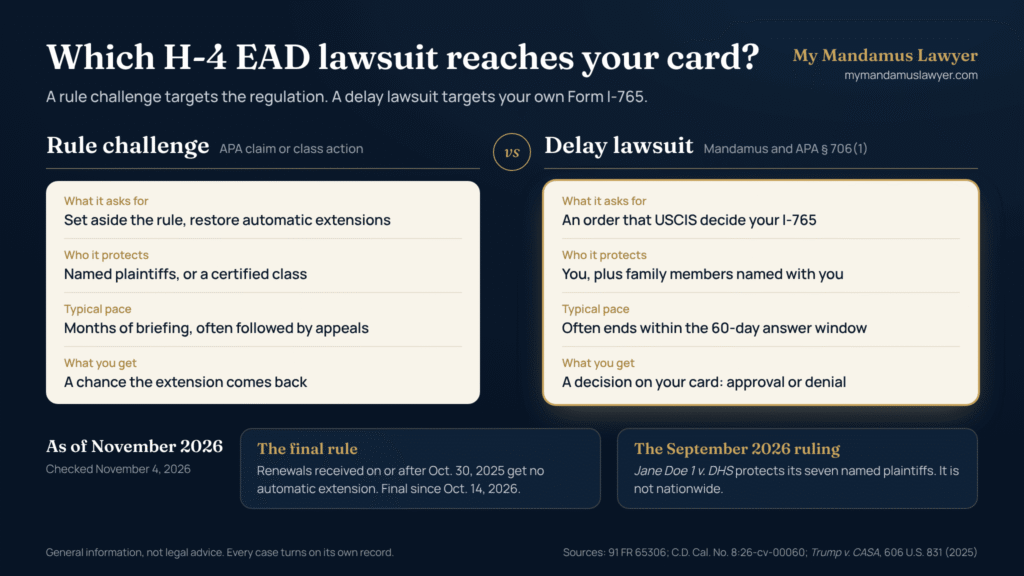
Most H-4 EAD lawsuit headlines in 2026 are about rule challenges: cases asking a court to set aside the October 2025 rule. A mandamus or delay lawsuit asks for something narrower. It asks a court to make USCIS decide your own Form I-765. The two protect different people on different timelines.
| As of November 2026 | Rule challenge (APA or class action) | Delay lawsuit (mandamus and APA § 706(1)) |
|---|---|---|
| What it asks for | Set aside the rule and restore automatic extensions | An order that USCIS decide your pending application |
| Who benefits | The named plaintiffs, or everyone in a class if a court certifies one | Only you, plus any family members named in the complaint |
| Typical timeline | Months of briefing, often followed by appeals | Many cases end within the government’s 60-day response period because USCIS decides |
| What you get | A chance that the extension comes back, for you or a class | A decision on your card: approval or denial |
| 2026 examples | Jane Doe 1 v. DHS (C.D. Cal.); Doe v. USCIS (D.D.C.) | Individual I-765 delay cases in district courts nationwide |
Seven H-4 spouses filed Jane Doe 1 v. U.S. Department of Homeland Security, No. 8:26-cv-00060 (C.D. Cal.) on January 8, 2026. In September 2026 the court granted a preliminary injunction setting the interim rule aside for those seven plaintiffs, finding DHS had not shown good cause to skip notice and comment. It did not extend relief nationwide. About five weeks later DHS issued the final rule after taking comments, so how that order applies going forward is an open question in the case.
A second case shows how such suits end. In Doe v. USCIS, No. 1:26-cv-01336 (D.D.C.), a single worker challenged the interim rule. After she sought emergency relief, USCIS processed her renewal, and the case was dismissed in June 2026 without a ruling on the rule itself.
Why does a win stop at seven people? In Trump v. CASA, Inc. (June 27, 2025), the Supreme Court held that universal injunctions likely exceed the equitable authority Congress gave federal courts. Broad relief for people who never sued now generally runs through a class certified under Rule 23. H-4 spouses have won class-level change before, in the 2021 Shergill v. Mayorkas and 2023 Edakunni v. Mayorkas settlements, but the second took almost two years.
If your card expires next month, a rule challenge is not a plan. Read about what you can do while an H-4 EAD renewal is pending, and treat a delay lawsuit as the tool aimed at your own file.
Will your card expire before a rule challenge could help?
Our team can review your I-797C receipt date, card expiration date and I-94, and tell you whether a delay lawsuit can reach a decision on your own I-765 in time.
How a Mandamus Lawsuit Gets an H-4 EAD Decided
Yes, a federal lawsuit can force USCIS to act on a pending H-4 EAD. It cannot force an approval. An H-4 EAD mandamus lawsuit asks a U.S. district court to order USCIS to decide a Form I-765 it has unreasonably delayed, usually under the Mandamus Act and the Administrative Procedure Act (APA) together.
The Legal Basis, and What “Unreasonable Delay” Means
Three provisions do the work:
- 5 U.S.C. § 555(b). The APA requires agencies to conclude matters within a reasonable time.
- 5 U.S.C. § 706(1). A court may compel agency action unlawfully withheld or unreasonably delayed.
- 28 U.S.C. § 1361. The Mandamus Act lets a court order a federal officer to perform a clear duty owed to you when no other adequate remedy exists. The two claims are usually pleaded together.
No regulation sets a deadline for deciding an I-765; the old 90-day rule ended on January 17, 2017. So courts ask whether the delay is reasonable under the TRAC factors from Telecommunications Research & Action Center v. FCC (D.C. Cir. 1984): whether the agency follows a rule of reason, whether Congress set a timetable, whether human welfare is at stake, what expediting your case would do to other applicants, and how much the delay is hurting you. For an H-4 spouse, a lost job and lost household income speak directly to the welfare and harm factors.
Unreasonable delay, defined for an H-4 EAD: the I-765 has been pending longer than those factors can justify. No number of months qualifies automatically. More on the TRAC factors courts use and on APA § 706(1) claims against USCIS.
The Process, Step by Step
- Build the record. Receipt notice, case history, service and expedite requests. Courts look at what you tried first.
- File the complaint. Filed in federal district court against USCIS and the responsible officials, it asks for an order to decide your I-765, and your I-539 if that is pending too.
- Serve the government. Service on the agency, the U.S. Attorney’s office and the Attorney General starts a 60-day period to answer under Federal Rule of Civil Procedure 12(a)(2).
- The response window. An Assistant U.S. Attorney (AUSA) takes the case. USCIS often acts in this window; the government may instead seek more time or move to dismiss.
- Decision and dismissal. Once USCIS decides, the delay claim is moot and the case is dismissed. A denial is a decision too, with its own next steps.
Across all case types, our published estimate is that most mandamus cases resolve within 30 to 60 days of filing, and no timing is guaranteed. See what happens after you file.
Is Your H-4 EAD Case Ready for Federal Court?
Run through this checklist before you call a lawyer:
- Is your (c)(26) Form I-765 properly filed, with an I-797C receipt notice in hand?
- Is the eligibility basis intact: your spouse’s H-1B status plus an approved I-140 or an AC21 extension?
- Is your own H-4 status valid, or is your I-539 pending alongside the EAD?
- Is nothing open on your side, such as an unanswered request for evidence?
- Has the renewal sat without movement for roughly three months or more? That is when our firm starts looking at a delay action for an H-4 EAD. It is a practice line, not a legal standard.
- Can you document the harm: a suspension letter, lost pay, a job offer you cannot accept?
A permit stuck for over a year usually makes the delay side of the case strong; the question becomes speed. And will a lawsuit get your H-4 work permit approved faster? Precisely, it gets it decided faster. For a complete, eligible file, a decision is what has been missing.
Service Request, Expedite or Lawsuit?
Most H-4 spouses try the administrative routes first. Each one reaches a different part of the government:
| Option | What it does | Its limit |
|---|---|---|
| USCIS e-Request (service request) | Asks USCIS to look at a case past its inquiry date | Produces a reply, not a deadline |
| Expedite request | Asks USCIS to move your file forward, for example for severe financial loss | Narrow criteria; the decision is discretionary |
| CIS Ombudsman or congressional inquiry | A third party asks about your case | Neither can make USCIS decide; replies often repeat USCIS’s answer |
| Mandamus lawsuit | Puts the delay before a federal judge | Costs money; needs a clean file and a sound venue |
Only the lawsuit creates a deadline the government must meet. Requests alone make sense when your card has many months left; when it expires within a few months, start the litigation review while they are pending. Our guides cover service requests, the Ombudsman and congressional inquiries and the H-4 EAD expedite request.
Where You Live Can Decide Whether a Court Hears It
If you live in Texas, Louisiana or Mississippi, your home district sits in the Fifth Circuit, which reads delay claims narrowly. In Li v. Jaddou (5th Cir. May 12, 2023, unpublished) and Cheejati v. Blinken, 106 F.4th 388 (5th Cir. 2024), the court said § 706(1) reaches only a discrete action an agency is required to take. Applying those cases in Dimson v. USCIS (S.D. Tex. Jan. 30, 2026), a magistrate judge recommended denying emergency relief to a self-represented EAD applicant because no statute or regulation sets a deadline for deciding an I-765.
That makes venue the first question, not the last. The venue statute for suits against federal agencies, 28 U.S.C. § 1391(e), can allow more than one proper court, such as where you live or where the relevant agency action or inaction occurred. Courts can also transfer a case with thin ties to the chosen court. Read more on where to file a mandamus lawsuit.
Group vs Individual H-4 EAD Lawsuit: Side by Side
A group H-4 EAD lawsuit joins many unrelated spouses in one complaint, relying on Rule 20 of the Federal Rules of Civil Procedure, usually for a lower fee per person. An individual lawsuit is filed for you alone or for your family.
The verdict in two sentences: a group case can make sense when your card has six months or more left and your file is ordinary. If the card expires within about 90 days, your I-539 is also stuck, or you live in the Fifth Circuit, an individual or family complaint usually fits better.
| What to compare | Group lawsuit | Individual lawsuit |
|---|---|---|
| Cost per person | Usually lower; filing fee and drafting are shared | One flat fee plus the $405 filing fee |
| Time to filing | Waits for a signup cutoff and enough plaintiffs | Filed as soon as your file is ready |
| Control over timing | The organizer sets the date for everyone | You and your lawyer decide |
| Your own harm facts (TRAC factor 5) | Summarized alongside many others | Your job and finances described in detail |
| Venue | One court chosen for the whole group | Chosen for your residence and circuit |
| Effect of other plaintiffs | A court can find plaintiffs misjoined and sever them under Rule 21 | None |
| When USCIS decides some cases | Those plaintiffs drop out and the rest continue | Your case ends when yours is decided |
| Communication with the lawyer | Often group updates | Direct contact with the attorney on your file |
| Who decides to dismiss or settle | Set by the group’s engagement terms | You, with your lawyer |
| Best fit | Six months or more on the card, standard file, cost decisive | Card expiring soon, I-539 pending, Fifth Circuit, unusual facts |
When a Group Case Makes Sense
A group case is a reasonable tool when four things are true:
- Your card has at least six months left.
- Your file is standard, with no RFE and no I-539 complication.
- The complaint will be filed within weeks of joining.
- Cost is the deciding factor.
Some group offers are well-run, legitimate cases. Judge them the way you would judge any lawyer.
Risks Group Ads Rarely Mention
- No parallel individual case. Two lawsuits seeking a decision on the same application are duplicative, so joining a group usually means giving up the faster route.
- Signup cutoffs delay filing. Weeks spent waiting for enough plaintiffs are weeks your card may not have.
- The hardest file sets the pace. One plaintiff with an eligibility problem can draw a motion that slows everyone.
- Severance means a new case. If a court severs plaintiffs under Rule 21, each one may need a new complaint and a new filing fee.
- Groups shrink. As USCIS decides some plaintiffs’ cases, their claims become moot and the rest continue. In Li v. Jaddou, only two of 33 plaintiffs were still waiting by the appeal, and the Fifth Circuit affirmed dismissal of their claims.
- Representation scope. Ask who the attorney of record is, whether that lawyer represents you individually, and who decides whether to dismiss or settle.
What You Get From Filing Alone
Speed, because nothing waits on other plaintiffs. Your own harm evidence before the judge. A venue chosen for where you live. One attorney who knows your file. The trade-off is price.
Is your H-4 EAD renewal pending past three months?
Send us your I-797C receipt date, card expiration date and I-94 date. We will tell you whether filing alone, with your family, or not yet makes sense. Message us on WhatsApp or call +1 (862) 799-2200.
The Middle Path: One Complaint for the Whole Family
Between a group of strangers and a case for one person sits the family complaint. Your I-539 and I-765, and your children’s I-539s, can usually be joined in one complaint with one $405 filing fee, because the applications depend on the same principal and the same filings. The facts are shared, so the joinder problems of a large group rarely arise.
One limit: the H-1B petition belongs to the employer, so a delayed I-129 is a separate question, usually raised by or with the employer. See our guide to H-1B petition delays.
Which Path Fits Your Situation
Two dates decide the path: how long your renewal has been pending, and how long your card has left. Work backward: review and filing take time, service takes days, and the government then has 60 days to answer. A case filed eight weeks before expiration may shorten a gap rather than prevent it.
| Your situation | Path that usually fits |
|---|---|
| Card expires in under 90 days; renewal pending three months or more | Individual lawsuit; speed comes first |
| Card valid six months or more; standard file; cost is decisive | A group case can work if it files within weeks |
| Your I-539 is also pending | Individual or family complaint covering both applications |
| You live in Texas, Louisiana or Mississippi | A venue assessment before anything else |
| Renewal filed before Oct. 30, 2025; I-94 end date is close | Individual case on both the I-539 and the I-765 |
| Already part of a group lawsuit | Talk to the group’s attorney before filing anything separately |
8 Questions to Ask Before You Join a Group Lawsuit
- Who is the attorney of record, and where are they admitted?
- Which court, and why is venue proper for me?
- When will it be filed, and is there a signup cutoff?
- How many plaintiffs, and what facts do we share?
- What is the fee, what does it cover, and what happens if I am severed?
- What happens when USCIS decides my case, or someone else’s?
- Who decides to dismiss or settle?
- How, and how often, will I get updates?
How to Hire a Lawyer for an H-4 EAD Mandamus Lawsuit
To hire a lawyer for an H-4 EAD mandamus lawsuit, contact a firm that files delay cases in federal district court, send your receipt and card dates for an evaluation, and sign an engagement letter that states the fee and what it covers. The firm then drafts and files the complaint. At our firm, complaints are typically filed within days of engagement.
What to Gather Before You Call
- The I-797C receipt notice for your I-765, showing the receipt date.
- The front and back of your current or expired EAD (category C26).
- Your spouse’s H-1B approval notice (I-797) and I-140 approval, or the AC21 basis.
- I-94 records for you, your spouse and your children.
- Your I-539 receipt notice, if your H-4 extension is pending.
- Any employer letter about suspension or termination, and recent pay stubs.
- Records of service requests, expedite requests and congressional inquiries.
Our evidence checklist for a mandamus lawsuit explains why each item matters.
What Happens After You Retain a Firm
- Free case evaluation. We review your dates, status and venue and tell you whether to file now, later or not at all.
- Engagement. A written agreement with a flat fee and a defined scope.
- Drafting and filing. The complaint is built from your documents and filed in the proper district.
- Service and the 60-day window. We serve the government and track its response.
- Resolution. When USCIS decides, we dismiss the case; if it does not, the case proceeds.
My Mandamus Lawyer is the federal mandamus practice of Gozel Law Firm PC, led by Arif Gozel, Esq., who is admitted in New Jersey, New York and Maryland and is a member of AILA. In 2026 the firm filed more than 500 federal lawsuits in 57 federal district courts. It represents clients in all 50 states from offices in Clifton, New Jersey and Vienna, Virginia, in English, Spanish and Turkish. See how the process works.
What to Look For in an H-4 EAD Lawyer
- Federal court filings, not only USCIS forms. Ask how many delay cases the lawyer has filed and in which districts.
- Admission in your court. Or a clear plan for pro hac vice admission and local counsel.
- A written fee scope. It should say what happens if the government files a motion to dismiss.
- Straight answers. Decision versus approval, and the venue risk in your circuit.
- A named attorney you can reach. Not only a portal or a group chat.
More in our guide on how to choose a mandamus lawyer.
What It Costs
| Cost item | Amount | Note |
|---|---|---|
| Flat attorney fee, typical H-4 EAD case | $5,000 | Firm fee; a response to a government motion to dismiss is not included |
| Federal filing fee | $405 | $350 under 28 U.S.C. § 1914 plus a $55 administrative fee |
| Family complaint | One filing fee | Co-plaintiffs share the $405 |
Compare that with waiting: a spouse earning $8,000 a month loses more in three weeks without work authorization than the full cost of a typical case. See what a mandamus lawsuit costs compared with waiting.
Frequently Asked Questions
Did the October 2026 rule end the H-4 EAD program?
No. The final rule published October 14, 2026 only removed automatic extensions for renewals received on or after October 30, 2025. Eligible H-4 spouses can still apply for and hold a (c)(26) EAD. A separate DHS plan to rescind the program has no published proposed rule as of November 2026.
Does the September 2026 court ruling restore my automatic extension?
No. In Jane Doe 1 v. DHS, the preliminary injunction covered only the seven named plaintiffs. It is not a nationwide order, and an employer cannot accept an expired card based on it. Relief for people who are not parties generally requires a certified class.
Can I join a group lawsuit if I already filed my own case?
Usually not. Two lawsuits seeking a decision on the same application are duplicative, and group organizers generally exclude anyone with a pending case. If you are in a group and want to sue alone, talk to the group’s attorney about withdrawing first.
Will suing USCIS hurt my spouse’s H-1B or green card case?
A delay lawsuit asks for a decision on your pending application. It does not ask for approval and does not put your spouse’s petition before the judge. USCIS still decides your I-765 on its merits, so an existing problem in the file can surface either way.
How long after filing does USCIS usually decide an H-4 EAD?
The government has 60 days after service to respond, and USCIS often decides within that window. Across all case types, our published estimate is that most cases resolve within 30 to 60 days of filing. Timing varies by court and file, and no result is guaranteed.
Can my spouse and children be in the same lawsuit?
Usually, yes. Family members whose related applications are delayed can join one complaint as co-plaintiffs and share one filing fee, provided every file is complete and on the same timeline.
Can I sue if my H-4 extension (I-539) is also pending?
Yes. USCIS generally needs a valid H-4 status decision before it approves the EAD, so the complaint usually asks the court to compel both applications. Suing only on the I-765 can leave the case waiting on the I-539.
Is a class action better than a group lawsuit?
A class certified under Rule 23 can bind the government for everyone in the class, including people who never signed up, but certification takes months. A group lawsuit covers only the named plaintiffs, moves faster, and ends for each person when USCIS decides that person’s case.
What is the success rate of H-4 EAD mandamus lawsuits?
No public dataset tracks H-4 EAD mandamus outcomes, and a rate means little unless it says whether it counts decisions or approvals. Many delay cases end when USCIS decides before the answer is due. Ask any lawyer what their number measures. Our guide explains how mandamus results are measured.
Your Card Date Decides the Path
The October 2026 rule did not end the H-4 EAD; it ended the cushion. Without the automatic extension, the date printed on your card is the only date your employer can use.
Ask three questions now: how long has the renewal been pending, how many weeks are left on the card, and is anything open on your file or your I-539? Those answers separate a wait you can absorb from one that needs a federal court.
Your case delay is not your fault.
A mandamus lawsuit can be a legal remedy against an unreasonable H-4 EAD delay. Contact our team to review your I-797C receipt date and card expiration, your I-94 and any pending I-539, your spouse’s H-1B and I-140 status, and whether filing alone, with your family, or not yet makes sense in your district. More on our work permit delay lawsuit service.
Phone: +1 (862) 799-2200
WhatsApp: WhatsApp
Legal Disclaimer: This article is provided for general informational purposes only and does not constitute legal advice. Every immigration case has unique circumstances. For legal guidance specific to your situation, we recommend consulting with an experienced immigration attorney. The information in this article reflects laws and policies as of the publication date; subsequent changes may affect its accuracy. Federal regulations, agency guidance and judicial authorities were reviewed as of November 4, 2026. Prior results do not guarantee a similar outcome.
Sources
- Removal of Automatic Extensions for Certain Employment Authorization Documents, final rule, 91 FR 65306, U.S. Department of Homeland Security, October 14, 2026.
- Removal of the Automatic Extension of Employment Authorization Documents, interim final rule, 90 FR 48799, U.S. Department of Homeland Security, October 30, 2025.
- 8 CFR 274a.13, Application for Employment Authorization, Electronic Code of Federal Regulations, accessed November 4, 2026.
- Jane Doe 1 v. U.S. Department of Homeland Security, No. 8:26-cv-00060 (C.D. Cal.), docket, CourtListener, filed January 8, 2026, accessed November 4, 2026.
- Doe v. U.S. Citizenship and Immigration Services, No. 1:26-cv-01336 (D.D.C.), case record, Civil Rights Litigation Clearinghouse, accessed November 4, 2026.
- Save Jobs USA v. Department of Homeland Security, No. 24-923, docket, Supreme Court of the United States, certiorari denied October 14, 2025.
- Trump v. CASA, Inc., No. 24A884, 606 U.S. 831, case file, SCOTUSblog, decided June 27, 2025.
- Dimson v. USCIS, No. 4:26-cv-00442 (S.D. Tex.), memorandum and recommendation, U.S. District Court for the Southern District of Texas, January 30, 2026.
- Li v. Jaddou, No. 22-50756, U.S. Court of Appeals for the Fifth Circuit, May 12, 2023 (unpublished).
- Telecommunications Research & Action Center v. FCC, 750 F.2d 70, U.S. Court of Appeals for the D.C. Circuit, 1984.